
If you’ve been searching for information on the difference between a therapist and psychiatrist in Chicago, you’re not alone. You finally decide to get mental health support, open a browser, type something like “mental health provider Chicago,” and immediately hit a wall: psychiatrists, psychologists, LCSWs, LPCs, PMHNPs. Half the results sound overly clinical, the other half frustratingly vague, and none of them explain which one you actually need. At River North Counseling, this confusion is one of the most common things new clients bring up before their first appointment. It’s a fair question, and it deserves a straight answer.
Therapists and psychiatrists both work in mental health, but they train differently, work differently, and serve different purposes in your care. Knowing those differences before you book an appointment saves you time, money, and a lot of second-guessing. This guide covers the core distinctions, Illinois-specific prescribing rules, how to read your own symptoms, what care costs in Chicago right now, and exactly what to do next.
Difference Between Therapist and Psychiatrist in Chicago: Training & Scope
Who therapists are and what their credentials mean
Licensed therapists in Illinois hold credentials like LCSW (Licensed Clinical Social Worker), LPC (Licensed Professional Counselor), or doctoral-level designations like PhD or PsyD in psychology. All of these require graduate-level education and clinical training in mental health, supervised hours under licensed professionals, and passing state licensing exams.
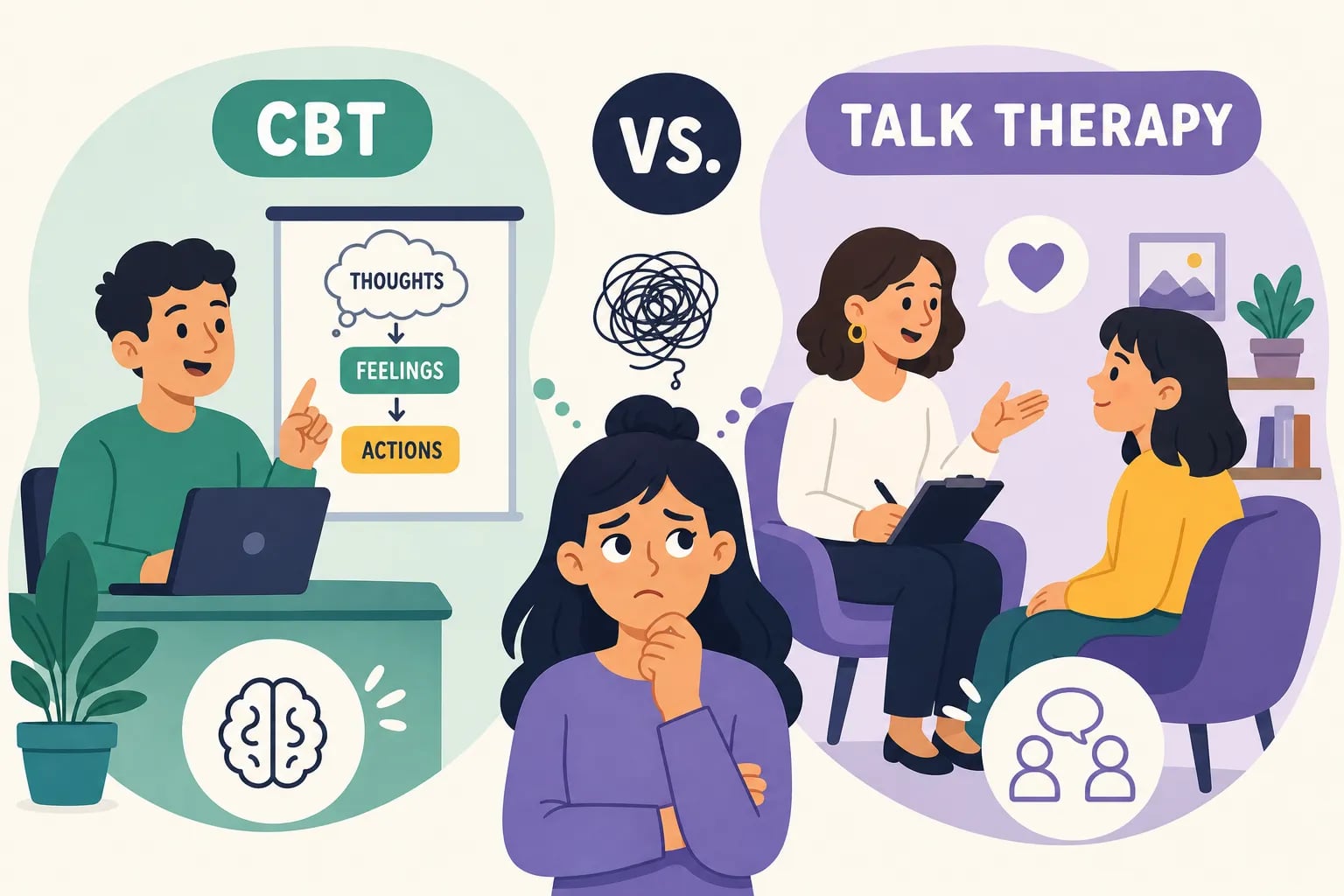
Their work centers on the therapeutic relationship: talk-based treatment approaches like Cognitive Behavioral Therapy (CBT), trauma-informed care, skill-building, and behavioral change. Most licensed therapists, including LCSWs and LPCs, do not prescribe medication and do not practice medicine. Their expertise lives entirely in the psychological and relational dimensions of mental health, which is exactly where most people need the most support.
What makes a psychiatrist different from day one
Psychiatrists are medical doctors, either MD or DO, who complete four years of medical school followed by a four-year psychiatric residency. Their training is rooted in biology, neurology, and pharmacology, which is why diagnosing mental health conditions and prescribing medication sits at the core of what they do. Many psychiatrists also provide therapy, but most outpatient psychiatric practices in Chicago focus primarily on medication management: evaluating symptoms, starting or adjusting medications, and monitoring how your body responds over time.
Psychiatric nurse practitioners: a growing option for Chicago residents
Psychiatric-mental health nurse practitioners, known as PMHNPs, are increasingly filling gaps in access to mental health care across Chicago. As of January 1, 2026, PMHNPs who meet Illinois’s clinical hour and continuing education requirements can achieve full independent practice authority, meaning they diagnose conditions and prescribe medications, including controlled substances, without physician oversight. For many Chicagoans, a PMHNP offers a faster and often more affordable path to a medication evaluation than waiting for a psychiatrist appointment.
Illinois Licensing Rules and Who Can Prescribe Medication
The prescribing hierarchy in Illinois
In Illinois, psychiatrists and PMHNPs can prescribe independently. Clinical psychologists occupy a middle ground: they can prescribe only under a written collaborative agreement with a physician, and they face meaningful restrictions. Specifically, they may not prescribe Schedule II controlled substances, injectable medications, or any medications for patients under 17 or over 65. LCSWs and LPCs have no prescribing authority under any circumstances. The Illinois Department of Financial and Professional Regulation (IDFPR) governs all of these licenses.
You can review the relevant state statutes for professional regulation directly on the Illinois General Assembly’s site to understand the legal framework in more detail: Illinois statutes on professions and professional regulation.
Understanding this hierarchy tells you exactly what each provider can and cannot offer from the very first appointment, and helps you avoid booking the wrong one.
What therapists in Illinois are legally equipped to do
Licensed therapists conduct psychotherapy, assess mental health conditions, develop treatment plans, and coordinate care. Their scope is entirely non-medical. They don’t order labs, can’t diagnose medical conditions driving mental health symptoms, and don’t manage prescriptions. Rather than viewing this as a gap, consider it a specialization: therapists are focused entirely on the psychological and behavioral dimensions of mental health, which is where the vast majority of people need the most sustained work.
Why this matters when you’re building a care plan
Knowing the legal scope of each provider prevents wasted appointments and mismatched expectations. If you suspect your symptoms have a biological component and might require medication, a therapist alone won’t fully address that need. If your primary need is processing grief, managing anxiety patterns, or working through a relationship challenge, starting with a psychiatrist who primarily handles medication management may not be the most effective first step either.
How to Read Your Symptoms and Pick the Right Starting Point
Symptoms that respond well to therapy first
Mild to moderate depression, generalized anxiety, relationship stress, life transitions, work burnout, grief, and trauma processing are all conditions where evidence-based talk therapy, particularly CBT, is a well-supported first intervention. Daily functioning may feel difficult, but the person can still maintain basic self-care and safety. Starting with a licensed therapist in these situations is typically the most accessible and effective path forward. APA clinical guidelines identify CBT as a first-line treatment for these presentations, and the evidence base for talk therapy in this range of symptoms is well established.
Symptoms that call for a psychiatric evaluation sooner
Certain profiles warrant faster medical attention. Severe depression with an inability to function, significant mood cycling, symptoms that haven’t responded to several weeks of therapy, psychosis, or any active thoughts of self-harm all benefit from a medication evaluation alongside or before therapy begins. Waiting to see only a therapist in these situations can delay meaningful relief. If any of these descriptions fit what you’re experiencing right now, reaching out to a psychiatrist or PMHNP directly is the right move, not a step you need to earn.
When you’re genuinely unsure where to begin
Many people fall somewhere in the middle, and that’s exactly where a licensed therapist’s clinical assessment becomes valuable. For many people, the answer isn’t either/or. At River North Counseling, prospective clients can speak with a therapist during an initial session to assess symptoms, clarify goals, and determine what level of care fits their situation. That conversation often makes the path forward clear: therapy alone, a psychiatric referral, or a coordinated approach using both. It’s a practical, low-pressure way to stop second-guessing and start moving. For a deeper decision framework, see Therapist or Psychiatrist in Chicago: How to Decide.
When Using Both Providers at the Same Time Makes Sense
What collaborative mental health care looks like in practice
A common and highly effective care model pairs a psychiatrist or PMHNP handling medication management with a therapist handling regular sessions. The psychiatrist may see you monthly for a 30-minute check-in focused on how your medication is working, while your therapist sees you weekly for the behavioral and emotional work. These providers communicate about your progress, adjust the plan based on what both are observing, and work toward the same treatment goals. The Collaborative Care Model, developed and studied extensively at the University of Washington, has shown strong outcomes across a wide range of mental health conditions, including depression and anxiety, and has become a widely adopted framework in outpatient mental health settings. The AMA provides a clear overview of how collaborative care can help close gaps in mental health access: AMA overview of collaborative care.
How Chicago providers coordinate across specialties
Larger group practices in Chicago increasingly offer both therapy and psychiatric services under one roof or through formal referral networks. This reduces the friction of managing two completely separate providers who don’t know each other. For clients who start with therapy at River North Counseling, referrals to trusted Chicago-area psychiatrists and PMHNPs can happen through the practice directly, keeping the care path coherent and coordinated rather than fragmented. Learn more about when to consult a psychiatrist in our piece Psychiatrist in Chicago: when to see one vs. a therapist.
What Care Actually Costs in Chicago Right Now
Therapist vs. psychiatrist in Chicago: the real cost breakdown
An initial psychiatry visit in Chicago typically runs $300 to $700 out-of-pocket, reflecting the longer 60- to 90-minute evaluation and the cost of urban medical practice overhead. Follow-up medication management appointments average $50 to $150 per visit. Therapy sessions range from $70 to $275, with the Chicago median sitting around $155 for individual sessions. With in-network insurance, most clients pay $20 to $60 per visit as a copay for either service type. The initial psychiatric evaluation is the most expensive appointment you’ll have because it’s a comprehensive medical assessment, not a standard check-in.
Illinois insurance rules and what to verify before booking
Illinois insurance plans are required to cover mental health services at parity with medical care, meaning your plan should cover therapy and psychiatry visits similarly to how it covers primary care appointments. Before booking, confirm whether your provider is in-network, whether your deductible applies first, and what your per-visit copay will be. Many people find that calling their insurer’s behavioral health line directly is faster and more reliable than navigating online portals, which often carry outdated provider information.
Wait times and how to get seen faster in Chicago
Chicago’s provider density makes access faster than the national average. Through platforms like Zocdoc’s listings for Chicago psychiatrists, psychiatrists in Chicago are often available within 24 hours, and therapists typically have first appointments within one to three days. Private practices may carry slightly longer waits depending on specialty demand. Telehealth options, which River North Counseling offers across Illinois, can significantly shorten the time between deciding to get help and actually sitting down with a provider for the first time.
Practical Ways to Find Care in Chicago Right Now
Directories and tools that work for Chicago residents
Psychology Today and Zocdoc both allow filtering by provider type, insurance, neighborhood, and telehealth availability. You can use resources like Psychology Today’s directory of psychiatrists in Illinois to narrow candidates by specialty and location. The Illinois DFPR license lookup tool lets you verify that any provider you’re considering holds a current, valid license in the state. For urgent situations, 988 (the Suicide and Crisis Lifeline) provides immediate support while you work on arranging longer-term care. Most of these tools can be completed in about 10 minutes and may save you weeks of back-and-forth searching.
Why starting with a licensed therapist often shortens the path
A licensed therapist can complete a thorough intake, assess your symptoms, and give you a clear, informed sense of whether a medication evaluation is warranted. This prevents two common mistakes: booking a psychiatrist for concerns that respond well to therapy alone, and waiting for a therapy opening when psychiatric care should realistically happen sooner. Therapists are trained to make these clinical distinctions, and starting there gives you a knowledgeable guide rather than a solo decision.
How River North Counseling helps Chicago residents navigate this decision
River North Counseling is a group therapy practice with in-person offices in River North and Skokie, and virtual therapy available across Illinois. The practice offers individual therapy, CBT, couples therapy, child therapy, parent coaching, and neuropsychological assessment, serving adults, families, professionals, and high achievers throughout Chicagoland. For anyone who isn’t sure whether they need a therapist, a psychiatrist, or both, speaking with one of River North Counseling’s licensed therapists is a practical and concrete way to get clarity before committing to a direction. For local guidance on options and next steps, see our resource on Mental health in Chicago: how to find the right care.
The Decision You’re Actually Making
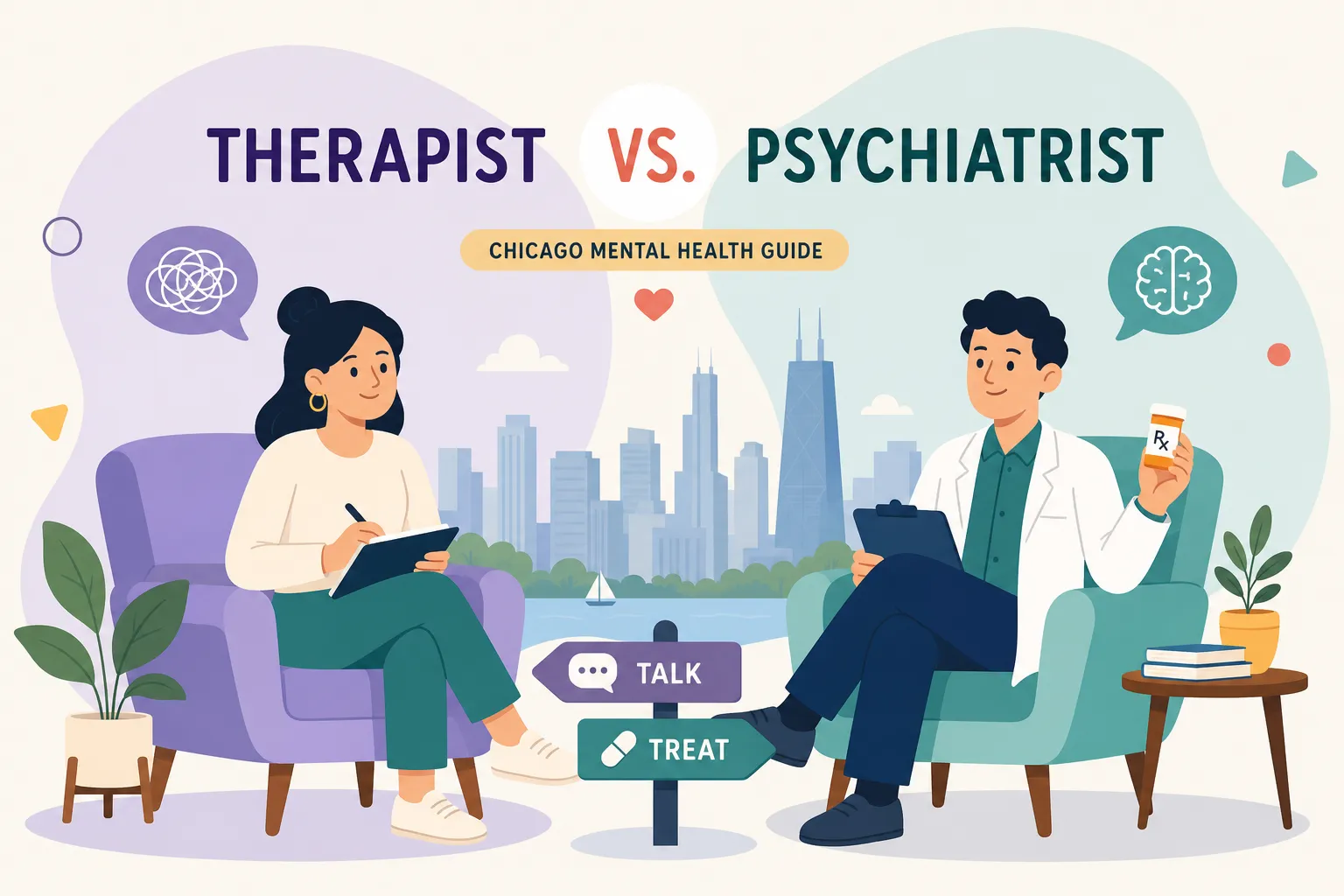
Therapists are trained for talk-based, behavioral, and psychological care. Psychiatrists are medical doctors who prescribe and manage medication. Illinois licensing determines precisely what each can offer, and most people benefit from understanding both options before choosing one. Understanding the difference between a therapist and psychiatrist in Chicago will help you choose the right first step in care. For Chicagoans navigating mild to moderate symptoms, a therapist is typically the right starting point. For more severe presentations, significant mood disruption, or when therapy alone hasn’t produced change, a psychiatric evaluation belongs sooner in the process. For many people, both providers working in coordination produces the best outcomes over time.
You don’t need to have everything figured out before you make a move. One step is enough: reach out to River North Counseling, speak with a licensed therapist, and get a clearer picture of what care path actually fits your life right now. The confusion that brought you here doesn’t have to be what keeps you stuck.