

Most people searching for help don’t get stuck on whether they need therapy. They get stuck on who to call. The alphabet of credentials, MD, LCSW, PsyD, PMHNP, LPC, LMFT, can make finding support feel more complicated than it already is. Understanding the different mental health professional types cuts through that confusion immediately and gets you to the right person faster.
At practices like River North Counseling in Chicago, several of these provider types work side by side. That arrangement only works because each clinician fills a specific role: different training, different scope, different strengths. By the end of this article, you’ll know exactly what separates each category of behavioral health provider, who can prescribe medication and who can’t, and how to match your specific situation to the right kind of care.
The single most important dividing line between mental health professional types
Before getting into credentials, understand one foundational distinction: some mental health providers can prescribe psychiatric medication, and most cannot. This single fact explains the majority of the confusion people encounter when looking at the field.
Why prescribing authority changes everything
In the United States, psychiatrists hold universal prescribing authority in all 50 states. Psychiatric-mental health nurse practitioners (PMHNPs) follow closely, with prescribing rights across all states, though some states require physician collaboration. All other mental health clinicians (psychologists, LCSWs, LPCs, LMFTs) are therapy-only providers in the vast majority of states. Illinois is one of just seven states, alongside New Mexico, Louisiana, Iowa, Idaho, Colorado, and Utah, where psychologists can prescribe with additional postdoctoral psychopharmacology training, but this remains the clear exception rather than the rule.
Therapy-only providers: doctoral vs. master’s level
Among non-prescribing providers, there’s a second important split: doctoral-level versus master’s-level training. Psychologists holding a PhD or PsyD complete five to seven years of graduate study on top of undergraduate education, qualifying them for formal neuropsychological assessment and complex diagnostic work. Master’s-level providers (LCSWs, LPCs, and LMFTs) complete two to three years of graduate training plus thousands of supervised clinical hours. Both levels deliver evidence-based therapy effectively; the difference shows up in scope, particularly around formal testing and assessment.
Psychiatrists and PMHNPs: prescribing mental health professional types explained
For anyone dealing with moderate-to-severe symptoms, treatment-resistant depression, or a diagnosis that involves complex neurological or biological factors, understanding the two prescribing-capable provider types is essential.
What psychiatrists are trained to do
A psychiatrist completes four years of undergraduate education, four years of medical school, and a four-year psychiatry residency, roughly twelve years of training before independent practice. That path makes them the only providers on this list who are fully trained medical doctors. Their focus is medication management, complex diagnosis, and cases where biological factors are central. Many psychiatrists do not provide ongoing talk therapy. Instead, they often coordinate with a separate therapist to manage the full picture of a client’s care. In Chicago, psychiatrist sessions typically run $200 to $460 out-of-pocket, based on local market pricing data.
How psychiatric nurse practitioners fit into modern mental health care
PMHNPs hold a master’s or doctoral nursing degree with a psychiatric specialization, plus 2,000 or more supervised clinical hours. They can prescribe, diagnose, and provide therapy, which makes them a versatile option, particularly for common-to-moderate conditions like anxiety and depression. They often bridge the gap between medication management and talk therapy in a single provider relationship. Chicago-area PMHNP sessions average roughly $140 to $345 out-of-pocket, based on local market pricing data.
Signs you may benefit from starting with a prescriber
Consider a psychiatrist or PMHNP as your first contact if your symptoms significantly impair daily functioning, you have a diagnosis of bipolar disorder, schizophrenia, or severe clinical depression, you’ve had prior medication trials, or your primary care doctor has already suggested a psychiatric evaluation. Suicidal thoughts or self-harm urges also require a prescriber’s involvement for immediate stabilization. For mild-to-moderate anxiety or depression without those complicating factors, starting with a therapist is often the more practical first step.
Psychologists: doctoral-level therapy and formal assessment
Many people use “psychologist” and “therapist” interchangeably. They’re not the same. Psychologists bring doctoral-level training that qualifies them for services most master’s-level providers aren’t credentialed to deliver.
PhD vs. PsyD: does the degree type matter in practice?
A PhD in psychology follows a scientist-practitioner model, emphasizing research alongside clinical training. A PsyD is clinically focused, getting students into hands-on work more quickly. Both require five to seven years of graduate study plus 1,500 to 6,000 supervised clinical hours. In day-to-day outpatient therapy, the distinction rarely affects your experience as a client. For neuropsychological assessment, either credential qualifies, what matters more is whether the psychologist specializes in the area you need evaluated.
What neuropsychological assessments reveal that therapy alone cannot
A full neuropsychological evaluation involves standardized cognitive and personality testing, clinical interviews, and behavioral observation, typically spanning three to ten hours depending on the scope. These assessments identify learning disabilities, ADHD, cognitive decline, traumatic brain injury effects, and complex psychiatric conditions like schizophrenia. They’re especially valuable for adults who need diagnostic clarity before beginning treatment or who haven’t responded to standard interventions and want to understand why. Some group practices offer neuropsychological assessment as part of their clinical services for exactly this reason: some questions require data, not just conversation.
Therapy modalities psychologists commonly use
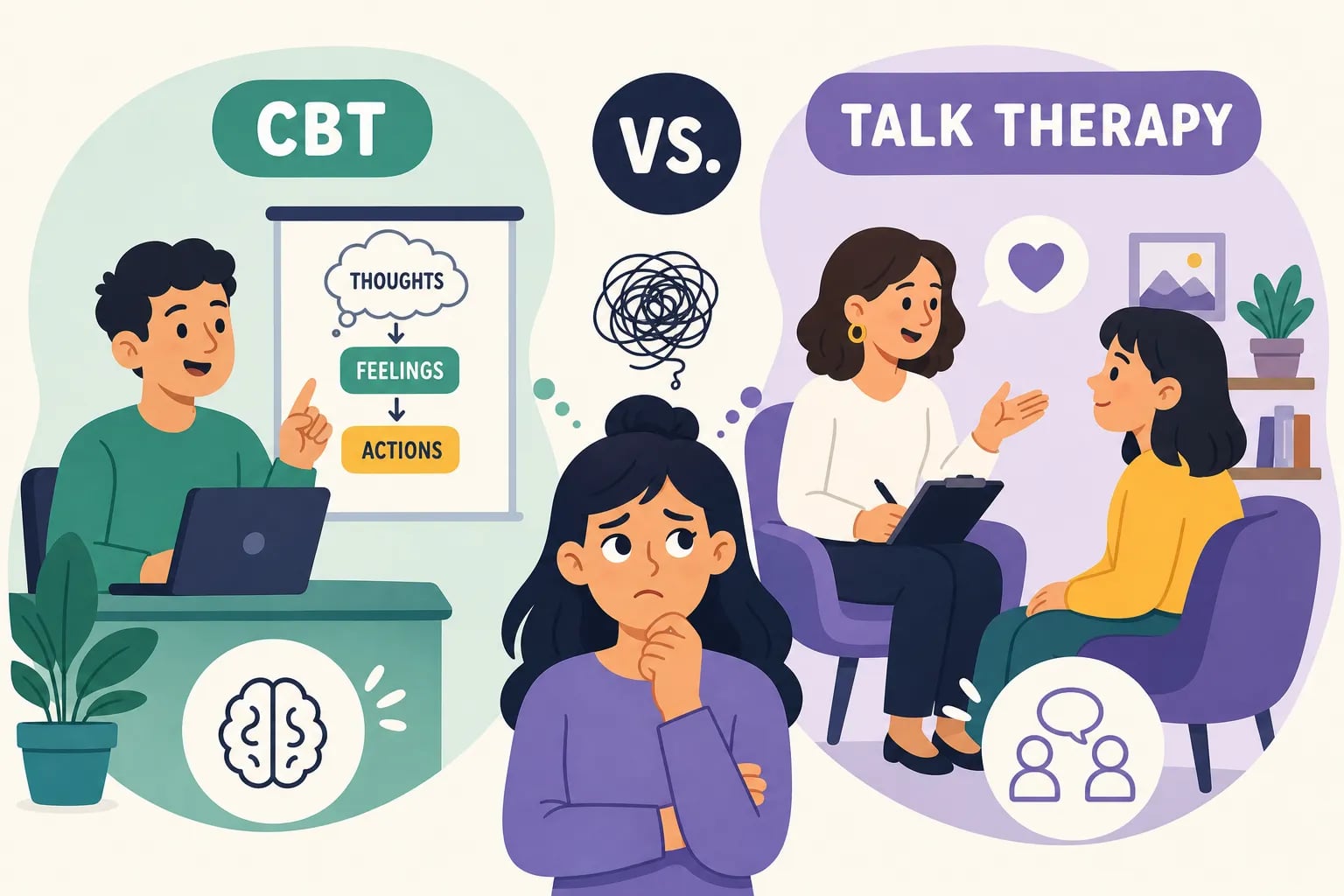
Psychologists deliver evidence-based therapy using approaches like Cognitive Behavioral Therapy (CBT), Dialectical Behavior Therapy (DBT), Eye Movement Desensitization and Reprocessing (EMDR), and Acceptance and Commitment Therapy (ACT). They can formally diagnose using the DSM-5 and regularly work with clients managing complex, long-standing conditions. Chicago-area psychologist sessions average $125 to $345 out-of-pocket, depending on experience and specialty, based on local market pricing data.
Licensed therapists: LCSWs, LPCs, and LMFTs explained
The majority of people who search for “a therapist” end up working with a master’s-level licensed clinician. This is the largest and most varied category in the field, and the differences between credentials matter when you’re trying to find the right fit.
LCSWs: therapy through a social systems lens
A Licensed Clinical Social Worker holds a Master of Social Work from a CSWE-accredited program, followed by 2,000 to 3,000 hours of supervised clinical practice. Their training uniquely integrates mental health treatment with social and environmental context: family systems, housing instability, access to resources, and community-level stressors. LCSW training explicitly incorporates these social and environmental factors into both assessment and treatment, making them a strong fit for clients whose life circumstances and mental health are closely entangled. They diagnose, deliver therapy, and often coordinate with other providers as part of a broader care plan.
LPCs and LMHCs: individual therapy for everyday mental health
Licensed Professional Counselors and Licensed Mental Health Counselors hold master’s degrees in counseling or a related field with similar supervised hour requirements. Their focus is individual coping, skill-building, and mental health treatment. They’re among the most common provider types for adults navigating anxiety, depression, burnout, and life transitions through ongoing talk therapy. If you’re a Chicago professional managing work stress or looking to build better emotional regulation skills, an LPC or LMHC is often a strong starting point. Chicago-area rates for these providers typically range from $75 to $201 per session.
LMFTs: when the relationship itself is the client
Licensed Marriage and Family Therapists specialize in relational and family systems. Their graduate training centers on how dynamics between people, couples, parent-child relationships, entire family units, shape individual mental health. They’re trained in modalities like Emotionally Focused Therapy (EFT) and Integrative Behavioral Couples Therapy (IBCT). When the presenting problem is communication breakdown, relationship conflict, or family disruption, an LMFT is typically the right fit rather than an individual therapist.
Choosing among mental health professional types: matching your situation to the right provider
The framework above is only useful if you can apply it to your own circumstances. Use the scenarios below to identify which provider type fits your situation, then bring that clarity to your first conversation.
Common scenarios and the right provider match
- Anxiety or depression, talk therapy only: Start with an LPC, LMHC, or LCSW.
- Medication evaluation alongside therapy: Start with a psychiatrist or PMHNP, ideally coordinated with a therapist.
- Relationship conflict or communication breakdown: An LMFT is the right fit.
- Formal diagnostic evaluation for ADHD, a learning disability, or cognitive concerns: Seek a psychologist who offers neuropsychological assessment.
- Children with behavioral or emotional difficulties: A child psychologist or specialized LCSW is the appropriate starting point.
- Not sure where to start: A group practice that employs multiple provider types can conduct an intake assessment and guide the match for you.
Three questions to ask before your first appointment
Before committing to any provider, ask these three things directly:
- What is your licensure, and what populations or concerns do you specialize in?
- Do you use evidence-based approaches for my specific concern, and what does that look like in practice?
- If my needs change or evolve, do you coordinate with other providers or refer internally?
You can verify any clinician’s license through your state licensing board. In Illinois, that’s the Illinois Department of Financial and Professional Regulation (IDFPR), which maintains a publicly searchable database. Most reputable practices are also transparent about fees upfront. In-network copays typically run $20 to $46 per session; out-of-network costs are significantly higher, and sliding-scale options exist at community clinics and university training centers for clients without coverage.
Why a multi-specialty practice makes the search simpler
Finding the right mental health professional is hard enough without having to start the search over every time your needs evolve. A group practice that employs or coordinates across multiple provider types solves that problem before it starts.
What it means to have multiple provider types under one roof
When a practice includes LCSWs, psychologists, LPCs, LMFTs, and coordination pathways to prescribers, a client can begin with one provider type, have their needs reassessed over time, and transition to a better-suited provider without losing continuity of care or the relationship they’ve already built. Many clients find this kind of internal coordination genuinely useful, it means the intake process itself does some of the clinical matching work, rather than leaving you to navigate the credential alphabet alone.
How River North Counseling covers the full spectrum
River North Counseling serves clients across the Chicago area, with virtual therapy available throughout Illinois. The practice’s team covers individual therapy, couples counseling, child psychology, CBT, parent coaching, and performance coaching, with referral pathways to assessment services when diagnostic questions arise. A client managing burnout can start with individual therapy, move into performance coaching as they stabilize, and be connected with appropriate assessment resources if needed, all within the same practice relationship. The intake process is designed to match you with the right provider type from the start, not leave that determination to chance.
Understanding the full range of mental health professional types isn’t about memorizing credentials. It’s about getting to the right person faster. The prescriber-versus-therapist distinction, the doctoral-versus-master’s split, and the specialty focus of each license together form a clear map. Use that map to narrow your search, ask the right questions, and verify what you find. The search doesn’t have to start with guesswork, and if you’re ready to take that first step, River North Counseling’s intake process is built to guide you there.