
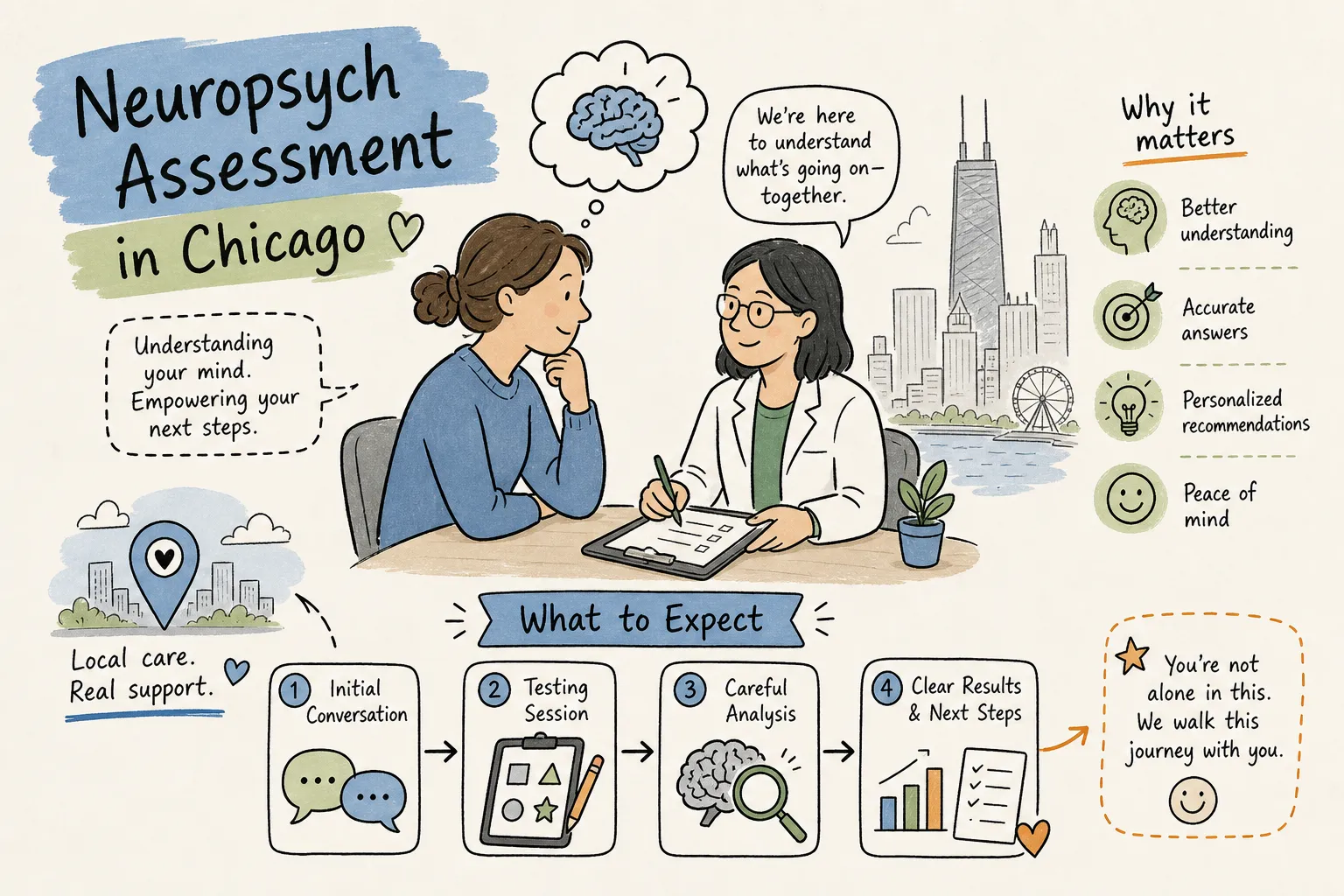
If you’re considering a neuropsychological assessment in Chicago, you’ve likely reached this page because a doctor, psychiatrist, or school psychologist recommended an evaluation, and now you’re trying to figure out what that actually means. Most people have never heard of this type of testing until someone they trust suggests it, and the gap between “you should get tested” and “I know exactly what to do next” can feel overwhelming. This guide is designed to close that gap. You’ll learn what a cognitive evaluation measures, who performs it, how long it takes, what it costs in the Chicago area, and what to do once you have the results. If you’re already looking for a place to start, River North Counseling is a licensed group mental health practice in Chicago that offers neuropsych testing and evaluations for adults, with offices in River North and Skokie and virtual options across Illinois.
Why doctors refer patients for neuropsychological testing
It helps to understand what prompts a referral before sorting out the logistics. Neuropsychological testing is ordered when someone needs an objective, detailed map of how their brain is functioning, not just a clinical impression from an interview. If you recognize your situation in the list below, you’re likely in the right place.
The most common referral reasons include adult ADHD, traumatic brain injury (TBI), early-onset memory loss or concerns about dementia, learning disabilities, anxiety or depression that’s affecting concentration and daily functioning, seizure disorders, and post-COVID cognitive symptoms (often called “brain fog”). These are situations where understanding the specific pattern of cognitive strengths and weaknesses changes what treatment looks like.
How this differs from a standard psychological evaluation
A standard psychological evaluation focuses on emotional and behavioral functioning. It typically involves a clinical interview, personality questionnaires, and symptom checklists. A neuropsychological evaluation does something different: it maps how your brain performs across specific cognitive domains using standardized, performance-based tasks. Instead of asking how you feel, it measures how you actually process information. That distinction matters because it determines what kind of recommendations come out the other side, whether that’s a medication consultation, academic accommodations, a referral to neurology, or skills-based therapy.
What a neuropsychological assessment in Chicago actually measures
One of the most common sources of anxiety before testing is not knowing what to expect. A neuropsychological evaluation is not a pass/fail test. It’s a structured snapshot of how different parts of your cognitive system are performing relative to people of similar age, education, and background.
A thorough evaluation covers general intelligence, attention and concentration, executive functioning (planning, problem-solving, and self-regulation), verbal and nonverbal memory, language processing, processing speed, visuospatial skills, motor coordination, and mood and personality.
Commonly used instruments include the Wechsler Adult Intelligence Scale (WAIS) for general intelligence, the California Verbal Learning Test (CVLT) for memory, the Delis-Kaplan Executive Function System (D-KEFS) for executive function, and standardized mood questionnaires. The specific tests chosen always depend on the referral question, so no two batteries are identical. For clinical overviews of how these assessments are structured, see the Cleveland Clinic’s guide to neuropsychological testing and assessment and Penn Medicine’s resource on neuropsychological testing.
How to plan for testing day: time, format, and what to bring
A standard battery takes roughly two to four hours. More comprehensive evaluations can run six to eight hours and are sometimes split across two appointments when fatigue becomes a factor. Plan to eat a good meal beforehand, bring glasses or hearing aids if you use them, and arrive rested. Bring a current list of your medications and any prior testing records if you have them. Tests may be paper-based, computer-based, or oral depending on what’s being assessed. The most important preparation is simply showing up in a condition where you can focus.
Finding a neuropsychological assessment provider in Chicago
Chicago has a range of options for cognitive testing services, and the right fit depends on your age, your referral question, your timeline, and your budget. Knowing your options and what happens during psychological testing before you call saves time.
River North Counseling: an accessible adult-focused option in Chicago
River North Counseling is a licensed group mental health practice with offices in Chicago’s River North neighborhood and in Skokie, with virtual services available across Illinois. Their evaluations are designed for adults navigating questions about cognitive functioning, attention, personality, and emotional health. What sets them apart from standalone testing centers is that evaluations are connected to a broader care relationship rather than structured as a one-time clinical transaction. If testing reveals something actionable, whether that’s ADHD, cognitive changes, or something more nuanced, you can move directly into therapy, performance coaching, or care coordination within the same practice rather than starting over somewhere new.
Other Chicago providers serving adult and pediatric populations
The city also has university-based training clinics, which offer lower-cost evaluations supervised by licensed PhD psychologists. Hospital systems like Northwestern Medicine and Advocate Children’s Hospital provide both inpatient and outpatient assessments. For pediatric neuropsychological assessment in Chicago specifically, covering ages 0 to 18, providers like NSPT (North Shore Pediatric Therapy) and Lighthouse Pediatric Psychology specialize in child and adolescent populations. Before scheduling anywhere, confirm whether the provider sees adults, children, or both; if you’re evaluating memory and attention problems, our Memory and Focus Concerns: When to Consider Testing in Chicago guide may be helpful. It’s easy to overlook on a website, and calling the wrong clinic adds unnecessary friction to an already stressful process.
Questions to ask a provider before booking
Going in informed puts you in a better position to evaluate your options. Ask these four questions before committing to any provider:
- Does the evaluation include a dedicated feedback session to walk me through the results?
- How long will it take to receive the written report after testing is complete?
- Do you accept my insurance, or can you provide a superbill for out-of-network reimbursement?
- What is the current wait time for a first appointment?
These questions reveal a lot about how a practice operates and how much they prioritize the client experience after the testing is done.
Neuropsychological assessment in Chicago: costs and insurance coverage
Cost is consistently one of the first things patients want to understand, and for good reason. The costs are real, insurance coverage is inconsistent, and the rules vary by plan and diagnosis.
What cognitive testing typically costs in Chicago’s market
Private specialty centers in Chicago typically charge between $2,500 and $5,000 for a comprehensive evaluation, with some premier centers reaching up to $9,000. University or training clinics are significantly more accessible, often charging $300 to $800 for evaluations supervised by licensed PhD psychologists. Out-of-network insurance reimbursement typically covers $500 to $1,400, which means most patients absorb the majority of the cost out of pocket regardless of their coverage. If a learning disability assessment is added to the evaluation, expect an additional $1,800 or more, and note that this add-on is often excluded from insurance coverage entirely.
How to verify coverage before you schedule
Most major private plans, along with Medicare and Medicaid in Illinois, cover neuropsychological testing when medical necessity is documented. Medicare, for example, covers testing to evaluate a known or suspected medical condition that influences clinical decision-making, but it explicitly does not cover testing used solely for Alzheimer’s screening. Before scheduling, call the member services number on your insurance card, confirm whether prior authorization is required, and ask whether a physician referral is needed for the provider to bill your plan. If you want a quick overview about how insurance typically treats neuropsychological testing, see this discussion of is neuropsych testing covered by insurance. Getting coverage details in writing, or documented by date and representative name, protects you if a coverage dispute arises later.
What happens after the evaluation is complete
Testing day is only one part of the process. What happens next is where the real value of the evaluation is realized, and where many guides leave readers without direction.
Understanding the feedback session and written report
After testing is complete, the neuropsychologist scores and interprets your results against age-, education-, and background-adjusted norms. This process takes time: most written reports are delivered within two to four weeks. Before the report is finalized, most providers schedule a feedback session to walk you through the findings in plain language. The written report will include diagnostic impressions, a profile of cognitive strengths and weaknesses, and specific recommendations tied to your referral question. If you’re waiting longer than six weeks without communication, it’s reasonable to follow up directly with the provider. For additional context on variability in reporting and timelines across practices, see this review of neuropsychological assessment considerations.
Translating results into next steps
The report itself is not the finish line, it’s the starting point for action. A diagnosis of ADHD typically leads to a medication consultation with a psychiatrist and skills-based therapy like CBT to build attention and organization strategies. Findings related to cognitive decline may involve a referral to neurology for further workup. Learning disability findings often support formal accommodation requests at work or school. For adults who complete their evaluation through River North Counseling, the path from assessment to treatment doesn’t require starting over. Therapy, performance coaching, and care coordination are all available within the same practice, which means your clinician already has context for your results and can move forward with you rather than handing you a report and wishing you well.
You’re more prepared than you think
Deciding to pursue a neuropsychological assessment takes a kind of quiet courage, whether you’re navigating memory concerns or simply following up on a recommendation you’ve been putting off. Understanding the process from referral to report removes much of the anxiety around taking that first step. A neuropsychological assessment in Chicago is more accessible than it may appear, with options across price points, settings, and populations.
If you’re an adult in the Chicago area looking for a practice that combines clinical depth with continuity of care, reach out to River North Counseling. Their team offers cognitive testing and evaluations alongside therapy and coaching, so your results lead somewhere meaningful. You can connect with them at their River North or Skokie offices, or virtually from anywhere in Illinois. The first step is simply reaching out.