

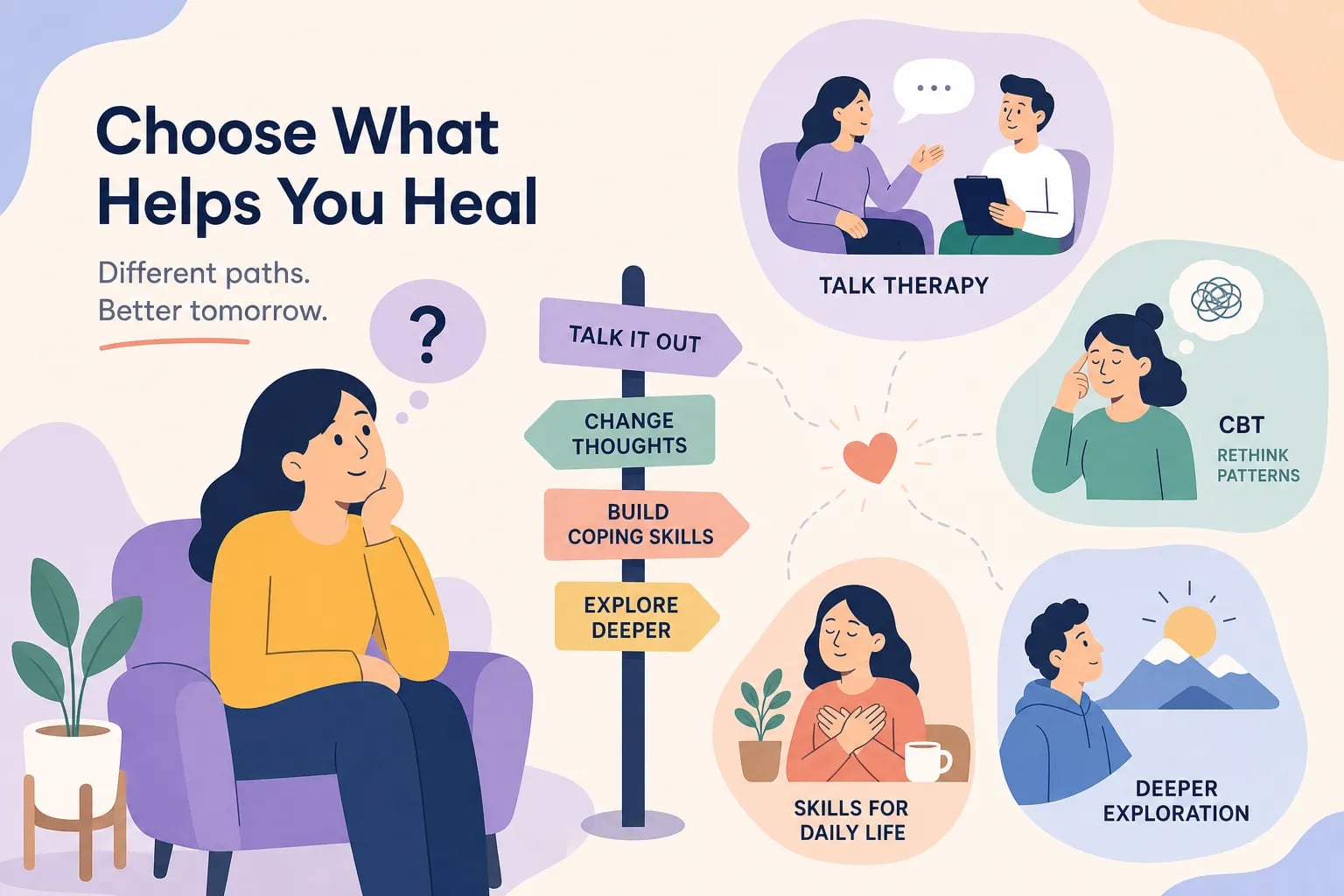
Getting a diagnosis of major depression takes real courage. You finally name what’s been happening. You walk into a clinician’s office, and then someone hands you a list: CBT, IPT, DBT, psychodynamic. Choose one. The cruelty of that moment is real. You’re being asked to make an informed, consequential decision at the exact point in your life when thinking clearly feels impossible.
Here’s what makes that moment less paralyzing: the research actually has useful, specific answers. Not a single winner, but a decision framework built on decades of head-to-head trials and clinical moderator data. Knowing how to choose between therapy types when dealing with major depression doesn’t require a medical degree. It requires understanding what each approach targets and who tends to respond to it. Moderator research offers meaningful guidance for that matching process, and while evidence for large, consistent outcome gains from prescriptive matching is still developing, this framework can meaningfully inform clinical decisions.
This guide walks through the major evidence-based therapy options for major depressive disorder, what the research says about effectiveness, and how your specific symptoms and circumstances can point you toward the right starting point. For Chicago-area residents ready to take that step, River North Counseling offers individualized treatment matching through a multi-specialty team of clinicians.
What the evidence actually says about therapy for major depression
The American Psychological Association, NICE (the UK’s clinical guidelines body), and the World Health Organization all agree on one foundational point: for mild-to-moderate major depression, evidence-based psychotherapy is a first-line treatment, not a backup plan for people who don’t want medication (APA Clinical Practice Guidelines, 2019; NICE Guidelines CG90, 2022; WHO mhGAP Intervention Guide). Therapy isn’t the consolation prize. For many presentations, it’s the recommended starting point.
Severity matters, though. Mild depression often responds well to psychotherapy alone, including structured self-help or brief interventions. Moderate depression opens the door to either psychotherapy or antidepressants as a first step. Severe depression shifts the calculus further: psychotherapy remains relevant, but guidelines increasingly favor combined treatment or specialist-level care. Knowing where you fall on that spectrum shapes everything that follows.
What makes the research genuinely useful is not a ranking of therapies. In large network meta-analyses comparing psychotherapy for MDD, including the influential Cipriani et al. and Cuijpers et al. systematic reviews, CBT, interpersonal therapy, and behavioral activation show no statistically significant difference in pooled response and remission rates. No single therapy wins universally. The real power of the evidence lies in what researchers call moderators: specific clinical and personal features that predict better outcomes with one approach over another. That’s the framework worth understanding when you’re deciding how to choose between therapy types when dealing with major depression.
A plain-language breakdown of the four main therapy types
Before you can match a therapy to your situation, you need a clear picture of what each one actually involves. Not a textbook definition. A real sense of what happens in the room.
CBT and behavioral activation: targeting thoughts and actions
Cognitive behavioral therapy is structured and skills-based. It works by identifying the connection between distorted thinking patterns and the behaviors that sustain depression. A CBT therapist helps you recognize automatic negative thoughts, test them against evidence, and build more adaptive responses over time. Sessions involve homework, tracking, and active skill practice between appointments. CBT typically runs 12 to 20 sessions and is designed to produce measurable change within a defined timeframe.
Behavioral activation is a close cousin that zeroes in on one core mechanism: re-engaging with activities that used to feel rewarding. Depression causes withdrawal; withdrawal deepens depression. Behavioral activation interrupts that cycle directly. Research and Cochrane reviews on behavioral activation indicate most structured protocols run 8 to 16 sessions, with some brief formats as short as 5 to 8 sessions depending on severity and setting.
IPT: healing depression through relationships
Interpersonal therapy approaches depression from a different angle entirely. Rather than examining thought patterns, IPT focuses on the interpersonal context fueling the depression. Grief after a significant loss, conflict in a key relationship, a major life transition that hasn’t been processed, chronic social isolation, these are the domains IPT addresses directly. It doesn’t assume your thinking is distorted; it assumes your depression is embedded in your relational world. IPT typically runs 12 to 16 sessions and is especially effective when you can identify a clear interpersonal trigger for the current episode.
Psychodynamic therapy and DBT: longer arcs and different goals
Psychodynamic therapy is the right fit for a different kind of depression: chronic, recurrent, and rooted in long-standing emotional patterns rather than a single situational trigger. If the depression is recurrent, tied to identity or relationship patterns, and resistant to brief therapies, psychodynamic therapy offers a longer, more exploratory path. It’s measured in months to years, not sessions.
DBT, on the other hand, isn’t a primary depression treatment in most clinical settings, but it becomes highly relevant when significant emotion dysregulation, intense mood swings, or self-harm behaviors are part of the picture alongside depression. It’s a structured commitment, often six to twelve months, that includes both individual sessions and a skills training group.
How to choose between therapy types when dealing with major depression: a matching framework
Moderator research provides tentative, clinically useful signals rather than definitive rules. Certain clinical features consistently predict better outcomes with specific therapies. This isn’t a diagnostic test, but it is a useful starting framework for the conversation with your clinician.
When CBT is usually the right starting point
If rumination, self-criticism, and catastrophizing are prominent features of your depression, CBT is typically where to start. It outperforms other therapies when negative thinking patterns are central, when depression severity is moderate-to-high, and when the person can engage with structured skill-building and between-session practice. CBT has the largest randomized controlled trial evidence base among psychotherapies for MDD and is listed among first-line psychotherapy options in APA and NICE summaries, making it a frequent starting recommendation in clinical settings, though not a universal default. Some studies and meta-analyses also suggest CBT holds advantages when comorbid personality features are present, while findings on IPT performance in that subgroup are more limited; these results should be interpreted cautiously given the modest body of direct comparison research.
When IPT or psychodynamic therapy fits better
If your depression started in the wake of a major loss, a relationship breakdown, or a life transition you haven’t been able to process, IPT is often a stronger clinical match than CBT. The therapy works precisely because it targets the interpersonal driver directly, not the cognitive overlay. Psychodynamic therapy makes the most sense when the pattern of depression is long-standing and recurring, when it’s tied to relationship or identity-level themes rather than a discrete trigger, or when shorter-term therapies have produced partial improvement that doesn’t hold. Personality features and chronic depression are both clinical signals that a longer-term approach may produce more durable change.
A note on DBT and when it enters the picture
DBT belongs in the conversation when emotion dysregulation is significant. Not just sadness or low mood, but intense emotional swings, difficulty tolerating distress without acting on it, or self-harm behaviors that accompany the depression. It’s a more intensive commitment than standard weekly therapy, and it’s reserved for presentations where those added components are genuinely part of the clinical picture. If you’re not sure whether your situation fits, that’s exactly the kind of question to bring into an intake conversation with a clinician who knows both treatments.
When therapy alone isn’t the right answer
Not every case of major depression should start with psychotherapy as a standalone treatment. Being honest about therapy’s limits is part of responsible clinical guidance, and it’s worth knowing these thresholds before you start.
Severity and chronicity: when combination treatment makes sense
For moderate-to-severe depression, many trials and meta-analyses show that combining an antidepressant with psychotherapy outperforms either treatment alone, though the magnitude and consistency of that benefit vary by study and patient subgroup. Both APA and NICE guidelines support this approach, with APA explicitly framing combination therapy as an appropriate initial treatment for moderate-to-severe MDD. Chronic or recurrent depression also favors combined treatment, as does partial response to either therapy or medication used alone. These aren’t signs that therapy failed. They’re signs that depression at this level benefits from more than one mechanism of action working simultaneously.
Red flags that require urgent or stepped-up care
Some clinical presentations require more than an outpatient weekly appointment. Active suicidal ideation with a plan, psychotic features, catatonia, inability to maintain basic self-care like eating and hydrating, or rapid functional collapse all indicate that outpatient psychotherapy is not a sufficient first step. ECT remains among the most effective interventions for severe or treatment-resistant depression with psychotic features, particularly when a fast response is medically necessary. If any of these apply to you or someone you care about, the right move is same-day urgent evaluation, not scheduling a first therapy session. That’s not a failure of the therapy system. It’s the therapy system working as it should.
What to expect in terms of time, and when to reconsider your approach
One of the most common reasons people leave therapy prematurely is misaligned expectations about how long change is supposed to take. Knowing realistic benchmarks in advance protects against quitting too early or staying too long with an approach that isn’t working.
CBT and IPT typically run 12 to 20 sessions over three to five months, with most structured protocols designed to produce measurable change within that window. Behavioral activation follows a similar arc, often completed in fewer sessions. Psychodynamic therapy operates on a much longer horizon, months to years, because it’s targeting deeper patterns rather than acute symptom relief. DBT involves a structured cycle, often six to twelve months, with both individual sessions and group skills training running in parallel. Knowing these timelines in advance helps you assess whether a therapy is working or whether the pace is simply different from what you expected.
If there’s no meaningful improvement after eight to twelve sessions of a structured therapy, that’s a clinically reasonable point to reassess, consistent with guidance from major clinical reviews on adequate treatment trials. It’s not a failure. It’s a signal. Partial improvement that plateaus, inability to engage with the therapy model, or new symptoms emerging, like increasing self-harm or psychotic features, are all reasons to switch, augment, or consult a psychiatrist. Progress in therapy should show up in day-to-day functioning, not just in-session insight. If your life outside the therapy room isn’t changing, something in the treatment plan needs to.
How River North Counseling matches Chicago clients to the right therapy
At River North Counseling, the intake process is designed around exactly the kind of evidence-informed matching this article describes. Clients aren’t assigned to whoever has an open slot. The intake conversation is built to understand your symptom profile, your history, and your goals, connecting you with a therapist who practices the approach most suited to your presentation. With clinicians trained in CBT, IPT, psychodynamic therapy, and more, the practice offers the clinical range that makes genuine matching possible. That breadth is something a single-provider practice often can’t deliver.
River North Counseling offers both in-person appointments at its River North and Skokie offices and virtual sessions across Illinois, which matters for Chicagoans navigating demanding schedules alongside a depressive episode. The first step is an initial consultation that covers what’s been happening, what you’ve tried before, and what you’re hoping for. From there, you and your therapist build a treatment plan that reflects your actual presentation, not a one-size protocol. If you’re working through how to choose between therapy types when dealing with major depression, that conversation is the right place to start.
Frequently asked questions: choosing therapy for major depression
How do I know which therapy type is right for my depression?
The best starting point is an intake conversation with a clinician who can assess your symptom profile, severity, history, and interpersonal context. As a general guide: CBT fits best when rumination and negative thinking are central; IPT fits best when a clear relational trigger is present; psychodynamic therapy fits best for chronic, recurring patterns; DBT becomes relevant when emotion dysregulation is part of the picture.
How long should I try a therapy before switching?
Most structured brief therapies, CBT, IPT, behavioral activation, are designed to produce measurable change within 8 to 16 sessions. If there’s no meaningful functional improvement after 8 to 12 sessions, clinical guidelines generally support reassessing the treatment plan. That reassessment might mean adjusting the approach, adding medication, or consulting a psychiatrist.
Is therapy enough on its own for severe depression?
For moderate-to-severe depression, many trials and clinical guidelines recommend combining psychotherapy with an antidepressant rather than relying on either alone. Therapy remains an important component, but severity and chronicity often indicate that more than one mechanism of action is needed.
The right therapy is out there for you
Major depression is treatable. The research on that point is clear. And figuring out how to choose between therapy types when dealing with major depression becomes far less overwhelming when you have a framework built on evidence rather than guesswork. CBT and IPT are the most consistently supported starting points for most presentations. Behavioral activation offers a focused, effective alternative. Psychodynamic therapy and DBT serve distinct clinical needs that a skilled clinician can help you identify.
Your symptom profile, interpersonal context, severity, and history all inform the right choice. No one should have to figure that out alone, especially not while in the middle of a depressive episode. If you’re ready to take the next step, reach out to River North Counseling. The team is built to help you answer exactly this question, and then to do the work of getting you better.