
If you’ve searched for the best evidence-based therapy for depression in Chicago, you’ve probably encountered a wall of therapy acronyms, competing provider claims, and very little guidance on what actually works. CBT, IPT, ACT, DBT: each one gets thrown around with equal confidence, which makes it nearly impossible to know where to start. Not every therapy that markets itself as effective has the research to back that up, and choosing the wrong approach can cost you months of time and real money.
Below is a clear breakdown of the therapies with genuine research support for adult depression, what the studies actually show, and how to find a qualified provider delivering evidence-based depression therapy in Chicago. But first, you need to understand what you’re actually looking for.
What “evidence-based” actually means for depression treatment
Evidence-based doesn’t mean popular, widely advertised, or even well-intentioned. It means a therapy has been tested in randomized controlled trials, peer-reviewed, and replicated across different populations and settings. The American Psychological Association maintains specific criteria for what earns this label: the research has to show a meaningful effect, and that effect has to be reproducible by other researchers, not just the people who developed the therapy.
For you as a patient, this distinction matters practically. When a therapist uses an evidence-based approach, they follow a structured protocol, monitor your progress with validated outcome measures like the PHQ-9 or BDI, and adjust the plan when you’re not improving. That’s fundamentally different from a supportive conversation with no roadmap. If you’ve tried therapy before and didn’t see real change, it’s worth asking whether the approach you used had research behind it at all.
CBT for depression in Chicago: what the research actually shows
How CBT works and what to expect
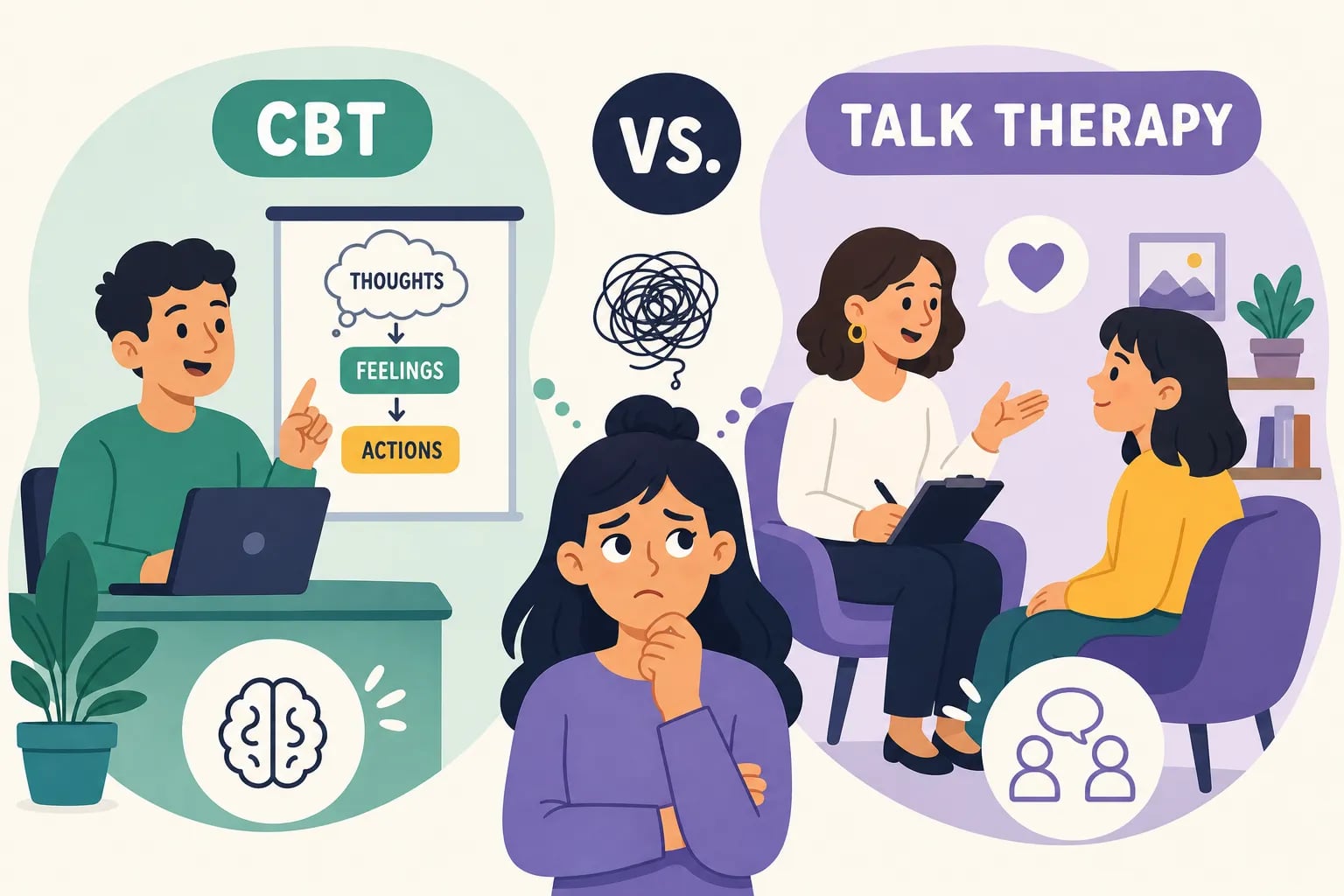
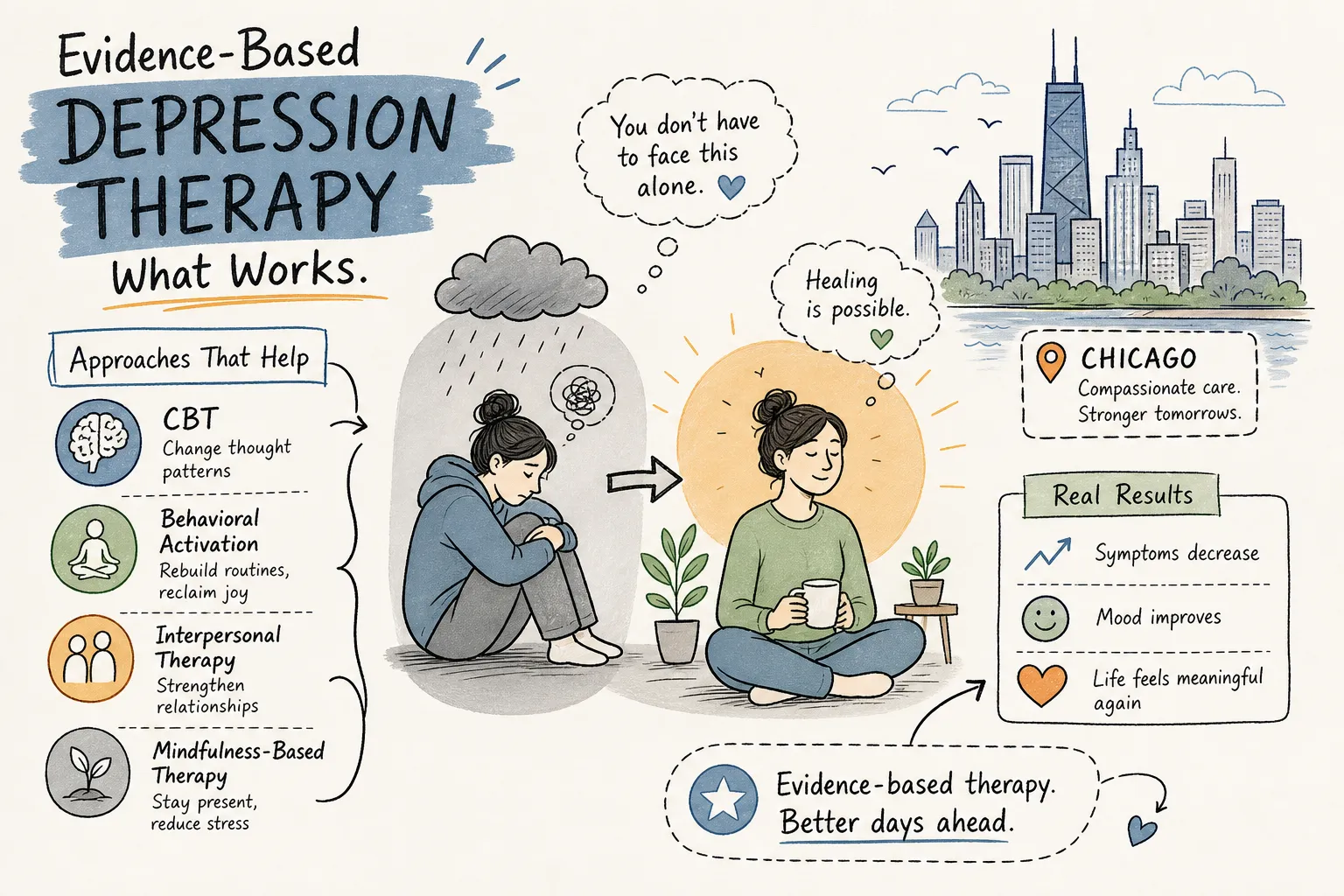
Cognitive Behavioral Therapy is the most extensively studied psychotherapy for adult depression in existence. The core mechanism is straightforward: CBT targets the connection between thoughts, emotions, and behaviors. Therapists help clients identify distorted thinking patterns, challenge them directly, and build behavioral strategies that interrupt the cycle of depression. Sessions are structured and skill-focused, with between-session practice built in because applying skills outside the therapy room is part of what drives change. Most protocols run 12 to 20 sessions, a range supported by major clinical guidelines and meta-analyses.
CBT: what the numbers show
Across 409 trials, CBT shows a moderate-to-large effect size (g=0.79), with roughly a 50% response rate and remission rates of 36% compared to 15% in control groups. At six-month follow-up, 75% of patients show sustained improvement. These are not marginal findings produced by a single enthusiastic research team. They represent decades of rigorous, replicated science. For a concise summary of those outcomes, see the available data on CBT success rate statistics.
CBT tends to work especially well for mild-to-moderate depression in people who are willing to engage actively between sessions. It’s also highly effective when depression comes with comorbid anxiety, which is common. The approach does ask something of you: a willingness to examine your thought patterns honestly, show up consistently, and practice skills outside the therapy room. For the right person, that investment pays off clearly.
IPT: the relationship-focused alternative
How IPT addresses depression differently
Interpersonal Psychotherapy takes a different angle entirely. Rather than focusing on thought patterns, IPT examines the interpersonal context of your depression, grief, role transitions, relationship conflicts, and social isolation. The core premise is that depression is often triggered and sustained by disruptions in key relationships, and therapy addresses those disruptions directly. It builds communication skills and coping strategies around the specific interpersonal problems driving your symptoms.
IPT: evidence and outcomes
IPT holds up as well as CBT in head-to-head trials. Response rates land around 40 to 45%. One trial reported that 79% of IPT participants showed meaningful improvement on the BDI scale compared to 76% for CBT, and some studies have found IPT outperforms CBT on specific severity measures like the MADRS, though it’s worth noting that meta-analyses generally treat the two as equivalent overall, with individual fit determining which works better for a given person. At 24-month follow-up, there’s no significant difference between the two in response, remission, or relapse, see research on the long-term outcomes of CBT and IPT for more detail.
IPT is often the more intuitive choice when your depression is clearly tied to something happening in your relationships: a divorce, a death, a job loss, a career shift that changed your sense of identity. If what’s weighing on you feels less like a pattern of negative thinking and more like a specific loss or relational disruption, that’s worth raising with any therapist you’re considering in Chicago. It changes which approach makes the most clinical sense.
DBT and ACT: when these approaches make sense
DBT, Dialectical Behavior Therapy, was originally developed for borderline personality disorder and chronic suicidality. The research on this is clear: DBT is not a first-line standalone treatment for standard adult depression. It has real value when depression is accompanied by intense emotional dysregulation, self-harm behavior, or active suicidal ideation. If a therapist recommends DBT for straightforward depression without explaining that clinical rationale, it’s a reasonable question to ask. The evidence base for DBT exists in a specific clinical context, not as a general substitute for CBT or IPT.
Acceptance and Commitment Therapy takes a genuinely different approach. Rather than challenging distorted thoughts, ACT builds what researchers call psychological flexibility: the ability to observe difficult thoughts without being controlled by them, and to take action aligned with your values even when you’re depressed. In head-to-head trials against CBT, some studies report comparable short-term remission rates, roughly 75% for ACT versus 80% for CBT, though some data suggests CBT may hold a long-term advantage in certain populations. The evidence base for ACT is growing and legitimate; it’s listed among effective interventions in recent comparative reviews. It tends to suit people who find direct thought-challenging difficult or who are drawn to mindfulness-informed frameworks. It is not a replacement for CBT or IPT in terms of research depth, but it’s a credible option with a real rationale behind it.
How to match the right therapy to your situation
Severity is the most important starting point. Mild-to-moderate depression is the sweet spot for outpatient individual therapy, and both CBT and IPT show strong outcomes here. Severe depression often needs a more intensive approach first: a skilled clinician will assess whether individual therapy alone is appropriate, or whether medication, a higher level of care like an intensive outpatient program, or a combination is needed before standard weekly sessions begin. Getting that assessment right matters; it affects how quickly you start to feel better.
Before committing to any therapist you’re considering in Chicago, ask these questions directly:
- What specific therapy approach do you use for depression, and how was it validated by research?
- Do you use outcome measures at each session to track my progress?
- Do you receive ongoing supervision or consultation to make sure you’re following the protocol correctly?
- Can you walk me through what a typical session looks like for someone with my presentation?
A therapist trained in evidence-based practice will answer those questions with specifics: a named modality, a named outcome tool, a clear description of session structure. Vague answers about a “personalized” or “integrated” approach without naming a clinical model are worth probing. Flexibility is reasonable; vagueness is a different problem. For a broader overview on local options, see Depression treatment in Chicago: know your options.
Finding the best evidence-based depression therapy in Chicago
When you’re evaluating providers, look for therapists who name the specific modality they use rather than relying on broad terms like “talk therapy” or “eclectic approach.” Ask whether they track outcomes using standardized tools. Therapists with post-graduate training in a specific model, formal certification, or ongoing clinical supervision are more likely to deliver therapy with fidelity to the research. That fidelity matters because it’s what connects you to the outcomes shown in the studies. If you want practical guidance on how to find a clinician and what to expect from intake, review Therapy for Depression in Chicago: How to Get Real Help.
It’s also worth understanding when standard outpatient therapy isn’t the right fit. If your depression is moderate to severe and significantly disrupting your daily functioning, partial hospitalization programs (PHP) and intensive outpatient programs (IOP) in Chicago show substantially better outcomes than weekly individual therapy alone for those presentations. Clarity Clinic reported that 81% of PHP and IOP participants achieved clinically significant improvement in 2025, according to their published outcome data, that kind of structured, high-frequency care can stabilize symptoms faster than weekly sessions when severity demands it. For more on levels of care and IOP offerings in the area, consider searching local intensive outpatient program listings when evaluating next steps.
For treatment-resistant depression specifically, providers in Chicago also offer options like intranasal esketamine (Spravato) through clinics such as Rush University Medical Center and Relief Mental Health, though those are distinct clinical conversations that start with your treating provider.
River North Counseling is a licensed group practice with offices in Chicago’s River North neighborhood and Skokie, and virtual sessions available throughout Illinois for clients who need flexibility. Licensed therapists there work with adults experiencing depression using CBT and other evidence-based approaches tailored to each client’s presentation and severity. The intake process is designed to match you with the right clinician from the start, learn more about their local CBT offerings at CBT in Chicago: How It Works and Who It Helps, River North Counseling. You can reach their team directly to schedule an intake and learn which approach fits your situation.
The next step is simpler than it seems
CBT and IPT are the gold-standard choices for anyone seeking the best evidence-based therapy for depression in Chicago, backed by decades of rigorous, replicated research. ACT is a credible and growing option. DBT serves a specific clinical role, not a general one. Choosing between them depends on the nature of your depression, how severe it is, and your personal fit with the therapeutic model.
The goal isn’t to pick the “best” therapy in the abstract. It’s to find a qualified therapist in Chicago who is trained to deliver that therapy properly, tracks whether it’s working, and adjusts when it isn’t. That’s what evidence-based depression treatment in Chicago actually looks like in practice, and it’s what you should expect from any provider you commit to. River North Counseling is one place in Chicago where that kind of care is available. Scheduling an intake is a straightforward next step, and a direct path to finding out which approach is right for you.