

Depression doesn’t announce itself with a clear label. It shows up as persistent heaviness you can’t shake, a loss of interest in things that used to matter, weeks of disrupted sleep, or a growing sense that nothing is going to get better. Chicago’s pace doesn’t make this easier, long commutes, high-pressure careers, and winters that drain the light can make it genuinely harder to prioritize your own mental health. Many people spend days or weeks searching for therapy for depression in Chicago without knowing what to actually look for, what questions to ask, or what the process looks like once they find someone.
This guide is designed to close that gap. It covers the main treatment approaches that work, how to find a therapist who fits your specific needs, the different levels of care available in the city, and the practical details around insurance and access. If you want a solid place to start, River North Counseling is a licensed group practice with offices in Chicago’s River North neighborhood and Skokie, offering evidence-based depression treatment in-person and virtually across Illinois. But here’s everything you need to make a confident decision, regardless of where you land.
Which types of therapy for depression in Chicago actually work
Not all depression treatment looks the same, and not every approach is equally supported by evidence. Understanding the main options helps you choose a provider whose methods match how you process and heal, not just whoever happens to have availability.
Cognitive behavioral therapy: the most evidence-backed approach
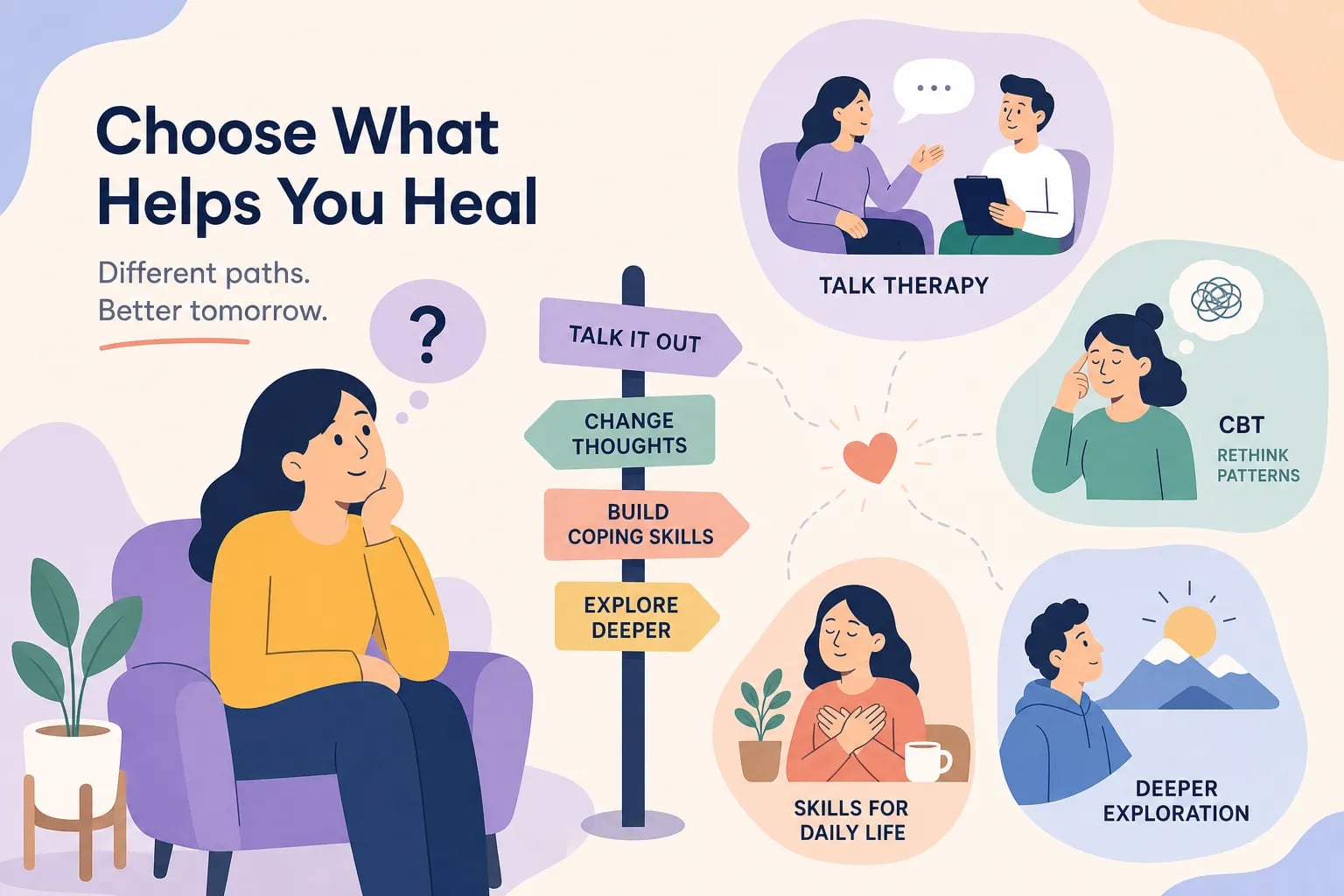
CBT is consistently rated the gold-standard psychotherapy for depression. Clinical research shows a response rate of roughly 42% for CBT compared to approximately 19% in control conditions, with remission rates around 36%. It works by helping you identify patterns of negative thinking and replace them with more accurate, balanced responses. Sessions are structured and goal-oriented, which appeals to people who want measurable progress rather than open-ended conversations. For mild depression, 8 to 12 sessions often produce meaningful change; moderate depression typically requires 8 to 16; and severe or chronic cases may need 16 or more, sometimes with periodic booster sessions. Large systematic reviews and network meta-analyses support CBT’s effectiveness across a range of depressive presentations.
Psychodynamic therapy and other evidence-based approaches
Psychodynamic therapy goes deeper into the emotional roots of depression: unresolved grief, long-standing relational patterns, early experiences that shaped how you see yourself. It’s a better fit for people whose depression feels tied to identity or long-standing pain rather than specific thought patterns. Acceptance and Commitment Therapy (ACT) and Interpersonal Therapy (IPT) also carry strong evidence bases and may be offered as alternatives or complements to CBT, depending on the therapist and your situation.
Where medication fits in
Therapy and medication aren’t mutually exclusive. For moderate to severe depression, antidepressants combined with psychotherapy often produce better long-term outcomes than either approach alone. A licensed therapist can collaborate with your prescriber or refer you to a psychiatrist if medication management becomes a useful part of your care. The therapist doesn’t prescribe; they coordinate and advocate.
How to find Chicago depression therapy that fits your life
Knowing the therapy types is only half the work. Finding the right person to deliver that care matters just as much as the method itself.
What to look for in a depression specialist
Look for a therapist who holds an Illinois license, LCSW, LCPC, Psy.D., or Ph.D., explicitly lists depression as a specialty, and uses evidence-based methods like CBT. You can verify licensure categories through the Illinois Department of Financial and Professional Regulation. Beyond credentials, consider their availability, whether they offer telehealth, and whether they accept your insurance. Vague bios that list every condition under the sun are a warning sign. Specificity signals genuine expertise and an organized practice.
Before committing to an intake, ask a few direct questions: Do you specialize in depression specifically? What treatment approach do you use? How do you measure progress? What is your current wait time for new patients? These questions quickly reveal whether a provider is organized, experienced, and genuinely client-focused. For additional local guidance on navigating providers and services, see our mental health in Chicago: how to find the right care guide.
Why River North Counseling is worth contacting first
River North Counseling is a multi-specialty group practice with offices in River North and Skokie, plus virtual therapy available across Illinois. Their licensed therapists specialize in evidence-based depression counseling in Chicago, including CBT, and take a personalized approach to matching each client with the right fit, a deliberate match based on your needs, goals, and schedule, with flexible options designed for working professionals. If you’re searching for depression therapy in Chicago and want a practice built around your schedule rather than around its own convenience, this is a sensible first call.
Levels of care: matching treatment intensity to where you are
Not everyone needs the same level of support, and Chicago’s mental health system offers multiple tiers of care. Starting at the right level matters. Over-treating wastes time and resources, while under-treating leaves real suffering unaddressed.
Standard outpatient therapy: where most people start
Weekly one-on-one therapy is the right starting point for mild to moderate depression where you’re still functioning in daily life but struggling. This is the level of care River North Counseling and most private practices operate at. It’s effective, accessible, and doesn’t require you to rearrange your life. Many people who commit to this level see measurable improvement within the first two to three months of regular weekly sessions.
Intensive outpatient and partial hospitalization programs
If weekly therapy isn’t providing enough structure, Intensive Outpatient Programs (IOP) offer group and individual therapy several times per week, typically 9 to 20 hours across three to five days. Partial Hospitalization Programs (PHP) are a step up from there, closer to a full-day clinical structure without overnight stays, usually 20 to 30 hours per week. PHP is designed for acute or severe symptoms where someone needs close daily support but can safely return home each evening. In Chicago, providers like Clarity Clinic offer these programs for people whose depression is significantly disrupting daily functioning. If you’re considering IOP or PHP-level depression treatment in Chicago, ask any prospective provider directly which programs they’re currently running. For a clear comparison of how these levels differ, see an overview of the differences between IOP, PHP, and inpatient programs.
Advanced interventions for treatment-resistant depression
A smaller percentage of people don’t respond to standard therapy or medication. For those cases, TMS (Transcranial Magnetic Stimulation), ketamine infusion therapy, and Spravato (esketamine) are available in the Chicago area. Rush University Medical Center has one of the most established TMS programs in the city, and Stella Mental Health in Oak Park specializes in several of these biological interventions. These are medical treatments requiring a psychiatric evaluation and referral; they’re not offered through general therapy practices.
Insurance, telehealth, and realistic access in Chicago
Practical access factors often determine whether someone gets help or gives up. Here’s what Chicago residents actually need to know before making calls.
How insurance typically covers depression therapy
Under the Mental Health Parity and Addiction Equity Act, most employer-sponsored insurance plans must cover mental health services at the same level as medical care. If your plan covers outpatient therapy, it must cover depression treatment under the same financial terms: same copays, same deductibles, same visit limits. Common Chicago-area insurers that many therapy practices accept include BCBS, Aetna, Cigna, and UnitedHealthcare. Always verify in-network status directly with the practice, since insurer websites are often outdated by months. For more on how mental health parity is enforced in practice, see this overview, and when checking coverage ask practices about their accepted plans to confirm they take your insurer.
Virtual therapy as a practical option across Illinois
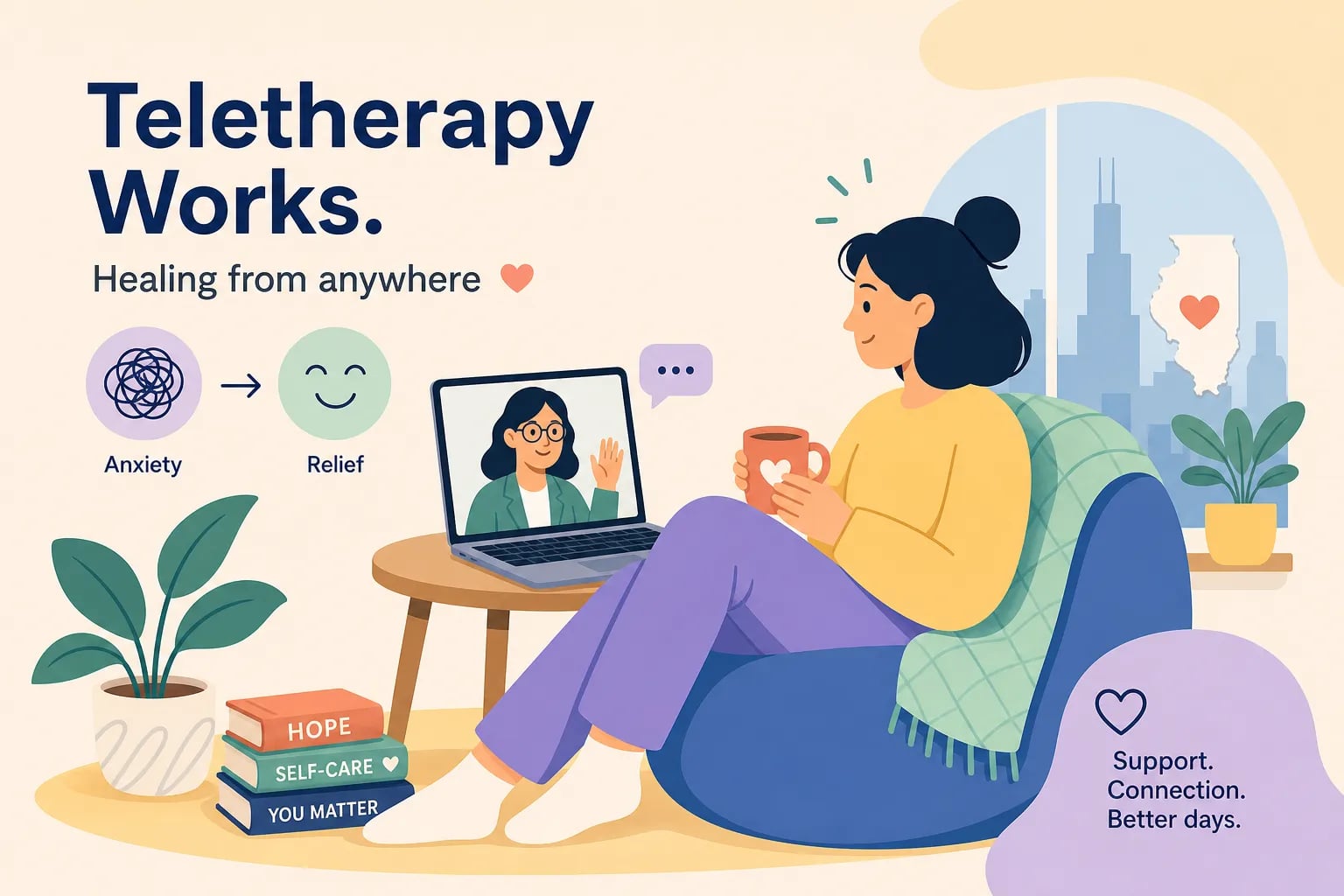
Telehealth has meaningfully expanded access to depression treatment across Illinois, and research consistently shows that online therapy is as effective as in-person care for most individuals. River North Counseling offers virtual sessions statewide, particularly useful for clients with demanding schedules or those in suburban communities who’d rather skip the commute. The therapeutic work is the same; the setting is just more flexible. Several studies have demonstrated comparable outcomes for teletherapy versus face-to-face treatment, see this meta-analysis on telebehavioral health outcomes for further details: telehealth psychotherapy evidence.
What to realistically expect around wait times
New patient wait times in Chicago vary widely. Booking platforms report median waits of around one day for therapists, though that figure reflects platform-based availability and may not apply to all practices or insurance situations. Group practices often have more scheduling flexibility than solo clinicians, simply because there are more providers available to match with. If you’re in crisis right now, contact 988 (Suicide and Crisis Lifeline, available by call or text) or go to the nearest emergency room rather than waiting for an outpatient appointment.
What to expect when you start depression therapy
Many people delay starting therapy not because they don’t want help, but because they don’t know what “starting” actually looks like. The reality is more straightforward than most people expect.
Your first session is an intake, not a deep emotional dive. The therapist will ask about your symptoms, their duration, your history, and your goals. They may ask you to complete a brief standardized assessment like the PHQ-9, which helps establish a clinical baseline. You don’t need to have everything figured out before you arrive; that’s what the process is designed to do. By the end of the session, you and your therapist will have a rough treatment plan and a shared understanding of where you’re starting from. If you want a practical checklist to prepare for that first visit, several clinic guides outline the typical intake process and forms to expect.
Progress in depression therapy doesn’t always feel dramatic at first. Early signs that the work is paying off include sleeping more consistently and noticing slightly more energy on certain days. You may also start catching negative thoughts before they spiral, or find a bit more motivation for ordinary tasks. These small shifts matter. Some people report meaningful change within the first month or two of weekly therapy, though timelines vary depending on depression severity and individual circumstances. Encouraging early progress is a sign the work is taking hold, not a reason to stop. If you’re unsure whether your experience meets clinical criteria, our guide on recognizing depression symptoms and accessing resources for support can help you decide the next step.
Low-cost and community options when budget is a barrier
Cost should never be the reason someone goes without support. Chicago has more affordable options than most residents realize, and several are expanding in 2026.
The Chicago Department of Public Health (CDPH) operates city-run mental health clinics serving adults, adolescents, and children for depression, trauma, and stress-related conditions. A new clinic is opening in Pilsen in August 2026, with a Roseland location following shortly after. The CARE Teams program pairs CDPH mental health workers with first responders for community-based crisis response, available Monday through Friday. Several FQHCs and community organizations across Chicago also offer sliding-scale or no-cost therapy, including:
- CommunityHealth: No-cost care for low-income, uninsured individuals
- Association House of Chicago: Most services at no cost, fully bilingual
- Center on Halsted: Affirming care for LGBTQIA+ individuals
- Clarity Clinic and the Chicago Psychoanalytic Institute: Reduced-fee tiers starting around $10 per session based on income
If you’re in crisis, 988 (Suicide and Crisis Lifeline) offers 24/7 free, confidential support by call or text. NAMI Chicago provides support groups, classes, and connection to local resources at no cost. These aren’t fallback options; they’re real, functioning services staffed by trained professionals.
Taking the next step toward real support
Depression is treatable. That’s not a platitude, it’s a clinical fact backed by decades of research. The challenge for most Chicago residents isn’t whether effective help exists; it’s knowing where to start and having enough clarity to make that first contact. Finding the right therapy for depression in Chicago takes a little research, but the path forward is clearer than it can feel when you’re in the middle of it.
If you’re looking for depression counseling in Chicago with experienced therapists, evidence-based methods, and flexible scheduling built around real lives, River North Counseling is a strong place to begin. With offices in River North and Skokie and virtual therapy available across Illinois, they offer a range of options whether that’s an in-person visit or a telehealth session from wherever you are. You don’t have to have everything figured out before reaching out. The first call is just a conversation.