
It’s 11 p.m. Your thoughts are running through everything that could go wrong tomorrow. Someone suggested you “just breathe.” It didn’t help. What actually interrupts the anxiety spiral isn’t a vague reassurance, it’s a structured technique that addresses the thought fueling the fear, not just the feeling it produces. These 10 CBT exercises for anxiety you can practice at home are the same cognitive behavioral techniques licensed therapists teach in session and assign as structured homework between appointments. At River North Counseling, home practice is built into treatment because applying techniques between sessions accelerates progress. Whether you’re managing work stress, social anxiety, or generalized worry, you’ll find something here you can use tonight.
Why CBT techniques work when general coping strategies don’t
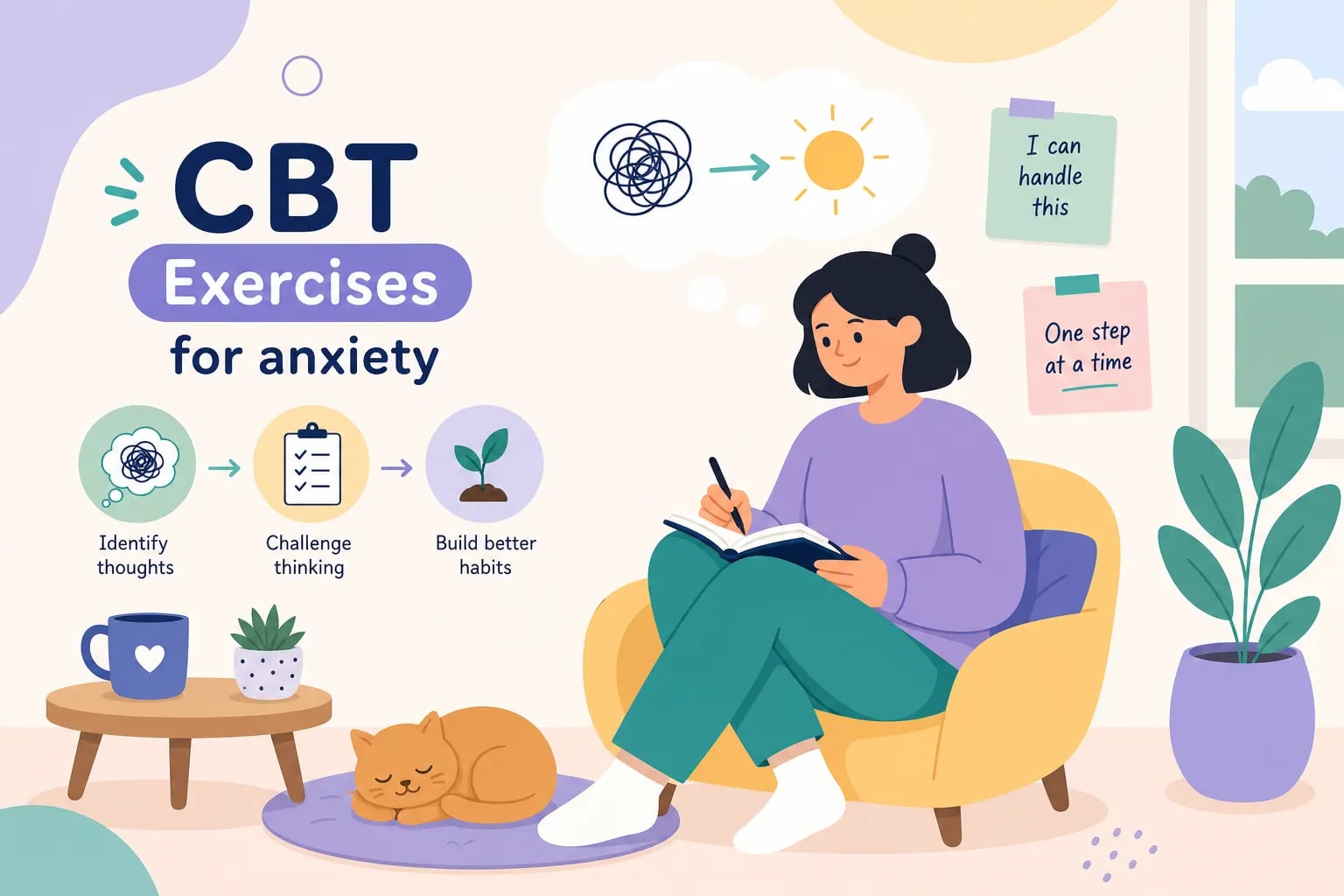
Most anxiety coping tips address the feeling without touching the cause. CBT works differently because it targets the full loop: an anxious thought triggers an anxious feeling, which drives avoidance behavior, which confirms the original thought and keeps the cycle going. When you only manage the feeling, you get temporary relief. When you work all three layers, the pattern itself begins to change.
“Evidence-based” doesn’t mean complicated. These are structured, repeatable techniques that have been tested in clinical trials across anxiety disorders. Self-administered versions are less intensive than working with a therapist, but meta-analyses of self-guided CBT programs show they still produce meaningful symptom reduction when practiced consistently, particularly for mild-to-moderate anxiety.
To get the most out of any CBT exercise for anxiety at home, track your distress on a 0, 10 scale before and after each session, practice several times per week, and do the writing. Writing thought records is a well-established CBT technique that may help by externalizing and structuring anxious thoughts, making the invisible visible so you can examine it. Keep a notebook or a notes app specifically for this.
CBT exercises for anxiety you can practice at home: thought records and cognitive restructuring
1. How to complete a thought record in 7 steps
A thought record is the foundational self-help CBT worksheet for anxiety. It works by slowing down the automatic thought process and testing anxious predictions against actual evidence. Work through each step in order:
- Situation: Write what happened, where, and who was present.
- Emotion: Name the feeling and rate its intensity from 0 to 10.
- Automatic thought: Write the exact thought that went through your mind.
- Evidence for: List the facts that seem to support the thought.
- Evidence against: List facts that don’t support it, or point to another explanation.
- Balanced thought: Write a more realistic version that accounts for both sides.
- Re-rate emotion: Rate the feeling again from 0 to 10.
2. Try the fill-in-the-blank version first
Here’s a worked example you can model: Your manager asks to speak with you after a meeting. Anxiety spikes to 8/10. Automatic thought: “I’m in trouble. I must have done something wrong.” Evidence for: they sounded serious and didn’t explain why. Evidence against: managers also call meetings for routine updates, feedback, or new assignments, and nothing was said about a problem. Balanced thought: “I don’t know the reason yet. It could be serious, but it’s just as likely to be routine. I’ll wait for the facts.” Re-rate: anxiety drops to 5/10.
Many people report a measurable drop in anxiety after completing a thought record worksheet, even on the first attempt. The cognitive distortions to watch for in your own records are catastrophizing, mind-reading, all-or-nothing thinking, and fortune-telling. Spotting your pattern across multiple records is what makes this tool more powerful over time.
Exposure exercises for anxiety you can practice at home
3. Build your personal fear ladder
Graded exposure is the most clinically robust technique in the CBT toolkit for anxiety. The goal is to approach avoided situations in a structured, graduated way rather than avoiding them, avoidance only strengthens fear. Start by picking one specific fear, then brainstorm 8 to 15 related situations. Rate each on a 0, 100 distress scale and arrange them from easiest to hardest.
Here’s an example hierarchy for phone call anxiety: (1) Read a phone script aloud alone, distress 20. (2) Call a family member and say one sentence, distress 35. (3) Call a store to ask a basic question, distress 45. (4) Make an appointment by phone, distress 55. (5) Handle a small issue with a business, distress 65. (6) Make an important call without a script, distress 75. Start somewhere in the lower-to-middle range, not at the top.
4. How to run a single exposure session
Before you start, write your prediction and your starting anxiety rating. Enter the situation deliberately and stay until your anxiety drops by roughly half from where it began. Record what actually happened versus what you predicted. Repeat the same step until it feels manageable before moving up.
The one rule that matters most: do not leave early. Escaping when anxiety spikes is the mechanism that keeps avoidance patterns alive. Staying is what teaches the nervous system that the situation is survivable. Most simple fears show meaningful reduction within five to eight practice sessions.
Exercise 5: Behavioral experiments for testing anxious predictions
A behavioral experiment takes the logic of exposure and applies it to a specific prediction you can test directly. This works especially well for social anxiety. Use this four-field format: write your prediction and how likely you think it is (0, 100%), design a specific action that tests it, collect observations during or after, and record what you actually learned.
Worked example, Prediction: “If I speak up in the team meeting, people will think my idea is stupid” (confidence: 80%). Test: contribute one idea in the next meeting. Outcome: two colleagues built on the idea, one asked a follow-up question. Learning: the feared outcome did not happen, and confidence in the prediction drops to 30%. Repeating this process across multiple experiments is how longstanding anxious beliefs begin to shift.
Exercises 6 and 7: Breathing and progressive muscle relaxation
6. The 4-6 breathing script for immediate calm
Sit with both feet on the floor. Drop your shoulders and unclench your jaw. Inhale gently through your nose for 4 counts. Exhale slowly through your mouth for 6 counts. Repeat for 5 to 8 cycles. The longer exhale is associated with increased vagal and parasympathetic activity, which dials down the fight-or-flight response. This is why the ratio matters: a longer exhale produces a measurable physiological shift, not just a distraction.
7. A 2-3 minute progressive muscle relaxation sequence
Work through each muscle group: tense for 5 seconds, then release for 10. Feet: curl your toes and squeeze. Legs: press your thighs and calves together. Hands and arms: make fists and tighten your forearms. Shoulders: lift them toward your ears. Face: scrunch your eyes shut and tighten your jaw. After each release, notice the contrast between the tension and the loosening. The contrast between tension and release is what produces relief, passive relaxation without the tensing phase is less effective.
Use breathing and PMR to lower physical arousal before or during an exposure session. They reduce the body-level experience of anxiety effectively, but they don’t change anxious thoughts or avoidance patterns on their own. Pair them with cognitive restructuring or exposure for lasting results.
Exercises 8, 9, and 10: Behavioral activation, worry time, and grounding
8. Behavioral activation for anxiety-driven withdrawal
Anxiety narrows life. It pulls you away from meaningful activities, which feeds more anxiety and fewer reasons to feel okay. Behavioral activation counters this directly: schedule one or two small, concrete activities each day that align with what matters to you. Use a simple log, activity, time, mood before (0, 10), mood after (0, 10). Track it for one to two weeks and let the data speak.
9. The worry time technique for chronic rumination
Designate a specific 15, 20 minute window each day as your scheduled worry time. When worries arise outside that window, write them down and consciously defer them. During the worry window, review the list deliberately. This reduces the “always-on” quality of anxious thinking without suppressing it or pretending the worry isn’t real. For each item, note the specific worry, distress rating, and what you actually learned when you reviewed it at the scheduled time.
10. The 5-4-3-2-1 grounding technique for acute spiraling
When anxiety spikes suddenly, this technique pulls your attention into the present using your five senses. Name 5 things you can see, 4 you can physically touch, 3 you can hear, 2 you can smell, and 1 you can taste. Each sense observation interrupts the spiral and redirects attention away from the anxious thought loop. This works as a quick interrupt, not as a standalone treatment for anxiety over time.
When home practice isn’t enough: taking the next step
Self-guided CBT exercises are a legitimate starting point, and for mild-to-moderate anxiety, research supports their use. But there are clear signs that worksheets have reached their limit. Consider three situations: anxiety is disrupting your daily functioning; you’re managing panic attacks, trauma, or intrusive thoughts; or you’ve practiced these techniques for several weeks without meaningful relief. None of those situations is failure. Each one is useful information about the level of support you need.
A licensed CBT therapist adds something worksheets can’t: case formulation. That means connecting the dots between your specific history, triggers, and patterns so that the techniques are calibrated to your situation, not a general anxiety template. A therapist also paces exposure work safely and adjusts the approach when progress stalls. Clinical warning signs that indicate professional care include anxiety that persists most days for weeks, avoidance that keeps expanding, recurring physical symptoms like chest tightness or chronic insomnia, and any use of alcohol or substances to manage fear.
At River North Counseling, CBT-focused therapy is available with licensed therapists at in-person offices in River North and Skokie, and virtually across Illinois. If these exercises have started something worth continuing, working with a therapist is a natural next step. Reach out to schedule a consultation and keep the momentum you’ve already built.
Start with one CBT exercise for anxiety tonight
The CBT exercises for anxiety you can practice at home in this article aren’t a watered-down version of therapy. They are the building blocks of it, the same thought records, exposure hierarchies, breathing scripts, and worry postponement strategies that licensed therapists teach in session. Consistency matters more than perfection. Pick one technique this week, track your anxiety ratings before and after, and notice what shifts.
Each practice session generates data about your own patterns, which makes the next session more targeted and more effective. If you hit a wall after several weeks of genuine effort, that’s not a sign the approach failed. It’s a sign that a skilled clinician can take what you’ve already learned and help you go further. Either way, you’re doing the thing that matters most: taking anxiety seriously enough to act on it. Pick one of these CBT exercises for anxiety you can practice at home this week and start building that record.