
You know the feeling. It’s 2 a.m. and your mind is running a highlight reel of everything that could go wrong tomorrow. You skipped the networking event “just this once.” You’ve rehearsed that email so many times it’s lost all meaning. Anxiety has a rhythm: dread builds, avoidance brings relief, and the whole cycle starts again the next morning. The problem is that relief feels like safety, so your brain files avoidance as the solution. It isn’t.
This step-by-step guide to cognitive behavioral therapy for anxiety explains the CBT model, the core tools, and a week-by-week framework you can begin using right now. Cognitive behavioral therapy is the most rigorously researched psychotherapy available for breaking the anxiety cycle. A 2021 meta-analysis published in Psychological Medicine found that CBT produces moderate-to-large effect sizes compared to control conditions across generalized anxiety disorder, social anxiety, and panic disorder, consistently placing it as the first-line psychological treatment. The structure here mirrors how licensed CBT therapists actually work, including the clinicians at River North Counseling in Chicago, where clients move through these exact phases with personalized support.
How CBT Breaks the Anxiety Cycle
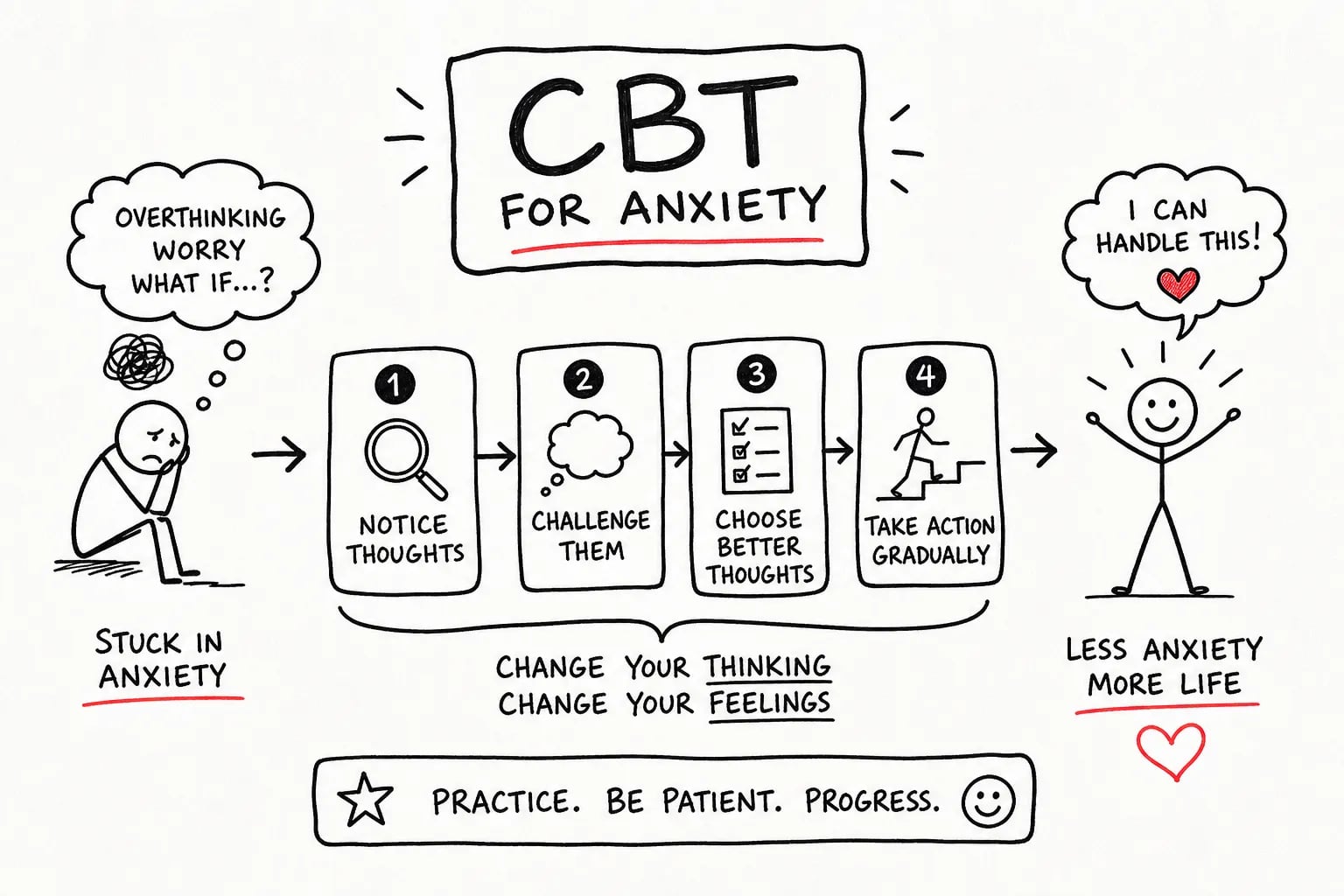
Every anxious episode follows the same chain. A situation occurs, an automatic thought fires, an emotion surges, and a behavior follows. Your supervisor sends a short email: “Can we talk Monday?” The automatic thought arrives instantly: “I must have done something wrong.” Anxiety spikes. You spend the weekend scanning your recent work for mistakes. By avoiding the uncertainty, you get short-term relief, but you also never find out that the meeting was routine. The brain logs avoidance as protective, and the belief grows stronger.
Anxious thinkers tend to fall into recognizable patterns: catastrophizing (assuming the worst outcome) and probability overestimation (treating a small chance as nearly certain) often pair with mind reading, assuming others are judging you negatively. These are not character flaws. They are learned mental shortcuts the brain developed to manage perceived threat. CBT treats them as habits, not facts, which means they can be examined and changed.
The core insight CBT delivers is this: avoidance is what keeps anxiety alive. When you cancel the call, skip the meeting, or check that email one more time, anxiety never gets the chance to learn it was wrong. Exposure, the deliberate practice of approaching feared situations, is the antidote. The rest of this step-by-step guide to CBT for anxiety explains exactly how to do it.
A Step-by-Step Guide to Cognitive Behavioral Therapy for Anxiety: The Core Toolkit
Before walking through the week-by-week plan, it helps to understand the four tools you’ll return to again and again. Think of them as instruments in a small kit: each serves a specific purpose, and together they address both the thinking and the behavioral sides of anxiety.
Thought records and cognitive restructuring are how you slow down automatic thinking and examine it as evidence rather than fact. A thought record worksheet structures that examination across seven fields, from the triggering situation to a more balanced alternative. Cognitive restructuring uses that evidence review to build a realistic replacement thought, not a falsely positive one.
Behavioral experiments take a feared prediction out of your head and test it in real life. Instead of reasoning yourself out of a belief, you design a small, specific situation to find out what actually happens. The shift is from “avoiding to feel safer” to “testing to learn the truth.” It’s a surprisingly powerful distinction.
Graded exposure organizes feared situations into an ordered list, from easiest to hardest, and works through them one step at a time. Repeated, planned exposure teaches the nervous system that the feared outcome either doesn’t happen or, when it does, can be managed. Activity scheduling rounds out the toolkit by planning meaningful actions in advance to reverse the behavioral withdrawal that anxiety often creates, restoring a sense of structure and agency.
Your Week-by-Week CBT Plan for Anxiety
A standard CBT course for anxiety runs 8 to 12 weeks. The work moves through three clear phases, each building on the last. If you’re self-guiding, treat each phase as a module with its own goal and homework, not as a rigid schedule. Many people also supplement this work with a CBT workbook for anxiety to keep their practice organized and consistent.
Phase 1, Weeks 1, 3: Building Self-Awareness
The goal in this phase is self-monitoring, a real clinical skill, not a passive exercise. Each day, track which situations triggered anxiety, what thoughts arose, how intense the emotion was on a 0-to-100 scale, and what you did in response. A simple worry log works well here. You’re not trying to change anything yet. You’re learning your own pattern with enough specificity to work on it, because you can’t challenge what you haven’t clearly seen.
Phase 2, Weeks 4, 7: Step-by-Step Cognitive Restructuring and Belief Testing
This is where thought records and behavioral experiments become your primary tools. Each week, identify at least one catastrophic prediction, examine the evidence for and against it, write a balanced alternative, and run at least one real-world belief test. This phase also targets what therapists call “positive beliefs about worry”, the conviction that worrying helps you prepare or stay in control. These beliefs are often the hidden engine keeping anxiety going long after the surface thoughts have been challenged.
Phase 3, Weeks 8, 12: Exposure Practice and Relapse Prevention
The cognitive work builds the case that feared outcomes are unlikely or manageable. Exposure proves it through experience. In this phase, you move up your fear hierarchy one step at a time, practicing each level repeatedly until distress shifts before moving higher. The final weeks focus on relapse prevention: identifying your personal early warning signs, writing a coping plan, and scheduling ongoing skill practice. Recovery isn’t a finish line you cross, it’s a set of habits you maintain.
How to Use Each Tool Correctly
Filling Out a Thought Record Worksheet, Step by Step
A seven-column thought record works through these fields in order. Here is a filled example based on a common workplace scenario, with each field on its own line for clarity:
| Situation | Your supervisor says “let’s review this tomorrow” after your presentation. (Factual, no interpretation.) |
| Emotion | Anxiety, 80/100 |
| Body sensations | Chest tightness, shallow breathing |
| Automatic thought | “I messed up and they think I’m incompetent.” |
| Evidence for | They scheduled another meeting; you stumbled once. |
| Evidence against | They thanked you, asked only clarifying questions, said nothing critical. |
| Balanced thought | “I was nervous and made one mistake, but the meeting wasn’t a disaster. They may simply want to go deeper on the details.” |
| Re-rated emotion | Anxiety, 45/100 |
The goal is not to feel great. The goal is to think accurately.
Building Your Exposure Hierarchy
Start by identifying the fear theme and listing every specific situation you avoid, aiming for 10 to 15 items. Rate each on a 0-to-100 scale for anticipated distress, then order them from lowest to highest. Choose a starting point in the moderate range, around 30 to 40, rather than at the very bottom. A sample hierarchy for social anxiety might look like this:
- Saying hello to a cashier: 20
- Asking a cashier a question: 35
- Making a short phone call without a script: 50
- Ordering in a busy café during peak hours: 65
- Giving a short update in a team meeting: 80
Practice each step repeatedly until distress drops by roughly half from its peak before moving up. Track your anxiety before, during, and after each exposure. The data you collect matters as much as the exposure itself.
Running a Behavioral Experiment
State the belief you want to test as a specific prediction, then rate your confidence that it will happen. Design the experiment with safety behaviors reduced or removed entirely, dropping them is what makes the test informative. Define in advance what counts as confirming or disconfirming your prediction, carry it out, and then compare prediction to reality.
For example: Belief, “If I ask a question in the meeting, people will think I’m stupid.” Prediction: at least one person will laugh or criticize me. Confidence: 85%. Experiment: ask one clarifying question without apologizing first or rehearsing it excessively. Outcome: the manager answered normally; a colleague said the question was helpful. Confidence after: 30%. Next step: ask two questions in the next meeting. The shift in belief happens through accumulated evidence, not argument.
Making the Plan Stick: How to Follow Through on CBT Homework
Studies on CBT adherence point to a consistent pattern: vague goals collapse, and specific ones succeed. “Be less anxious at work” is not an assignment. “Ask one question in Tuesday’s meeting without apologizing first” is. Small, observable, rationale-linked tasks get done far more often than general intentions. Before starting each week’s homework, write down exactly what you will do, when, and where.
Review the prior week before starting the next one. What actually happened versus what you predicted? What did you learn? Reviewing effort rather than perfect execution is what sustains motivation. Therapists know that nobody completes CBT flawlessly, and they don’t expect perfection. The review is where learning actually consolidates.
Habit-stacking and scheduled reminders help significantly in self-guided formats. Link your thought record practice to an existing routine, after your morning coffee, for instance, and set a phone reminder to back it up. CBT apps can guide the exercise and track completion, but they work best when they structure the practice rather than just deliver information. The doing matters more than the reading.
When to Work with a Licensed CBT Therapist
Self-guided CBT is effective for mild to moderate anxiety, and the work you do on your own builds a real foundation. There are also situations where it isn’t enough, and recognizing them early matters.
Specific red flags that signal a need for professional support include symptoms that worsen despite consistent practice over several weeks, significant impairment at work or in relationships, trauma memories or dissociation emerging during exercises, and any thoughts of self-harm or suicide, which require immediate professional evaluation. These are not signs of failure. They are signals that the work needs expert guidance, not that the approach is wrong.
Therapist-administered CBT produces larger and more durable outcomes than self-help alone, particularly for severe or complex presentations. A licensed CBT therapist sets collaborative goals, builds skills session by session, practices techniques with you in the room, and adjusts the plan based on what’s actually happening week to week. That personalized feedback loop is hard to replicate on your own.
If you’re in the Chicago area and ready for that kind of support, River North Counseling is a strong place to start. Their CBT therapists serve Chicago’s River North neighborhood and Skokie through both in-person and virtual therapy, specializing in anxiety and adapting the structured protocol to each client’s specific pattern, goals, and pace. The intake and therapist-matching process is designed to feel accessible rather than clinical and overwhelming.
Taking the Next Step
CBT for anxiety is not a collection of coping tricks. It’s a structured process for genuinely changing the relationship between your thoughts, feelings, and behavior. This step-by-step guide to cognitive behavioral therapy for anxiety has walked you through that three-phase arc, from awareness to cognitive restructuring to exposure and maintenance, because each phase has a clear purpose and the skills build on each other.
Self-guided progress is real. The thought records you complete, the exposures you practice, and the beliefs you test in real life all contribute to lasting change. Professional support accelerates and deepens that progress, especially when anxiety is complex, longstanding, or significantly interfering with your life. Many people do both, moving from self-guided work into supported care when they’re ready, and the skills translate directly.
If you’re in the Chicago area and ready for licensed, personalized CBT delivered by a team that specializes in anxiety, reach out to River North Counseling. The same step-by-step approach to cognitive behavioral therapy for anxiety outlined here is what their therapists bring to every session, adapted to who you are and what you’re working toward.