
You’re in the middle of a sentence and the word you need just disappears. You’ve read the same paragraph three times and none of it is sticking. Or maybe it’s been several months since you recovered from COVID-19, and you still feel like you’re thinking through fog. These aren’t dramatic symptoms, but they’re real, and they’re affecting your work, your relationships, and your sense of yourself. If you’re searching for a cognitive evaluation in Chicago, this guide explains what to expect, what it costs, and how to get started.
A cognitive evaluation is not something to fear. It’s a structured, evidence-based process typically administered by a licensed clinical psychologist or neuropsychologist, designed to give you a clear, objective picture of how your brain is functioning across multiple areas. At River North Counseling, we offer neuropsychological assessment services for Chicago-area adults who want real answers about what’s affecting their thinking, memory, or focus. By the time you finish reading, you’ll know exactly what testing involves, what it costs, where to go in the city, and how to prepare so your results are as accurate as possible.
What a cognitive evaluation actually tests (and why it’s more than a memory quiz)
When most people hear “cognitive testing,” they picture a doctor asking what day it is or asking them to remember three words. That kind of brief screening, called a Mini-Mental State Examination (MMSE) or Montreal Cognitive Assessment (MoCA), takes 10 to 15 minutes and is useful only as a flag. A comprehensive neuropsychological evaluation is an entirely different process, typically lasting four to eight hours and covering six distinct cognitive domains. For a clear walkthrough of the typical test session and what to expect during psychological testing, see What Happens During Psychological Testing: A Clear Walkthrough, River North Counseling.
The core cognitive domains assessed
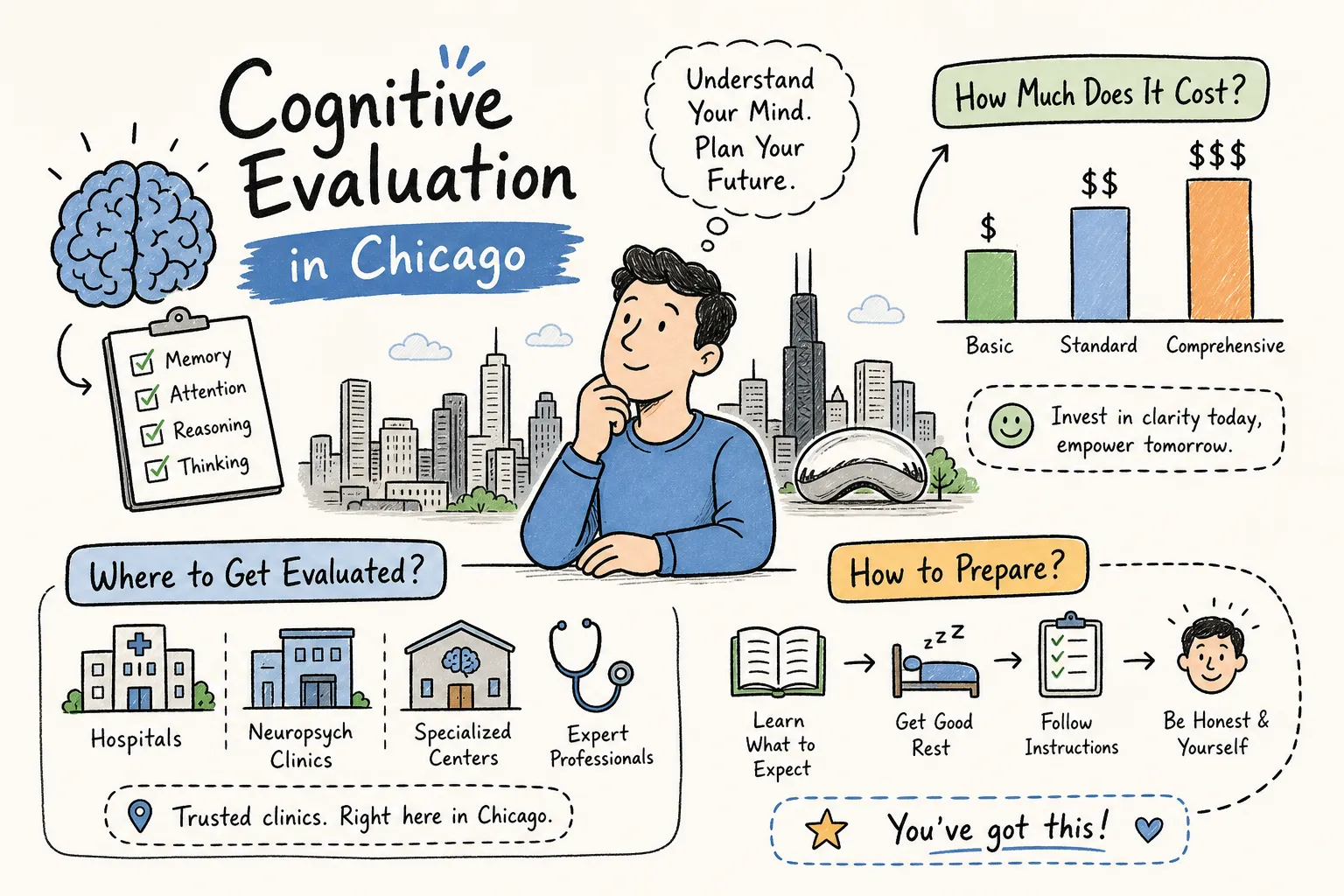
Memory is one piece of a much larger picture. A full evaluation also assesses attention, using tasks like Trail Making Tests and Continuous Performance Tests to measure how well you sustain and shift focus. Executive function covers higher-order thinking skills: verbal fluency tasks (naming as many animals as you can in one minute), card sorting tasks, and problem-solving under pressure. Language is evaluated through picture naming, following multi-step verbal directions, and processing written information. Abstract reasoning and visuospatial skills round out the battery, giving the neuropsychologist a complete map of your cognitive strengths and weaknesses.
Brief screenings vs. comprehensive evaluations
The brief tools your primary care doctor uses are designed for general wellness visits. They catch obvious concerns but lack the resolution to distinguish, say, early mild cognitive impairment from normal aging, or ADHD from depression-related concentration difficulties. A comprehensive evaluation produces a diagnosis-grade report with standardized scores, diagnostic impressions, and specific recommendations. If you’re seeking answers beyond “something might be off,” a full neuropsychological battery is what you need.
What you receive at the end
At the conclusion of testing, your neuropsychologist writes a detailed report documenting performance across every domain, comparing your scores to age-matched norms, and drawing clinical conclusions. A feedback session is typically included, where the clinician walks you through the findings in plain language. You leave with a document you can share with your physician, therapist, employer, or school, one that actually explains what’s happening and what to do about it.
Why Chicago adults are seeking cognitive evaluations right now
Clinicians report seeing more referrals for neuropsychological testing in recent years. Three groups account for much of that demand: adults who’ve reached their 30s and 40s and are wondering whether what they’ve always chalked up to “just being scattered” might actually be ADHD; adults noticing real changes in memory or mental sharpness as they age; and a growing number of people still experiencing cognitive symptoms months after a COVID-19 infection.
ADHD evaluation in adulthood
Many adults go decades without a formal ADHD diagnosis, having developed workarounds and coping strategies that masked the condition through school. When careers intensify, responsibilities multiply, and those strategies stop working, the underlying difficulty becomes impossible to ignore. A comprehensive ADHD evaluation for adults establishes an objective baseline, provides documentation needed for workplace accommodations, and informs decisions about medication or therapy. It’s one of the most common reasons adults in Chicago seek cognitive testing today. For additional context on memory and attention concerns and when to consider a formal assessment, see Memory and Focus Concerns: When to Consider Testing in Chicago, River North Counseling.
Memory concerns and early cognitive changes
Forgetting a name here and there is normal. Repeatedly losing your train of thought, struggling to retain information you just read, or noticing that your mental sharpness has genuinely declined over months, that’s worth discussing with a professional. Cognitive testing can distinguish normal aging from mild cognitive impairment (MCI), early neurodegenerative disease, or other treatable conditions affecting brain function. Getting evaluated early, before symptoms progress, creates more options for intervention and planning. If you’re looking for practical guidance on memory and focus issues and next steps for testing, our article Memory and Focus Concerns: When to Consider Testing in Chicago, River North Counseling may be helpful.
Post-COVID brain fog and neurocognitive symptoms
Post-COVID cognitive dysfunction is now formally recognized as a condition in which attention, processing speed, and episodic memory are measurably impaired following SARS-CoV-2 infection, with symptoms persisting at least three months after the acute illness. Brief screenings like the MoCA are often insufficient for capturing these deficits. A full neuropsychological evaluation objectively documents the specific areas of impairment, which supports both treatment planning and requests for workplace accommodations. Recent research has documented measurable cognitive deficits following COVID-19 infection; see a systematic discussion of post-COVID cognitive changes in the literature here and a related report in The Lancet. If you’ve been telling your doctor you “just feel slower” and they can’t find anything on a standard exam, formal cognitive testing can quantify those deficits and support a clearer clinical picture, even when a standard exam comes back clean.
Where to get a cognitive evaluation in Chicago
Chicago has strong options across three tiers of care: hospital-based academic programs, private neuropsychology clinics, and integrated mental health practices. Each serves a different type of client, and choosing the right one depends on the complexity of your situation and what you want to happen after the evaluation is complete. If you’ve been searching for a neuropsychological evaluation in Chicago or simply wondering about cognitive assessment near me, the breakdown below can help you decide.
Hospital-based neuropsychology programs
UChicago Medicine, UI Health (UIC), and Northwestern Medicine all operate neuropsychology departments with deep specialty expertise. These programs are the right choice for complex neurological cases, including stroke, traumatic brain injury, epilepsy, multiple sclerosis, and neurodegenerative disease. UIC’s Department of Psychiatry runs specialty clinics for multiple sclerosis and NFL-related evaluations. The trade-off is that most require a physician referral and carry wait times of six months to well over a year. For additional hospital-affiliated memory services in Chicago, consider the Rush Memory Center.
Private neuropsychology clinics
Chicagoland Cognitive Assessment Center, led by Dr. Maia Feigon (ABPP board-certified) and Dr. Julia Rao (PhD), both with postdoctoral training at UIC and Northwestern, specializes in memory problems, age-related cognitive decline, and dementia evaluations. Chicagoland Neuropsychology serves adults, children, and legal referrals. LifeStance Health has multiple Chicago locations with neuropsychological testing services. Private clinics typically don’t require referrals and can schedule faster than hospital systems, though many operate out-of-network and provide superbills rather than direct insurance billing, verify network status with any clinic before booking.
River North Counseling: cognitive assessment with integrated care
For adults who want a cognitive evaluation paired with the option to continue care under one roof, River North Counseling’s neuropsychological assessment services offer something the other options often don’t: continuity. Getting a report from one provider and then starting over with a separate therapist to act on the findings is a frustrating gap that many clients experience. At River North Counseling, assessment and follow-on care, whether that’s individual therapy, CBT, or performance coaching, happen in the same clinical home. The practice serves clients in River North and Skokie, with virtual options available across Illinois. If you want clarity on what’s affecting your cognition and a clear path forward, this is where assessment meets action.
What cognitive testing costs in Chicago (and what insurance covers)
Out-of-pocket costs for a comprehensive neuropsychological evaluation in Chicago typically range from $2,000 to $7,000, with most standard adult evaluations falling between $3,500 and $5,250 depending on the scope of testing and the provider. Those numbers shift significantly when insurance applies.
Out-of-pocket cost ranges by provider type
Hospital-based programs typically bill through insurance at standard rates, making them the lowest out-of-pocket option for insured patients, though your actual cost will vary by plan, medical necessity determination, and prior authorization requirements. Some private clinics operate out-of-network and offer superbills for partial reimbursement through your plan’s out-of-network benefits; verify the network status of any clinic directly before booking. Person-Centered Psychological Services (PCPS), by contrast, is in-network with Aetna, Anthem, BCBS, Cigna, Optum, and UnitedHealthcare, which can bring costs down to a copayment or deductible amount. It’s worth noting that no major Chicago private clinic currently accepts Medicaid, and those on Medicaid may need to explore community health center options.
Navigating insurance and reducing your costs
Before booking, call the behavioral health number on your insurance card and ask specifically whether neuropsychological testing is covered. The relevant CPT codes are 96130 and 96131 (neuropsychological testing evaluation services) and 96132 and 96133 (neurobehavioral status exams). Ask whether prior authorization is required and whether a physician referral is needed for coverage to apply. Even out-of-network superbills can yield partial reimbursement if your plan carries out-of-network benefits, so don’t assume a clinic’s out-of-network status means you’ll pay full price out of pocket.
How to prepare for your cognitive evaluation appointment
There is nothing to study. The evaluation measures how your brain actually functions, not how well you prepared, and attempting to “practice” cognitive tasks beforehand can distort your results. A few practical steps, though, genuinely affect the accuracy of what the evaluation captures, so it’s worth knowing them before your appointment day arrives.
What to bring on the day of testing
- Your current medication list or the bottles themselves, so the neuropsychologist can account for any cognitive side effects
- Any prior medical records, imaging reports, or previous psychological evaluations
- Insurance card and referral documentation if applicable
- A trusted family member or caregiver who can provide an independent account of the cognitive and behavioral changes they’ve observed in you
How to set yourself up for accurate results
Sleep matters more than most people expect. Fatigue mimics cognitive impairment on standardized tests, so getting a full night’s sleep before your evaluation is one of the most straightforward things you can do to ensure your scores reflect your actual functioning rather than your tiredness. Eat a normal meal beforehand, since testing runs four to eight hours and some clinics build in breaks but not full meal periods. Anxiety is normal and the neuropsychologist accounts for it, but arriving in a state of severe sleep deprivation or acute stress can meaningfully skew results in ways that complicate interpretation and may require retesting.
Getting started: your next step toward clarity
A cognitive evaluation is one of the most direct routes to understanding what’s actually happening in your brain. Chicago has strong options at every level of care, from major academic medical centers to specialized private clinics to integrated practices that can take you from assessment through treatment. Before you book, it helps to know what the evaluation covers, what your insurance will pay, and what you can do beforehand to make sure the results reflect your real baseline.
For Chicago-area adults who want answers and a clear path to act on them, River North Counseling is a natural starting point. Our neuropsychological assessment services are designed to give you clarity, whether your concern is ADHD, memory changes, post-COVID symptoms, or something harder to name. Early evaluation creates more options, and more options mean more control over what comes next. Reach out to River North Counseling to learn more about our assessment services and take the first step out of the fog.