
When a doctor first says the words “neuropsychological evaluation,” most adults feel a quiet surge of alarm. The term sounds clinical, heavy, and hard to decode. What exactly are they testing? What happens if the results reveal something serious? And what does any of this mean for your day-to-day life? Those are fair questions, and they deserve clear answers.
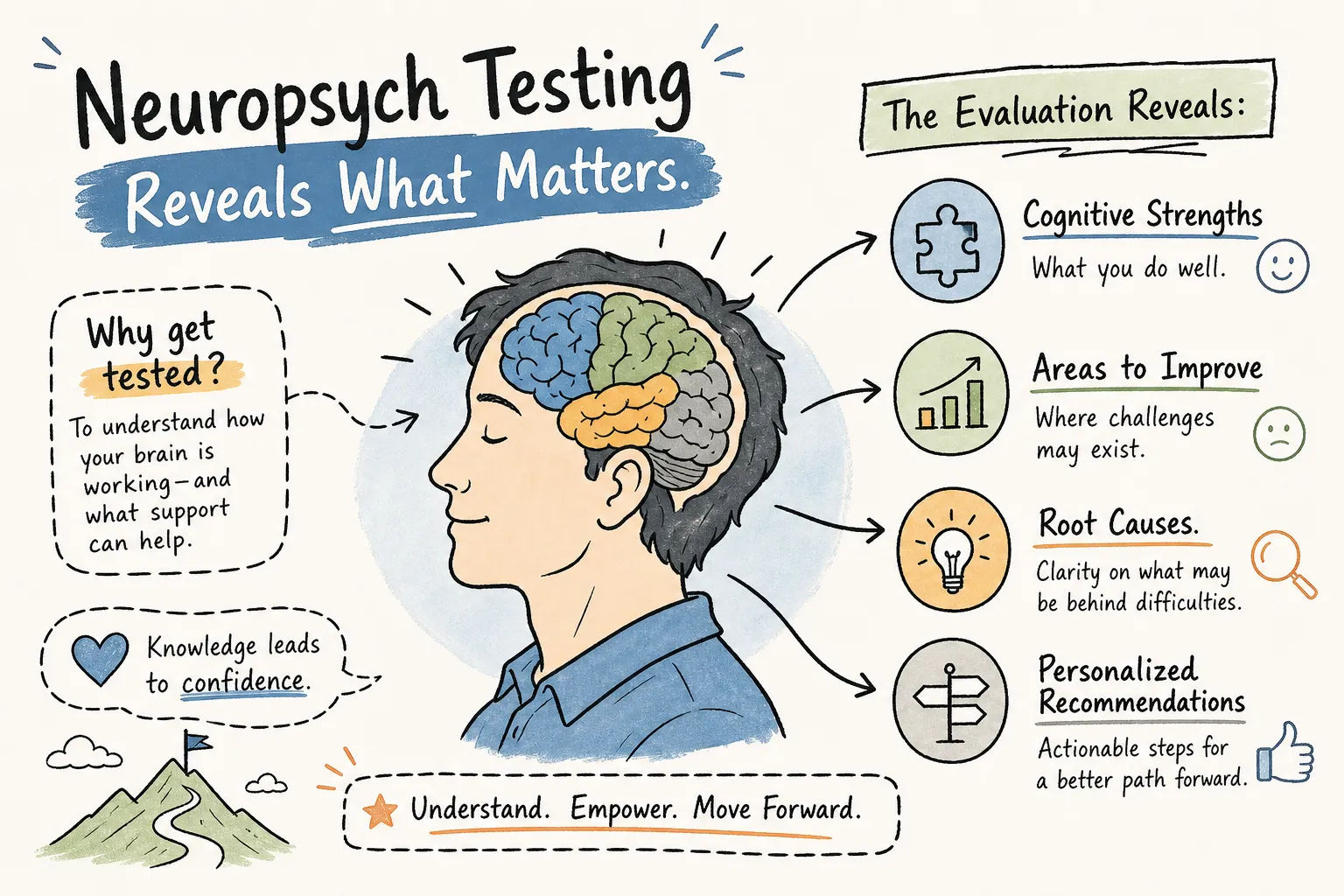
Neuropsych testing for adults is one of the most thorough, precise looks available at how your brain is actually functioning. It measures memory, attention, language, reasoning, and processing speed with a level of detail that no standard medical appointment can match. At River North Counseling, we’ve guided many Chicago-area adults through this process and watched it do something unexpected: instead of generating fear, it generates clarity. People leave understanding themselves better than they did before.
What follows covers why adult neuropsychological evaluations exist, what the process looks like from start to finish, and how to turn the results into a real plan for your cognitive health.
Why adults pursue neuropsych testing
The medical conditions that prompt a referral
Physicians and psychiatrists refer adults for neuropsych testing when they need answers that a brief office screening simply cannot provide. The six most common clinical drivers are dementia, mild cognitive impairment (MCI), traumatic brain injury (TBI), adult ADHD, stroke, and psychiatric conditions that mimic neurological decline.
For dementia, the evaluation performs a differential diagnosis, distinguishing Alzheimer’s disease from frontotemporal dementia requires a detailed cognitive profile, not a quick memory quiz. Guidelines on neuropsychological assessment in dementia diagnosis outline recommended practices that clinicians use to support diagnostic accuracy. For MCI, testing establishes a baseline so clinicians can track whether cognitive decline is progressing over time. After a TBI, the evaluation maps deficits in attention, memory, and processing speed so rehabilitation can target the right areas.
Adult ADHD evaluations distinguish genuine attention problems from the cognitive fog that comes with anxiety or depression. Following a stroke, testing identifies language and visuospatial deficits to guide occupational and speech therapy. And in cases of severe depression, neuropsych testing separates “pseudodementia”, cognitive symptoms caused by a psychiatric condition, from true neurodegenerative disease.
When self-referral is the right call
You don’t need a physician’s order to pursue an adult cognitive assessment. Many adults come to testing on their own when they notice memory slips interfering with their work, difficulty sustaining focus during meetings, or a general sense that their thinking isn’t as sharp as it used to be. Others want documentation to support a formal workplace accommodation request. Self-referring is a legitimate and empowering choice: if your cognitive concerns are affecting your quality of life and you want real answers rather than reassurance, neuropsych testing for adults gives you an objective picture of what’s actually happening.
What neuropsych testing for adults actually measures
The six core cognitive domains
A comprehensive neuropsychological evaluation covers six core areas of cognitive functioning. The first three, memory, attention, and executive function, tend to be the most clinically significant for adults seeking evaluation. Memory includes episodic memory (recalling specific events), working memory (holding information while using it), and semantic memory (general knowledge). Attention and concentration measure how well you sustain focus and filter distractions. Executive function covers the higher-order skills you use every day: planning, mental flexibility, and inhibitory control.
The remaining three domains round out the full cognitive picture. Language testing looks at your ability to name objects, comprehend spoken or written words, and generate verbal output. Visuospatial skills assess how your brain processes and organizes visual information. Processing speed measures how quickly and accurately you respond to information under standardized conditions. These aren’t abstract categories, the evaluation translates everyday experiences into measurable data. For a broader perspective on what testing can, and cannot, answer, see our article Psychological Testing in Chicago: What It Answers and What It Doesn’t, River North Counseling.
Common tests and what they target
Several well-validated instruments appear across most adult neuropsychological evaluations. The Wechsler Adult Intelligence Scale (WAIS) measures general reasoning, verbal comprehension, working memory, and processing speed. The Trail Making Test assesses mental flexibility and planning by asking you to connect a sequence of dots under timed conditions. The Stroop Test measures inhibitory control, your ability to suppress an automatic response. The Wisconsin Card Sorting Test evaluates conceptual reasoning and the ability to adapt when the rules change. The Montreal Cognitive Assessment (MoCA) serves as a broader initial screen covering memory, orientation, language, and visuospatial skills.
None of these tests require studying or preparation. They’re designed to capture how your brain naturally performs under standardized conditions, which means trying to “study up” would actually undermine the accuracy of the results. For more detail on what neuropsychological testing typically involves, Penn Medicine provides a clear overview of neuropsychological testing, and a comprehensive review of assessment methods can be found in the literature on neuropsychological assessment research.
How the neuropsychological evaluation is structured
The clinical interview and the testing day
The evaluation unfolds in three distinct phases. The first is a one-to-two-hour clinical interview conducted by a licensed neuropsychologist. This conversation covers your full medical, psychiatric, developmental, and educational history. It’s thorough because context matters: a score on a memory test means something different for someone with a history of depression than for someone without one. Family members are often welcome to join this portion of the process.
The second phase is the cognitive testing itself, typically administered by a trained psychometrist under the neuropsychologist’s direct supervision. This portion runs four to six hours and is completed by the patient alone. The full face-to-face time for a comprehensive neuropsychological exam typically spans six to eight hours, sometimes divided across two sessions when fatigue is a concern. Plan for a full day commitment.
The feedback session and how long to wait for results
After testing is complete, the neuropsychologist scores every measure and interprets the results within the full context of your personal history. Writing a comprehensive clinical report takes two to four weeks. The process takes time because the interpretation is the most valuable part: it’s where raw scores become a coherent cognitive profile.
The feedback session, which runs one to two hours, is where the evaluation pays off. The neuropsychologist walks you and, often, a family member through the findings in plain language. You’ll learn what each score means in practical terms, receive a clear diagnostic impression, and leave with tailored recommendations for next steps. This isn’t just a report delivery. It’s a conversation designed to turn data into direction. For guidance on making sense of the written report and planning next steps, see our resource Interpreting Testing Results: What the Report Means for Next Steps, River North Counseling.
How to prepare for your neuropsych appointment
What to bring and what to skip
Practical preparation matters. Bring a complete list of your current medications with dosages, any prior psychological or medical records that might be relevant, and contact information for your referring physician if you have one. If a trusted family member or partner is attending the interview portion, let them know to be available for the first one to two hours.
Avoid alcohol the night before your appointment and skip extra caffeine on testing day. Both affect processing speed and working memory in ways that can alter your results. Wear comfortable clothing, eat a real breakfast, and plan to be at the clinic for most of the day. The Cleveland Clinic offers practical guidance on preparing for neuropsychological testing and assessment.
Managing expectations going in
The most common fear adults bring into a neuropsych evaluation is the sense that they might fail. This comes from a reasonable place: school and professional life condition us to perform on tests. But a neuropsychological exam for adults isn’t designed around passing or failing. It’s designed to capture your full range of cognitive performance, including areas where things are genuinely harder.
The neuropsychologist needs to see how you actually think, not how you perform under pressure. Authentic responses produce accurate results, and accurate results drive better care decisions. Get a full night of sleep the night before, eat before you arrive, and approach the day without trying to impress anyone. The most useful thing you can do is show up honestly.
What your results mean and how they guide next steps
Reading your score report
Neuropsychological test scores are reported as standard scores, with a mean of 100 and a standard deviation of 15, alongside percentile ranks and qualitative descriptors such as Average, Low Average, or Borderline. A comprehensive report includes your reason for referral, background history, behavioral observations during testing, domain-by-domain results, a clinical interpretation, diagnostic impressions, and individualized recommendations.
The report is not a verdict. It’s a detailed cognitive profile that describes how your brain is functioning right now, relative to others in your age and education group. A profile that shows memory strengths and executive function challenges is not a diagnosis of failure, it’s a road map.
Treatment plans, accommodations, and referrals
Results translate directly into action. A confirmed ADHD diagnosis might lead to a referral for CBT to build organizational and attention skills, along with formal documentation supporting workplace accommodations like extended deadlines or a modified schedule. Evidence of early memory decline often prompts a neurology referral and a structured monitoring plan to track changes over time. TBI-related cognitive deficits guide occupational therapy and speech therapy to target concrete functional gaps. In any of these cases, the written report serves as formal documentation that schools, employers, and disability offices recognize and act on.
The goal of any adult cognitive assessment is never just a label. It’s a personalized plan built on real data, one that’s calibrated to your brain and your life.
Neuropsych testing costs, insurance, and getting evaluated in Chicago
What evaluations cost and how insurance works
Navigating the financial side of neuropsychological testing can feel overwhelming, so it helps to know what to expect before you book. A standard comprehensive adult neuropsychological evaluation typically runs between $2,500 and $4,500. Complex cases involving TBI or multiple co-occurring conditions can reach $6,000 or more. Many clinics operate on a private-pay or out-of-network basis, which is worth understanding upfront.
PPO plans often reimburse 50, 80% of the contracted rate after deductibles are met, provided you submit a Superbill, the detailed receipt your provider gives you. Key billing codes to know: 96132 and 96133 cover neuropsychological evaluation services for the first and additional hours; 96136 and 96137 cover test administration and scoring. One important limitation: academic or school-eligibility testing is generally not covered by insurance and must be paid privately. Ask any provider upfront about sliding-scale fees and whether they provide a Superbill for out-of-network reimbursement. A quick call to your insurance company before your appointment will clarify your out-of-network benefits.
How River North Counseling serves Chicago-area adults
River North Counseling offers comprehensive neuropsychological assessments for adults across the Chicago area, with in-person locations in River North and Skokie and virtual options available throughout Illinois. Our licensed neuropsychologists handle interpretation and feedback while coordinating the full evaluation process within a multi-specialty practice. That structure matters: after neuropsych testing produces its findings, you don’t have to search for a therapist, a CBT provider, or a referral coordinator on your own. Learn more about local logistics and what to expect in our Neuropsychological Assessment in Chicago: What to Expect.
We offer individual therapy, CBT, parent coaching, and referral coordination under one roof, making River North Counseling a practical resource for whatever comes after the diagnosis. Whether your next step is treatment, accommodations, or further evaluation, we can support that transition without sending you back to square one.
The evaluation is a starting point, not a verdict
Neuropsych testing for adults is not something you pass or fail. It’s a structured, expert-guided look at how your brain is functioning right now, and what that means for your life going forward. Whether a physician referred you or you’re pursuing an adult cognitive assessment on your own, the process is built to give you answers, not anxiety.
Clarity about your cognitive health is the first step toward acting on it. If you’re in the Chicago area and ready to move forward, River North Counseling offers neuropsychological assessments built around your individual questions and goals. Call our River North or Skokie office to schedule a consultation, or reach out online to ask questions before you commit.