
Someone flagged a concern about your cognition, whether it was your doctor, a family member, or a quiet worry you’ve been carrying on your own, and now you’re staring at the phrase “neuropsychological assessment” trying to figure out what that actually means for you. It sounds clinical and intimidating. It doesn’t have to be.
A neuropsychological evaluation is a highly comprehensive, individualized assessment of cognitive functioning. It isn’t a pass/fail test. It’s a structured process designed to map how your brain is working across multiple systems simultaneously, then translate those findings into real guidance you can act on. At River North Counseling, serving Chicago and the surrounding Chicagoland area, comprehensive neuropsychological assessments include a guided debrief appointment so every client understands exactly what their results mean and what to do next.
If you’ve been wondering what does a neuropsychological assessment test for in adults, this article answers that directly: every cognitive domain measured, the standardized tests used, the clinical reasons that lead to referrals, and what the appointment itself looks and feels like from start to finish.
What does a neuropsychological assessment test for in adults: core cognitive domains
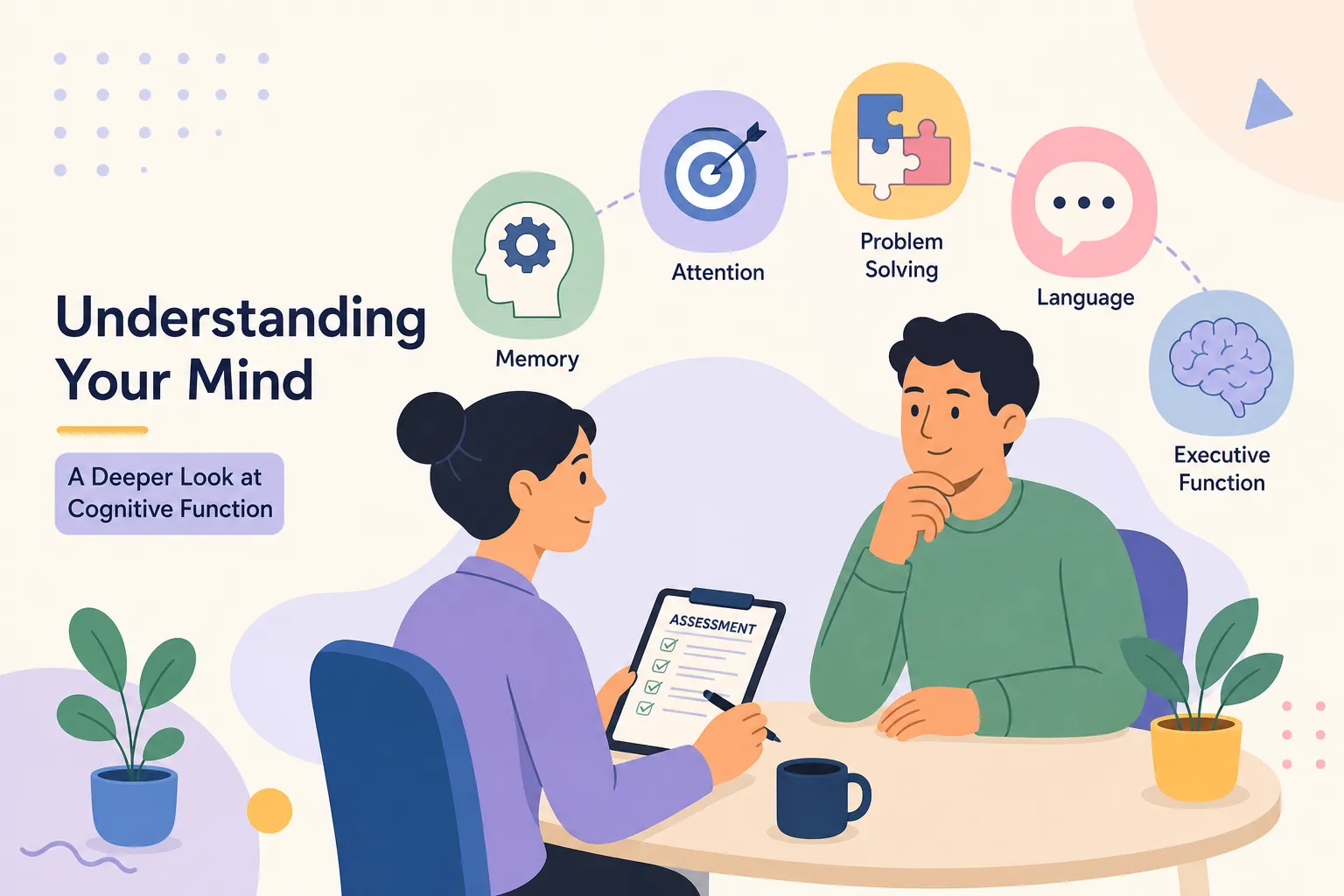
A full evaluation doesn’t measure one thing in isolation. It systematically maps multiple cognitive systems to build a complete picture of how your brain is functioning, where it’s strong, and where it’s working harder than it should have to.
Memory and learning capacity
Memory is often the first concern that brings adults to testing, and it’s more complex than most people realize. Clinicians assess working memory (holding information in mind for immediate use), episodic memory (recalling specific events and experiences), and semantic memory (general knowledge and factual information). Both verbal memory, such as recalling a list of words or a short story, and visual memory, such as remembering a figure or design, are tested separately because each relies on different neural systems.
Attention, concentration, and processing speed
Attention is not a single skill; it’s a family of related abilities. Sustained attention captures how long you can stay focused on a task, while selective attention reflects how well you filter out distractions and divided attention shows how you handle multiple inputs at once. These three subtypes are distinct enough clinically that each is assessed on its own terms. Processing speed, how quickly your brain moves through information, is also evaluated here. It can serve as an early indicator in certain conditions, including some presentations of dementia and traumatic brain injury, sometimes shifting before other cognitive changes become apparent.
Executive function and reasoning
Executive function is the brain’s management system. It governs planning, problem-solving, cognitive flexibility, impulse control, and the ability to shift between tasks. Deficits in this domain don’t always look like “forgetfulness.” They often show up as difficulty organizing a project, making decisions under pressure, or stopping an automatic response when the situation calls for a different one. These are skills that affect work performance, relationships, and daily life in ways that can be easy to misattribute to stress or personality.
Language ability and visuospatial skills: two domains people don’t expect
Most adults referred for neuropsychological testing expect memory and attention to be on the agenda. Fewer expect language and spatial reasoning. Both are assessed in every comprehensive battery because disruptions in either area can point to specific neurological patterns that other tests wouldn’t catch.
What language testing covers
Language evaluation separates expressive language, finding and producing words, from receptive language, which is understanding what’s said or written. The clinician also assesses verbal fluency and naming ability. Subtle word-finding difficulties, those moments when the right word sits just out of reach, may be an early sign of certain conditions such as primary progressive aphasia or some presentations of Alzheimer’s disease. That’s exactly why they’re measured carefully rather than dismissed as a normal part of aging.
Visuospatial and visuo-constructional abilities
Tasks in this domain involve drawing, assembling objects, and judging spatial relationships. These skills connect directly to everyday activities like driving, navigating a new neighborhood, and reading a map. Deficits in visuospatial processing tend to localize to specific regions of the brain, particularly right parietal lobe involvement, giving the neuropsychologist diagnostic information that memory tests alone can’t provide.
Emotional and psychological functioning: the piece most adults overlook
A common assumption is that neuropsychological testing is purely “brain-based”, a series of cognitive puzzles with no emotional component. That assumption leads people to be surprised when they’re asked about mood, anxiety, or how they’ve been feeling overall. The surprise makes sense, but the integration of emotional assessment into the evaluation isn’t incidental. It’s clinically essential.
Why mood and behavior are part of the assessment
Depression, anxiety, and emotional dysregulation directly affect cognitive performance. A person with untreated depression often shows memory and processing speed deficits that closely resemble early cognitive decline. If a clinician measures cognition without measuring mood, those results can be misread, and the wrong treatment path gets chosen. Including emotional functioning in the assessment ensures the findings reflect what’s actually happening rather than a confounded picture.
Separating psychiatric symptoms from neurological ones
One of the most valuable things neuropsychological testing does is help clinicians distinguish whether symptoms stem from a mood disorder, a neurological condition, or a combination of both. That distinction shapes the entire treatment plan. Someone whose concentration problems are driven by anxiety needs a different intervention than someone whose concentration problems are driven by early executive dysfunction. The evaluation is built to make that differentiation with precision.
The standardized tests used in neurocognitive testing
Adults who’ve been referred for testing often research specific test names beforehand. Here’s what the most commonly used assessments actually measure, explained in plain language. For a broad overview of neuropsychological testing, clinicians and patients often consult consolidated clinical resources that summarize common measures and their clinical uses.
The Wechsler battery: WAIS and WMS
The WAIS-IV (Wechsler Adult Intelligence Scale, Fourth Edition) is the backbone of most adult neuropsychological evaluations. It measures intellectual functioning across four areas: verbal comprehension, working memory, processing speed, and perceptual reasoning. The WMS-IV (Wechsler Memory Scale, Fourth Edition) pairs with it to drill deeper into verbal and visual memory through subtests that assess both immediate recall and delayed retention. Together, these two instruments cover a wide swath of cognitive territory and provide the normative foundation the rest of the battery builds on. Clinicians also sometimes include other standardized batteries such as the Neuropsychological Assessment Battery (NAB) depending on referral questions.
Trail Making, Stroop, and Boston Naming: what they add
Trail Making Test Part A measures attention and visual sequencing by asking the person to connect numbered dots in order. Part B adds executive demand by requiring the person to alternate between numbers and letters, measuring mental flexibility under cognitive load. The Stroop Test isolates inhibitory control: the person must name the color of ink a word is printed in rather than reading the word itself, which requires overriding an automatic response. The Boston Naming Test assesses word retrieval and naming ability, making it a direct window into the language deficits described earlier. These tests don’t duplicate the Wechsler battery; they sharpen and extend the picture it begins.
The main reasons adults are referred for neuropsychological testing
Referrals come from neurologists, psychiatrists, primary care doctors, and sometimes from individuals who recognize something has changed and want answers. The clinical scenarios vary widely, but several categories account for the majority of evaluations.
Memory concerns, aging, and dementia screening
Progressive memory concerns in older adults are the most common driver of neuropsychological referrals. The evaluation can distinguish normal age-related cognitive slowing from Mild Cognitive Impairment (MCI) and differentiate MCI from early dementia with strong diagnostic accuracy. A meta-analysis published in Neuropsychology Review found that neuropsychological testing can distinguish Alzheimer’s dementia from normal functioning with sensitivity rates approaching 90 percent when demographic adjustments are applied; see this recent review on diagnostic accuracy for more detail. Early identification matters because it changes the treatment trajectory, creates the opportunity for early intervention, and gives families the information they need to plan.
TBI, stroke, ADHD, and psychiatric differentiation
Adults with traumatic brain injury use neuropsychological testing to understand the lasting cognitive effects and guide rehabilitation. Stroke survivors are assessed for language changes, memory deficits, and functional impacts that imaging alone doesn’t fully capture. Adults pursuing an ADHD evaluation for the first time, particularly those who were never identified as children, use testing to confirm the diagnosis and rule out other explanations for their symptoms. Individuals whose psychiatrist or primary care doctor suspects a neurological component to otherwise psychiatric symptoms round out this group. No two evaluations look identical because no two presentations are identical.
What the appointment feels like and how results guide your care
Understanding what’s actually measured is half the picture. Knowing what to expect when you walk in for the evaluation makes the process far less daunting.
The clinical interview, testing session, and what to expect
The evaluation begins with an in-depth clinical intake interview conducted by the neuropsychologist. This covers your medical history, cognitive concerns, educational and work background, and emotional functioning. The structured testing battery follows, administered by a neuropsychologist or trained psychometrist. Tasks vary widely: drawing figures, solving puzzles, answering questions, completing written exercises, and working through computer-based tasks. A full evaluation typically runs six to seven hours, sometimes split across two sessions to accommodate stamina. There is no passing or failing. The goal is mapping your personal profile of strengths and challenges, not judging you against an arbitrary standard. For a clear, practical description of what happens during testing, see What Happens During Psychological Testing: A Clear Walkthrough, River North Counseling.
From the written report to real-life recommendations
After testing, a comprehensive written report is generated comparing your performance to age- and education-matched peers using standardized normative data. Scores are expressed as standard scores and percentiles, situating your results within the broader population in a way that’s clinically meaningful rather than arbitrary. The report translates those scores into specific recommendations covering treatment, accommodations, rehabilitation priorities, and follow-up monitoring. Neuropsych report interpretation is built into the process at River North Counseling: a clinician walks you through the findings in plain language, answers every question, and helps you connect your results to your daily life and next steps. The report isn’t a verdict handed to a referring doctor and filed away. It becomes a roadmap you can actually use. For more on what an evaluation reveals, review our overview: Neuropsych Testing for Adults: What the Evaluation Reveals.
What does a neuropsychological assessment test for in adults? Answers, not a label
The anxiety most people bring into this process comes from not knowing what to expect. Once that uncertainty lifts, the evaluation becomes something far less intimidating, a structured way to finally get clarity. The process is comprehensive by design because the brain is comprehensive. Measuring one domain in isolation misses the interactions between systems that tell the real clinical story.
If you’ve received a referral, or if you’re considering reaching out on your own, River North Counseling in Chicago offers comprehensive neuropsychological evaluations for adults across Chicagoland, with in-person appointments at our River North and Skokie offices and virtual options available across Illinois. Learn more about our local services and what to expect from a city-based evaluation at Neuropsychological Assessment in Chicago: What to Expect. Our team pairs rigorous, standardized assessment with a supportive debrief process that turns clinical data into something you can understand and act on.
Contact River North Counseling to learn more about our neuropsychological assessment services or to schedule a consultation. A thorough evaluation is designed to give you exactly that, not a label, but a clear picture of how your brain works and where to go from here.