
You set your keys down and then cannot find them ten minutes later. You reach for a word mid-sentence and it simply will not come. For most people, moments like these are fleeting and easy to dismiss. But when they start happening more often, the fear that follows is anything but small. You wonder whether this is just getting older, or whether it is something else entirely.
That uncertainty is one of the hardest parts. Not the forgetting itself, but not knowing what the forgetting means. Understanding how neuropsychological assessment helps with memory and cognitive concerns is where that uncertainty begins to lift. A comprehensive neuropsychological evaluation is not a brain scan, and it is not a short quiz. It is a structured, evidence-based process that maps how your cognitive system is actually functioning across multiple domains, then compares those results against validated norms for your age and education level. Adults across Chicagoland are turning to specialists at practices like River North Counseling to get exactly that kind of clarity.
This article walks you through what a neuropsychological assessment actually tests, what conditions it can identify beyond dementia, how results distinguish normal aging from mild cognitive impairment or early dementia, and what changes once you have your findings in hand. You will also find practical guidance on how to prepare and how to find the right evaluator.
How neuropsychological assessment helps with memory and cognitive concerns
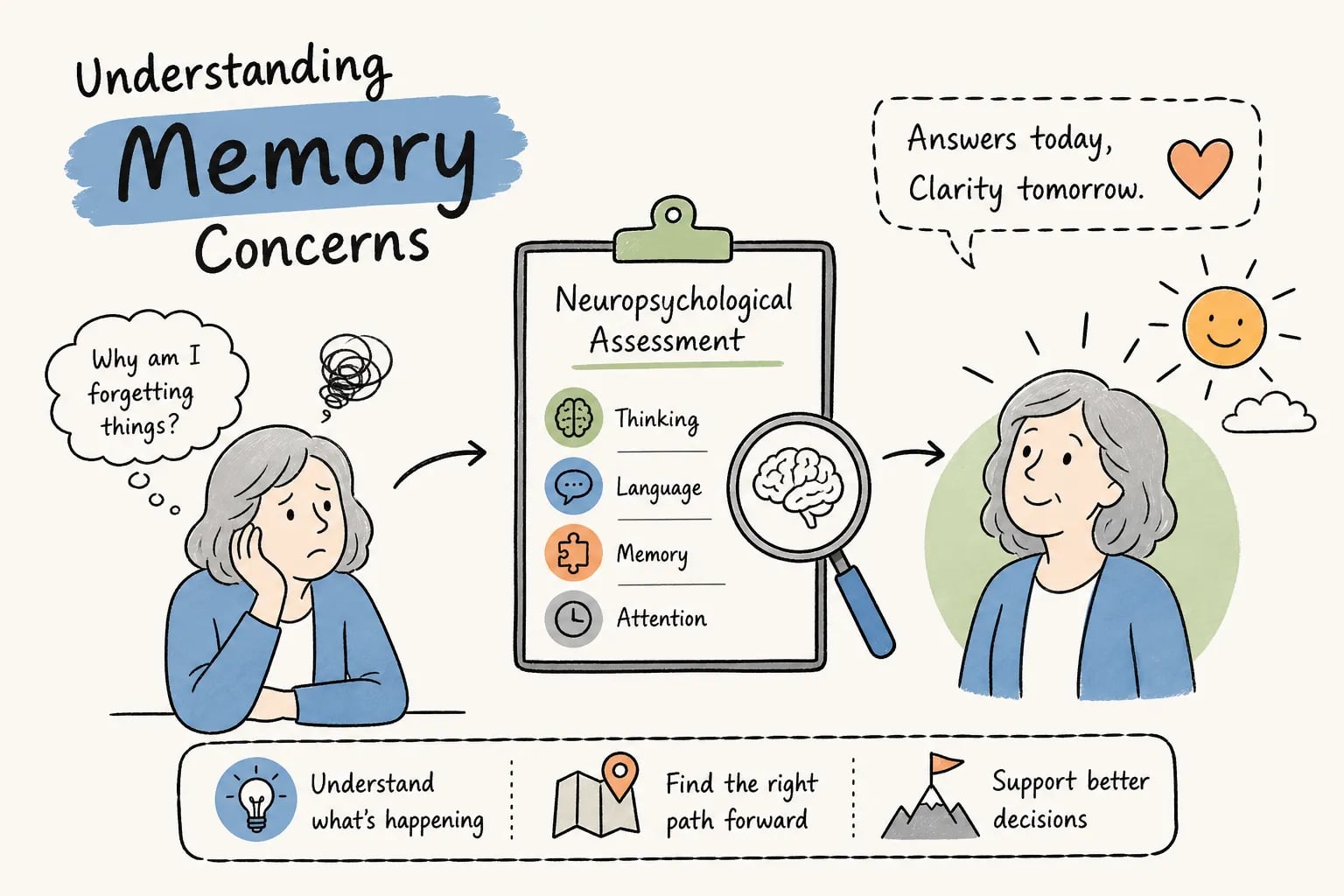
Most people expect either a brain scan or a quick memory quiz. The reality is far more detailed than either. A full neuropsychological evaluation maps multiple cognitive systems simultaneously, creating a profile of where your brain is performing as expected and where it is not. Knowing how neuropsychological assessment helps with memory and cognitive concerns starts with understanding the scope of what that testing actually covers.
The cognitive domains covered in a full evaluation
A comprehensive battery assesses memory, attention and concentration, language ability, processing speed, visuospatial skills, and executive function. Attention measures capture how well you sustain focus and resist distraction. Language testing looks at naming, fluency, and comprehension. Processing speed reflects how quickly your brain handles incoming information, and slowing here often shows up before other symptoms do. Visuospatial skills assess your ability to perceive and organize visual information, which matters for tasks like navigating or reading maps. Executive function covers planning, reasoning, cognitive flexibility, and impulse control.
Each domain matters because different diseases and conditions affect different systems. A pattern of isolated memory loss with intact executive function tells a very different story than a pattern of slowed processing across the board.
How memory itself is broken down
Memory is not one thing, and a skilled neuropsychologist does not treat it as one. Neurocognitive testing distinguishes episodic memory (your personal experiences and events), semantic memory (general knowledge and language), and working memory (holding information briefly while you use it). Beyond those categories, testing also separates how well you learn new information from how well you retain it after a delay. That delay-based distinction is clinically important: Alzheimer’s disease tends to disrupt storage itself, while other conditions may impair initial learning but leave retention relatively intact once information is encoded.
Why mood and personality are part of the picture
Standardized mood and personality questionnaires are routinely included in a comprehensive evaluation, and there is a strong clinical reason for that. Depression and anxiety can produce memory complaints that look strikingly similar to early cognitive decline on the surface. Someone who is significantly depressed may perform poorly on memory tasks not because neurons are degenerating but because their attention and motivation are profoundly affected. Measuring emotional health alongside cognitive performance is part of what separates a full neuropsychological evaluation from a basic cognitive screening tool.
Memory concerns that are not always caused by dementia
Fear is the engine behind most searches about memory loss. People assume the worst. But a significant portion of adults who seek evaluation discover that their memory concerns have a cause that is fully or largely treatable.
Common reversible causes that mimic memory loss
Depression, generalized anxiety, chronic poor sleep, and obstructive sleep apnea can all produce noticeable memory complaints. So can thyroid dysfunction and vitamin B12 deficiency. Certain medications are also worth flagging: benzodiazepines, anticholinergics, some pain medications, and certain antiepileptics have all been associated with cognitive side effects. The memory problems feel completely real, and they are. But the origin may have nothing to do with neurodegeneration. Once the underlying cause is identified and addressed, cognitive function often improves substantially. Getting evaluated is not just about ruling in a diagnosis. It is equally about ruling out causes that respond well to treatment.
How the pattern of test results reveals the actual cause
An experienced neuropsychologist does not simply look at whether scores are low. They examine which functions are impaired, how severely, and in what combination. Depression-related cognitive symptoms typically show inconsistent effort, notably slowed processing speed, and a pattern where recognition memory is relatively better preserved than free recall. Medication or sleep-related impairment tends to look like fluctuating attention and inefficient learning rather than a clear failure to retain information once it is stored. These profiles are meaningfully different, and distinguishing between them is something a five-minute screening at a primary care visit simply cannot do.
How neuropsychological assessment helps separate normal aging, MCI, and early dementia
This is the question behind most searches on this topic. People want to know whether testing can actually tell them whether what they are experiencing is serious. The honest answer is: yes, with important nuance about the harder boundaries.
What normal cognitive aging actually looks like on testing
Some slowing in processing speed and occasional word-finding lapses are expected across adulthood. They are not signs of disease. Neuropsychological data is compared against age- and education-matched norms, which makes clear whether your scores fall within the expected range for someone with your background. This is why formal testing is far more reliable than comparing yourself to how you performed at 35, or measuring yourself against a younger sibling. Norms exist precisely to account for those variables.
The boundary between MCI and early dementia, and why it matters
Distinguishing mild cognitive impairment from early dementia is the most challenging diagnostic call in this field. Mild cognitive impairment refers to measurable decline that does not yet significantly interfere with independent daily functioning. Early dementia crosses that threshold. A comprehensive neuropsychological battery is more informative than a single screener at this boundary because it samples multiple domains and generates a richer profile of impairment. A 2020 review in Neuropsychology Review found that comprehensive neuropsychological batteries consistently outperformed brief screening tools, including the MMSE, at detecting early and subtle cognitive decline. Even so, no evaluation can perfectly separate MCI from early dementia in every case, since the two conditions exist on a continuum.
What early identification of MCI does allow, regardless of that challenge, is monitoring over time, lifestyle interventions that may slow progression, medical planning, and meaningful family conversations while the person at the center of those conversations can still participate fully in them.
Why comprehensive neuropsychological testing outperforms a quick memory screen
Brief tools like the MoCA or MMSE are useful starting points in primary care, but they sample only a narrow slice of cognition. A full neuropsychological battery covering six or more domains provides a much richer clinical picture, improves diagnostic confidence, and is especially critical when concerns are subtle or when the referring physician is uncertain about staging. Clinical evidence consistently favors comprehensive memory assessment over brief screening tools for early or ambiguous presentations, making the full evaluation the more defensible choice when stakes are high.
What changes after your evaluation results come in
A neuropsychological evaluation is not just a diagnostic label. It is a clinical roadmap that redirects care in concrete, practical ways. Understanding how a neuropsychological assessment helps with memory and cognitive concerns becomes most tangible at this stage, when findings translate directly into action.
How results reshape diagnosis and treatment plans
A finding that memory problems stem from depression rather than neurodegeneration leads to a fundamentally different care plan than an early Alzheimer’s pattern would. Results guide whether treatment should focus on psychotherapy, medication review, sleep medicine, cognitive rehabilitation, speech therapy, occupational therapy, or some combination of these. When the cause turns out to be reversible, knowing that changes everything about the path forward. When the cause is neurodegenerative, having a baseline established early allows for meaningful monitoring of change over time, which shapes both clinical decisions and family planning.
Functional decisions and care planning that follow
Results also inform the practical life decisions that families are often quietly worried about. Is it still safe to drive? Are workplace accommodations warranted? What level of daily living support might be appropriate? For families managing a loved one’s cognitive decline, the feedback session with the neuropsychologist often provides the language and framework they have been missing for months. Having a clinician name what they are observing, explain what it means, and map out what comes next brings a kind of relief that no amount of online searching can replicate.
What the evaluation process looks like and how to prepare
Fear of the unknown keeps some people from seeking evaluation longer than it should. Understanding the process removes that barrier.
The timeline and structure of a typical evaluation
A comprehensive evaluation typically involves four to eight hours of direct testing, sometimes divided across two sessions to account for stamina. The process begins with a detailed intake interview covering medical history, current medications, and the specific concerns that brought you in. From there, standardized tests are administered in a structured sequence, with breaks built in at regular intervals. After scoring and interpretation, the neuropsychologist meets with you and, when appropriate, family members, for a dedicated feedback session reviewing findings and specific recommendations. That feedback session is not a formality. It is where the clinical picture becomes actionable.
How to prepare so results are as accurate as possible
Sleep well the night before, eat a meal before your appointment, and take your prescribed medications as usual unless the evaluating neuropsychologist gives you different instructions. Bring your glasses or hearing aids if you use them, and bring a current medication list. If the clinic sends questionnaires in advance, complete them before arriving.
One preparation mistake is worth flagging specifically: you cannot study for a neuropsychological evaluation. The assessment is designed to measure your current cognitive functioning as it actually is. Memorizing lists or practicing puzzles beforehand does not help your scores, and it may actually obscure the real clinical picture the neuropsychologist is trying to see. Come rested, come fed, and come as you are.
Getting answers in Chicago: finding the right evaluator
Knowing you want an evaluation and knowing how to find the right one are two different things. Not all cognitive assessments are created equal, and the qualifications of the person administering the testing matter significantly.
What to look for in a qualified neuropsychologist
A neuropsychological evaluation should be conducted by a licensed psychologist with specialized training in neuropsychology, not a brief cognitive screen administered by a nurse or medical aide. The evaluator should use validated, standardized test batteries, produce a written report, and offer a dedicated feedback session where results are reviewed in plain language. When you contact a practice, ask about the evaluator’s specific experience with adult cognitive concerns. Experience with pediatric neuropsychology or traumatic brain injury is valuable, but you want someone with direct experience in the adult cognitive aging and memory space.
Starting the process at River North Counseling in Chicago
River North Counseling offers neuropsychological assessment services for adults navigating cognitive health concerns, with in-person availability at their River North and Skokie locations and virtual options across Illinois. The licensed team conducts structured, comprehensive evaluations and delivers findings through a dedicated feedback session designed to translate clinical data into plain-language recommendations you can act on. If you are unsure whether a full evaluation is the right next step, reaching out to discuss your specific concerns is a low-pressure starting point. The goal is to help you figure out what makes sense for your situation, not to push you toward a service you do not need.
The clearest path from worry to understanding
Worrying about memory and thinking changes is not dramatic. It is a reasonable response to a real experience, and it deserves a real answer. How neuropsychological assessment helps with memory and cognitive concerns comes down to this: it replaces uncertainty with a clear, evidence-based picture of what is actually happening in your cognitive system, whether the cause is treatable, and what the appropriate next steps are.
Not knowing is harder than knowing. The evaluation process takes time, but what it produces is worth having: a specific, individualized clinical picture that removes guesswork from a situation where guesswork is doing no one any good.
If you or someone you love is experiencing concerning changes in memory or thinking, River North Counseling’s assessment team in Chicago is ready to help you get the answers you need. Reach out to start the conversation.