
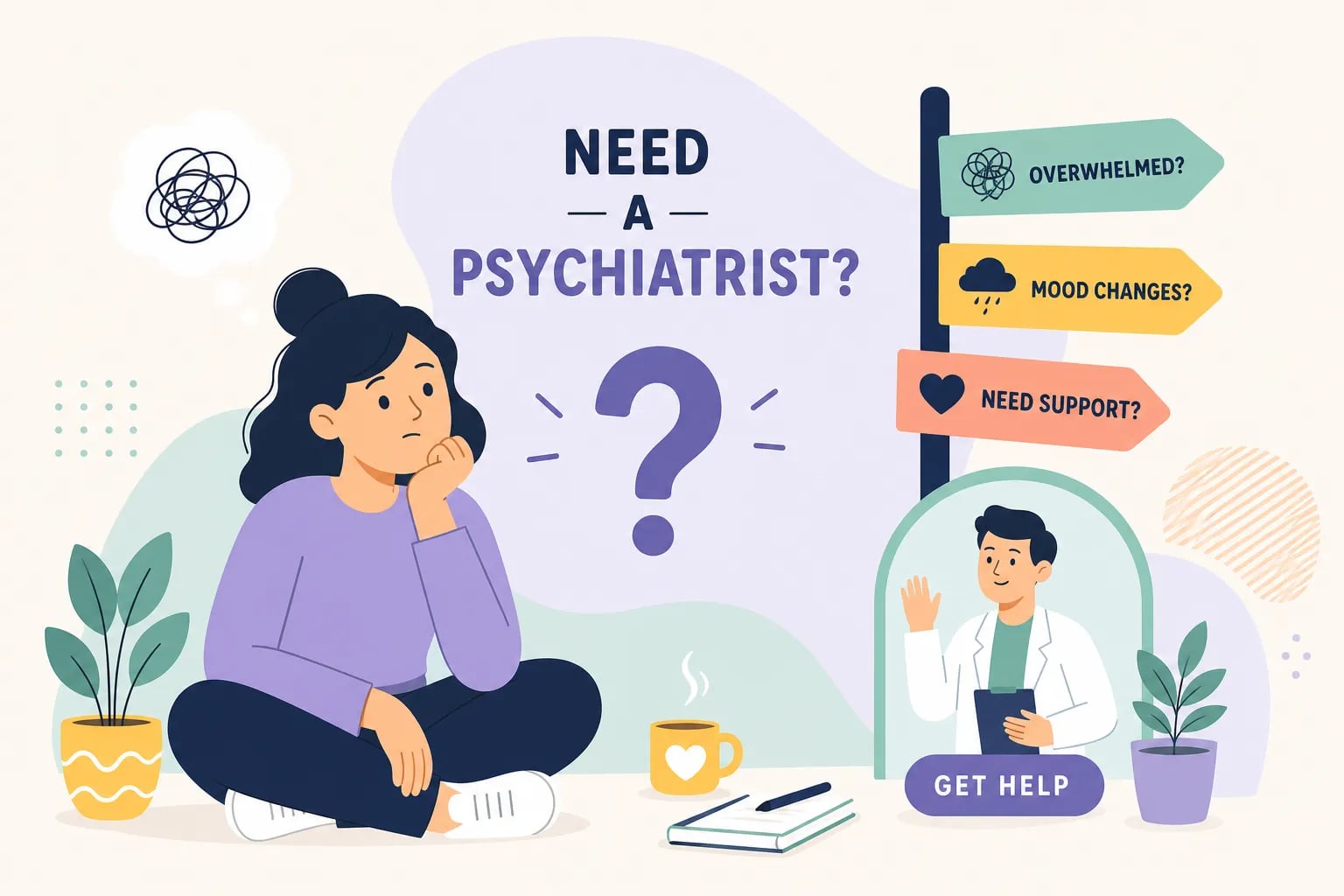
If you’re asking yourself, “Do I need a psychiatrist?”, you’re not alone. Most people who finally decide to get help find themselves standing at the first fork in the road, staring at two signs: “psychiatrist” and “therapist.” Maybe someone mentioned a psychologist too. You’re not sure which direction applies to you, and the uncertainty itself starts to feel like another reason to wait. Many people get stuck exactly here, and that indecision can delay care far longer than the actual process of finding the right provider ever would.
At River North Counseling in Chicago, this question comes up regularly. People walk in unsure whether they need medication, talk therapy, a formal diagnosis, or some combination of all three. That uncertainty is understandable, the mental health system doesn’t explain itself well. This article will clear that up. You’ll learn what separates each type of provider, which symptoms point toward a psychiatric evaluation, when starting with a therapist makes more sense, what the evidence says about medication, and what to do if the situation is urgent.
What actually separates a psychiatrist from a therapist (and a psychologist)
Most people use these three terms interchangeably, and that’s exactly where the confusion starts. Each role carries a distinct scope of practice, a different level of training, and a different set of services. Understanding those distinctions is the most practical first step toward knowing which door to walk through.
A psychiatrist is a medical doctor, either an MD or DO, who completed medical school followed by a psychiatry residency. That medical training is the critical distinction: psychiatrists can prescribe medication, order lab work, and approach mental health through a full clinical and biological lens. A psychologist holds doctoral-level training, typically a PhD, PsyD, or EdD, and specializes in psychological testing, formal assessment, and evidence-based therapies like CBT. In almost all states, psychologists do not prescribe medication, though a small number of states have granted limited prescribing authority to psychologists who complete additional specialized training. A licensed therapist, which includes licensed clinical social workers, licensed counselors, and marriage and family therapists, holds a master’s degree and provides talk therapy and counseling support. They do not prescribe medication or conduct formal neuropsychological assessments.
A shorthand that holds up in practice: psychiatrists prescribe, psychologists assess and provide therapy, and licensed therapists counsel. Psychiatrists do sometimes provide therapy, but most focus primarily on medication management and diagnostic evaluation. The most effective care model often pairs a psychiatrist with a therapist, letting each provider do what they do best. The right starting point depends entirely on what you’re experiencing, not on which title sounds more serious.
Do I need a psychiatrist? Signs that point toward seeing one first
There are specific clinical situations where a psychiatric evaluation should come before, or alongside, therapy. These aren’t reasons to panic, they’re reasons to be strategic about where you start so you get the right kind of help without delay.
Psychosis, severe mood swings, and significant functional impairment
The clearest indicators include hallucinations, hearing voices or seeing things others cannot see, as well as paranoia or a persistent sense of disconnection from reality. Extreme mood cycling, characterized by very high energy and a decreased need for sleep followed by significant crashes, also warrants psychiatric attention, as does an inability to function at work, school, or in basic self-care. Marked changes in personality, judgment, or behavior without a clear external cause merit medical evaluation, as does severe or poorly controlled substance use, particularly when it runs alongside mood or anxiety symptoms.
When prior therapy hasn’t helped
If you’ve already been in therapy for several months with little measurable improvement, that’s a meaningful signal too. Conditions like severe OCD, bipolar disorder, and schizophrenia typically require medication as a foundation, therapy alone for these conditions is not an evidence-based approach, and a psychiatrist can evaluate whether a biological component is being left unaddressed. Some people also pursue therapy for years without a clear diagnosis. A formal psychiatric or psychological evaluation can provide diagnostic clarity that changes the entire course of treatment. That’s not about labeling anyone. It’s about precision.
When starting with a licensed therapist makes complete sense
Seeing a psychiatrist first is not the default path for most people. For a wide range of experiences, starting with a licensed therapist is not only appropriate but often the most effective move. And if a referral to a psychiatrist becomes necessary, a skilled therapist will identify that and help you make the transition.
Therapy is typically the strong first move for mild to moderate anxiety or depression, grief and major life transitions, work burnout and chronic stress, past trauma without current psychosis or severe functional impairment, and relationship or communication challenges. These are the experiences that respond well to talk therapy, skill-building, and the relational foundation that a good therapeutic relationship provides.
At River North Counseling, clients often start with a licensed therapist because that first therapeutic relationship becomes the navigation point for figuring out what’s really going on. A skilled therapist tracks patterns over time, monitors symptom trajectory, and can recognize when a psychiatric referral makes sense. When that happens, the therapist facilitates the transition directly rather than leaving the client to find their own way.
What that path actually looks like: an initial intake session, a collaborative review of history and current symptoms, a working treatment plan, and regular assessment of progress. If medication becomes relevant, the therapist coordinates with a prescriber. Starting with a therapist is a legitimate, well-supported entry point into care, and it’s often faster than waiting for a psychiatric appointment. The process is iterative. You don’t need to get it exactly right on day one.
Medication vs. therapy: what the evidence actually says
The medication versus therapy question isn’t a competition. The right answer depends almost entirely on the diagnosis and the severity of symptoms.
For major depressive disorder, both psychotherapy and medication are effective for mild to moderate cases. For moderate to severe depression, combined treatment consistently outperforms either approach alone. Research, including a widely cited meta-analysis by Cuijpers and colleagues, has found that combining psychotherapy with medication produces roughly 25% higher response rates than medication alone and about 27% higher response rates than psychotherapy alone. For anxiety disorders, CBT is often considered a first-line treatment, and research does not consistently show that adding medication significantly improves outcomes over therapy alone, though combined approaches remain appropriate when symptoms are severe or persistent.
For bipolar disorder and schizophrenia, medication is not optional. Mood stabilizers and antipsychotics form the treatment foundation for both conditions, with psychotherapy added as an adjunct to improve functioning, support medication adherence, and assist family systems. Therapy without medication for these conditions is not supported by the evidence base.
The more useful framing isn’t medication or therapy. It’s: which provider should I start with, and what does a responsible treatment plan look like for my specific situation? For many conditions, particularly moderate to severe depression, combined care is both common and well-supported by the evidence.
Red flags that require immediate action, not a scheduled appointment
Some situations fall outside the outpatient decision-making process entirely. These are psychiatric emergencies. The steps below apply when someone is in active crisis, not to the earlier clinical warning signs described above.
The urgent indicators include active suicidal ideation with a specific plan or intent; access to lethal means combined with intent, such as stockpiling medication or access to firearms; commands to harm yourself or others; active psychosis with unsafe behavior; and severe self-neglect, not eating, not drinking, or being unable to perform basic self-care. Escalating agitation, rapid functional deterioration, and preparatory behavior like giving away possessions or writing goodbye notes also require an immediate response.
When any of these are present, the response is direct: do not leave the person alone; remove or secure lethal means if you can do so safely; call 988, the Suicide and Crisis Lifeline, for urgent situations that haven’t yet become a physical emergency; go to the nearest emergency department if someone has attempted to harm themselves or is actively unsafe; and use SAMHSA’s crisis locator at findtreatment.gov to search for local mobile crisis teams (verify services directly with listed facilities, as the locator does not filter by psychiatric specialty). Speak calmly, ask direct questions about safety, and do not argue with delusional thinking.
The distinction between urgent and emergent matters. Passive ideation without a specific plan, or significant functional impairment without active risk, may call for a same-day or next-day outpatient psychiatric evaluation. Active suicidal intent with a specific plan, access to means, or psychosis with unsafe behavior requires emergency intervention, not a scheduled appointment next week.
Practical next steps to find the right care
Finding the right provider is more manageable than most people expect. Here’s how to actually do it.
To find a psychiatrist, start with the member services number on your insurance card and ask for in-network psychiatrists who are accepting new patients. Your primary care doctor is another strong resource: many PCPs provide interim medication management while you wait for a specialist appointment and can offer a direct referral that speeds up the intake process. SAMHSA’s national treatment locator at findtreatment.gov lets you search by location, care type, and payment method, including Medicaid, Medicare, private insurance, and sliding-scale options. If in-person wait times are long, some telepsychiatry platforms offer faster access, and some accept insurance, check directly with each platform to confirm coverage.
These questions can help you screen any provider before your first appointment:
- Are you accepting new patients?
- Are you in-network with my insurance?
- Do you have experience treating my specific symptoms or condition?
- How do you coordinate care with a therapist or primary care doctor?
- What does the first appointment include, and what should I bring?
For readers in Chicago or the greater Chicagoland area who still aren’t sure where to begin, River North Counseling offers a clear starting point. With licensed therapists at offices in River North and Skokie, as well as virtual sessions available across Illinois, the practice serves people who don’t yet know whether they need a psychiatrist, a therapist, or both. An initial session with a licensed therapist can clarify the clinical picture, build a treatment plan, and, when appropriate, facilitate a warm referral to a psychiatric provider. You don’t need to have it all figured out before you reach out.
When to see a psychiatrist vs. a therapist: the decision doesn’t have to be perfect
If you’re still wondering, “Do I need a psychiatrist?”, that uncertainty is normal, and it’s not a reason to wait. Most people don’t know the right answer before they start, and that’s completely fine. The care system is designed to adjust. What matters is making the first move rather than holding out for perfect clarity.
Here’s a quick summary of what this article covered: severe symptoms, a possible medication need, and diagnostic uncertainty point toward a psychiatric evaluation. Emotional, relational, and mild-to-moderate clinical presentations often point toward starting with a licensed therapist. Crisis situations, including active suicidal ideation or psychosis with unsafe behavior, require immediate action rather than a scheduled appointment. In every case, collaboration between providers tends to produce better outcomes than either route alone.
If you’re in Chicago and ready to take that first step, reach out to River North Counseling. The first call doesn’t unlock the entire path. It just starts it.