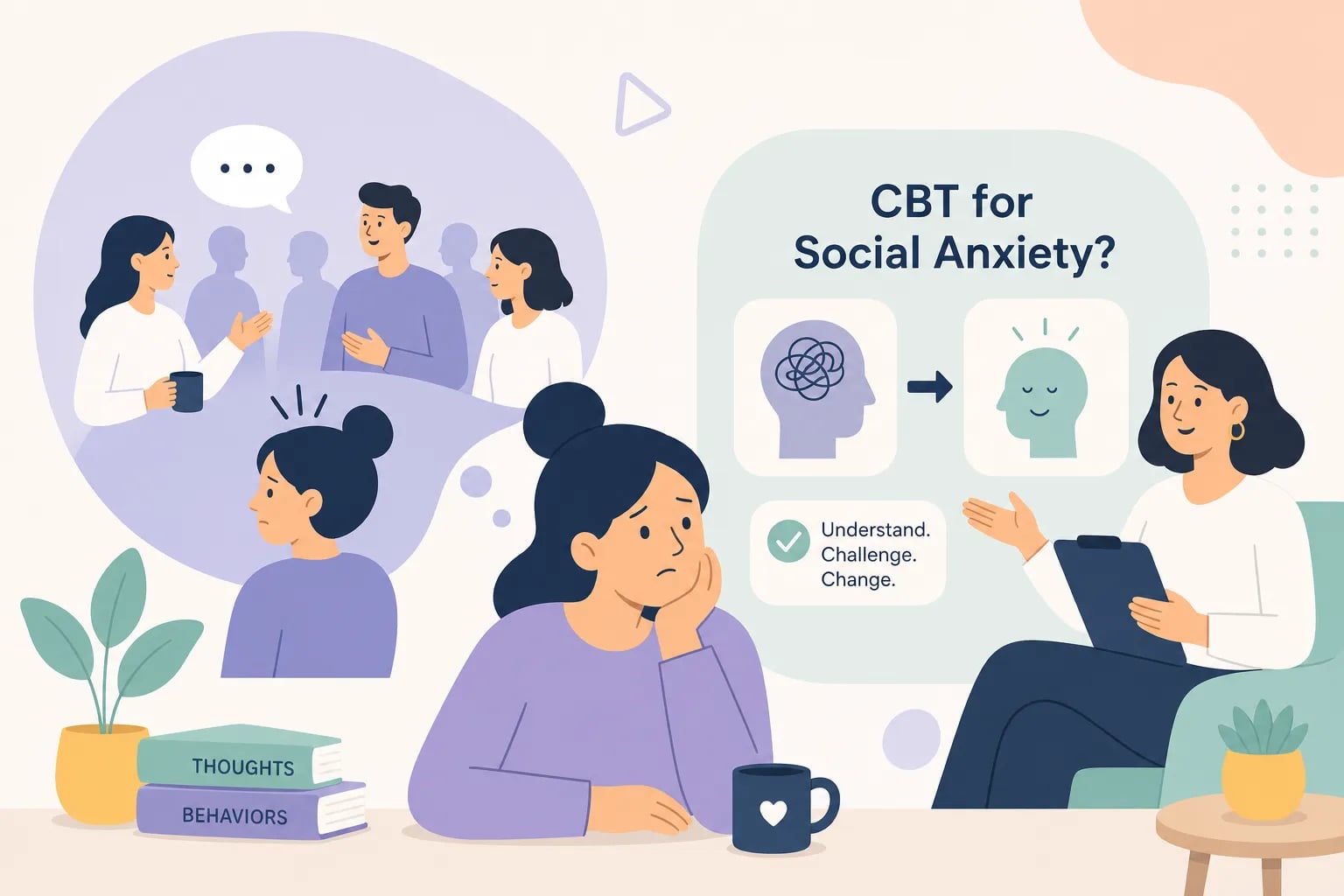

Two licensed therapists, equally experienced and well-intentioned, can look at the same depression diagnosis and recommend entirely different treatments. One says CBT. The other recommends a more exploratory approach. The frustrating part is that both are working from legitimate clinical reasoning. What separates one recommendation from the other is not guesswork but the specific picture your depression presents: how long it has lasted, how severe it is, what is driving it, and what you actually need from the process of getting better.
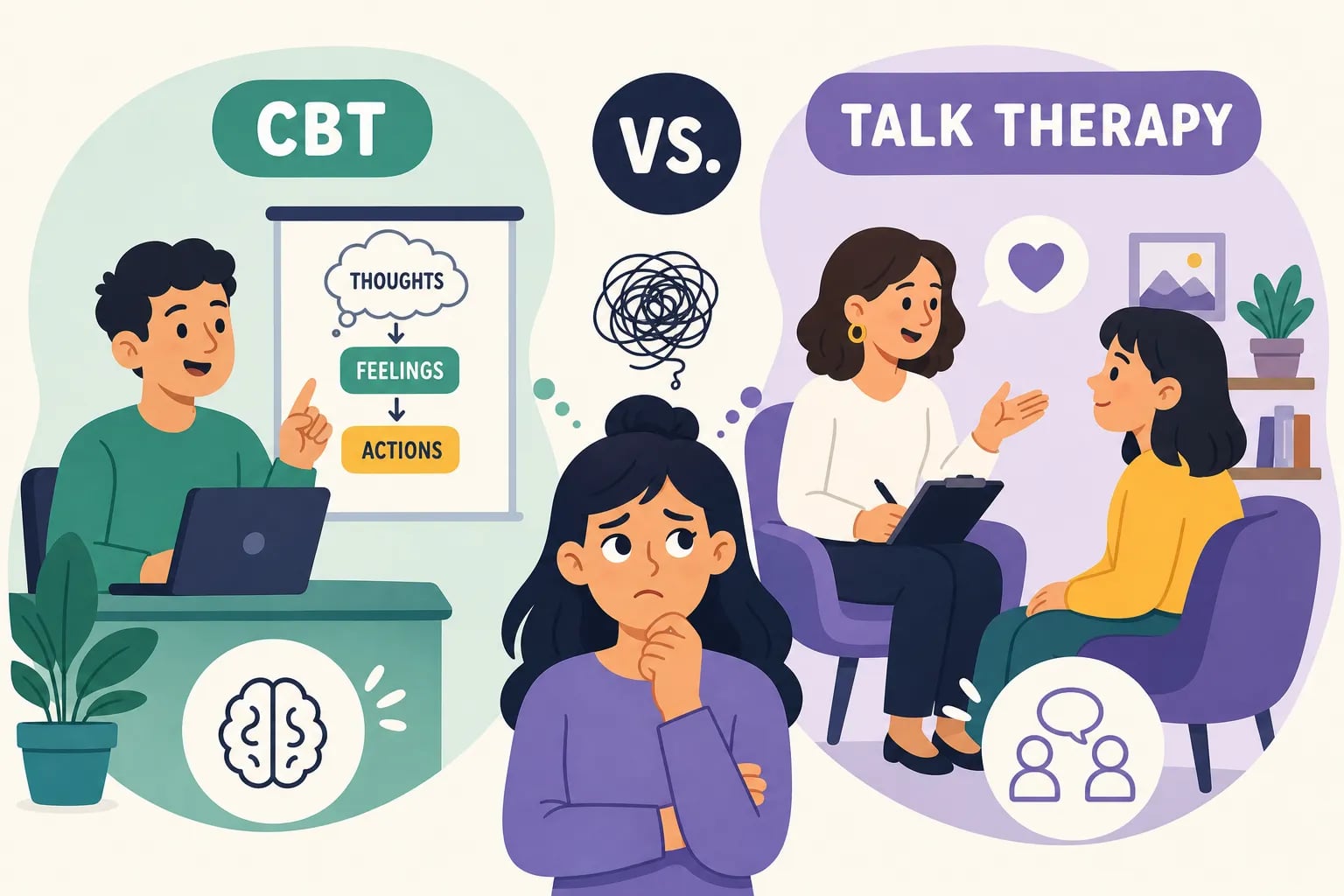
CBT (cognitive behavioral therapy) is structured, skill-based, and time-limited. Open-ended talk therapy, sometimes called supportive or psychodynamic therapy, is exploratory, relational, and built around understanding rather than technique. Each has a legitimate evidence base and genuine clinical utility. But the research does distinguish between them, and those distinctions matter when you are trying to choose a path forward.
At River North Counseling, a Chicago-based group practice, clinicians offer both CBT and other evidence-based approaches for depression. Matching the method to the client’s specific presentation is built into how they work from the start. This article walks through what the research actually shows, what each approach looks and feels like in practice, and what questions to ask to find the right fit for your own situation.
What the evidence actually shows about CBT vs. talk therapy
The research on psychotherapy for depression is substantial, and the overall picture is more nuanced than most summaries suggest. CBT has been studied extensively in randomized controlled trials and is well-supported for major depressive disorder, with a clear medium effect size versus inactive controls. When researchers pool these trials, CBT produces roughly 42% response and 36% remission compared to 19% and 15% respectively in control conditions, figures drawn from large meta-analytic syntheses of pooled trial data. Those numbers are meaningful, even if they also reflect that no therapy produces remission for everyone.
When researchers compare psychotherapies head-to-head in network meta-analyses, most active approaches perform similarly. CBT, behavioral activation, interpersonal therapy, and problem-solving therapy all tend to cluster together in efficacy, a pattern consistently reported across several large network meta-analytic reviews. There is one notable exception: nondirective supportive counseling repeatedly underperforms compared to every other psychotherapy studied. In the most comprehensive network meta-analyses of depression treatments, supportive-nondirective therapy was the clear outlier, less effective than all other therapies included, with a comparative effect size of roughly -0.29 favoring CBT in pooled direct comparisons.
This distinction matters because “talk therapy” is not one thing. It is a broad category that includes psychodynamic therapy, interpersonal therapy, supportive counseling, and more. The research does not indict all exploratory therapy. It specifically flags nondirective supportive counseling as weaker than alternatives. When you hear that CBT and talk therapy perform similarly, the accurate version of that claim is that CBT and other bona fide psychotherapies tend to perform similarly, with supportive-nondirective approaches as a notable exception.
Severity also shapes outcomes in ways worth understanding directly. In clinical subgroup analyses, moderately depressed patients receiving CBT achieved remission at a rate of roughly 40%. That number dropped to around 27.5% for severely depressed patients. More severe depression is harder to treat with therapy alone, and those numbers should inform conversations about whether adding medication makes sense.
How CBT and traditional talk therapy actually differ in practice
A CBT session has a structure you can count on. Sessions typically open by reviewing homework from the previous week, then move into identifying specific thought patterns or behaviors that are sustaining the depression. The therapist is active and directive, not just reflective. You might map out a thought record, practice a behavioral activation strategy, or work through a feared situation in a systematic way. Before the session ends, you get an assignment for the week ahead. Progress is tracked, often with standardized symptom measures, so both you and your therapist can see whether things are moving.
Open-ended talk therapy works differently. Many exploratory formats do not prescribe homework or a fixed endpoint, though practices vary across therapists and some structured relational modalities do include agreed timeframes or specific tasks. Sessions are typically driven by what you bring. The therapist tends to be more reflective than instructive, following your lead rather than directing the conversation toward a predefined goal. The purpose is not symptom reduction through technique but something deeper: understanding recurring patterns, the emotional logic of your relationships, how your history shapes your present. Some people find this approach profoundly useful. Others find it frustrating when they want tools and a timeline.
Both approaches value the therapeutic relationship, but they use it differently. In CBT, the relationship is the foundation that makes structured work possible. You need to trust your therapist enough to be honest about your thoughts and willing to try the techniques they recommend. In talk therapy, the relationship itself is often the primary vehicle for change. How you relate to your therapist, what patterns emerge, and what becomes possible in that space is the treatment. For some people, that relational depth is exactly what they need. For others, it is not.
Timeline: how quickly you can expect to see results
CBT is explicitly time-limited. Most structured protocols run 12 to 16 weekly sessions, with the full range spanning roughly 8 to 20 sessions depending on severity and complexity, a range documented across multiple CBT protocol studies and meta-analytic summaries. Many people begin noticing meaningful improvement within the first 4 to 8 sessions. That predictability is a real practical advantage: you know approximately what you are signing up for, and progress is measurable enough that both you and your therapist can assess whether the approach is working.
Open-ended therapy has no standard session count because it is not designed around one. Improvement tends to be more gradual and less tied to a symptom-reduction timeline. For some presentations, that slower arc of change is appropriate. The work is more complex, the goals are less specific, and meaningful change in how someone understands themselves or relates to others does not fit neatly into a 12-week arc. But for someone in the middle of an acute depressive episode who wants structure and measurable movement, the open-ended format can feel like a mismatch.
When you are already struggling with depression, time is not abstract. A structured, shorter-term approach that produces measurable improvement within weeks can build momentum and restore a sense of agency. To be clear, this is not an argument against open-ended therapy in every case. It is a reason to match the format to the clinical picture, factoring in chronicity, severity, and what the person can realistically engage with week to week, rather than defaulting to personal preference alone.
Who each approach is actually suited for
CBT tends to fit best when the depression is relatively acute and identifiable, when there is not decades of complex relational history woven into the symptom picture. If you are comfortable with structure, willing to do homework, and looking for practical coping tools you can use between sessions, CBT is likely to feel like a good match. It also tends to work well when the problem is circumscribed: a clear depressive episode, perhaps with specific cognitive patterns that are driving it, rather than something chronic and deeply embedded in how you have always experienced yourself and your relationships.
Talk therapy is a better fit for a different kind of presentation. If your depression is long-standing, if it feels woven into your identity or your relationships rather than like a discrete episode, if emotional exploration and relational understanding feel more relevant to you than symptom checklists, open-ended therapy may serve you better. People who find CBT’s structure rigid or anxiety-provoking, or who have difficulty with between-session homework, also tend to engage more readily with a less directive approach. Those with cognitive or learning difficulties may find the techniques involved in CBT harder to implement, making supportive therapy a more accessible starting point.
Common clinical realities add another layer. If anxiety is comorbid with depression but well-defined, like panic disorder or social phobia, CBT is usually the stronger pick. If the anxiety is diffuse, chronic, and tied to relational patterns or identity, a more exploratory approach often serves better. Personality features that suggest a need for relational or identity-level work typically point toward longer-term therapy rather than a short CBT course, regardless of the depression diagnosis attached.
When combining therapy with medication is worth considering
The combination of CBT and antidepressant medication tends to outperform medication alone. In a large randomized trial, the combined approach produced a recovery rate of 72.6% compared to 62.5% for medication alone, with the strongest advantage seen in people with severe, nonchronic depression. Network meta-analyses reinforce this pattern, finding that combined treatment outperforms both psychotherapy alone and pharmacotherapy alone for end-of-treatment response, with response ratios around 1.25 to 1.27 favoring the combination.
For mild-to-moderate depression, therapy alone, particularly CBT, is often sufficient, a conclusion reflected in clinical guidelines and meta-analytic reviews that recommend psychotherapy as a first-line option at lower severity levels. The case for adding medication becomes stronger as severity increases, especially when someone is struggling to engage meaningfully in therapy at all. When depression is severe enough to make concentration, motivation, and session-to-session follow-through genuinely difficult, medication can lower the floor enough to make the therapy more effective. The picture is less clear when comparing CBT plus medication against CBT alone: some analyses find no consistent additional benefit from adding medication to a solid CBT course.
The decision to add medication should involve a prescriber and usually evolves as treatment progresses rather than being locked in from the start. The most useful frame is not therapy versus medication as competing choices but as different mechanisms that can work together. A therapist can help you think through what makes sense for your situation and connect you with a prescriber if that conversation becomes relevant.
How to choose the right path for your depression
A few concrete questions can help clarify which direction fits your situation. Do you want a structured approach with homework and skill-building, or do you want open space to explore? How long have you been dealing with this? Months, or most of your life? Is this a specific episode or something that has always been part of how you experience yourself? How severe are your symptoms right now? Are you open to medication as well, or do you want to start with therapy alone? These are not tests with right or wrong answers. They are tools for starting a better conversation with a clinician who can assess your full picture.
The either/or framing of CBT versus talk therapy is also worth questioning. Most people do not need to make an abstract choice between modalities before they have ever spoken to a therapist. A clinician trained across multiple approaches will assess severity, chronicity, client preference, and prior treatment history before recommending a direction. What matters more than the label on the therapy is whether the approach matches your clinical picture and whether you can actually engage with it week after week.
Clinicians at River North Counseling work to surface these distinctions early in the intake conversation. Their licensed therapists are trained across multiple approaches, including CBT and more exploratory relational therapies, and the goal from the first conversation is to understand your specific presentation rather than fit you into a one-size-fits-all slot. Whether you need the structure of CBT, a longer-term exploratory approach, or a combination path that includes medication coordination, the practice has clinicians equipped to work with each of those directions. If you are in Chicago and figuring out where to start, reaching out to River North Counseling to talk through your options is a practical first step.
The bottom line
The question of which therapy works better for depression does not have one universal answer, but it does have better and worse answers depending on who is asking. CBT has strong evidence for acute major depression and consistently outperforms nondirective supportive counseling in head-to-head research. Chronic, complex depression shaped by long-standing relational patterns or personality features often calls for something different, and the research supports that conclusion as well.
The clinical complexity is real, and finding the right fit takes honest conversation. The most important step is not choosing the right modality in the abstract. It is finding a clinician who can assess your specific situation, talk through the options honestly, and build a plan that reflects what you actually need. Use the questions in this article as a starting point for that conversation. You do not have to arrive with everything figured out.