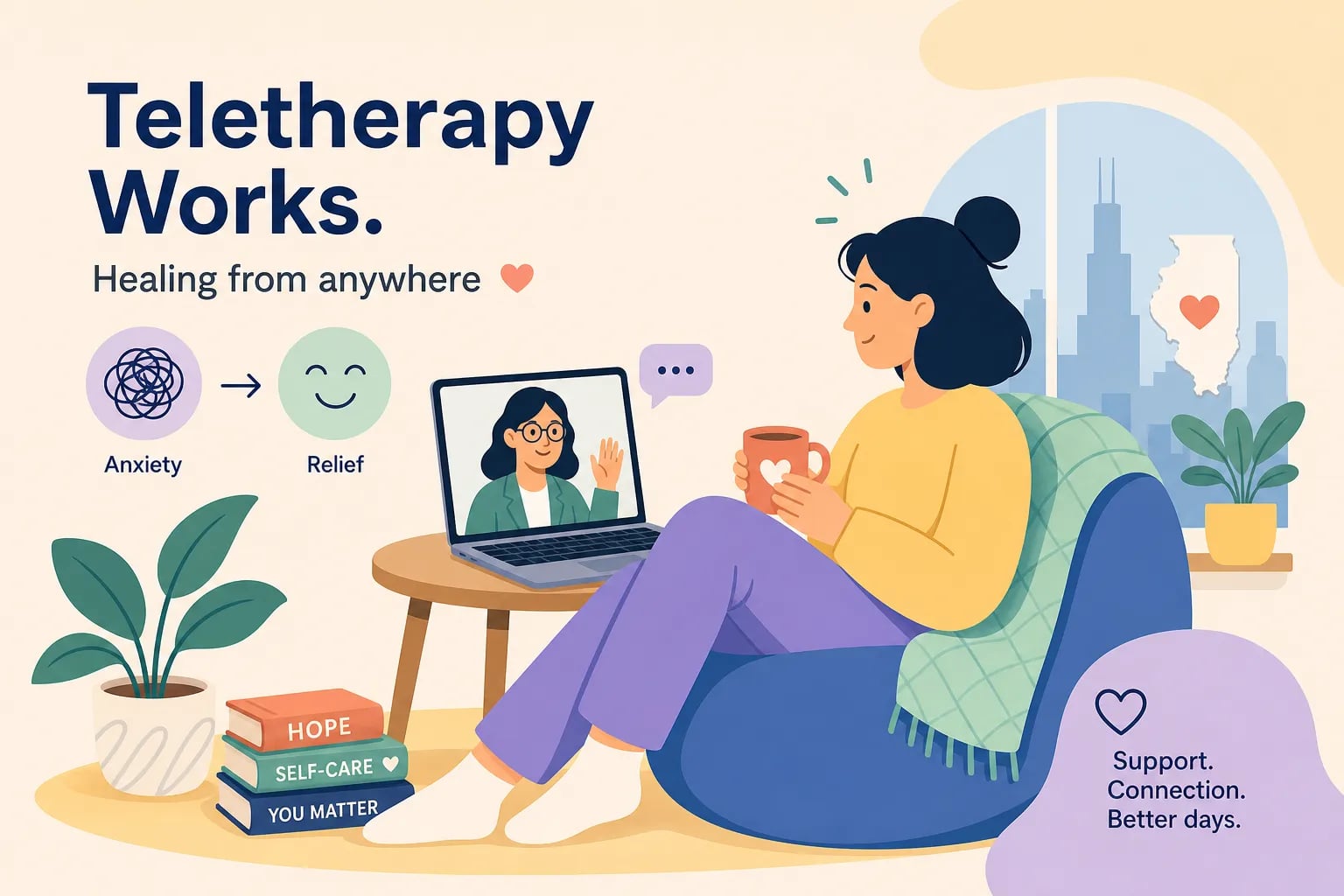


If you’re looking for depression treatment in Chicago, the options span a wider range than most people expect, from weekly outpatient therapy to inpatient stabilization and advanced biological treatments. That range is genuinely useful, but it can feel overwhelming when you’re already struggling to get through the day. Choosing the wrong provider or the wrong level of care wastes time and energy you simply don’t have right now. This article maps the full spectrum of Chicago depression treatment options, from evidence-based talk therapy to specialist interventions, written specifically to help you match the right level of care to where you actually are today.
River North Counseling is a multi-specialty licensed practice serving Chicago’s River North neighborhood and Skokie, with both in-person and virtual therapy options available to Illinois clients (confirm telehealth availability for your location when you reach out). Their team of licensed therapists provides personalized depression care using evidence-based approaches, and they’ll be referenced throughout this guide as a starting point for outpatient support. By the end of this article, you’ll know exactly what to ask and where to go next.
Knowing which level of care fits your situation
Many people searching for help with depression assume they need “a therapist,” when the reality is that their symptoms may call for something more structured, or far less intensive than they fear. Understanding the treatment continuum before you start calling providers saves you from being placed at the wrong level of care, which only delays real progress. If you’re unsure how symptoms translate to levels of care, see Recognizing Depression Symptoms And Accessing Resources For Support for a practical assessment and resource list.
Outpatient therapy, IOP, and PHP: the differences that matter
Standard outpatient therapy means meeting with a licensed therapist once per week, typically for 45 to 50 minutes. This fits most people with mild-to-moderate depression who can function at work, maintain relationships, and keep themselves safe at home. When symptoms are more disruptive but you’re still stable enough to live independently, the next two levels of care offer more structure without requiring overnight admission.
Intensive Outpatient Programs (IOP) provide structured therapy three to five half-days per week. Partial Hospitalization Programs (PHP) involve daily programming for five to six hours per day. Chicago providers including Compass Health Center, Clarity Clinic, and Rogers Behavioral Health in Skokie offer both tracks for adults managing moderate-to-severe depression without needing overnight supervision. These outpatient depression programs in Chicago are often the right bridge between weekly therapy and hospital-level care; for an overview of local outpatient therapy options, see our guide to Therapy for Depression in Chicago.
When inpatient care is the right call
Inpatient admission is appropriate when someone faces an immediate safety risk, has active suicidal ideation requiring 24/7 monitoring, or is in an acute crisis that prevents safe functioning at home. Montrose Behavioral Health Hospital offers short-term inpatient stabilization, typically five to seven days, with same-day assessments available. Needing inpatient care is not a failure; it’s appropriate triage, the same way a severe infection calls for a hospital rather than urgent care. Once stabilized, most people step down to PHP or IOP to continue recovery at a sustainable pace. If you’re evaluating inpatient or residential options in Chicago, directory resources for local rehab centers in Chicago can help you compare levels of care and program focus.
Therapy modalities that actually treat depression
Not all therapy is the same, and knowing which approach fits your specific presentation helps you ask better questions when evaluating providers. The right modality can significantly accelerate your progress, while a poor match often leaves people feeling like “therapy just didn’t work for me.”
Why CBT is the most researched starting point for depression treatment in Chicago
Cognitive Behavioral Therapy (CBT) works by identifying the thought-behavior-emotion loops that maintain depression and teaching practical skills to interrupt them. It’s time-limited, typically 12 to 20 sessions, goal-oriented, and carries the strongest evidence base of any talk therapy approach for depression. A 2023 meta-analysis in Psychological Medicine found that roughly 60 percent of patients showed meaningful improvement after approximately 12 to 13 weekly sessions, meaning most people see real progress within three to four months. River North Counseling’s licensed therapists are experienced in treating depression using CBT as a core modality; confirm specific clinician specializations during your intake call.
DBT, ACT, and when a different approach fits better
Dialectical Behavior Therapy (DBT) was originally designed for emotional dysregulation and is especially useful when depression coexists with intense mood swings, self-harm urges, or a trauma history. Acceptance and Commitment Therapy (ACT) fits well for people stuck in avoidance patterns, where pulling away from meaningful activities feeds the depression cycle. These aren’t competing with CBT, they’re tools for different presentations. A skilled clinician will help you identify which approach fits your specific situation during the intake process.
The role of medication alongside therapy
For moderate-to-severe depression, clinical guidelines from organizations such as the APA and Cochrane reviews support combining antidepressant medication with weekly therapy over either treatment alone. Therapists don’t prescribe, so you may need both a licensed therapist and a prescribing provider, such as a psychiatrist or psychiatric nurse practitioner, all coordinated under a single care plan. When evaluating providers, ask directly whether they can help coordinate your care with a prescriber if medication becomes part of your plan. For a focused discussion of combined approaches, see our piece on Depression Treatment Options: Therapy, Medication, or Both?
Advanced depression treatment in Chicago: options when standard care hasn’t worked
If you’ve tried standard antidepressants or therapy and found limited relief, you’re not out of options. Chicago has a growing number of specialist providers offering advanced biological treatments for treatment-resistant depression, and knowing what’s available removes a significant barrier to getting appropriate care.
TMS therapy in Chicago: what to know
Transcranial Magnetic Stimulation (TMS) is FDA-approved for treatment-resistant depression and entirely non-invasive. A typical TMS protocol involves a series of outpatient sessions using magnetic pulses to stimulate mood-regulating brain circuits, with no anesthesia and no significant recovery time. TMS has a relatively favorable side-effect profile compared to systemic medications; the most common effects are temporary scalp discomfort and mild headache, and while rare adverse events such as seizure have been reported, rates are considered low based on FDA labeling and published safety data. A full course in the Chicago area averages around $5,500 for self-pay patients, and TMS is covered by many insurance plans when standard treatments have been documented as insufficient. GIA Chicago specializes exclusively in TMS, while Relief Mental Health and Stella Mental Health offer TMS alongside other biological treatments across multiple Chicagoland locations.
Ketamine and esketamine: who qualifies
IV ketamine infusions and Spravato (esketamine nasal spray) are increasingly available through Chicago-area clinics including Stella Mental Health, Relief Mental Health, Balance Ketamine Clinics, and Northwestern Medicine. Spravato is FDA-approved specifically for treatment-resistant depression and is administered as a nasal spray in a monitored clinical setting. Basic eligibility requires a confirmed treatment-resistant depression diagnosis and documented failure of multiple antidepressants; key contraindications include active psychosis and uncontrolled substance use. These are specialist-level interventions, not a first-line option, but they represent a meaningful path forward when standard treatments haven’t delivered results. For clinic-specific information on ketamine services in Chicago, see Stella Mental Health’s ketamine therapy resource here.
What depression care actually costs in Chicago
Cost uncertainty is one of the most common reasons people delay getting help. Here’s what the actual numbers look like, so you can plan rather than guess.
Typical out-of-pocket costs for therapy and medication management
Outpatient therapy in Chicago averages $125 to $175 per session, with rates in premium zip codes reaching $403. Medication management appointments typically run $100 to $250. With private insurance like Aetna or Blue Cross Blue Shield, most clients pay $25 to $50 per session as a copay. River North Counseling accepts Blue Cross PPO and HMO, Aetna, and Medicare, billing these plans directly. For IOP and PHP programs, costs increase significantly but are often substantially covered by commercial insurance when the level of care is medically necessary.
Insurance, Medicaid, and sliding-scale options
Medicare Part B covers 80 percent of outpatient mental health costs, with the patient responsible for the remaining 20 percent. Illinois Medicaid, as of 2026, covers outpatient depression therapy at private group practices without requiring prior authorization for medically necessary services, provided the practice is enrolled to deliver Medicaid services. Sliding-scale community mental health centers and Federally Qualified Health Centers serve uninsured individuals with session fees often ranging from $20 to $75 based on income. For TMS, coverage varies by plan and typically requires documented prior treatment failure; ketamine and esketamine require direct insurer verification, as coverage policies differ significantly across plans.
How to find the right depression psychiatrist or therapist in Chicago
This section gives you concrete tools to evaluate providers quickly and take the first step without getting stuck in endless research. You can also consult provider directories, such as the Psychology Today listings for Chicago depression treatment, to compare clinicians’ specialties, insurance accepted, and client reviews before calling for an intake.
Questions to ask before booking an intake appointment
These five questions filter out poor fits fast and help you compare providers with confidence:
- Do you specialize in depression, and which therapy modalities do you use?
- Is your CBT approach time-limited, and what does a typical treatment plan look like?
- What is your intake process, and how soon can I start?
- Do you accept my insurance, and what is my estimated out-of-pocket cost per session?
- Is telehealth available if I can’t make it in-person on a given week?
These aren’t just logistical questions. They tell you a lot about how a practice operates and whether they’re set up to actually support your care. A provider who can’t answer these clearly before your first session is worth approaching with caution.
Why therapist matching matters more than clinic brand
The single strongest predictor of therapy outcomes is the therapeutic alliance, how well you connect with your specific therapist, not just the reputation of the practice. This is why the intake process at any depression clinic in Chicago matters enormously. Practices that invest time understanding your presenting concerns, treatment preferences, scheduling needs, and past therapy experience before assigning a clinician consistently produce better outcomes than those that match by availability alone.
River North Counseling structures their intake process around exactly this kind of matching, pairing clients with clinicians based on specialty and approach at both their River North and Skokie offices, with virtual options for Illinois clients. For people managing depression who aren’t sure where to start, having access to a diverse multi-specialty team under one practice reduces the friction that keeps so many people stuck. Rather than interviewing ten different solo practitioners, you get coordinated access to licensed therapists experienced in evidence-based depression treatment, with scheduling flexibility built in from day one.
Taking the next step toward depression treatment in Chicago
Depression care in Chicago isn’t one-size-fits-all, and the most important move is matching your current level of need to the right level of care. For mild-to-moderate symptoms, outpatient therapy using CBT is the right starting point for most people. When depression is significantly disrupting daily functioning, IOP or PHP provides structure without requiring overnight admission. And when standard treatments haven’t worked, TMS and ketamine-based therapies offer real, evidence-backed options through Chicago specialist providers.
If outpatient therapy fits where you are right now, River North Counseling is a strong starting point. In-person sessions are available at their River North and Skokie offices, and virtual therapy extends access to clients across Illinois. Reaching out for an intake consultation isn’t a commitment to anything, it’s simply a chance to find out whether the fit is right, what to expect, and what the next step looks like. Many practices offer a free or low-cost initial consultation; check with the clinic about fees when you call. One conversation is how it starts.