
Most people don’t notice relationship red flags the first time they appear. They notice a feeling: a small discomfort they file away as stress, a bad week, a personality quirk they’re still learning to work around. The pattern continues. The explanations get more elaborate. And by the time the feeling becomes impossible to ignore, the behavior has been running unchecked for months, sometimes years.
The most damaging relationship patterns rarely arrive as obvious crises. They start as small frictions that feel easier to rationalize than confront. At River North Counseling, the couples and individuals we work with most often tell us the same thing: the signs were there early. They just didn’t have the language for what they were seeing. This article gives you that language, explains what each pattern actually signals, and tells you what to do next.
Knowing what a red flag means gives you real choices. Ignoring it just defers the decision.
Why relationship red flags are so easy to rationalize
Attachment can work against early recognition. When you care about someone, you’re more likely to reinterpret warning signs as problems to solve rather than signals to heed. You search for context, extend good faith, and reframe concerning behavior in the most generous possible light. That’s not naivety; it’s what caring feels like. But it also creates a window in which harmful patterns can establish themselves before you’ve named them.
Research on coercive control adds another layer: many controlling tactics are deliberately framed to resemble love. Possessiveness is packaged as devotion. Jealousy is packaged as passion. Isolation is packaged as protectiveness. When harmful behavior wears a loving mask, questioning it feels like questioning the relationship itself.
The most useful lens here is the distinction between a moment and a pattern. A single awkward comment is not a red flag. A repeated behavior that reliably leaves you feeling smaller, controlled, or afraid is. The clinical standard for emotional abuse involves three elements: the behavior happens repeatedly, it causes real harm, and it limits your autonomy. As you read through the patterns below, ask not “did this happen once?” but “does this keep happening, and how do I feel after?”
The silence problem: what stonewalling and emotional withdrawal really signal
Stonewalling looks like shutdown: monosyllabic answers, averted eye contact, walking out of the room mid-conversation, or a complete refusal to engage. It’s not the same as needing space. Gottman’s research identifies stonewalling as one of four key predictors of relationship breakdown precisely because it ends conversations before resolution is possible. One partner is left with an unresolved issue and the added injury of feeling abandoned mid-conflict.
Physiologically, stonewalling often happens because the stonewaller is flooded (meaning their nervous system is too activated to process the conversation constructively). That context matters for understanding it, but it doesn’t reduce the impact on the other partner, who typically experiences it as punishment or rejection. The difference between stonewalling and a healthy break is communication: “I need 30 minutes and I’ll come back at 7:00” is regulation. Disappearing without explanation is withdrawal.
Emotional withdrawal as a chronic pattern goes beyond conflict. It’s a general pulling back of warmth, interest, and investment in the relationship. Conversations get shorter. Affection disappears. Your partner is physically present but emotionally elsewhere. This pattern may reflect unresolved resentment, disconnection, or aspects of avoidant attachment. It won’t resolve on its own, and it tends to deepen the longer it goes unnamed.
Contempt and chronic criticism: why these two patterns do the most damage
Contempt: what it looks like and why it matters
Contempt is not just an insult. It’s expressed superiority: eye-rolling, dismissiveness, sarcasm used to demean, or mockery that signals the other person is beneath respect. Decades of research by John Gottman consistently identify contempt as the single strongest predictor of relationship dissolution, a finding that holds across conflict frequency, sexual dissatisfaction, and financial stress.
What contempt signals is a fundamental erosion of admiration. A partner who feels contempt has, on some level, decided the other person is not their equal. That’s a harder problem to repair than a specific grievance, because it doesn’t live in a single argument; it lives in how one person sees the other. When contempt becomes the air a relationship breathes, the other partner either shuts down or escalates, and neither direction leads anywhere productive.
Healthy feedback vs. chronic criticism
Chronic criticism is different from healthy feedback, and the distinction matters. Healthy feedback addresses a specific behavior: “I felt frustrated when the appointment got missed.” Chronic criticism attacks character: “You always forget,” “You never follow through,” “You’re so irresponsible.” The recipient has nowhere to go because the indictment targets who they are, not what they did. Over time, they either stonewall to survive the onslaught or become so defensive that real conversation becomes impossible. This criticism-defensiveness cycle is self-reinforcing and often persists without intervention, but it commonly responds well when couples get support early.
Relationship red flags that get written off as quirks
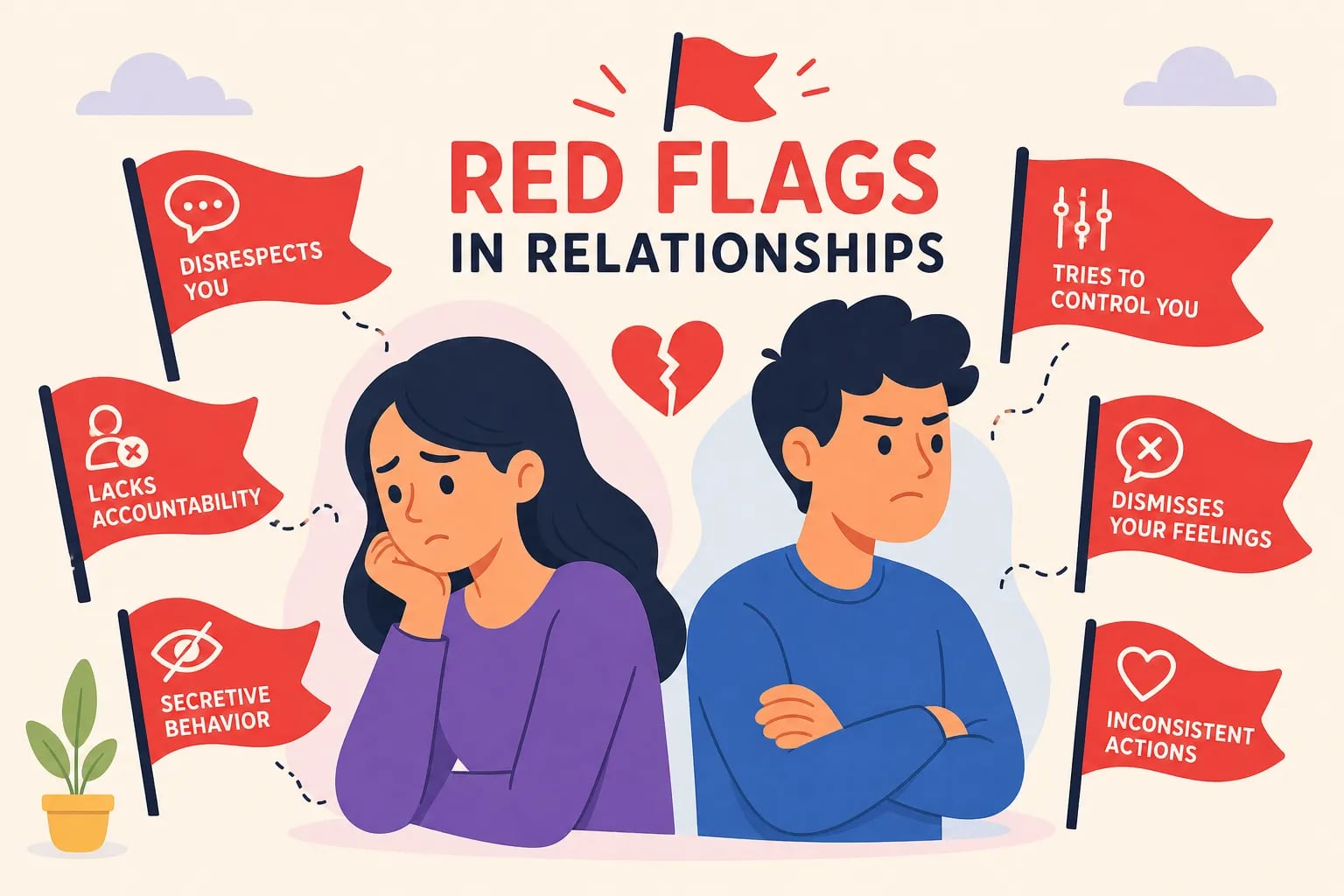
Some of the most significant toxic relationship signs in early dating are the ones that look like affection, humor, or ordinary compatibility issues. Love-bombing is the clearest example: overwhelming attention, rapid declarations of love, pressure to commit quickly, and constant messaging that creates an illusion of exceptional chemistry. Intensity paired with entitlement is not a sign of deep connection, it is often a setup for control, particularly when the intensity later disappears or becomes conditional on compliance.
Possessiveness framed as care is equally common. Frequent demands for location updates, discomfort when you spend time with friends independently, or criticism of your close relationships are not expressions of care, they’re compliance tests. Healthy interest respects privacy. Possessiveness requires access and compliance. The real test is whether limits are respected after they’ve been stated clearly. A partner who adjusts is showing you curiosity; a partner who escalates after a clear “no” is showing you something else entirely.
Two partner behavioral red flags that undermine your sense of reality deserve particular attention:
- Invalidation and gaslighting: Regularly denying conversations happened, rewriting shared events, or implying you are “too sensitive.” Clinical literature on coercive control documents this tactic as one commonly used to destabilize a partner’s trust in their own memory and perception. When it happens repeatedly, the effect is cumulative: you start to doubt your own judgment before you ever raise a concern.
- Humor that humiliates: Repeated sarcasm about your body, intelligence, or insecurities, dismissed with “I was just joking” when you react. The test is not the tone. The test is whether it reliably leaves you feeling smaller, and whether your reaction is met with accountability or ridicule.
The silent treatment used as punishment is a third pattern worth naming. Taking a stated, time-limited break from a heated conversation is healthy. Using cold withdrawal to force apologies or compliance is emotional control. The difference lies in whether the pause has a clear, communicated purpose or whether it’s deployed to make the other person feel afraid of the relationship’s stability until they give in.
What to say and do when you recognize a warning sign
Addressing relationship red flags: scripts and steps
Effective boundary statements are brief, calm, and focused on your own actions rather than trying to change the other person’s behavior. The less you explain and justify, the less material there is for the other person to argue against. A boundary is a statement of what you will do, not a negotiation about what they should do.
A few scripts that hold up under pressure:
- “I’m not continuing this conversation while voices are raised. I’ll come back when we’re both calm.”
- “My answer is no. I’m not discussing it further.”
- “When this keeps happening, I need to step back and reassess whether this is working for me.”
- “You may see it differently, but my boundary still stands.”
The broken-record technique is worth knowing: repeat the same phrasing once rather than expanding into a debate. More explanation typically becomes an invitation to argue. You are not obligated to justify a boundary; you are only responsible for following through on it.
If you set a clear, calm limit and it’s consistently met with escalation, punishment, or mockery, that response is itself a relationship dealbreaker signal. At that point, the question is no longer about the original issue, it’s about whether the relationship is safe to be honest in.
When recognizing these patterns means it’s time to get support
Stonewalling, contempt, chronic criticism, and emotional withdrawal are learned patterns. That means they’re also changeable ones. But the longer they run without being named and addressed, the more they become a relationship’s default. Research on evidence-based couples therapy, including Emotionally Focused Therapy and behavioral approaches, finds meaningful improvement for roughly 60 to 80 percent of distressed couples. Early intervention consistently produces better outcomes than waiting for crisis.
The work looks genuinely different when couples come in at friction versus collapse. When goodwill still exists, when both partners remain motivated, when patterns haven’t calcified into resentment, that’s when therapy has the most room to move. At River North Counseling, our couples therapy program focuses on communication skills, identifying the underlying dynamics driving conflict cycles, and rebuilding the emotional connection that these warning signs erode over time. Both in-person sessions in Chicago and virtual options are available for couples across Chicagoland, so working around demanding schedules is part of how we operate.
When a relationship involves fear, threats, physical intimidation, or escalating control, the priority shifts from repair to safety. The National Domestic Violence Hotline is available 24 hours a day, seven days a week at 1-800-799-SAFE (7233). You can also text START to 88788 for confidential support. If you are using a shared device, consider reaching out from a private one. Working with a trained therapist or advocate allows you to build a safety plan without alerting a controlling partner, and that planning step is not optional when safety is in question.
Seeing clearly is not the same as giving up
Relationship red flags are not personality quirks, and they’re not inevitable growing pains. They are information. A pattern that reliably leaves one partner feeling afraid, diminished, or uncertain of their own perception is telling you something real about the relationship’s dynamics, regardless of how the other person explains or minimizes it.
One difficult conversation is not a red flag. A consistent dynamic that keeps one person smaller, quieter, or less certain of themselves is. Seeing that clearly is not a reason to panic, and it’s not a verdict. It’s a reason to make a deliberate choice rather than a passive one.
Whether you’re processing what you’ve noticed in your own relationship or trying to find language for something a friend is describing, support is closer than you might expect. Couples therapy, individual therapy, or even a single consultation can bring clarity well before months of uncertainty take a further toll. Reach out to our team at River North Counseling to talk through what you’re experiencing and find the right next step.