
Most couples don’t call a therapist the first time something goes wrong. They wait. They tell themselves it’s a phase, that every relationship has hard stretches, that things will settle once work calms down or the kids get older. Months pass. Sometimes years. And by the time they do reach out, they’ve often minimized patterns that have been building the whole time. Many clinicians report this delay as one of the most common obstacles to effective relationship repair.
This is one of the most consistent things therapists observe in their work with couples: the warning signs were rarely invisible. They were present, sometimes from early on, but hard to name and even harder to act on. At River North Counseling, couples arrive at this exact crossroads regularly, certain something is wrong, uncertain what to do about it. What they need isn’t judgment. It’s a clear way to assess what they’re actually dealing with.
This article maps the relationship red flags therapy takes seriously, explains how to gauge severity, and helps you decide what kind of support actually fits your situation. Whether you’re questioning your relationship or trying to understand what healthy looks like, what follows gives you a grounded, clinically informed place to start.
What Separates a Red Flag from a Rough Patch
All couples argue. Conflict is not the problem. The problem is what happens during conflict and after it: whether it leads anywhere productive, whether both partners feel heard and safe, and whether repair actually occurs. A rough patch typically has a clear cause, job loss, grief, a new baby, a major move, and both people remain emotionally present and motivated to reconnect, even when it’s hard.
Why One Bad Argument Doesn’t Define a Relationship
Therapists don’t evaluate relationships based on whether conflict exists. They look at the pattern and style of conflict: does it cycle without resolution, leave one or both partners feeling unsafe, or consistently end with one person taking all the blame? A relationship where arguments happen but repair follows is fundamentally different from one where the same wound gets reopened every few weeks without anything changing.
How Therapists Define “Red Flag” in Clinical Terms
A red flag, in clinical terms, is a repeated behavioral pattern that undermines emotional safety, fairness, mutual respect, or trust. The key word is repeated. Red flags don’t require dramatic incidents or visible bruises. Consistent emotional withdrawal, quiet contempt, or chronic unreliability can erode a relationship just as steadily as open hostility. A useful clinical frame many therapists apply is this: does the relationship have secure functioning? Meaning, do both partners feel safe, heard, and respected on a reliable basis? When the honest answer is no, that’s worth paying attention to, and it may be time to consider relationship red flags therapy.
Relationship Red Flags Therapy Identifies Most Often
The patterns below aren’t a checklist for labeling your partner or your relationship. They’re a clinical map of what therapists consistently identify as behaviors that damage relationships over time, the toxic relationship signs that couples counseling is designed to address. The goal is recognition, not verdict.
Emotional and Verbal Patterns That Erode the Relationship
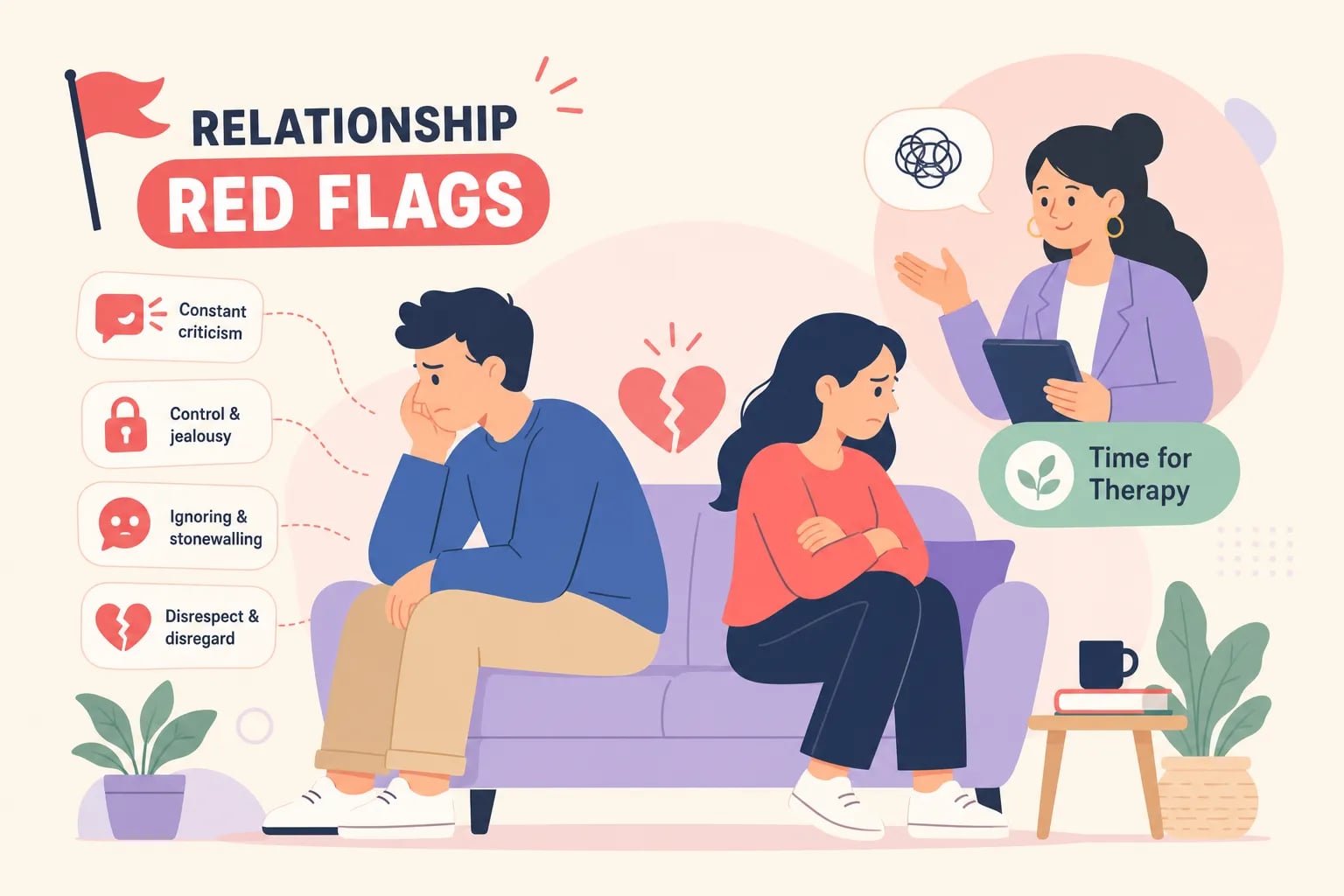
Researcher John Gottman identified contempt, criticism, defensiveness, and stonewalling as among the strongest predictors of relationship breakdown, a framework documented extensively in his published research on marital stability, and working therapists see this play out constantly. Contempt shows up as eye-rolling, sarcasm, mockery, or condescension. Criticism targets a partner’s character rather than a specific behavior. These aren’t just communication failures; they’re signals that something deeper has shifted in how partners regard each other.
Gaslighting-adjacent behavior is another pattern therapists flag consistently. This looks like one partner repeatedly making the other feel “crazy,” overly sensitive, or responsible for conflicts they didn’t create. If you regularly feel like you’re always the problem, always apologizing, or always editing yourself to avoid a reaction, that pattern deserves attention. Research on emotional abuse indicators shows this kind of chronic blame-shifting shapes how victims see themselves over time, it’s information about the dynamic, not a flaw in you.
Control, Isolation, and Boundary Violations
Controlling behavior exists on a spectrum. The obvious end includes monitoring a partner’s phone, restricting finances, or demanding to know their location at all times. The subtler end includes making decisions without consultation, weaponizing jealousy, or creating situations where a partner’s independence feels risky. Both ends of that spectrum matter clinically, and both qualify as relationship dealbreakers that warrant professional attention.
Isolation is one of the most significant patterns a therapist can identify. When one partner limits the other’s contact with friends, family, or community, it removes the outside perspective and support that healthy relationships depend on. Repeated boundary violations, ignoring stated needs, dismissing requests for space or privacy, or treating one partner’s comfort as less important than the other’s, signal the same underlying imbalance: one person’s experience consistently gets ranked below the other’s.
Love Bombing, Inconsistency, and Eroded Trust
Love bombing refers to intense early affection or attention used to accelerate intimacy, create dependency, or establish a dynamic that becomes harder to question later. Therapists flag this pattern in new relationships and longer-term ones alike, because the behavior it establishes doesn’t disappear; it often cycles with withdrawal or criticism once the initial phase passes.
Chronic inconsistency, saying one thing and doing another, making promises that don’t hold, makes trust-building structurally impossible. It keeps partners in a state of low-grade anxiety, waiting to see which version of their person shows up. When trust breaks down repeatedly without genuine repair, the relationship loses the foundation that couples therapy red flags work is designed to rebuild. This doesn’t mean the relationship is over, but it does mean the pattern needs to be named and addressed directly.
When Red Flags Signal Escalating Risk
There’s an important distinction between a relationship that is unhealthy and one that carries real safety risk. Both matter, but they require different responses. Being clear about the difference protects you from both under-reacting and from taking steps that could unintentionally increase danger.
Behaviors That Move Beyond Unhealthy into Unsafe
Escalating conflict frequency or intensity, threats (verbal or implied), and any physical intimidation or harm are not couples therapy issues. They are safety issues. Research on intimate partner violence consistently identifies jealousy and possessiveness, coercive control, increasing isolation, and prior episodes of physical harm as the strongest markers of escalating risk. Each of these patterns, alone, is concerning. In combination, they require immediate attention.
One clinical note that often surprises people: separation itself can temporarily increase risk in abusive dynamics. This is not a reason to stay in an unsafe situation. It is a reason to plan carefully and get support before acting. Clinicians use structured tools, including the validated Danger Assessment instrument, to evaluate lethality risk and guide safety planning. If a partner has made threats to cause harm, there is access to weapons in the home, or violence has already occurred, the priority is a safety plan, not a couples session. The National Domestic Violence Hotline, reachable at 1-800-799-7233, provides confidential, around-the-clock support for exactly this step.
Couples Therapy, Individual Therapy, or Something Else: How to Decide
Knowing that something is wrong is one thing. Knowing what to do about it is another. The type of support that fits depends on where the distress actually lives: in the relationship, in one partner’s individual experience, or in a safety concern that needs to be addressed before anything else.
When Couples Therapy Is the Right Fit
Couples therapy works best when the primary issue is the relationship itself: recurring conflict cycles, communication breakdown, emotional distance, a trust rupture like infidelity, or adjustment to a shared transition such as parenthood or relocation. Both partners need to be willing to participate and safe enough to engage honestly in the same space. When that condition is met, conjoint work addresses the dynamic directly rather than treating each person in isolation.
When Individual Therapy Should Come First
If one partner is managing untreated depression, anxiety, trauma, or substance use that limits their ability to be present in sessions, individual therapy first creates a stronger foundation for later couples work. Individual therapy is also the right path when only one partner is willing to seek help, or when a person needs to understand their own patterns before exploring them relationally. This isn’t a failure of the relationship. It’s a clinically sound choice, and it often leads to better outcomes when couples work eventually begins.
When Safety Planning Takes Priority Over Sessions
Ongoing abuse, coercive control, or credible threats are contraindications for standard couples therapy. Joint sessions can make safety worse in these situations, not better, because they create an opportunity for the abusive partner to gather information, escalate, or use the therapy setting as leverage. In these cases, individual support and connection to specialized safety services come first. When to seek couples counseling, if it’s ever appropriate in these circumstances, would only be determined much later and under very specific clinical conditions.
What to Look for in a Qualified Couples Therapist
Finding the right therapist matters as much as deciding to go. A poor therapeutic fit, or an unethical practitioner, can set couples back rather than move them forward. Knowing what to look for protects your time, your resources, and your trust in the process.
Questions Worth Asking Before Your First Session
Ask directly about the therapist’s couples-specific training and the approach they use. A qualified therapist answers this clearly without deflecting. Ask how they handle situations where one partner has been harmed by the other, how they maintain neutrality, and how they measure progress. These answers reveal clinical judgment and help you assess whether their approach aligns with what you actually need.
Good couples therapists can explain what early sessions will look like, what realistic goals are, and what success means within their specific framework. Research on best practices in couples therapy suggests transparency about method and goal-setting is a meaningful marker of clinical competence. They won’t promise to save the relationship. They will promise to help you both understand it more clearly and work toward something better defined than “things feel off.”
Signs a Couples Counselor May Not Be the Right Fit
A therapist who consistently sides with one partner, minimizes harmful behavior, or allows sessions to become a platform for blame is not practicing ethically. Be cautious of practitioners who impose personal values about what relationships should look like, or who make you feel judged for your specific circumstances. If you leave sessions feeling consistently worse in a way that reflects shame, hopelessness, or invalidation rather than the productive discomfort of real growth, that is meaningful information about fit. Switching therapists is not a failure. Sometimes it’s the most clinically sound decision you can make.
Taking the Next Step When You’re Ready
One of the most persistent myths about couples therapy is that you have to hit rock bottom before it’s justified. Couples therapists consistently report the opposite: the earlier couples come in, the more there is to work with. Recognizing relationship red flags therapy addresses is not a verdict on your relationship. It’s information. And information, in the right hands, is what therapy turns into change.
For Chicago-area couples navigating these questions, River North Counseling offers relationship counseling rooted in evidence-based practice. Their licensed therapists specialize in helping couples identify patterns, rebuild communication, and make clear-eyed decisions about their future together. Whether you’re facing a specific crisis or simply feel like something has been off for a long time, their team can help you figure out which type of support makes the most sense. In-person sessions are available in River North and Skokie, with virtual options for those who need flexibility.
If you recognize relationship red flags, therapy can help you make sense of them. A first conversation doesn’t lock you into anything. It just gives you more to work with, and sometimes that’s exactly what a relationship needs to find its footing again. Reach out to the River North Counseling team to schedule an assessment today.