
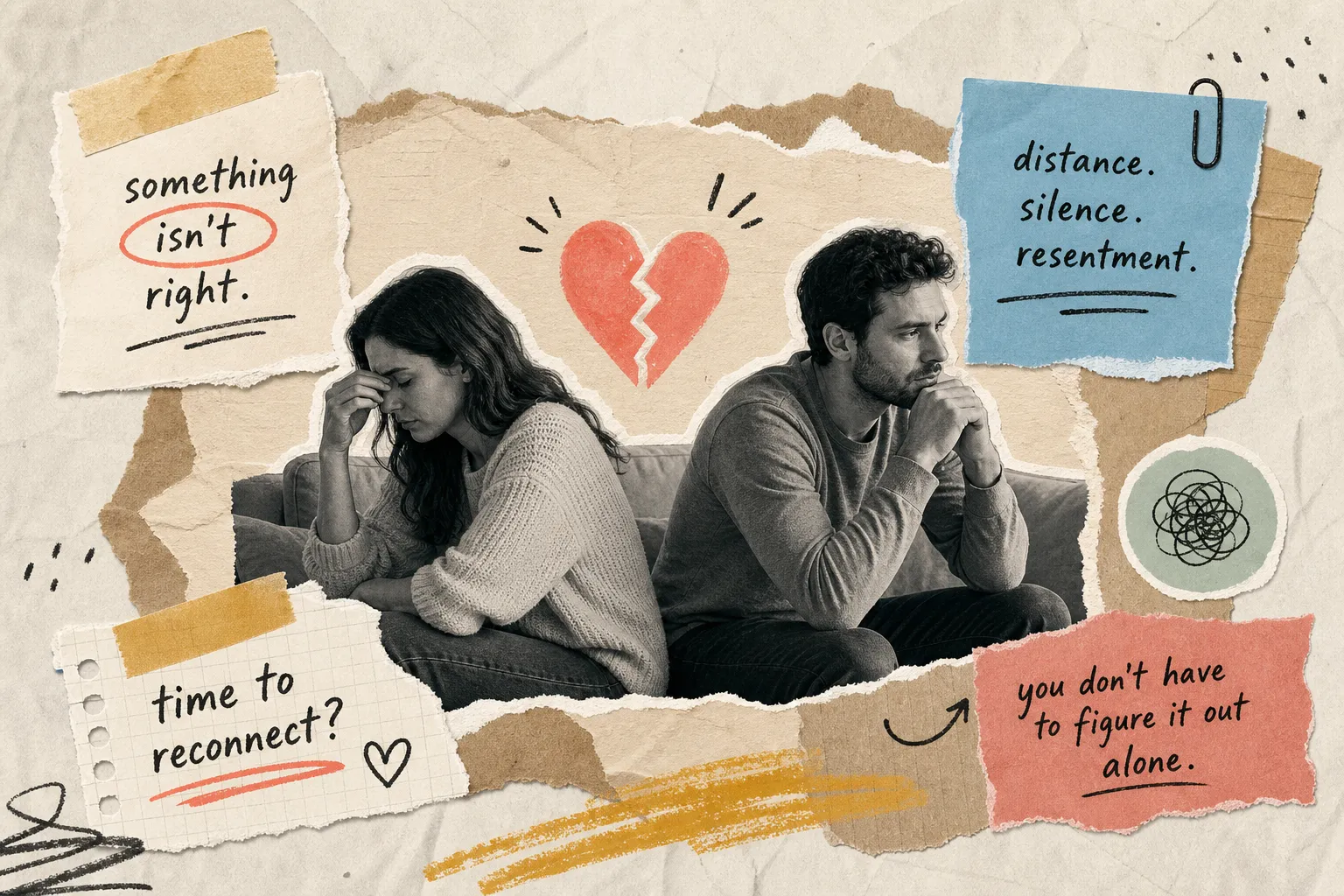
Research on couples therapy timing suggests that partners wait an average of about 2.7 years after problems begin before seeking professional support, and many wait considerably longer. By the time they arrive in a therapist’s office, the patterns have become deeply entrenched, defenses are high, and both partners have cycled through the same painful dynamic more times than either can count. Recognizing the signs your relationship needs professional couples counseling is the first step, but knowing whether what you’re experiencing rises to that level is harder than it sounds.
At Couples Therapy in Chicago, therapists hear the same patterns from couples every week. Partners frequently say they wish they’d come in sooner. That’s not a criticism of waiting, it’s a reflection of how subtle the warning signs can be when you’re living inside them.
The following ten signs are clinically recognized indicators that couples counseling is likely to help. You don’t need to check every box. If several of them feel familiar, that recognition is worth acting on.
Signs Your Relationship Needs Professional Couples Counseling: Communication Has Broken Down
Sign 1: The same argument keeps happening without resolution
You know the one. Same trigger, same accusations, same emotional outcome, no actual progress. The argument might be about chores, money, parenting, or how one partner spends their time, but the content almost doesn’t matter anymore. The cycle itself has become the problem. Clinically, this is one of the most consistent predictors therapists look for, because it signals that the couple is stuck in a negative interaction loop that conversation alone won’t break.
Sign 2: Conversations shut down or escalate fast
Stonewalling and defensive escalation are mirror-image responses to the same underlying fear. One partner withdraws; the other pushes harder. One goes quiet and cold; the other raises the volume to get any reaction at all. Neither feels heard, and neither gets resolution. This is a communication pattern, not a character flaw, and it’s one that professional couples counseling directly and systematically addresses.
Sign 3: Important topics get avoided entirely
The “walking on eggshells” pattern is quieter than the other two but just as damaging. When avoiding conflict becomes the relationship’s main strategy, a growing list of unresolved issues builds beneath the surface. Over time, that accumulation creates emotional distance that feels inexplicable, because neither partner can point to one specific cause.
Emotional and Physical Closeness Have Quietly Faded
Sign 4: You feel more like roommates than partners
You coordinate logistics. You share a space. You might even have pleasant evenings together. But genuine emotional connection, the kind where you actually feel known by the other person, has quietly disappeared. This shift often happens so gradually that couples miss it until it’s significant. Coexistence is not the same as partnership, and one of the clearest relationship red flags is realizing you can’t remember when that changed.
Sign 5: Physical affection has dropped noticeably
Every relationship has natural fluctuations in physical closeness, especially during high-stress periods. The sign worth paying attention to is a sustained, noticeable decline that neither partner has directly addressed. Physical distance often reflects emotional disconnection as much as anything physical. When both partners recognize it but neither knows how to bridge it, that’s a clear opening for professional support.
Sign 6: You feel lonely even when you’re in the same room
This is one of the most painful and least-discussed signs in any relationship. Loneliness within a partnership is a strong signal that emotional attunement has broken down. You’re physically present with someone you chose, and you still feel alone. Couples therapy is particularly effective at rebuilding this kind of connection because it creates a structured, safe space for both partners to actually reach each other again.
When to Seek Professional Couples Counseling: Trust and Outside Pressures
Sign 7: Trust was broken and hasn’t fully healed
Infidelity, dishonesty, and repeated boundary violations leave lasting damage when not professionally addressed. Time alone doesn’t repair broken trust, it just gives both partners more opportunities to either rebuild poorly or avoid rebuilding entirely. Trust repair is possible with the right support, and couples therapy has a clear evidence base for working through betrayal. The key word is “working through,” not around.
Sign 8: A major life change cracked the foundation
New parenthood, job loss, relocation, grief, retirement, or financial strain can destabilize even strong relationships. These transitions change roles, routines, and identity in ways that ripple through every part of a partnership. Seeking support during a major transition is proactive, not reactive. Many couples who thrive after big life changes do so because they got help navigating the shift rather than assuming love would carry them through automatically.
The Relationship Is Approaching a Breaking Point
Sign 9: Separation or divorce has become a serious thought
If separation feels like it might be the only option, that’s not evidence the relationship is over. It’s a strong signal that professional help is overdue. Many couples who enter therapy at this stage do find a path forward, research consistently shows that delayed couples can still benefit meaningfully from structured support. Waiting longer typically makes the work harder, not because the therapist can’t help, but because both partners have usually accumulated more hurt and more distance by then. For more on timing and help-seeking patterns, see a study on wait times before seeking couples therapy that examines typical delays and implications for care.
Sign 10: One or both partners have stopped trying
Disengagement looks like this: no longer initiating repair after an argument, going through the motions without emotional investment, feeling resigned rather than frustrated. Frustration, at least, signals that someone still cares. Emotional withdrawal is one of the harder patterns to reverse, and the research suggests its difficulty increases with duration and depth of disengagement, but it’s not impossible with skilled, consistent support. The sooner it’s addressed, the more options both partners retain.
When the Situation Requires Urgent Attention Before Standard Counseling
Intimate partner violence is a safety issue, not a communication issue
If there is physical danger, coercive control, threats, or any history of strangulation, standard couples counseling is not the right first step. Couples therapy is designed for two people who are both emotionally safe enough to do the work together. It is not designed for situations where one partner is afraid of the other. If you are in danger, contact the National Domestic Violence Hotline at 1-800-799-7233 or text START to 88788 (source: thehotline.org). Your safety comes first, and there are people trained specifically to help you with a plan. Learn to recognize abusive red flags everyone should know, and reach out to local resources immediately if you identify them.
Active addiction, mental health crises, and suicidal ideation need immediate support first
If one or both partners are in active addiction, experiencing a mental health crisis, or having thoughts of suicide, those needs require individual crisis support before couples work begins. Couples therapy is most effective when both people are in a stable enough place to engage. If you or your partner is in crisis, call or text 988 (the Suicide and Crisis Lifeline, 988lifeline.org) or go to your nearest emergency room. A therapist can help coordinate individual and couples care once safety is established, and that coordination is often part of a solid treatment plan. For ideas on individual support and daily well-being practices that can complement clinical care, see Practical, actionable self-care strategies to improve well-being, River North Counseling.
How to Take the First Step Toward Couples Counseling
What to expect in that first session
The first session is an intake and assessment, not a deep problem-solving session. Your therapist will ask about your relationship history, what brought you in now, and what each of you hopes to change. You likely won’t resolve your central issue on day one, and that’s completely normal. Think of the first session as the therapist mapping the terrain so the work that follows is actually targeted to your relationship’s specific patterns.
Finding a couples therapist who is the right fit
Look for a licensed therapist with specific couples experience: LMFT, LCSW, or LPC credentials are all qualified starting points, though licensing titles vary by state (you may also see LMHC or LPCC depending on where you live). Ask about their approach. Gottman Method, Emotionally Focused Therapy (EFT), and Behavioral Couples Therapy each have strong research backing, and a good therapist will be able to explain which they use and why. The consultation call is worth taking seriously, the fit between therapist and couple genuinely matters for outcomes.
If you’re in Chicago, River North Counseling offers couples therapy with therapists who specialize in the communication breakdowns, trust repair challenges, and emotional disconnection covered throughout this article. Their team serves clients in-person in River North and Skokie, and virtually across Illinois. You can reach them directly through their website to schedule a consultation.
Recognizing the Signs Is the First Act of Caring for Your Relationship
Most couples don’t seek counseling because they’ve given up. They seek it because they care enough to try something different. Recognizing these signs in your own relationship isn’t a failure, it’s clarity. And clarity is what makes change possible.
Couples therapy has a strong evidence base for addressing communication breakdown, trust repair, and emotional reconnection. Gottman’s longitudinal research and Johnson’s work on Emotionally Focused Therapy both point to the same finding: earlier intervention is associated with better outcomes, not because problems become unsolvable over time, but because negative interaction patterns become more automatic the longer they go unaddressed. For more on the evidence behind couples interventions, see this review of relationship therapy outcomes.
Do we need couples counseling? It’s a question worth asking honestly. The signs your relationship needs professional couples counseling are rarely dramatic at first. They’re usually quiet patterns that compound: a conversation that shuts down, a topic that never gets raised, a moment of closeness that doesn’t happen. If several of the signs in this article feel familiar, that recognition is worth acting on. Additional resources, like signs you need to go to couples therapy, can help you assess readiness. Schedule a consultation with a licensed couples therapist, the sooner you reach out, the more you have to work with. For an overview of when and why to seek help, you may also find The Benefits of Therapy: When and Why to Seek Help, River North Counseling useful.