
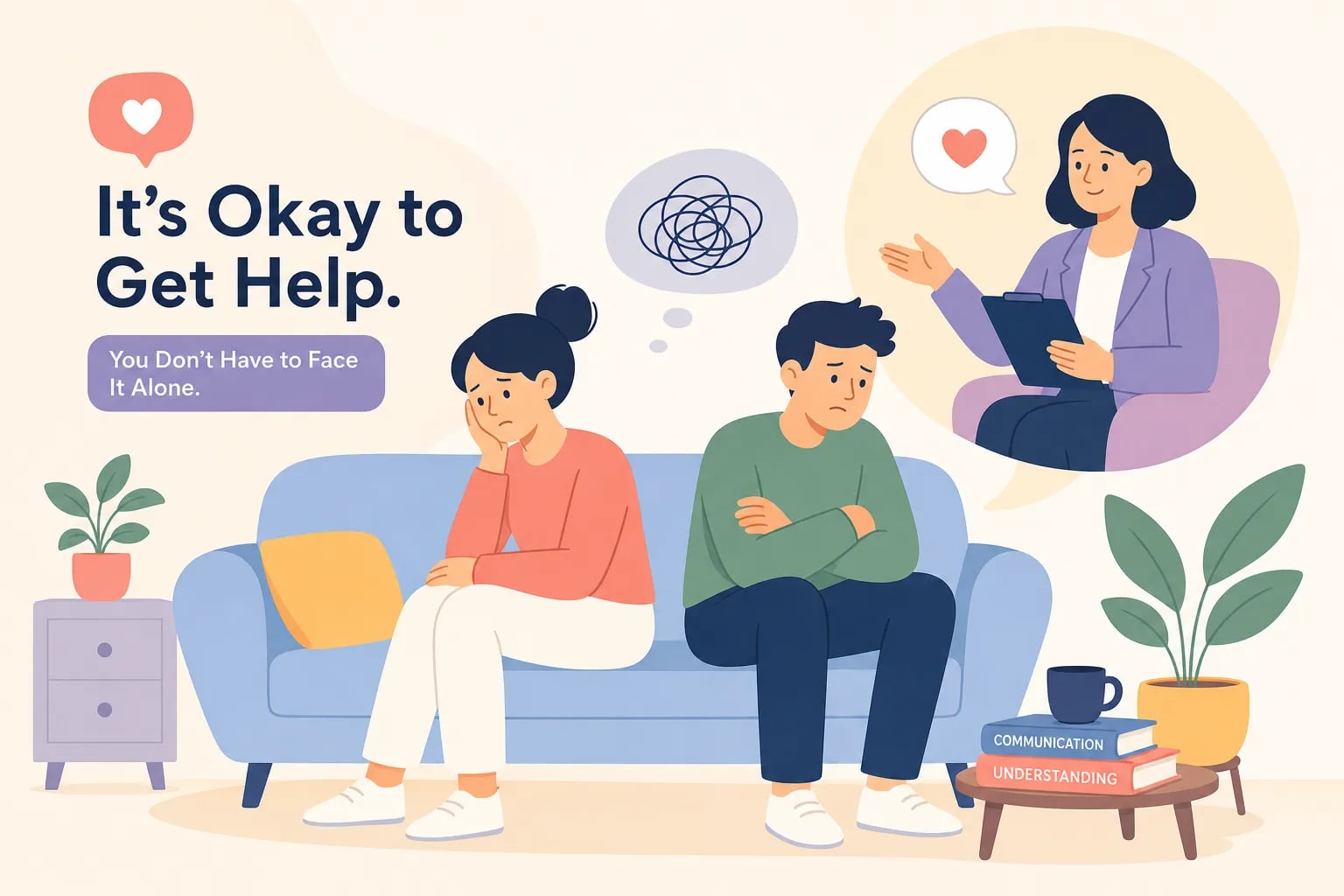
If you’re wondering when to seek professional help for relationship issues, you’re already asking the right question. Research shows that couples wait an average of 2.68 years from the onset of serious relationship problems before entering couples therapy. That’s nearly three years of living inside the same arguments, the same silence, the same growing distance before deciding to ask for help. It’s not stubbornness or denial, it’s a deeply human pattern. Most people hold on because they’re hoping things will shift on their own, or because they’re not sure their problems are serious enough to warrant professional attention.
Knowing when to reach out is genuinely hard. The line between a rough patch and something that needs outside support isn’t always obvious. At River North Counseling, one of the most common things therapists hear from new clients is some version of “we should have come in sooner.” That phrase tends to carry real weight, not guilt, but recognition that earlier support might have spared them months of pain they didn’t have to carry alone. (This reflects a common clinical observation rather than a formal study, but it mirrors what the research on delay and relationship deterioration consistently shows.)
This article covers the clearest signs a relationship needs professional support, the warning signs that call for immediate help, the types of care available, and how to find a couples therapist who’s actually qualified to do this work.
Why Most Couples Wait Too Long
The 2.68-year average isn’t just a statistic. It represents the window during which problems don’t simply stay the same, they compound. Conflict patterns harden. Emotional wounds accumulate layers. Resentment replaces goodwill. Research suggests that the sooner a couple enters therapy, the more options remain available to them. It’s worth noting that outcomes do vary: studies generally show that 60 to 80 percent of distressed couples improve significantly, though gains can diminish over time, and a meaningful portion of couples benefit less than expected or need ongoing maintenance to hold onto early progress. Still, the evidence consistently points toward earlier intervention giving couples more to work with.
People talk themselves out of seeking help for predictable reasons. There’s the belief that relationship problems should stay private. There’s fear about what a therapist might bring to the surface. There’s hope, sometimes reasonable, sometimes not, that things will naturally improve. And there’s a persistent uncertainty about whether the situation is “bad enough” to justify calling someone. These hesitations are understandable, but they reflect a cultural script that positions professional help as a last resort rather than a smart, constructive move. Reaching out early is not an admission that the relationship is failing. It’s a sign that both partners value it enough to invest in it.
When to Seek Professional Help for Relationship Issues: Key Signs
Chronic Conflict That Never Fully Resolves
Every couple argues. The signal worth paying attention to is when arguments cycle back to the same core issues without ever actually resolving them. Raised voices are one thing; contempt, stonewalling, and persistent defensiveness are another category entirely. Gottman’s research on what he called the “Four Horsemen”, criticism, contempt, defensiveness, and stonewalling, identified these behaviors as the most reliable predictors of relationship breakdown. When these patterns become the default mode of communication, professional intervention has meaningful research support behind it. Meta-analyses of couples therapy outcomes suggest roughly 60 to 80 percent of distressed couples show significant improvement, though results vary across settings and follow-up periods.
The distinction between productive disagreement and destructive repetition matters here. Productive conflict moves somewhere, even when it’s uncomfortable. Destructive conflict circles back, leaves both partners feeling unheard, and gradually erodes trust. If you can identify a handful of arguments you’ve had dozens of times without resolution, that’s a concrete signal that you need a structured space to break the pattern, and a clear indicator of when to get professional help for your relationship.
Emotional Disconnection and the “Roommate” Dynamic
Emotional disconnection is quieter than conflict but often just as damaging. It looks like parallel lives, minimal meaningful conversation, physical or emotional intimacy that has steadily declined, and a creeping sense of loneliness that’s difficult to explain to people outside the relationship. The defining experience is feeling invisible or unknown by the person you share your life with. That’s not ordinary busyness or a season of stress. That’s a structural shift in the relationship that tends to deepen over time without deliberate intervention.
Couples therapy is well-supported by outcome research for rebuilding emotional closeness when both partners are willing to engage. The key qualifier is timing. Emotional distance that has been accumulating for years is harder to address than distance that’s been recognized and named while there’s still active goodwill on both sides. This is one of the clearest signs you need couples therapy, and one of the strongest arguments for not waiting.
Major Life Transitions That Create Lasting Strain
New parenthood, job loss, career changes, relocation, grief, or even a positive milestone like buying a home or getting married can expose fault lines in a relationship that were previously manageable. Transitions disrupt established rhythms and often surface mismatched expectations that neither partner realized they had. When one or both partners feel consistently unsupported, misunderstood, or resentful months after a major change, that’s a clear signal the relationship may benefit from a structured space to process what happened. Clinically, waiting for the transition to “settle down” on its own may mean allowing resentment to settle in instead, though every couple’s situation is different.
Warning Signs That Require Immediate Professional Help
Physical Safety, Coercive Control, and Fear
Any physical violence, threats, or intimidation requires immediate help, not couples therapy first, but crisis intervention and individual support. Coercive control includes isolating a partner from family and friends, controlling finances, monitoring communications, dictating work or school attendance, or creating an environment where one partner changes their behavior out of fear of the other’s reaction. Couples therapy is not appropriate when one partner is afraid of the other. The dynamics of that relationship require a different kind of professional support, and attempting joint sessions in these circumstances can increase risk.
If you or someone you know is in this situation, the National Domestic Violence Hotline (1-800-799-7233) is available 24/7 and can connect you with local resources and safety planning support. This is not a situation to navigate alone, and it is not a couples counseling situation. Safety comes first, always.
Severe Mental Health Deterioration Linked to the Relationship
When one partner is experiencing suicidal ideation, self-harm, or severe depression or anxiety that appears directly tied to what’s happening in the relationship, individual therapy and stabilization are the immediate priority. Clinical guidance is consistent on this point: joint couples work may follow once that person is receiving appropriate individual care, but it is not the starting point. These situations are not signs of weakness or personal failure. They are clear, urgent signals that professional care is needed now, not after another few months of waiting and hoping.
Understanding Your Professional Support Options
When Couples Therapy Is the Right Fit
Couples therapy involves both partners attending sessions together with a licensed therapist who has specific training in evidence-based couples modalities, most commonly Emotionally Focused Therapy (EFT) or the Gottman Method. It’s appropriate for dating couples, cohabiting partners, and married couples, not just marriages that are in crisis. The outcome data is meaningful: research shows that roughly 60 to 80 percent of distressed couples improve significantly through couples therapy, with better results generally associated with earlier intervention. It’s also worth knowing that some couples require ongoing maintenance or booster sessions to sustain gains, and a smaller percentage may not respond to treatment as expected, which is why finding a qualified therapist with couples-specific training matters.
When Individual Therapy Should Come First
There are scenarios where individual therapy is the better starting point. If one partner is working through trauma, anxiety, or depression that’s driving the relationship strain, that personal work often needs to happen before joint sessions can be productive. If one partner isn’t willing to attend couples sessions, the other person can still benefit enormously from individual support. Individual and couples therapy can also run in parallel, and often complement each other directly. At River North Counseling, clients can access both services within the same practice, meaning one partner’s individual therapist and the couple’s joint therapist can coordinate care without the logistical complexity of working across separate organizations.
Marriage Counseling vs. Couples Therapy vs. Mediation
The terms “marriage counseling” and “couples therapy” are often used interchangeably, but there’s a useful distinction. Marriage counseling tends to be more present-focused and skills-based, often shorter-term, and useful for couples who want practical tools or help with a specific current issue. Couples therapy is typically deeper, more pattern-focused, and more attentive to the emotional history and underlying dynamics between partners. Mediation is a separate category entirely: it’s a neutral process for reaching concrete agreements, typically used during separation or divorce, and it is not a form of emotional repair. Knowing which goal you’re actually working toward helps you identify the right type of relationship counseling help from the start.
How to Find a Couples Therapist Who’s Actually Qualified
What Credentials and Training Actually Matter
State licensure is the baseline. Look for a therapist with an LMFT, LCSW, LPC, or doctoral-level license who practices independently in your state. Beyond licensure, what matters most for couples work is specific training in a recognized couples modality. Ask whether the therapist has formal training in the Gottman Method, EFT, Integrative Behavioral Couple Therapy, or a comparable evidence-based approach, directories through AAMFT, ICEEFT, and the Gottman Institute can help you locate certified providers. A general therapist without couples-specific training and supervision is not the same as a relationship specialist, even if they’re excellent at individual work. Session costs typically range from $75 to $300 out of pocket, and insurance coverage for couples therapy varies widely, so check directly with the provider before your first appointment.
Questions Worth Asking Before You Book
A brief phone consultation can tell you a lot. Ask the therapist what evidence-based couples approach they use and why. Ask how much of their current caseload is couples work, a therapist who sees couples regularly will have a different depth of experience than one who does it occasionally. Ask how they handle situations where partners come in with different goals for therapy. Ask what a typical session looks like during the first few months. A qualified, experienced therapist will answer these questions clearly and without defensiveness. Vague or evasive answers are worth noting.
Finding the Right Fit in the Chicago Area
River North Counseling offers licensed therapists with specialized training in couples therapy and individual therapy, with offices in River North and Skokie as well as virtual sessions across Illinois. Their model is built for the real complexity of relationship work: clients can access both joint and individual sessions within the same practice, which is particularly valuable when one or both partners are navigating personal mental health needs alongside couples work. If you’re not sure whether couples therapy, individual therapy, or some combination is the right starting point, their team can help you figure that out during an initial consultation. You don’t need to have it all sorted before you reach out. For anyone in the Chicago area searching for a qualified Chicago couples therapist, River North Counseling is a strong place to start that conversation.
The Decision to Ask for Help Is Already the Hard Part
If you’ve read this far, you already sense that something needs to change. That awareness is not the problem, it’s the beginning of the solution. Many of the patterns described here are unlikely to resolve on their own, and waiting longer rarely makes the work easier. What it tends to do is narrow the options and deepen the distance, which is precisely why recognizing when to seek professional help for relationship issues matters.
Couples therapy has strong outcome data behind it, with the majority of distressed couples showing meaningful improvement, though results vary, and some couples benefit from ongoing support to maintain those gains. Seeking professional help is one of the most constructive choices a couple can make, not because it guarantees a specific outcome, but because it creates the conditions for honest, structured, supported change that’s difficult to generate alone. The research consistently points in one direction: earlier is better.
If you’re ready to take the next step, reach out to River North Counseling to schedule an initial consultation. Whether you’re looking for couples therapy, individual support, or simply guidance on which direction makes the most sense for where you are right now, their team can help you figure it out. Knowing when to seek professional help for relationship issues is one thing, acting on that knowledge is another. Seeking help doesn’t mean the relationship is over. It means both of you care enough to do something about it.