
Is virtual therapy as effective as in-person therapy sessions? It’s the question most people quietly ask themselves before booking their first appointment. It feels like a minor logistical preference, but it carries real weight. You want to make sure you’re not settling for a lesser version of care just because it’s more convenient.
The good news is that this question has been studied rigorously, and the answer is largely reassuring. For most people managing anxiety, depression, or stress, the format matters far less than the quality of the therapist and the consistency of attendance. At River North Counseling, we’ve seen this from both sides of the equation. Our team delivers in-person care at offices in River North and Skokie, and HIPAA-compliant virtual sessions to clients throughout Illinois. What follows is a clinical breakdown of what the evidence actually shows, organized to help you make a confident, informed choice.
Is Virtual Therapy as Effective as In-Person Therapy Sessions? What the Research Concludes
The core finding from large-scale meta-analyses is straightforward: no significant differences in symptom severity or functioning outcomes exist between teletherapy and face-to-face therapy immediately after treatment, or at follow-up points up to 12 months. A widely cited meta-analysis, Fernandez et al. (2021), found a mean difference of just 0.05 (95% CI: -0.17 to 0.27) between the two modalities, a statistically negligible gap. Video-delivered psychotherapy is clinically non-inferior to in-person care. A comprehensive review of teletherapy outcomes is available on PubMed Central for readers who want to examine the methodology in depth: meta-analysis on PubMed Central.
CBT and the 2024 large-scale trial
Cognitive Behavioral Therapy delivered online carries the strongest and most replicated evidence base of any therapy type studied remotely. Online CBT produces results comparable to in-person CBT for both anxiety and depression, which matters because CBT is among the most widely recommended treatment approaches in mental health care. A 2024 study analyzing more than 27,500 patients, published in Nature Mental Health, confirmed that online therapy is equally effective as in-person care for these conditions. That finding is not marginal. It is a pattern that has held up across decades of research. For Illinois residents wondering about local logistics and how teletherapy is delivered in our state, see our guide: Virtual Therapy in Illinois: What to Know Before You Start.
Long-term outcome data
One important caveat: research comparing virtual and in-person therapy beyond 12 months is still emerging. Short- and medium-term comparisons consistently support equivalence, but the evidence thins beyond that window. Most people completing a standard course of therapy, typically 12 to 20 sessions, are unlikely to be affected by this gap. It’s worth noting, however, and your therapist can speak to it if long-term maintenance care is part of your plan.
How Effectiveness Varies by Mental Health Condition
The evidence for virtual therapy is strongest for depression, generalized anxiety disorder, PTSD, and mild-to-moderate OCD. Multiple meta-analyses and randomized controlled trials confirm equivalent outcomes for these conditions, particularly when CBT is the treatment modality. For these populations, choosing virtual therapy is not a compromise. It is a clinically sound option supported by the same quality of evidence that underlies evidence-based care more broadly.
The picture looks different for severe mental illness, including schizophrenia and bipolar disorder. Research in these areas remains insufficiently developed to draw confident conclusions about telehealth parity. For clients experiencing acute psychiatric crises, severe psychotic symptoms, or conditions that substantially impair daily functioning, in-person therapy is the clinically preferred starting point. In-person settings enable more complete clinical observation, faster crisis intervention, and physical presence during moments of acute risk. This is not a failure of virtual care, it’s a calibration. The format should match the clinical need.
Therapeutic Alliance on Screen: Does the Distance Affect the Relationship?
The most common concern prospective clients raise about virtual therapy is whether a genuine connection is possible through a screen. Empirical research has a clear answer. Large-scale meta-analyses, including Fernandez et al. (2021, Psychological Medicine), confirm statistically equivalent therapeutic alliance strength in teletherapy for common mental health conditions, measured using validated tools such as the Working Alliance Inventory. The American Psychological Association has also discussed how virtual communication shapes therapeutic connection in its Monitor: APA Monitor on virtual communication.
There are real nuances worth acknowledging. Trust can develop more slowly in virtual settings, and therapists have reduced access to subtle nonverbal information, micro-expressions, postural shifts, physiological cues visible only in a shared physical space. A subset of studies suggests in-person therapy may accelerate alliance development in early sessions because of the co-regulatory effect of shared physical presence. A 2022 study in JMIR Mental Health examined alliance and engagement factors in videoconferencing psychotherapy and offers useful detail for clinicians and clients evaluating these differences: 2022 JMIR study on videoconferencing psychotherapy. These are meaningful clinical considerations, not reasons to avoid virtual therapy, but reasons to approach it with awareness.
What often surprises people is that virtual settings carry their own therapeutic advantages. Psychologist John Suler’s research on online communication (2004) documents a disinhibition effect in which some clients disclose more openly from the familiarity of their own space. The lower-stakes home environment can encourage earlier vulnerability. For couples, video sessions can actually reduce interpersonal tension compared to sitting side-by-side in a clinical office, giving each partner a degree of emotional distance that helps prevent escalation. The medium carries its own therapeutic properties alongside its limitations.
Session Adherence and the Real-World Case for Virtual Therapy
One of the most counterintuitive findings in this area involves treatment completion. Despite the perception that in-person therapy offers a richer clinical experience, virtual therapy demonstrates significantly higher session attendance and treatment retention. A 2022 survey published in Psychiatric Services reported a 60.5% completion rate for virtual therapy versus 44% for in-person care. Telehealth patients attended approximately 26% more sessions overall, and some data show telehealth users were five times less likely to cancel or no-show compared to in-person appointments.
The reasons are practical. Virtual therapy removes transportation barriers and fits more easily around demanding work schedules, reducing the psychological activation that comes with entering a clinical building. For many Chicago-area professionals managing long commutes and back-to-back meetings, the difference between attending a session and skipping it often comes down to whether getting there requires 45 minutes of logistics.
Consistency is a primary driver of therapeutic progress, and this is where the teletherapy effectiveness advantage becomes clinically significant. A client who attends virtual sessions reliably will achieve better outcomes than a client who intends to attend in-person sessions but skips them repeatedly. Higher adherence, even through a screen, compounds into meaningful progress over a full course of treatment.
Licensing, Safety Protocols, and What to Verify Before Starting
Teletherapy is not legally equivalent to a phone call. Therapy is legally considered to occur where the client is physically located during the session, not where the therapist’s office is based. This means a therapist must hold a valid license in the state where you are sitting when the session takes place. Most states, including Illinois, require full in-state licensure for even a single session. If you travel out of state and log into a virtual appointment, your therapist may be practicing without authorization in that state, even unintentionally.
This matters practically if you travel for work, spend time in another state, or relocate temporarily. Interstate compacts like PSYPACT provide pathways for psychologists to practice across eligible state borders, and some states offer telehealth-specific registration options or temporary practice carve-outs, though these vary widely by state and by license type. When in doubt, ask your therapist directly about their licensure before you begin, and notify them if you plan to be in another state during a scheduled session.
Responsible telehealth providers maintain documented safety protocols before a first virtual session begins, consistent with APA and state licensing board guidelines for telehealth practice. These include confirming local emergency contacts for the client’s area and establishing a clear crisis escalation plan that accounts for mandatory reporting laws in the client’s jurisdiction. Crisis management across state lines is more complex than in a shared physical space. At River North Counseling, our virtual intake process addresses these protocols directly, so clients begin care with a documented safety plan already in place.
Choosing Your Format and How River North Counseling Supports Either Path
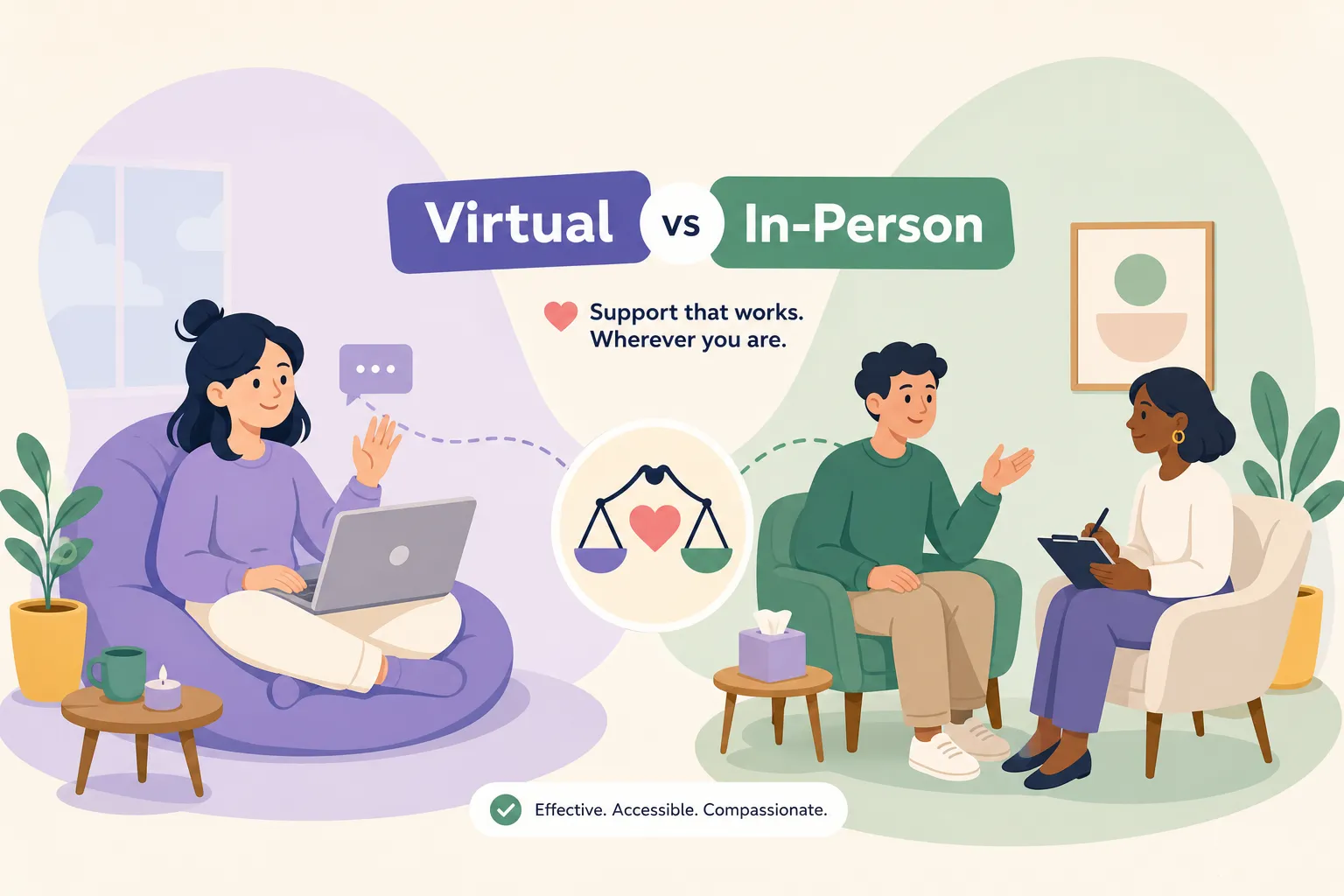
The decision between virtual and in-person therapy doesn’t require a complicated framework. If you’re managing mild-to-moderate anxiety, depression, or PTSD and scheduling or transportation presents real barriers to consistent attendance, virtual therapy is a fully evidence-supported choice. If your symptoms are severe or in an acute phase, if you anticipate needing crisis support, or if trust builds more naturally for you in a physical space, in-person therapy is the stronger starting point. Neither format is categorically better. Both serve different clinical needs, and the research reflects that.
What matters most is not locking yourself into one format permanently. At River North Counseling, clients can move between modalities as their circumstances change. Starting with in-person sessions and shifting to virtual as a demanding work season begins is a real option. Beginning virtually and adding in-person appointments during more intensive treatment phases works equally well. The goal is continuity of care with a therapist who knows your history, not a fixed commitment to one delivery method.
Our practice serves clients in-person at offices in River North and Skokie, and virtually throughout Illinois. If you’re unsure which format fits your current situation, our intake process includes a conversation about your symptoms, schedule, and preferences before any session begins. For local readers interested in an introductory overview, we offer Teletherapy in Chicago: A Beginner’s Guide to Online Therapy that covers practical steps for getting started. The format decision is clinical, not just logistical, and it should be made with guidance from someone who understands your full picture.
The Bottom Line on Virtual Versus In-Person Care
For the conditions most people seek therapy for, the research is consistent: virtual therapy is as effective as in-person therapy sessions when delivered by a skilled clinician. The gap in therapeutic alliance is smaller than most people expect. Treatment completion rates actually favor virtual care. What drives outcomes is finding a therapist whose approach fits your needs and showing up consistently, regardless of where that happens.
The format question is worth taking seriously, but it should not become a barrier to starting. Whether you sit in an office in River North or connect from a quiet room at home, the therapeutic work is what creates change. If you want a general consumer-facing overview to help decide whether online therapy fits your situation, UCLA Health provides a helpful primer: Is online therapy right for you. Assess your current symptoms and schedule honestly, then reach out to a licensed provider who can help you make the format decision based on your specific clinical picture. If you need assistance locating an appropriate clinician or guidance on how to choose, see our local resource: Online Therapy in Chicago: How to Find the Right Therapist.