
If you’ve ever asked yourself, “How do I bring up couples therapy to my partner without starting a fight?” you’re not alone, and you’re not wrong to think the conversation requires some care. For many people, finding a therapist isn’t the hard part. Finding the right words is. The conversation itself can feel like a minefield, and the fear of a partner getting defensive, shutting down, or turning the suggestion into an accusation often keeps it from happening at all.
How you bring it up matters far more than the fact that you’re bringing it up. The timing, the framing, the language you choose, these aren’t small details. They’re what separates a conversation that opens a door from one that slams it shut. This guide walks you through every step, from picking your moment to handling pushback, so you can introduce therapy to your partner from a place of care rather than conflict.
And if you’re already at the point where you just want a low-pressure starting point, practices like River North Counseling in Chicago offer initial consultations specifically designed for couples who aren’t sure where to begin. More on that later.
Important note: If your relationship involves abuse, coercion, or a significant power imbalance, couples therapy may not be the appropriate first step. In those situations, individual support and personal safety should come first. Please reach out to a trusted individual therapist or a crisis resource before pursuing joint counseling.
Timing Is Half the Conversation
The middle of an argument is one of the worst possible moments to suggest therapy. When emotions are running high, both partners are operating from a dysregulated nervous system, and a brain in protection mode simply can’t receive new information the way a calm one can. Your partner’s prefrontal cortex, the part responsible for clear thinking and perspective-taking, goes offline under stress. So even if your words are loving, they’ll land like an accusation. Bringing up counseling mid-conflict greatly increases the likelihood that the suggestion will get tangled up in whatever you were already arguing about.
The right moment looks very different. You’re looking for a window that is private, unhurried, and emotionally neutral. A quiet evening after dinner. A relaxed Saturday morning before the day fills up. A walk in the neighborhood where neither of you is rushing anywhere. Not the car when one of you is driving. Not right before work. Not during errands. The goal is a moment where both of you have enough space to actually hear each other, because that’s the only environment where this conversation has a real chance.
Your own nervous system matters here too. If you go into the conversation already bracing for a fight, your body language and tone will signal that tension before you say a single word. A few minutes of slow, deliberate breathing beforehand, or a short walk to clear your head, may help shift you from guarded to genuinely open. That shift is something your partner will feel, and it changes the entire texture of how the conversation lands.
How to Bring Up Couples Therapy: The Words That Open the Door
Language is the hinge point of this conversation. “I” statements keep the focus on your experience rather than your partner’s behavior, and that distinction matters more than most people realize. “I’ve been feeling disconnected” is fundamentally different from “You never make time for us.” The first invites your partner in. The second puts them on trial.
Before you have this conversation, retire a few specific phrases entirely. “You always” and “you never” close the door before it’s even open. “You need therapy” frames counseling as a correction applied to one person, which almost no one receives warmly. Anything that sounds like blame, a verdict, or hopelessness will activate exactly the defensiveness you’re trying to avoid. Choosing your words deliberately isn’t just stylistic, it’s the difference between extending an invitation and issuing an ultimatum.
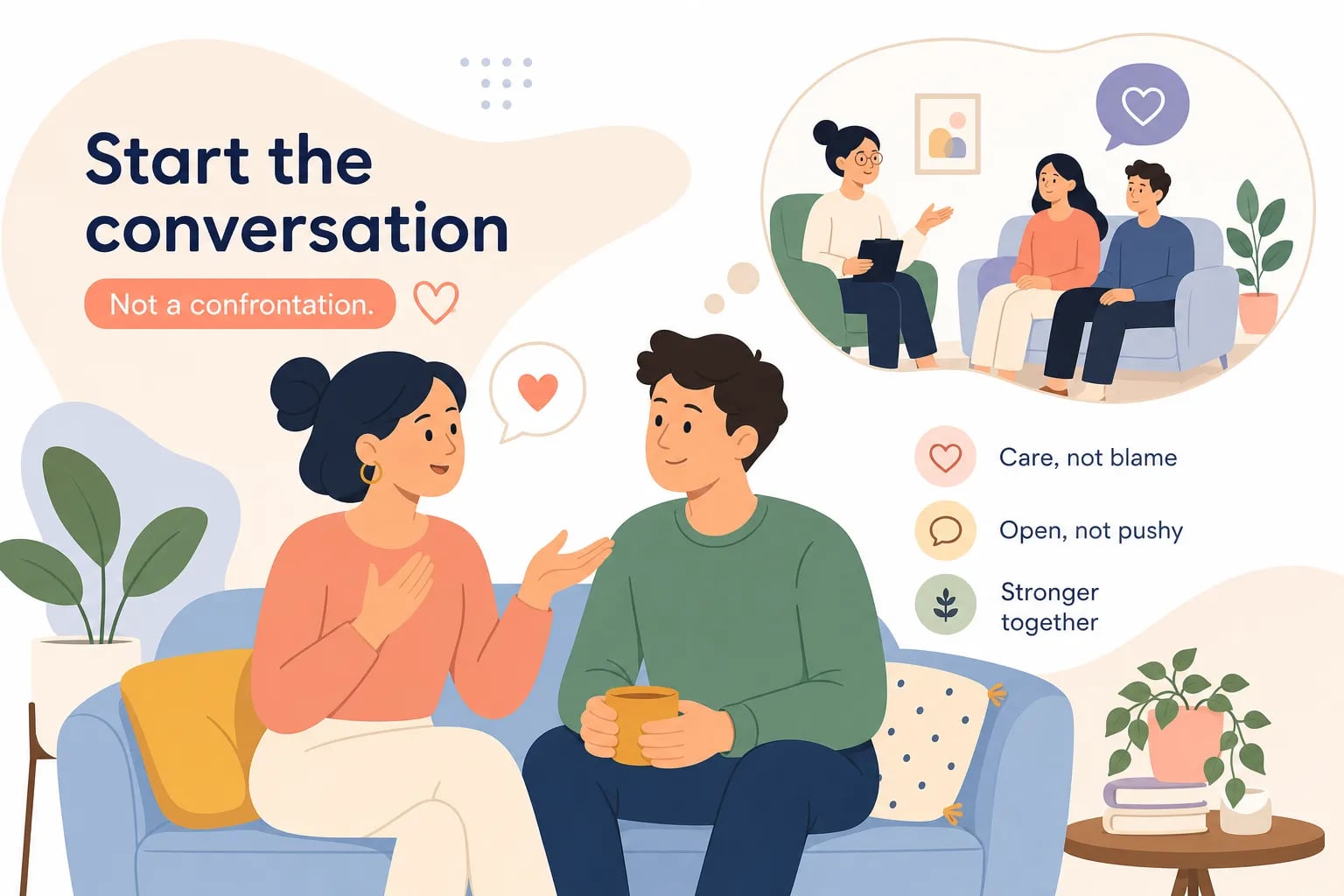
The structure that works best follows a simple pattern: affirm the relationship, name a feeling or need, invite collaboration. Here are four scripts you can adapt word for word when you’re figuring out how to bring up couples therapy without starting a fight:
- “I care about us, and I think couples therapy could help us talk better and feel closer. Would you be open to trying it?” It leads with love, not blame, making it one of the least defensive openers you can use.
- “I’m feeling stuck, and I want help understanding each other better. Could we look for a couples counselor together?” This uses vulnerability and frames the problem as shared.
- “I’m not saying either of us is the problem. I’m saying we might do better with some support.” This directly neutralizes the fear of being blamed before it can take root.
- “I value our relationship enough to want outside help with this. Would you be willing to try a few sessions?” This makes the request concrete and time-limited, which lowers the feeling of being locked in.
Notice what all four scripts share: they position therapy as something you’re doing together, not something being done to your partner. That shared framing reduces defensiveness because it removes the implicit accusation that one person is the problem.
Reframing Therapy as a Relationship Investment, Not a Red Flag
Many partners resist couples counseling because they’ve absorbed a cultural story that therapy means something is seriously broken. That belief is worth addressing directly, because the data tells a different story. Research on couples therapy outcomes, including frequently cited meta-analyses of emotionally focused therapy (EFT), consistently shows that roughly 70 to 75 percent of couples who attend therapy report significant improvement in relationship satisfaction. More importantly, couples who seek help early, before resentment calcifies, tend to have better outcomes than those who wait until the relationship is in crisis. Therapy isn’t what couples do when it’s over. It’s what people who take their relationship seriously do to keep it strong.
One of the most effective reframes is connecting the suggestion to something your partner already cares about, less tension at home, more closeness, better communication around the kids. When the invitation is anchored in your partner’s existing values rather than abstract “relationship health” language, it feels relevant instead of clinical. Try this short exercise before the conversation: identify one or two things your partner has actually said they want more of in your relationship, then build the bridge from that desire to the idea of working with a therapist. That bridge makes the suggestion feel personal, not procedural.
Handling Pushback Without Losing Your Cool
Partners who resist therapy usually do so out of fear, not stubbornness. That fear often takes recognizable shapes, fear of being exposed, fear of being blamed, or even fear that going signals the relationship is already over. Understanding what’s driving the objection makes it much easier to respond with empathy instead of frustration, and empathy is the only thing that actually moves the conversation forward.
Here’s how the most common objections translate, and how to respond to each one calmly:
- “We don’t need therapy. It’s not that bad.” This is often fear of what sessions might uncover. Try: “I hear that you don’t see this as urgent. I’m asking because I want help before things get worse, not because I think we’re hopeless.”
- “The therapist will just take your side.” This is fear of being ganged up on. A good response: “My hope is for a neutral person who helps both of us feel heard, not someone who teams up with either of us.”
- “Talking about this will just make us fight more.” This is a fair concern, and worth acknowledging as such: “A therapist can actually help slow the conversation down and keep it from turning into the same argument we already have at home.”
- “I’m afraid we’ll break up if we go.” This is real vulnerability. Meet it gently: “I get why that feels scary. My goal is to understand what’s happening between us, not to push us apart.”
- “This just isn’t me.” Keep it low-pressure: “You don’t have to become a different person. I’m asking for one conversation with a professional to see whether it helps.”
The principle behind all of these responses is the same: acknowledge the concern first, offer a reframe, then leave the door open. Don’t argue point by point. Don’t push. Pressure reliably produces resistance. Patience reliably produces openings.
Lowering the Stakes So Saying Yes Feels Possible
A permanent commitment to couples therapy can feel enormous to a hesitant partner. A single session does not. When you frame the first step as a one-time experiment rather than a long-term obligation, resistance drops significantly. “Can we just try one session and then decide together?” removes the feeling of being locked in and gives both of you agency over what comes next. The smaller the initial ask, the more likely your partner is to say yes, and getting to that first session is really all you need right now.
This is where the practical structure of a practice matters. River North Counseling offers initial consultations specifically designed for couples who aren’t sure whether therapy is right for them or what it would even look like. These sessions are exploratory rather than obligatory, structured around understanding your situation, not committing to a full treatment plan. For a hesitant partner, knowing the first conversation is a no-pressure check-in can shift the answer from “maybe” to “yes.” River North Counseling works with couples both in-person at their Chicago and Skokie offices and virtually across Illinois, so scheduling around a demanding work life doesn’t have to be another barrier. Virtual sessions remove the commute factor entirely, which can make a real difference for couples managing already-packed schedules.
The First Conversation Is the Hardest Part
For most couples, the hardest part of getting into therapy isn’t the work inside the sessions. It’s taking that first step. And that first step begins with one calm, caring conversation, at the right moment, in the right words, with the right level of patience for whatever comes back.
When you’re thinking through how to bring up couples therapy to your partner without starting a fight, four moves make the biggest difference: choose a calm, private moment; lead with “I” language that centers your experience rather than your partner’s faults; reframe therapy as a sign that you take the relationship seriously; and offer the smallest possible first step. Those moves won’t guarantee a “yes” the first time. But they give the conversation its best possible chance.
If you’re ready to take that step, reaching out to a practice like River North Counseling is a natural, low-pressure way to begin. You don’t have to have it all figured out before you call. You don’t have to know what to say to a therapist any more than you need to have the perfect words for your partner right now. Starting the conversation, with your partner or with a counselor, is enough. The rest gets easier from there.