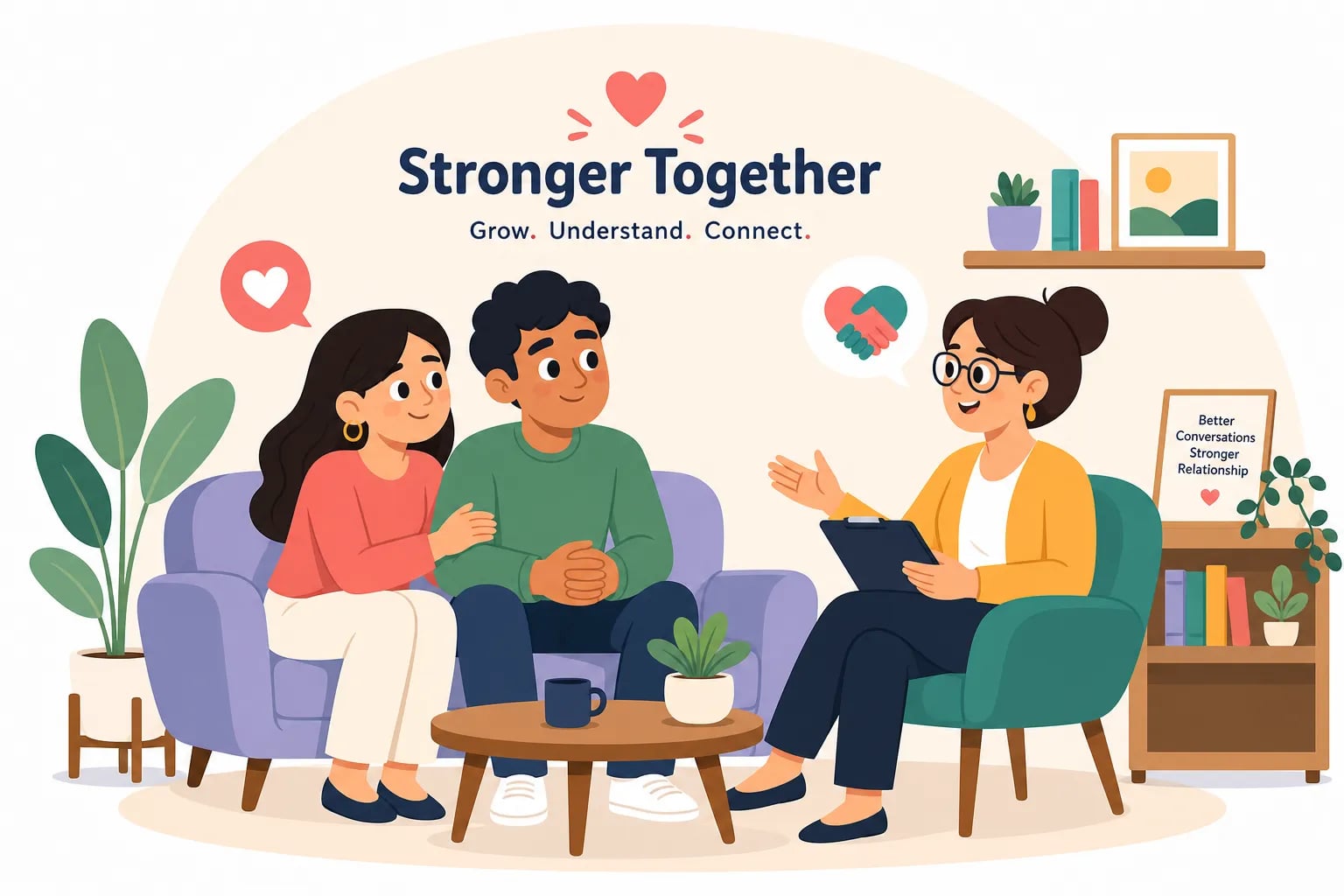

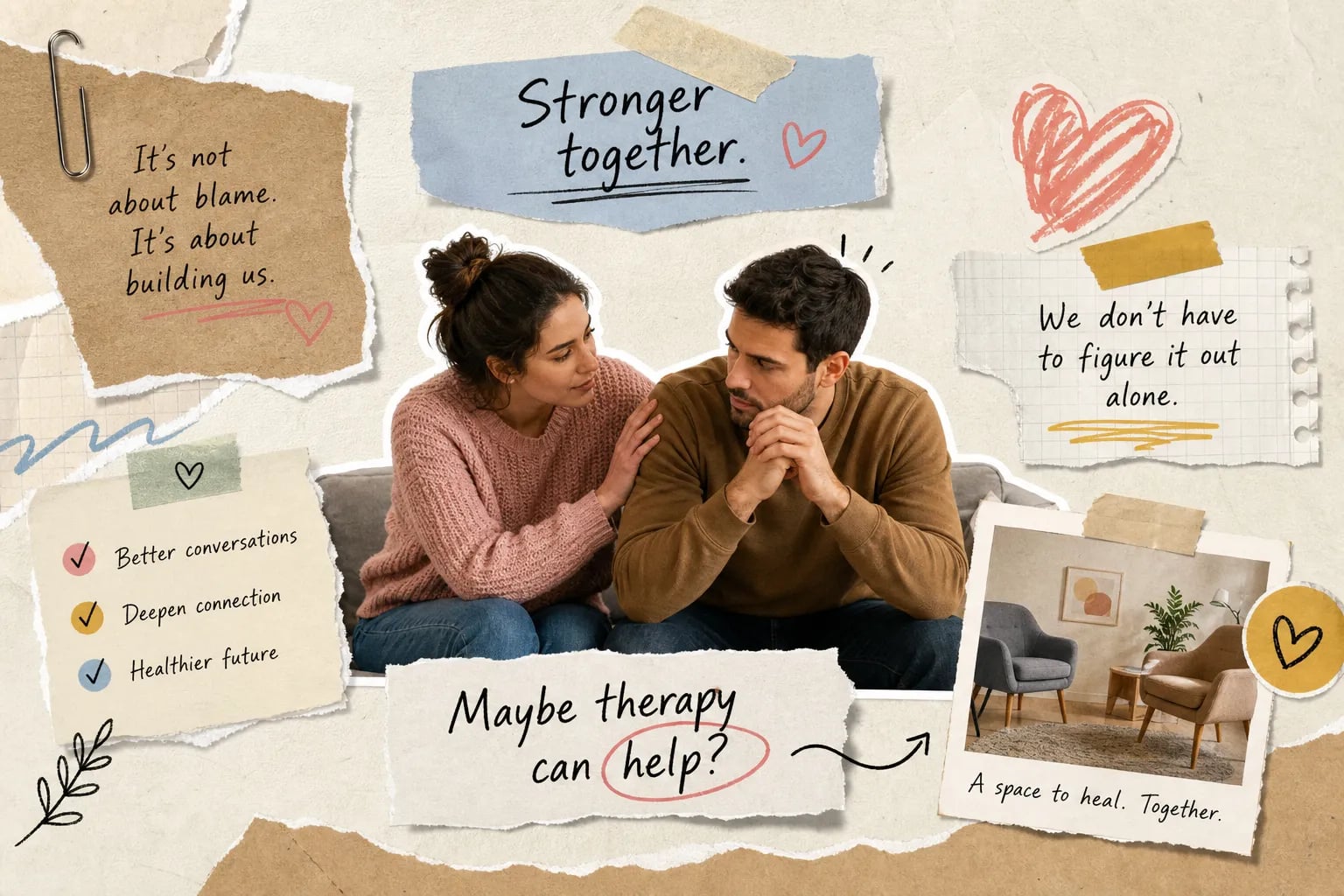
You can see what’s happening. The same argument loops back every few weeks. The distance feels a little wider each time. You’ve thought about couples therapy, maybe even researched it, but every time you bring it up, the answer is some version of no. If you’re trying to figure out how to convince your partner to try couples therapy, you’re already in one of the most frustrating places a relationship can land: you’re motivated to work on things, and your partner isn’t ready to take that step.
At River North Counseling, therapists commonly hear a version of this story. One of the first things couples say in early sessions is that they almost didn’t come because one partner kept saying no. Those same couples often go on to make meaningful, lasting progress, a pattern supported by decades of outcome research on evidence-based couples therapy. Where you are right now, wanting help and not sure how to get your partner on board, is not a dead end. It’s a starting point.
By the end of this article, you’ll have a clearer picture of what’s actually driving your partner’s resistance, the words and timing that make the conversation go better, and a first step that’s small enough to feel manageable for both of you.
What “No” Usually Means When a Partner Resists Therapy
Resistance to couples counseling almost never means your partner doesn’t care about the relationship. More often, it signals something specific worth understanding: fear of being judged, shame about needing outside help, a worry about being outvoted in the room, or a genuine misunderstanding of what relationship counseling actually involves. When you know what’s underneath the refusal, you stop trying to win an argument and start responding to something real.
In practice, resistance tends to show up as dismissiveness or logic-based objections: “we can handle this ourselves,” or “we’re not that bad.” But that surface-level pushback is often vulnerability in disguise. Someone who grew up believing that therapy is for people who’ve already failed will carry that meaning into every conversation about it. The words sound practical, but the feeling underneath is closer to shame or fear.
This reframe changes your entire approach. When you lead with curiosity instead of persuasion, your partner stops feeling cornered. You’re no longer making an argument they have to defeat. You’re opening a conversation they can actually join.
How to Convince Your Partner to Try Couples Therapy: Timing Tips
Even the right words can fail at the wrong moment. Couples therapists consistently point out that when and where you raise the idea matters as much as how. Bringing it up mid-argument, right after a tense night, or in the ten minutes before bed almost guarantees a defensive response. The goal is a window of calm, not an emotional peak.
Settings that reduce defensiveness
A quiet evening walk, a neutral moment over coffee when things feel okay between you, or even a low-key text during a calm part of the day, these contexts signal partnership rather than confrontation. What therapists who work with reluctant partners describe as a “neutral state” conversation is exactly this: you’re not reacting to anything, and neither is your partner. You’re just two people who care about each other, talking.
Timing mistakes that tend to backfire
Avoid raising the idea right after a fight, in a public setting where your partner can’t respond honestly, or as the last thing you say before one of you falls asleep. Also worth noting: opening with “we need to talk” often prompts defensiveness before you’ve said anything, a pattern well-documented in Gottman-oriented communication guidance. Instead, start with something low-stakes, give the conversation some room, and let it breathe before you get to the ask.
Scripts to Convince a Hesitant Partner to Try Couples Therapy
The exact words you use aren’t everything, but they matter more than most people realize. Knowing how to ask your partner to go to counseling in a way that doesn’t feel like an accusation is half the battle. Gottman Method and Emotionally Focused Therapy (EFT) approaches share the same core principle: speak from your own experience, frame therapy as something you want to do together, and keep the first ask small. Avoid anything that implies your partner is the problem or that the relationship is broken.
The “I” statement approach and why it changes the room
Language that centers your own feelings rather than your partner’s behavior tends to reduce defensiveness immediately. A few examples that therapists consistently recommend:
- “I love us, and I’ve noticed we keep getting stuck in the same spot. I’d like to have some support working through it together.”
- “I want us to get better at this, and I think a neutral space could help. Would you be open to exploring it?”
- “I feel like we have something worth investing in. Couples counseling feels like a way to do that.”
These lines work because they don’t position your partner as the obstacle. You’re not saying they broke something. You’re saying you want to build something, and you’d like them with you.
The low-commitment ask: one session, not a life sentence
“Would you come with me to one session?” is a fundamentally different question than “we need couples counseling.” The first ask is bounded, specific, and low-risk. Your partner can picture it. They can agree to something concrete without feeling like they’re signing up for an indefinite process, and when the first step is small, people are far more willing to take it.
How to invite your spouse to therapy after they’ve already said no
A previous no is not a permanent answer. If you need to revisit the idea, try something like: “I’m not bringing this up to pressure you. This is still something I’d really like for us, and I think I’d feel better if we had some support. Would you be willing to take another look at it?” That framing acknowledges their earlier answer, removes the pressure, and gives them room to reconsider without losing face.
How to Respond When Objections Come Up
Even a well-framed invitation will meet resistance. Having a calm, ready response to common objections keeps the conversation open rather than shutting it down. The goal isn’t to argue your partner into therapy, it’s to address the real fear underneath so they can make a clearer choice.
“The therapist will just take your side”
This is one of the most common fears, and it makes sense. No one wants to walk into a room and feel outnumbered. A useful response: couples therapists are trained to focus on patterns between partners, not on assigning fault. They’re not judges. Framing the therapist as a neutral coach rather than a referee helps. You can also offer to choose a therapist together, which gives your partner real ownership over the process from the start.
“We’re not bad enough to need counseling”
This objection reflects a widespread myth: that relationship counseling is only for couples on the edge of separation. A direct, non-defensive response is to reframe it as maintenance rather than crisis intervention. The analogy to physical health is apt, you don’t wait for a serious injury to start taking care of your body. Research on early intervention in couples therapy consistently suggests that partners who seek support before reaching a crisis point have more emotional resources and relational flexibility to work with.
“I don’t think it’ll work”
Skepticism is worth validating rather than arguing against. You can say: “I hear that. I don’t know for sure either. What if we tried three or four sessions with a clear check-in point, and then decided together whether to keep going?” A time-limited trial reduces the perceived risk. Your partner can see the exit from the start, which makes saying yes feel like a lot less of a leap.
A Low-Stakes First Step That Makes Saying Yes Easier
One of the most effective shifts you can make is moving the ask away from “couples therapy” as a concept and toward a single, concrete action. For many reluctant partners, the idea of therapy feels abstract and daunting, a specific, no-commitment first step feels manageable by comparison.
What a one-session consultation actually looks like
A consultation or intake session is exactly what it sounds like: one meeting where both of you meet the therapist, ask questions, and decide whether to continue. There’s no contract, no expectation that you’ll keep going, and no pressure to open up about everything at once. It functions as an information session as much as a therapy session. Many couples report that the first meeting reduces much of the anxiety they brought in with them.
How River North Counseling makes starting easier
River North Counseling offers both in-person sessions at their offices in River North and Skokie, and virtual sessions via telehealth for clients across Illinois. For a hesitant partner, a virtual consultation from home often feels significantly less intimidating than showing up to an office for the first time. The practice also matches couples with therapists based on the specific dynamic they’re navigating, so the first session is shaped around your situation from the start, not a generic intake process.
If they still say no after all of this
Sometimes, even after a calm conversation with good timing and honest language, a partner isn’t ready. That’s a real possibility, and it deserves an honest response. Individual therapy is a valid next step. Going to therapy on your own doesn’t mean you’ve given up on the relationship, it means you’re investing in how you show up in it, and it means you’re not stuck waiting. Sometimes one partner starting therapy on their own is exactly what eventually opens the door for both.
Frequently Asked Questions About Convincing a Partner to Try Therapy
How do I ask my partner to go to counseling without starting a fight?
Choose a calm, neutral moment, not during or immediately after a conflict. Use “I” statements that describe your own feelings rather than your partner’s behavior, and frame the ask as something you want to do together, not something they need to fix. Asking about one session, rather than committing to an ongoing process, also lowers the stakes considerably.
What if my partner refuses marriage counseling entirely?
A refusal is rarely the final word. Revisit the conversation at a different time with softer language, address the specific fear underneath the objection, and consider offering a time-limited trial of a few sessions with a defined check-in point. If your partner remains unwilling, individual therapy is a meaningful step you can take on your own.
Is there a way to convince a hesitant spouse to try couples therapy without pressuring them?
Yes. The most effective approach combines good timing, low-pressure framing, and a small first ask. Inviting your spouse to a single consultation, rather than proposing open-ended therapy, gives them a concrete, bounded choice. Letting them have input on selecting the therapist also helps them feel like an active participant rather than someone being pushed into a process.
Taking the Next Step, Even If It’s Just You
The reason you’re looking for a better way forward is straightforward: the relationship matters to you. That intention, handled with the right timing and language, is something most partners can feel even through their resistance. No single conversation has to carry all the weight. The goal right now is one small, honest, low-pressure ask.
If you’re wondering how to convince your partner to try couples therapy, or if you’re ready to take that first step yourself, River North Counseling offers couples consultations in Chicago and virtually across Illinois. Reaching out doesn’t require having everything figured out. It just requires starting, and that’s something you can do today.