

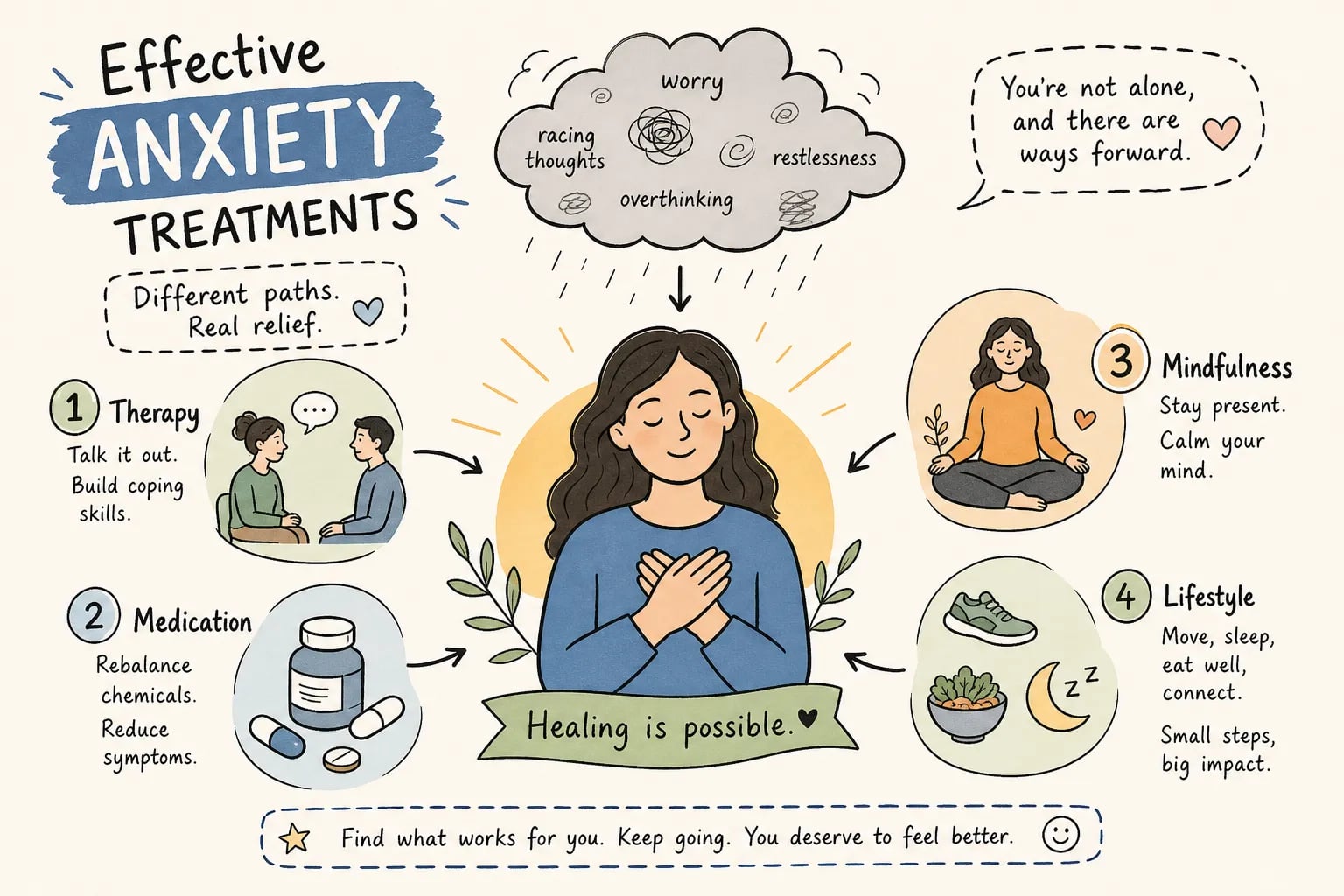
Anxiety treatment falls into three main categories: structured psychotherapy, medication, and non-medication self-management strategies. Research is clear that cognitive behavioral therapy (CBT) and certain medications carry the strongest evidence. For many people, especially those with moderate-to-severe symptoms, combined care is commonly recommended. Natural remedies and immediate coping tools play a meaningful supporting role, but they work best alongside clinical care, not as a replacement for it.
Knowing your options is only the first step. Matching the right treatment to the right person matters just as much. The sections below are a roadmap through each category, giving you enough to have an informed conversation with a clinician and take a confident next step.
Key takeaways
- CBT is first-line: Cognitive behavioral therapy has the strongest overall evidence for anxiety disorders, with response rates around 53% and remission rates around 54% in randomized controlled trials for GAD, according to a 2025 systematic review.
- Medication complements therapy: SSRIs and SNRIs are the go-to first-line medications, effective across GAD, panic disorder, and social anxiety, though benefits build over several weeks.
- Natural remedies have limits: Supplements like chamomile and kava have preliminary supporting evidence, but none are ready to replace structured treatment for diagnosed anxiety disorders.
- Coping tools help now: Paced breathing, sensory grounding, and progressive muscle relaxation can reduce physiological arousal within minutes during acute anxiety.
- Finding the right fit matters: Disorder-specific training in a therapist matters more than a generic “CBT” profile listing.
Anxiety treatment: which therapy works best?
Psychotherapy is the most commonly recommended first-line anxiety treatment for anxiety disorders, and not all therapies are equal in the evidence. The research consistently points to one approach above the rest.
Why CBT is the frontline recommendation
CBT for anxiety is a structured, skills-based approach that targets the connection between thoughts, behaviors, and physical symptoms. Across 41 randomized controlled trials, CBT showed a moderate benefit over placebo with a pooled effect size of g=0.56, and it nearly tripled the odds of response versus placebo with an odds ratio of 2.97, according to research published in PMC. For GAD specifically, a 2025 systematic review of 22 randomized trials estimated a CBT response rate of 53% and a remission rate of approximately 54%, compared to roughly 18% remission in control conditions. That gap is clinically meaningful. CBT has strong evidence across generalized anxiety disorder, panic disorder, and social anxiety disorder, making it the most broadly applicable therapy available.
How exposure therapy fits within CBT
Exposure therapy is one of CBT’s most powerful components, not a separate approach. It works by systematically confronting feared situations or sensations until the anxiety response diminishes. For specific phobias, OCD (as exposure and response prevention, or ERP), panic disorder with interoceptive exposure, and social anxiety, exposure is often the primary active ingredient. Research published in Springer indicates that in-vivo exposure consistently outperforms imaginal exposure for specific phobias, so physically facing the feared situation produces stronger and more lasting results than imagining it.
What about ACT and mindfulness-based approaches?
Acceptance and Commitment Therapy (ACT) and mindfulness-based CBT are credible, evidence-supported anxiety therapy options, particularly for GAD. A 2024 network meta-analysis found that both third-wave CBTs and standard CBT produced moderate-to-large benefits over usual care, with no statistically significant difference between active psychotherapies. However, only standard CBT showed clear long-term effectiveness after stricter analyses, per research published in Tandfonline. ACT is a solid choice when you prefer an acceptance-based framework or when standard CBT has already been tried, but it doesn’t outperform CBT as a starting point.
Medications for anxiety treatment: what to expect
Medication for anxiety disorders can be highly effective, especially when combined with therapy. The right choice depends on the specific disorder, the individual’s health history, and what other treatments are already in place.
SSRIs and SNRIs: the go-to first-line options
SSRIs and SNRIs are the most commonly prescribed medications for anxiety disorders, with a better long-term safety profile than older options like benzodiazepines. Common SSRIs include escitalopram, sertraline, paroxetine, and fluoxetine. Venlafaxine XR and duloxetine are the primary SNRIs used. For social anxiety disorder and panic disorder, sertraline, paroxetine, and venlafaxine XR all carry FDA indications for both conditions. Fluoxetine holds a narrower FDA indication specific to panic disorder, according to research published in PMC. Benefits build over several weeks and include reduced worry, fewer panic attacks, and less avoidance. Common side effects include nausea, sleep changes, early jitteriness, and sexual side effects. Clinicians typically start with a low dose and titrate slowly to reduce those early effects.
Other medications worth knowing
Buspirone is a non-addictive option well-suited to GAD, particularly when SSRIs or SNRIs aren’t tolerated. It has a slower onset and doesn’t provide acute relief during panic attacks. Benzodiazepines such as lorazepam and alprazolam act fast and can help bridge the gap while an antidepressant takes effect, but they carry dependence risk and are not appropriate as routine long-term treatment. Beta-blockers like propranolol reduce physical symptoms before a specific event but don’t address generalized worry or avoidance. Hydroxyzine offers short-term relief without the dependence risk of benzodiazepines, though drowsiness is a common side effect.
Do natural remedies actually help with anxiety?
Many people reach for supplements first because they feel more accessible, lower-cost, or safer than prescription options. Some do have preliminary supporting evidence, but none are ready to replace CBT or medication for diagnosed anxiety disorders. “Natural” also does not mean risk-free, and that distinction matters significantly when making treatment decisions.
What the research says about common supplements
Chamomile has the most reassuring safety profile of the commonly studied options. Trials using standardized chamomile extract at 1,500 mg per day showed some benefit for GAD symptoms, though a 2019 meta-analysis found no significant overall effect on anxiety diagnosis rates. The doses studied in clinical trials are not equivalent to ordinary chamomile tea. Kava has comparatively stronger efficacy evidence, with small-to-moderate short-term anxiety reduction in trials, but its rare risk of severe liver injury makes unsupervised use a poor choice. Ashwagandha is promising for stress-related symptoms in small trials, but the evidence remains insufficient for clinical anxiety disorders, and long-term safety data is limited. Magnesium’s evidence is the weakest of the four supplements discussed here; it’s most plausible when dietary intake is low, according to research from the National Institutes of Health.
The safety concerns that change the calculation
Kava’s liver-toxicity risk is the most serious concern across this group, and it should only be considered under clinician supervision with a reputable, standardized product. All four supplements can interact with other medications: chamomile can increase bleeding risk with anticoagulants like warfarin; ashwagandha can interact with thyroid medications and sedatives; magnesium can reduce absorption of certain antibiotics and levothyroxine. Standardized capsules used in research are not the same as low-dose store products or teas. Discuss any supplement with a clinician before starting, especially if you’re taking other medications.
Quick anxiety treatment tools for moments of acute stress
These anxiety management techniques reduce physiological arousal quickly. They cover three practical approaches: paced breathing, sensory grounding, and progressive muscle relaxation. Think of them as a toolkit for acute anxiety, not a substitute for structured treatment.
Paced breathing: the fastest reset available
Inhale gently through your nose for 4 seconds, then exhale slowly for 6 seconds. A longer exhale prolongs the phase in which parasympathetic input slows the heart, modestly increasing heart-rate variability and reducing cardiovascular arousal. Aim for 10 to 15 cycles. If counting increases stress, simply make the exhale slightly longer than the inhale. Avoid deep or rapid breaths: overbreathing can worsen dizziness and tingling, which are already common during panic.
Sensory grounding and progressive muscle relaxation
The 5-4-3-2-1 grounding method redirects attention from threat-focused rumination to present-moment sensory input. Name 5 things you see, 4 you can physically feel, 3 sounds you hear, 2 smells, and 1 taste. Describe each one concretely rather than evaluating it. For anxiety that includes marked physical tension, progressive muscle relaxation (PMR) is a strong complement: tense each muscle group for about 5 seconds, release for 10 to 15 seconds, and move through the body from feet to face. PMR works best when tension is a central feature; paced breathing acts faster during peak panic.
How to find the right anxiety care and take the next step
When you’re ready to go beyond in-the-moment tools, finding the right clinical support is the logical next step. The gap between knowing what anxiety treatment is and actually accessing it is where many people stall. Here’s how to close that gap efficiently.
What to look for when choosing a therapist
For anxiety disorders, disorder-specific training matters more than a general “CBT” listing on a profile. Ask directly: “Do you provide structured CBT for my specific concern?” and “How do you measure progress?” A therapist with solid training should be comfortable explaining their education, supervision history, and which protocol they’d use for your particular presentation. The APA Psychologist Locator and the ABCT Find-a-Therapist directory are reliable starting points for finding CBT-trained clinicians. Check insurance coverage before scheduling: confirm whether teletherapy is covered, what your copay and deductible look like, and whether a referral is required.
What to expect in your first few sessions
Session one covers your history, goals, and confidentiality. You don’t need to share everything at once; share what feels relevant and manageable. Sessions two and three typically involve formulation: the therapist explains how your thoughts, emotions, behaviors, and physical symptoms appear connected. By sessions three through six, the focus shifts to active skill-building, examining unhelpful patterns and avoidance, and reviewing what’s working. You should feel respected, understand the direction of treatment, and have a way to track progress. If that’s not the case by session six, raise it directly or consider finding a better fit.
River North Counseling: personalized anxiety care in Chicago
At River North Counseling, we’re a licensed group practice with in-person offices in River North and Skokie, and virtual therapy available across Chicagoland. Our team includes CBT-trained therapists who work with adults navigating GAD, panic disorder, social anxiety, and related concerns. Our intake and matching process is designed to pair each person with a therapist suited to their specific goals and presentation, not simply the next available opening. Whether you prefer to come in person or access care virtually, we work to make evidence-based treatment accessible on your terms.
The most important step is starting
Anxiety treatment works best when it’s matched to the specific disorder, the person’s preferences, and their real-life circumstances. CBT has the strongest overall evidence base across anxiety disorders. Medication is a well-supported complement or alternative, particularly for those with moderate-to-severe symptoms. Immediate coping tools give you something practical while longer-term care gets underway. And natural remedies can play a supporting role, but should not substitute for structured treatment when anxiety is causing real impairment.
The most common mistake people make is waiting until they have the perfect plan before acting. The evidence supports moving toward care now: calling a practice, checking your insurance for in-network therapists, or booking an introductory call. Reach out to our team at River North Counseling to learn more about our services and take that first step toward relief.
Frequently Asked Questions
How long before I might notice improvement from medication for anxiety?
You can expect medication benefits to build over several weeks. Clinicians typically start with a low dose and titrate slowly to reduce early side effects like nausea or jitteriness, so initial improvement may be gradual rather than immediate.
How many therapy sessions does it usually take for CBT to start helping?
You can expect initial assessment and formulation in the first two to three sessions and active skill-building to begin by sessions three through six. Those sessions focus on examining unhelpful patterns and practicing skills, with measurable progress tracked as treatment continues.
Can natural remedies like chamomile or kava replace CBT or medication for diagnosed anxiety disorders?
No, natural remedies are not ready to replace structured treatment for diagnosed anxiety disorders. Some supplements show preliminary benefits but have limits and safety concerns, kava carries rare liver-toxicity risk and chamomile, ashwagandha, and magnesium can interact with other medications, so they are best considered only as complements under clinician supervision.
Are the quick coping tools described a substitute for clinical care?
No, paced breathing, sensory grounding, and progressive muscle relaxation are practical tools for acute anxiety but are not substitutes for structured treatment. They reduce physiological arousal in the moment and can support you while longer-term CBT or medication gets underway.