
One of the most common questions we hear from first-time callers at River North Counseling is some version of this: “I know I need help, but I don’t know whether I need a therapist vs. a psychiatrist.” It’s a genuinely confusing question, and the confusion makes complete sense. The mental health field uses overlapping terms, trains providers across different academic paths, and hasn’t done a great job of explaining itself to the people it’s meant to serve.
This guide is for the person standing at the door, not the clinician in the room. By the time you finish reading, you’ll understand what therapists and psychiatrists actually do, how to decide which one fits your situation right now, and when working with both is the clearest path forward. No jargon, no pressure. Just a practical breakdown so you can take the next step with confidence.
What therapists actually do (and who counts as one)
“Therapist” is an umbrella term, not a single license. Several different credentials fall under it, and understanding the differences can help you choose the right fit from the start.
The major license types
Licensed Clinical Social Workers (LCSWs) hold a master’s in social work plus supervised clinical hours. They’re trained to see mental health through a broader lens, how factors like relationships, work stress, family history, and social circumstances shape psychological well-being. Licensed Marriage and Family Therapists (LMFTs) also hold a master’s degree, but their training centers on relational and family systems theory, making them especially well-suited for couples work, parenting challenges, and recurring relationship patterns.
Licensed psychologists (PhD or PsyD) hold doctoral degrees and are trained for both psychotherapy and formal psychological and neuropsychological assessment. In most U.S. states, none of these providers can prescribe medication. The right license type for you often depends on what you’re working on. Relationship dynamics or family conflict? An LMFT is often a strong match. Navigating a mix of life stressors and mental health symptoms? An LCSW brings a practical, systems-aware approach. Need both therapy and formal testing? A psychologist covers both bases.
How psychotherapy works in practice
Therapists deliver evidence-based treatments tailored to what you’re dealing with. Cognitive Behavioral Therapy (CBT) is the most widely researched approach, with strong evidence for anxiety, depression, panic disorder, OCD, PTSD, phobias, and insomnia. Dialectical Behavior Therapy (DBT) is particularly effective for emotion dysregulation and borderline personality disorder. For trauma and PTSD, EMDR and trauma-focused CBT are the leading approaches, while psychodynamic and interpersonal therapies work well when depression or anxiety is rooted in relationship patterns or unresolved grief. Sessions are typically 45 to 60 minutes, scheduled weekly or biweekly during active treatment.
Conditions that respond well to talk therapy alone
Clinical guidelines consistently support psychotherapy as a primary or standalone treatment for mild to moderate anxiety disorders, panic disorder, social anxiety, phobias, PTSD, OCD, and depression tied to life circumstances or interpersonal stress. The key is matching the therapy type to the condition. CBT for anxiety, EMDR for trauma, and interpersonal therapy for grief-related depression aren’t interchangeable, the match matters as much as the method.
Therapist vs. psychiatrist: what psychiatrists do and when their expertise matters
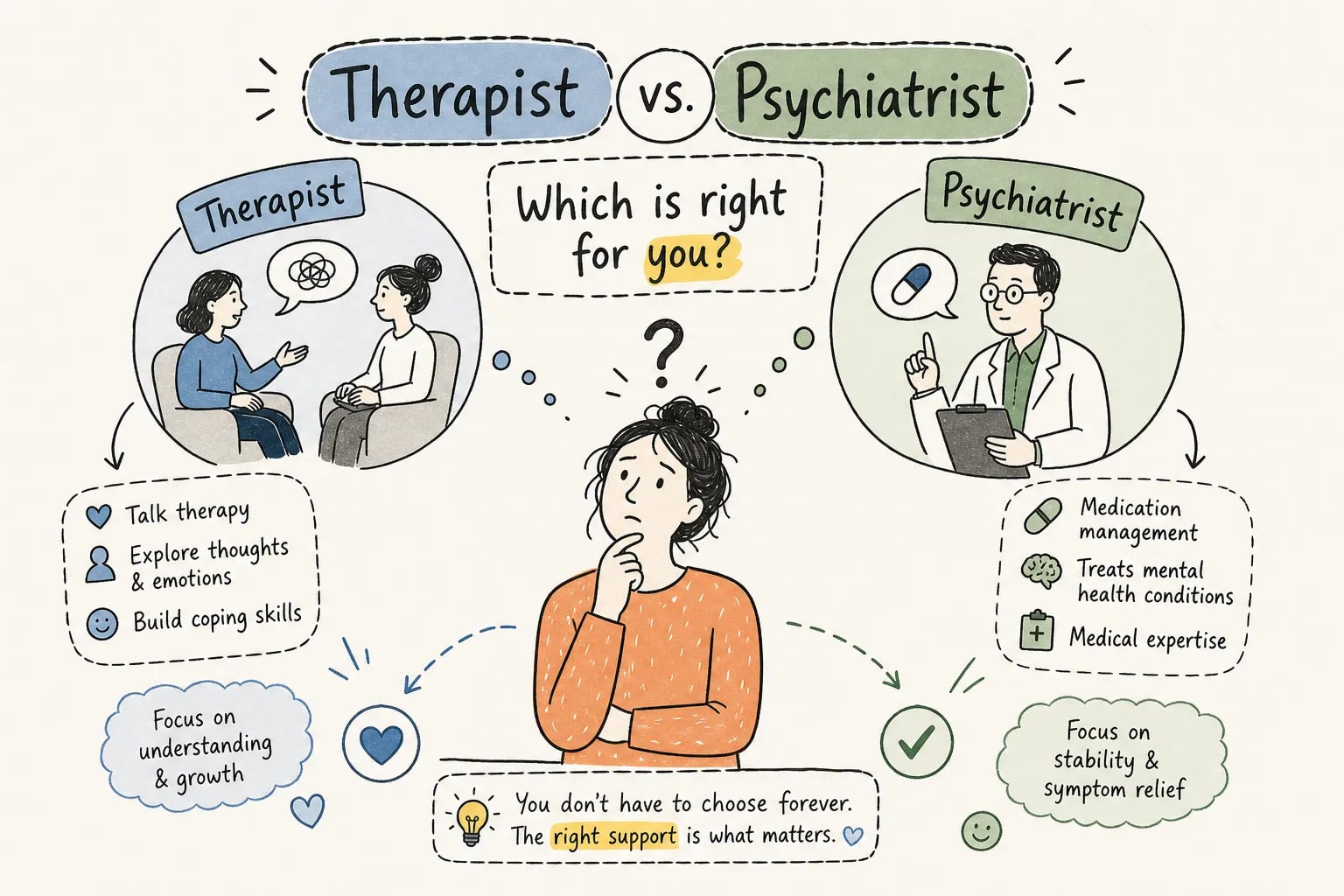
Psychiatrists are physicians. They complete medical school (earning an MD or DO) and then a psychiatry residency. That path gives them the medical training to rule out physical causes of symptoms and the prescribing authority to manage psychiatric medications. Some psychiatrists also provide psychotherapy, but most focus primarily on evaluation and medication management.
Conditions that typically require medication management
For certain diagnoses, medication is often central to treatment rather than optional. These include:
- Bipolar disorder, which typically requires mood stabilizers
- Schizophrenia and other psychotic disorders, treated primarily with antipsychotics
- ADHD, which responds to stimulant or non-stimulant prescription medications
- Severe major depression, moderate to severe anxiety disorders, OCD, and PTSD with significant biological symptoms such as hyperarousal, nightmares, or persistent agitation
This isn’t an either/or situation. Many of these diagnoses benefit from both medication and therapy, and research consistently supports combined treatment for better outcomes.
Where psychiatric nurse practitioners fit in
Psychiatric Mental Health Nurse Practitioners (PMHNPs) are advanced practice nurses with specialized psychiatric training who can prescribe medication in all 50 states. For many people seeking medication management, a PMHNP provides services similar to those of a psychiatrist and is often more accessible. In Chicago, wait times for psychiatrists can stretch significantly longer than for PMHNPs or therapists, so knowing this option exists matters if you need a medication evaluation and don’t want to wait months for an appointment.
The practical differences that affect your experience
The two care models look very different in day-to-day practice, and understanding those differences helps you set realistic expectations before you book your first appointment.
Session length, frequency, and cost
A psychiatric intake is typically 60 to 90 minutes. In Chicago, self-pay costs for an initial psychiatric evaluation generally run $200 to $375. Follow-up visits are much shorter, usually 15 to 30 minutes, and cost roughly $100 to $300 depending on the practice. Once a medication is stable, those follow-ups often shift to every few months rather than weekly.
Therapy sessions run 45 to 60 minutes and typically cost around $150 per session in Chicago, with appointments usually scheduled weekly or biweekly during active treatment. The per-session costs may seem comparable, but therapy’s higher frequency means annual costs add up differently. Neither option is inexpensive without insurance, which is worth factoring into your planning early.
Telehealth has changed access significantly
Both therapy and medication management are now widely available via telehealth across Illinois, and the format doesn’t meaningfully change the pricing structure. Telepsychiatry initial evaluations typically run $300 to $350, with follow-ups around $150 to $225 depending on the provider. Teletherapy is priced similarly to in-person sessions. For working professionals in Chicago who can’t easily leave the office midday, virtual options have removed one of the biggest logistical barriers to starting care.
Therapist vs. psychiatrist: how to decide which provider to see first
Most people don’t know with certainty what they need when they first reach out for help. That’s normal. What follows is a practical framework, not a diagnostic tool. Use it to get a direction, not a definitive answer.
Start with a therapist if your symptoms point here
Talk therapy is the right entry point if you’re dealing with persistent anxiety that interferes with daily life but doesn’t involve active crisis, moderate depression tied to life stress or relationship patterns, grief or a major life transition, or a desire to build coping skills and change behavioral habits. Therapy is also a useful starting point if you’re not yet sure what you need. A skilled therapist conducts a thorough intake assessment and can identify whether a psychiatric referral is warranted. Starting with therapy doesn’t close the door to medication, it often opens that conversation in a more supported, informed way.
For those in Chicago navigating these concerns, the licensed therapists at River North Counseling offer CBT, trauma-informed care, and a matching process designed to pair each client with the right provider from the first session. In-person appointments are available in River North and Skokie, with virtual sessions available across Illinois.
Go to a psychiatrist or PMHNP if these apply
A psychiatric evaluation is the more urgent starting point if your symptoms are severe enough to cause significant functional impairment, if you have a history of bipolar disorder or psychosis, if previous medication helped and you’ve since stopped it, if ADHD has gone unmanaged, or if you’ve already tried therapy without meaningful relief. Being honest with yourself here matters more than getting the taxonomy exactly right. Seeing the “wrong” provider first doesn’t set you back permanently, but if medication is likely part of your picture, going straight to a prescriber gets you there faster.
When therapist and psychiatrist together is the answer
Combined care isn’t a last resort, and it’s not a sign that things are especially complicated. For many conditions, it’s simply the most effective approach from the start.
Conditions that consistently benefit from combined treatment
Research supports better outcomes with combined care than with either treatment alone for moderate to severe depression, most anxiety disorders, OCD, PTSD, and bipolar disorder. The clinical logic is straightforward: medication reduces the biological symptoms that make it hard to engage with therapy, disrupted sleep, persistent agitation, intense anxiety. Once those symptoms are managed, therapy becomes more effective at addressing the behavioral patterns, cognitive distortions, and interpersonal dynamics that medication doesn’t touch. The two treatments work on different parts of the problem, which is exactly why they work better together for many people.
How collaborative care actually coordinates
In outpatient collaborative care, the therapist handles psychotherapy and monitors emotional progress. The psychiatrist or PMHNP manages medication and adjusts dosing as needed. Both communicate regularly through shared notes, brief check-ins, or direct coordination calls to keep the treatment plan aligned. In practice, the client often serves as the link between providers, bringing updates from one to the other at each appointment.
The goal is straightforward: two focused professionals working toward the same outcome rather than treating the same person in isolation. When collaborative care works well, the whole genuinely exceeds the sum of its parts.
Taking the first step when you’re not sure where to start
Most people seeking help for the first time are dealing with anxiety, depression, stress, burnout, or life transitions. These are conditions that fall squarely within the scope of psychotherapy, and for most of them, a licensed therapist is the right first call. A therapist can also conduct a thorough intake and refer you to a psychiatrist or PMHNP if a medication evaluation seems warranted after that initial assessment. Starting with therapy keeps the door open to every option while giving you immediate, structured support.
The therapists at River North Counseling work with adults, couples, and families across Chicagoland, with in-person appointments available at our River North and Skokie offices and virtual sessions available throughout Illinois. The intake process is designed to match each client with the right provider from the first appointment, not after several sessions of trial and error. If you’re not sure whether you need therapy, medication, or both, that uncertainty is something we can work through together at the start of care. You don’t need to resolve it before reaching out.
If you think medication may be part of the picture, reach out anyway. A therapist-led intake won’t delay your access to medication, it will give you a more informed, supported path toward it.
The bottom line
The therapist vs. psychiatrist question isn’t about who is better. It’s about what kind of care fits your current symptoms and goals. Therapists treat with talk; psychiatrists treat with medical evaluation and medication. Many people need both, and that’s neither complicated nor unusual.
The most important move is making the first appointment rather than waiting for perfect certainty. A skilled therapist can guide you toward the right next steps even when the full picture isn’t clear yet. If you’re in Chicago and ready to take that first step, reach out to River North Counseling. You don’t need to have it all figured out first.