

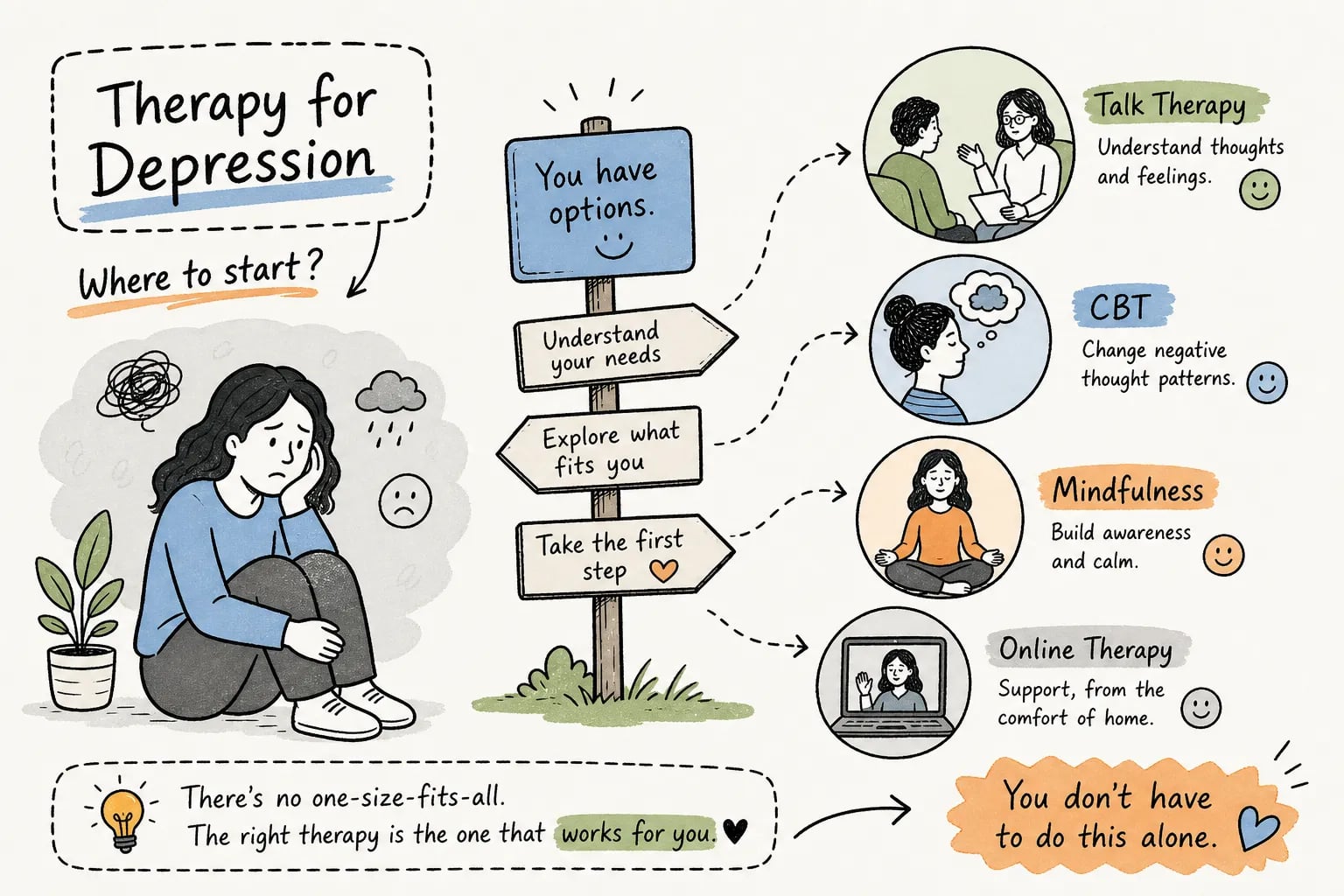
You’ve decided to get help for depression. That’s the hard part, and you’ve already done it. Then you open a browser, type something like “types of therapy for depression,” and suddenly you’re staring at a wall of acronyms: CBT, DBT, ACT, IPT, EMDR. The tab closes. Nothing happens. You’re right back where you started, except now you feel worse for having tried. Many people who are motivated to seek care still end up stalled for weeks or months because the sheer number of options makes it hard to know where to begin.
If you’re trying to figure out how to choose the right therapy for depression, the good news is that you don’t need a graduate degree or weeks of research to get there. It comes down to three filters: symptom severity, personal history, and your own preferences. Run your situation through those three, and the field narrows quickly. At River North Counseling in Chicago, this filtering process is built into intake, so clients walk into their first session already matched to an approach that fits their specific situation, not assigned to whatever slot happens to be open.
The main evidence-based therapies for depression, and what sets them apart
Not all talk therapy is the same. Knowing the major options doesn’t mean memorizing research papers; it means understanding what each approach actually does in the room, so you can recognize what sounds right for you.
CBT and behavioral activation: the strongest starting point
Cognitive Behavioral Therapy (CBT) and behavioral activation (BA) hold the most consistent evidence for depression across major clinical guidelines, including those from the APA, ACP, and NICE. CBT works by identifying and shifting thought patterns that maintain depression, while behavioral activation focuses on re-engaging with meaningful activities that depression tends to pull you away from. Both are structured and skill-focused. A standard course runs 8 to 20 weekly sessions, a defined timeline, not open-ended work.
IPT and psychodynamic therapy: when relationships are at the root
Interpersonal Therapy (IPT) is the third guideline-supported first-line option, and it’s particularly well-suited when your depression is tied to grief, a major life transition, or ongoing relationship conflict. IPT is also structured and time-limited, usually 16 to 20 sessions. Psychodynamic therapy takes a different path: it’s more exploratory, longer-form, and aimed at uncovering deeper relational and emotional patterns. The evidence for psychodynamic therapy in depression exists but is less robust than for CBT, BA, or IPT. That doesn’t make it useless, but it’s useful context so you can weigh it fairly rather than assume all therapies are equally supported for your specific situation.
ACT and DBT: useful, but not typically first-line
Acceptance and Commitment Therapy (ACT) and Dialectical Behavior Therapy (DBT) both have growing evidence bases and can be genuinely helpful. Where they tend to earn a place in depression treatment is when depression overlaps with anxiety, significant avoidance, emotional dysregulation, or self-harm. DBT was originally developed for borderline personality disorder, and while it addresses depressive symptoms effectively in that context, it isn’t the go-to recommendation for depression alone. If a therapist recommends ACT or DBT, ask what’s driving that, the answer will tell you whether it fits your specific picture.
How to choose the right therapy for depression: start with severity
Before you think about which therapy style appeals to you, start with a more basic question: how bad are things right now? Severity shapes not just which therapy to choose, but whether therapy alone is enough or whether medication should be part of the picture from the start.
Mild depression: therapy first, structure helps
For mild depression, clinical guidelines from both the ACP and NICE favor psychotherapy as the first-line option before medication. CBT or behavioral activation are logical starting points here. Some people do well with lower-intensity formats at this level, such as guided self-help or short-term structured therapy, before committing to a full course of weekly sessions.
Moderate depression: more flexibility, but structure still matters
The moderate range gives you the most options. Both therapy and antidepressant medication have solid evidence here, and the choice often comes down to your preference, what you’ve tried before, and what’s practically accessible. A structured approach like CBT or IPT is still a sound first move. If one has been tried and didn’t work, that history matters and should inform what comes next.
Severe or persistent depression: the case for combining therapy and medication
For severe, chronic, or treatment-resistant depression, APA and NICE guidelines broadly recommend combining therapy with medication rather than relying on either alone. The reason is straightforward: medication and psychotherapy address different mechanisms, and the combined effect tends to outperform monotherapy when depression is serious. This isn’t a failure; it’s a clinical reality that a good therapist will name directly. It also means you’ll want both a therapist and a prescribing provider involved in your care, and they should communicate.
What your personal history and preferences tell you
Severity tells you what level of intervention you likely need. Your history and preferences tell you how to get there in a way that actually fits how you think and work.
Using your treatment history as a signal
If you’ve been in therapy before, that experience is data. Did you respond well to homework, worksheets, and concrete goals between sessions? That’s a point toward CBT. Did prior therapy feel too surface-level, like you were circling the same topics without going deeper? A more exploratory approach might serve you better this time. If you’ve tried medication before, whether it helped or not is equally relevant. A thorough therapist will ask about all of this during intake, not as small talk, but because prior response is one of the strongest predictors of what’s likely to work again.
Structured vs. open-ended: knowing your own style
Some people do best with a clear agenda each session: a topic, a skill, a check-in on last week’s practice. Others need the space to talk without a predetermined structure and let the session find its own shape. Neither preference is wrong, and neither signals that you’ll do better or worse in therapy overall. What matters is knowing which feels more sustainable for you and communicating that to any therapist you’re considering. Fit on this dimension affects whether you’ll keep showing up, and research on therapy engagement consistently identifies attendance and adherence as major factors in whether treatment produces lasting results.
Access, format, and real-world constraints
The best therapy approach is the one you can actually access and keep attending. In Chicago, in-person therapy typically involves a wait of three to six weeks for an initial appointment, sometimes longer. Virtual therapy through telehealth platforms often moves faster. Out-of-pocket costs in Chicago run roughly $150 to $175 per session without insurance; with in-network insurance coverage, copays usually fall between $20 and $50. These factors aren’t secondary concerns to address after you pick an approach, they’re legitimate filters that belong in the decision from the start.
Choosing a therapist for depression: questions to ask before you commit
A first call or consultation with a therapist isn’t an interview where you’re the nervous applicant. It’s a focused conversation to find out whether this person’s approach and experience are a real match for what you’re dealing with. The following questions surface that information quickly.
Questions about approach and experience with depression
Ask what therapy approach they use for depression and why they think it fits. Ask how much experience they have with depression at the severity level you’re experiencing. If your depression includes low motivation, persistent hopelessness, or any thoughts of suicide, ask directly whether they’ve worked with those presentations. A therapist who deflects or speaks only in vague generalities at this stage is giving you useful information about how specific and transparent they’ll be throughout treatment.
Questions about format, timeline, and how progress gets tracked
Ask what a typical session looks like and how structured versus open the process tends to be. Ask roughly how many sessions they’d expect for someone with your presentation, and how you’ll both know whether therapy is working. Therapists who use formal outcome measures, like symptom scales or structured check-ins, tend to catch stalls earlier and adjust before weeks of unproductive sessions pile up. This approach, sometimes called measurement-based care, is supported by research showing that routine monitoring helps clinicians detect nonresponse sooner and course-correct more effectively. Ask whether the approach involves between-session work. If it does and that sounds difficult to sustain, say so, that’s a fit issue worth naming at the start, not discovering three months in.
A practical decision framework for choosing the right therapy approach
Everything above reduces to four questions. Work through them in order, and the fog tends to clear.
The four questions that cut through the noise
- How severe are my symptoms right now, and do I need medication as part of the picture? Honest severity assessment shapes everything downstream.
- Have I tried therapy before, and what did I take from it? A positive history with structured work points toward CBT. A sense that past therapy stayed too shallow might point toward psychodynamic or IPT. No prior therapy means you start with what the evidence favors most: CBT or BA.
- Do I want structured sessions with measurable goals, or more room to explore? This preference won’t make or break outcomes, but it will make a real difference in whether you stay engaged over weeks and months.
- What are my actual access constraints: location, schedule, and budget? In-person sessions in River North or Skokie, virtual therapy from anywhere in Illinois, insurance coverage, and self-pay options each come with different timelines and costs. Name the constraints before you commit to an approach that doesn’t fit your life.
How River North Counseling’s intake removes the guesswork
For Chicago-area readers, this framework is already built into how River North Counseling onboards new clients. The intake process covers severity, treatment history, therapist style preferences, and access needs before the first session begins, so clients aren’t matched randomly or by availability alone, but intentionally to a therapist whose approach fits what they’re actually dealing with. River North Counseling sees clients in person at offices in River North and Skokie, and offers virtual therapy across Illinois for those who prefer flexibility or can’t make in-person sessions work.
If you’re ready to stop researching and start working, reaching out to schedule an intake is the most direct path forward. The matching work gets done with you, not left as homework you have to finish before you can begin.
Moving forward without needing the perfect answer first
Having too many options can feel worse than having none. That’s a real psychological effect, not a personal weakness, and it’s exactly why so many people who are motivated to get help still end up stalled. Once you filter by severity, history, and preferences, most people find the field narrows to one or two realistic options fairly quickly.
Finding the right fit is less about landing on a perfect match on paper and more about taking a first step with enough clarity to feel confident. Research comparing CBT, behavioral activation, and IPT consistently finds broadly similar outcomes for most people with depression, which means you’re not choosing between a good option and a bad one. You’re choosing where to start, and that’s a much easier decision than it looked like from the browser tab full of acronyms.
If you’re in Chicago or anywhere in Illinois and wondering how to choose the right therapy for depression, River North Counseling’s intake process is designed to do that matching work with you. In-person and virtual options are both available. When you’re ready, reach out and let the process take it from there.