

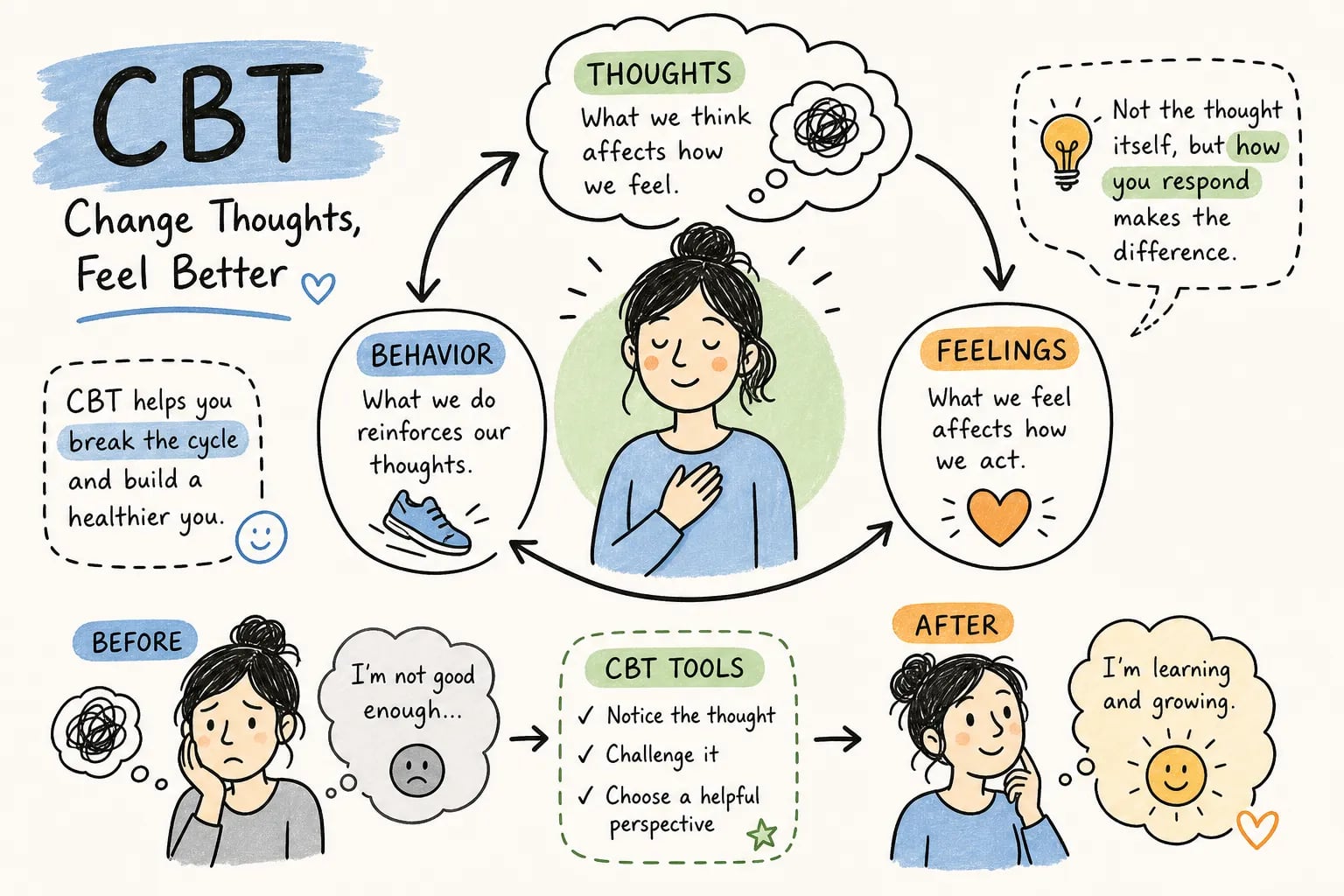
Many people hear the term “CBT” from a doctor, a friend, or a quick Google search and still walk away uncertain about what it actually means or whether it applies to them. If you’re asking “what is CBT?” you’re not alone, the letters get tossed around constantly in mental health conversations, but the actual experience of cognitive behavioral therapy rarely gets explained in plain terms: what happens in a session, how it works, what it asks of you.
After two decades of guiding clients through this exact question, I can tell you: the confusion is understandable, and it clears up quickly. By the time you finish reading, you’ll know exactly what CBT is, which conditions it treats most effectively, what you’ll actually do in sessions, and how to take a concrete first step if you decide it’s right for you.
What Is CBT: The Core Idea in Plain Language
The approach explained simply
Cognitive behavioral therapy is a structured, goal-oriented form of talk therapy built on one central insight: your thoughts, feelings, and behaviors are constantly influencing one another in a loop. What you tell yourself about a situation shapes how you feel. How you feel drives what you do. What you do feeds back into what you think. CBT targets that loop directly.
This is not the kind of therapy where you spend months or years revisiting your childhood without a clear roadmap. CBT is practical and specific. The work centers on identifying patterns of thinking and behavior that are keeping you stuck, then practicing concrete ways to shift them. Sessions have a structure. Progress is measurable. The skills you build don’t disappear when therapy ends.
Why the “cognitive” and “behavioral” parts both matter
The “cognitive” half refers to your thoughts, the stories you tell yourself about situations, other people, and your own capabilities. Many of those stories are distorted in predictable ways, and most people don’t realize it because the thoughts arrive fast and feel completely true. Cognitive work helps you slow that process down and examine whether your interpretations are actually accurate.
The “behavioral” half addresses what you do in response to those thoughts and feelings. Avoidance, withdrawal, and inaction are among the most powerful forces sustaining anxiety and depression, and most people underestimate just how much their behavior keeps the problem alive. Changing what you do shifts how you feel, which in turn changes what you think. That bidirectional relationship is why CBT produces lasting change in a relatively short timeframe, research comparing CBT to less structured, open-ended approaches, including some psychodynamic therapies, documents lower relapse rates and more durable skill retention for CBT completers.
Which Conditions CBT Treats Most Effectively
The strongest evidence base: anxiety and depression
Cognitive behavioral therapy carries the largest and most consistent body of research for anxiety disorders and depressive disorders. Generalized anxiety disorder, panic disorder, social anxiety disorder, specific phobias, and major depressive disorder all have decades of randomized controlled trials and meta-analyses supporting CBT as a first-line treatment. When clinicians use the phrase “evidence-based,” this is what they mean: outcomes replicated across thousands of patients in controlled studies, not simply reported anecdotally.
A large-scale meta-analysis of 375 randomized trials (Cuijpers et al., 2023) found large effect sizes for major depression, panic disorder, social anxiety disorder, and generalized anxiety disorder, and very large effects for PTSD and specific phobias. For most people dealing with anxiety or depression, clinical guidelines, including those from the American Psychological Association and the U.K.’s NICE, recommend starting with therapy before considering medication, except in severe cases or when access to therapy is limited. That recommendation is grounded in the data, not in preference.
Other conditions where CBT works well
Beyond anxiety and depression, CBT has meaningful clinical support for PTSD, OCD, bulimia nervosa, binge eating disorder, and chronic pain. The same meta-analysis cited above found very large effects for PTSD specifically, making it one of the stronger results in the literature. For OCD, expert-level CBT using exposure and response prevention has been shown to outperform medication alone in several head-to-head comparisons.
CBT-based approaches also produce what researchers call transdiagnostic benefits, reducing anxiety and depression across different formal diagnoses, which matters for the many people whose symptoms don’t fit neatly into a single category. For conditions like bipolar disorder or psychosis, CBT can be a valuable part of a broader treatment plan, though the evidence is less definitive than it is for anxiety and depression.
Core CBT Techniques You’ll Actually Use in Sessions
Cognitive restructuring: catching and questioning your thoughts
Cognitive restructuring is the process of identifying automatic negative thoughts, examining the evidence for and against them, and arriving at a more accurate interpretation. When a client says “I made one mistake, so I’m a failure,” the work isn’t to replace that thought with empty reassurance. It’s to lay out the actual evidence: prior successes, positive feedback, the fact that one imperfect moment doesn’t define a pattern. The goal is accurate thinking, not positive thinking. That distinction matters.
In practice, this often involves thought records, a written exercise where you document the situation, your automatic thought, the emotion it produced, the evidence on both sides, and a more balanced conclusion. The exercise feels mechanical at first. Over several sessions, many clients begin noticing distortions in real time as the skill becomes more automatic, and the written record becomes less necessary.
Behavioral activation and exposure: changing what you do
Behavioral activation targets depression by scheduling activities that generate a sense of mastery or pleasure, even when motivation is absent. Depression typically leads to withdrawal, and withdrawal deepens depression. Breaking that cycle means acting before you feel like it, which runs counter to instinct but is consistently supported by research. A client might start with something as small as a 10-minute walk after lunch or sending one text to a friend. Small actions compound.
Exposure therapy takes a different shape. It involves gradual, planned contact with feared situations so that anxiety loses its hold over time. Someone with a driving phobia might start by sitting in a parked car, then driving around the block, then taking short trips on quiet roads. The anxiety doesn’t disappear immediately, but repeated contact in a controlled way teaches the brain that the threat is not as real as it predicted. Between-session practice is central to both techniques: CBT is not something that only happens in the therapist’s office. Homework is part of the work.
What Is CBT: What to Expect in Sessions
Session structure and how many sessions to expect
A standard CBT course runs roughly 12 to 16 weekly sessions, each lasting about 50 to 60 minutes. Some presentations, particularly single-focus phobias or mild anxiety, resolve in 6 to 8 sessions. More complex situations, such as longstanding depression layered with trauma, may extend beyond 16. The range is wide because the therapy adapts to the person, not the other way around.
Each session follows a consistent structure: a brief check-in, agenda setting, review of the previous week’s homework, the main therapeutic work, and then a new homework assignment with a session summary. That structure is intentional. It keeps sessions focused, prevents drift, and ensures you leave every appointment with something concrete to practice before the next one.
What happens in your first session
The first session is primarily an assessment and orientation. Your therapist will ask about your current symptoms, what prompted you to seek help, relevant background, and what you’re hoping to change. They’ll explain how CBT approaches your specific concerns and begin mapping the connections between your thoughts, feelings, and behaviors. There is no pressure to share everything at once, the first session is also your opportunity to evaluate whether the therapist and approach feel like a good fit.
By the end of that first meeting, most clients have a clearer picture of what the treatment plan will look like. Goals get named, priorities get set, and the path forward stops feeling vague. That clarity tends to come as a real relief, especially for people who have been struggling without a clear sense of direction.
How CBT Compares to Medication and Other Therapies
CBT and medication: similar short-term results, different long-term stories
Research consistently finds that CBT and antidepressant medication produce comparable outcomes for depression and many anxiety disorders in the short term. Response rates, remission rates, and symptom reduction look similar when you compare the two groups at the end of an acute treatment phase. The meaningful difference emerges afterward. CBT skills tend to persist after treatment ends, while medication benefits are more dependent on continuing the drug. Several meta-analyses have documented lower relapse rates for clients who completed CBT compared to those who discontinued medication.
For anxiety disorders specifically, the American Psychological Association’s clinical practice guidelines note that psychotherapy is generally more effective than medication for most adult presentations, and that adding medication does not reliably improve outcomes beyond therapy alone. That finding surprises many people, but it reflects what the controlled trials show.
When combining treatments makes sense
Combined treatment does show advantages in certain contexts. For pediatric anxiety, research suggests that combining an SSRI with CBT often outperforms either approach on its own. For many adult presentations, however, CBT alone produces strong and durable outcomes without the added complexity of medication management. Psychodynamic therapy has genuine support for some conditions, particularly depression and anxiety, but CBT has a broader and more consistently replicated evidence base across the disorders most people seek treatment for. If you’re weighing your options, that track record is worth considering.
How to Find a CBT Therapist and Get Started
What to look for when choosing a therapist
Not every therapist who mentions CBT is equally trained in it. There’s a real difference between a therapist who has read about cognitive behavioral therapy and one who was formally trained in it, uses structured sessions, assigns between-session practice, and tailors specific techniques to your concerns. When evaluating a potential therapist, ask directly how they use CBT in their work and what a typical session looks like.
Practical logistics matter too. Consider whether you want in-person sessions, telehealth, or a combination. Research on remote therapy has consistently found virtual sessions to be as effective as in-person ones for most presentations, a finding supported by multiple telehealth meta-analyses, so the right choice is whichever format you’ll show up to consistently. Accessibility, scheduling, and comfort with the therapist all affect whether you stay in treatment long enough for it to work.
- Confirm the therapist is licensed and has specific CBT training, not just general talk therapy experience
- Ask whether they assign between-session homework and use structured session formats
- Consider your preferred format, in-person, virtual, or hybrid, based on your schedule and comfort
Starting CBT in Chicago: a note on River North Counseling
River North Counseling is a licensed group therapy practice in Chicago offering CBT-based treatment for anxiety, depression, stress, and a range of related concerns. The practice has offices in River North and Skokie, with virtual sessions available throughout Illinois for clients who prefer telehealth or have scheduling constraints that make in-person sessions difficult.
What distinguishes River North Counseling is the care taken with the matching process. Rather than assigning the next available therapist, the team works to connect each client with a clinician whose training and specialties align with their specific goals. Getting started means having a conversation, not making a commitment. For anyone in the Chicago area wondering whether CBT for anxiety, depression, or chronic stress might help, reaching out to River North Counseling is a practical, low-pressure first step.
Taking the Next Step
Cognitive behavioral therapy is a structured, evidence-backed approach that targets the connection between thoughts, feelings, and behaviors. Among psychotherapy approaches, it has one of the strongest bodies of research for anxiety and depression, with large, replicated effects documented across hundreds of randomized trials, along with meaningful evidence for PTSD, OCD, and eating disorders, and a consistent track record of producing changes that persist after treatment ends. The clinical literature supports each of those points.
If you’re still asking “what is CBT and could it help me?”, understanding it is a good start, but acting on that understanding matters more. If anxiety, depression, or chronic stress has been affecting your daily life, work, relationships, or sense of yourself, CBT offers a clear, skills-based path forward. Qualified help is closer than most people assume. Reach out, ask your questions, and let the first conversation be exactly that: a conversation.