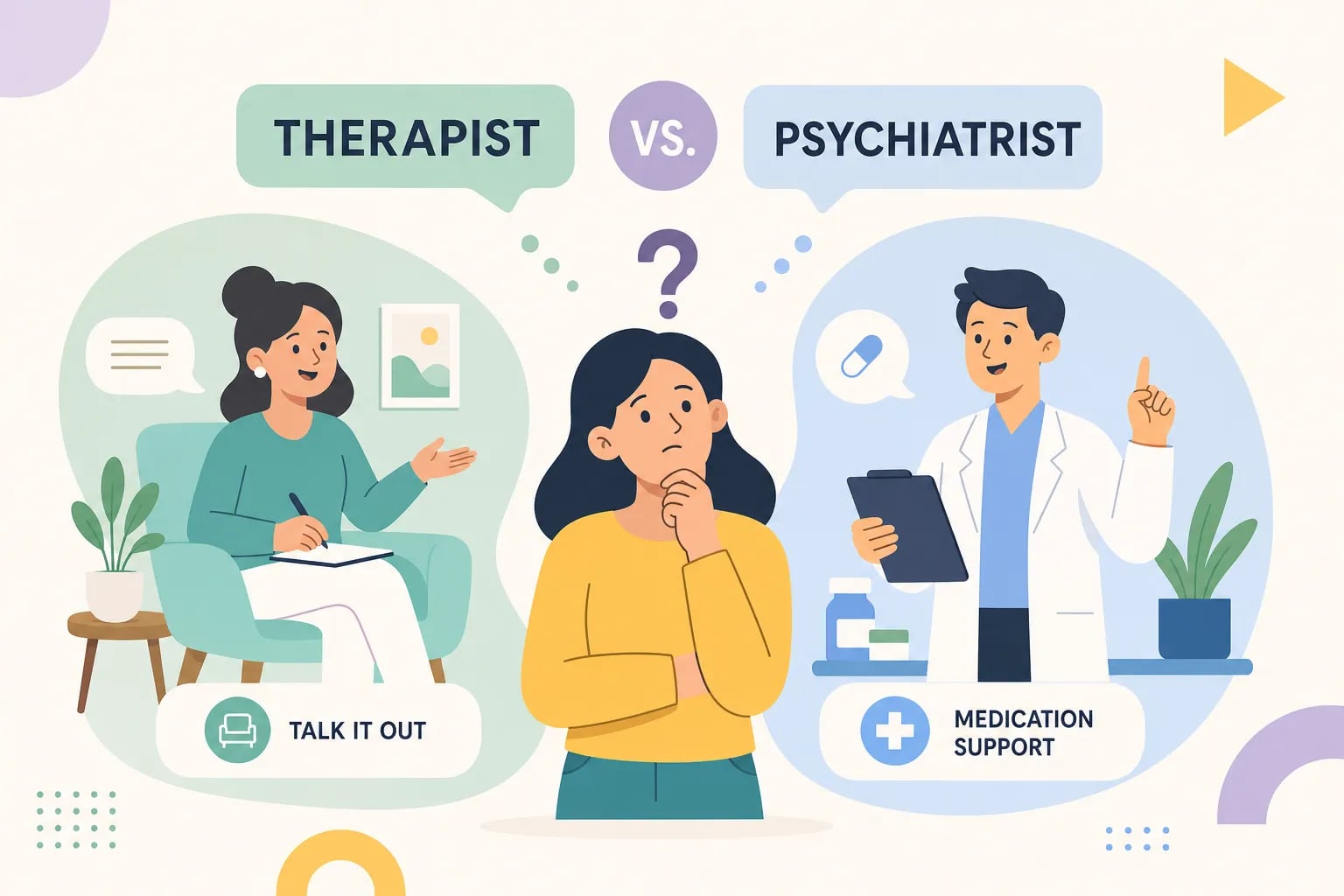

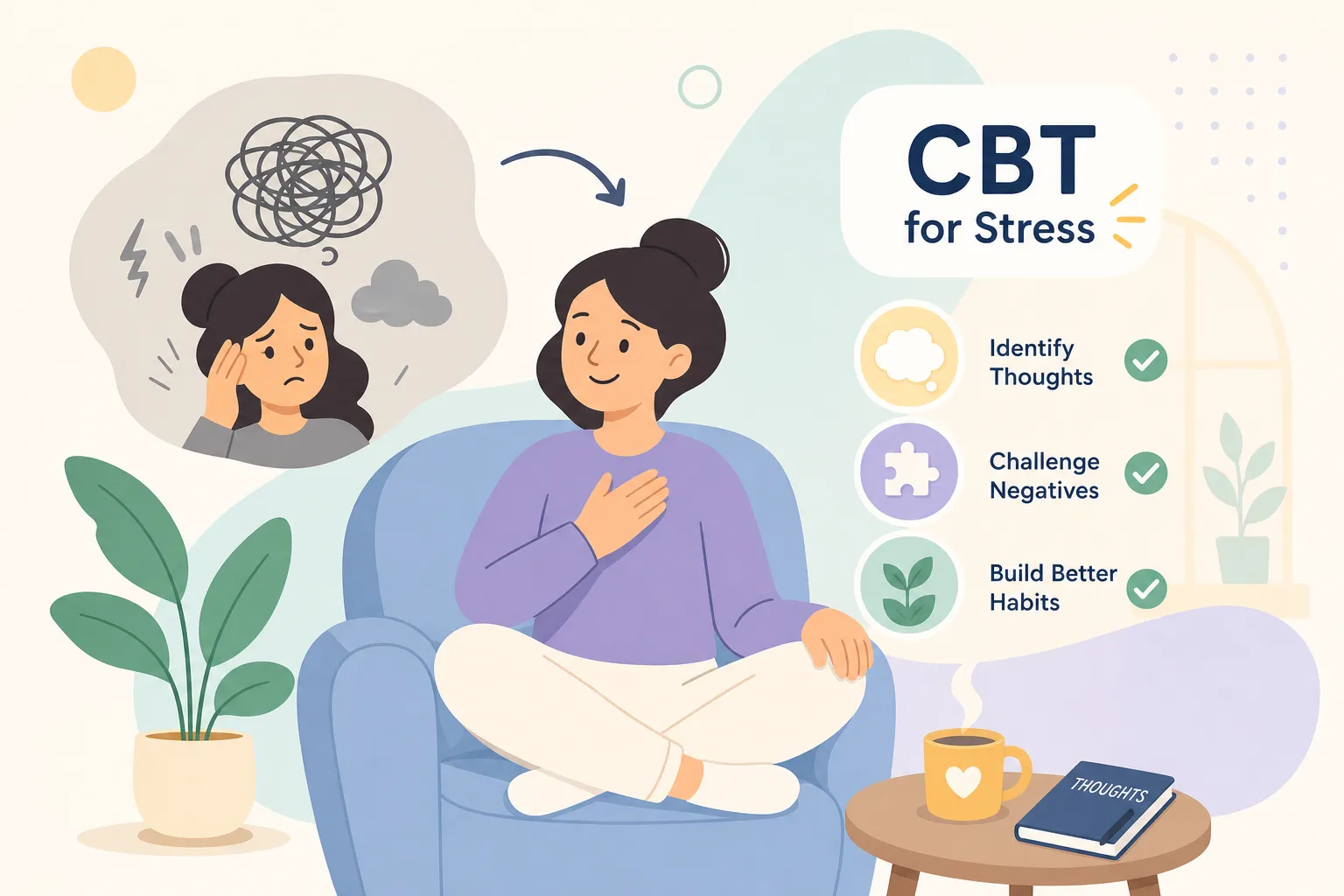
Sunday evening arrives, and instead of winding down, your mind is already running through Monday’s calendar. The work week hasn’t started yet, but your nervous system is already bracing for it. That kind of stress, the accumulated, relentless kind a weekend can’t touch, is exactly what CBT for stress is designed to address. Not by teaching you to think positively, but by helping you understand the mental patterns that keep the pressure building.
Cognitive behavioral therapy has strong research support for stress management, in meta-analytic reviews, it has outperformed organization-focused therapies for occupational stress, making it one of the most thoroughly studied approaches for professionals dealing with chronic workplace pressure. This article walks through how it works and gives you practical techniques you can start using right now. The therapists at River North Counseling work with Chicago professionals who need a more structured framework for managing this kind of pressure. CBT for stress is the foundation of that work, and the tools below are where it starts.
Why CBT Reduces Stress at the Root, Not Just the Surface
CBT understands stress through a specific model: a triggering event leads to an automatic thought, which generates an emotional response like dread or overwhelm, which then drives a behavior like avoidance, overworking, or snapping at people. Consider a professional who receives a critical email from their manager. The automatic thought, “They think I’m not performing,” produces anxiety. That anxiety leads to either frantic overcompensation or complete avoidance of the inbox. The stress isn’t just from the email. It’s from the mental loop that email activates.
The evidence behind cognitive behavioral therapy for stress management is substantial. A review of meta-analyses found that CBT-based interventions outperformed organization-focused therapies for occupational stress, with especially notable results on psychosocial outcomes. A separate systematic review found that internet-delivered CBT reduced perceived stress alongside anxiety and depression across 13 studies. Worth noting: most of this research measures stress-related outcomes like perceived stress, burnout, and occupational strain rather than a formal clinical “stress disorder.” That’s actually more relevant for most working professionals, whose stress doesn’t come with a diagnosis but still costs them sleep, relationships, and performance.
CBT for Stress: Techniques for Immediate Relief
Some techniques work fast. When stress is spiking right now, before a difficult conversation or after a meeting that went sideways, these are the tools that calm your nervous system quickly enough to matter.
Diaphragmatic Breathing (Box Breathing)
Sit comfortably and, if it helps, place one hand on your chest and one on your belly. Then follow this sequence:
- Inhale slowly through your nose for a count of four, letting your belly rise more than your chest.
- Hold for a count of four.
- Exhale slowly through your mouth or nose for a count of four.
- Hold for a count of four, then repeat for three to five cycles.
Slow, controlled breathing activates the parasympathetic nervous system, pulling you out of the fight-or-flight state, a mechanism well-documented in relaxation and stress physiology research. Among evidence-based CBT methods for stress, diaphragmatic breathing is commonly recommended precisely because it’s fast, free, and works anywhere. Practice it outside of stressful moments too, so the relaxation response is easier to access when you actually need it. For quick, portable exercises that fit into a busy day, see Mindful Moments: Quick Stress-Relief Methods, River North Counseling.
Progressive Muscle Relaxation
Start at your feet. Tense the muscles in your toes and feet while inhaling for a few seconds, then release completely while exhaling. Notice the contrast between tension and relaxation before moving upward through your calves, thighs, abdomen, hands, arms, shoulders, and face. The deliberate alternation between tension and release teaches your body to recognize and let go of the chronic low-level tension you may not even notice you’re carrying. Regular practice builds your ability to access this response more quickly, which is why it works best as a daily habit rather than a crisis intervention.
Cognitive Restructuring for Stress: Examining the Thoughts That Keep Pressure Building
This is the intellectual core of CBT-based stress management. Cognitive restructuring isn’t about positive thinking. It’s about learning to examine your automatic thoughts with evidence rather than accepting them as fact. High-achieving professionals often resist this work because their catastrophic thoughts feel like clear-eyed realism. They’re not. They’re usually a mix of accurate information and distortion, and learning to separate the two makes a measurable difference.
How to Use a Thought Record
A thought record is a structured way to examine a stressful thought in real time. Work through these seven steps:
- Write down the triggering situation as objectively as possible.
- Record the automatic thought exactly as it appeared in your mind.
- Note the emotion and rate its intensity from 0 to 100.
- List evidence that supports the thought.
- List evidence that contradicts or complicates the thought.
- Identify the cognitive distortion involved.
- Write a more balanced, accurate alternative thought, then re-rate the emotion.
The goal of this process is accuracy, not optimism. A balanced thought might still acknowledge a real problem, it just doesn’t catastrophize that problem into something it isn’t.
Common Thinking Errors That Amplify Work Stress
Certain distortions show up repeatedly in high-pressure professional environments. Catastrophizing sounds like “If this project goes wrong, my career is over.” All-or-nothing thinking sounds like “Either I deliver perfect results or I’ve failed.” Mind reading sounds like “My manager is disappointed in me,” stated as fact despite no direct evidence. Overgeneralization takes one difficult week and declares it proof of a permanent downward trend. Naming the distortion, giving it a label, creates a small but meaningful distance between you and the thought. That distance is where change becomes possible.
Behavioral Activation and Long-Term Stress Management Skills
Cognitive work alone doesn’t resolve chronic stress. The behavior patterns that develop under sustained pressure, the withdrawal, the canceled plans, and the shrinking life outside of work, all have to change too. Behavioral activation addresses this directly. For additional practical approaches to everyday stress, see Stress Reduction techniques for Modern Life Challenges, River North Counseling.
Scheduling Activities That Restore Energy
Start by listing your current activities across a typical week and marking which feel draining versus which give you any sense of energy, pleasure, or accomplishment. Then identify one or two small restorative activities you’ve dropped and schedule them like appointments. A 20-minute walk at lunch, a hobby that gets canceled whenever work runs long, a dinner that actually happens. The key insight from behavioral activation research is that the energy to do things often comes after doing them, not before. Waiting until you feel like it is the trap. The action comes first.
Problem-Solving as a Structured Stress Tool
Not all stress responds to cognitive reframing. When the stressor is real and solvable, structured problem-solving is the appropriate CBT tool. The process has seven steps: define the problem precisely, brainstorm all possible solutions without evaluating them, evaluate the pros and cons of each, choose the most feasible option, build a specific action plan, implement it, and then review the outcome. This approach is particularly useful for work-related stress where the actual problem, an unmanageable workload, unclear expectations, a difficult colleague relationship, requires a real solution, not just a different way of thinking about it. For an accessible overview of problem-solving therapy and a practical structured problem-solving guide, these resources provide concrete formats you can use to run the seven-step process effectively.
Self-Guided CBT Tools You Can Start Using Today
Not everyone begins their CBT work with a therapist, and starting with self-guided resources is a legitimate first step. Commonly recommended free options for self-help CBT for stress include:
- Think CBT Workbook, a 90-page downloadable resource usable on mobile and desktop
- TalkPlus Stress Workbook, a CBT-informed PDF designed for independent use
- Therapist Aid, stress management worksheets covering core CBT skills
- Psychology Tools, thought records, monitoring diaries, and structured planning tools
A systematic review of internet-delivered CBT has found reductions in perceived stress, anxiety, and depression, which supports the usefulness of well-structured self-guided or online CBT programs for many people.
When it comes to how much practice is enough, research is consistent on one point: consistency matters more than duration. Studies show measurable stress reduction across 5 to 20 sessions, with between-session practice being a key driver of results. Even 5 to 10 minutes of daily work on breathing, thought records, or activity scheduling builds the skill over time. Using these techniques only when things get bad doesn’t work. The goal is regular practice so the skills are available when you actually need them.
When Professional CBT Support Makes the Difference
Self-guided work is genuinely useful, and many people make meaningful progress with it. But there are clear signs that working with a trained CBT therapist becomes the more effective path. Stress that persists despite consistently applying coping tools, physical symptoms like sleep disruption or tension headaches that won’t resolve, and stress that’s starting to affect your relationships or job performance are all signals worth taking seriously. Burnout, specifically, often reaches a threshold where self-help strategies can’t create enough change on their own.
Professional CBT for stress typically begins with an intake and case formulation: your therapist works with you to identify the specific thought patterns and behavioral cycles driving your stress, rather than applying a generic protocol. From there, sessions focus on building the skills most relevant to your situation, with homework between sessions that translates the work into real life. Research supports early change, often within 6 sessions, with a typical treatment course running 12 to 20 sessions for sustained results.
River North Counseling is a Chicago group practice with therapists who specialize in CBT for professionals managing work-related stress and burnout. They see clients in person at their River North and Skokie offices, and virtually across Illinois for those who need more flexibility. Reaching out for an initial consultation isn’t a last resort. It’s a practical next step, the same kind of intentional move that characterizes how you approach most problems worth solving. For more on recognizing and addressing sustained workplace stress and exhaustion, you can review Understanding and Addressing Chronic Stress and Exhaustion, River North Counseling.
Chronic Stress Is a Pattern, and Patterns Can Change
CBT for stress works because it addresses what’s actually driving the pressure: automatic thoughts that distort reality, behaviors that reinforce avoidance and withdrawal, and cycles that keep the pressure building long after the original stressor has passed. The techniques in this article, breathing, thought records, behavioral activation, structured problem-solving, are evidence-based CBT methods that are genuinely learnable. They don’t require a diagnosis, a crisis, or a major life disruption to start using.
Chronic stress isn’t a character flaw or a sign of weakness. It’s a pattern, shaped by demands, habits, and a mental framework that has learned to interpret pressure as threat. That framework can be updated. Whether your next step is downloading a worksheet, building a short daily practice, or scheduling a consultation at River North Counseling, cognitive behavioral therapy for stress management offers practical, evidence-based tools you can put to use now. The step that matters is the one you actually take.