
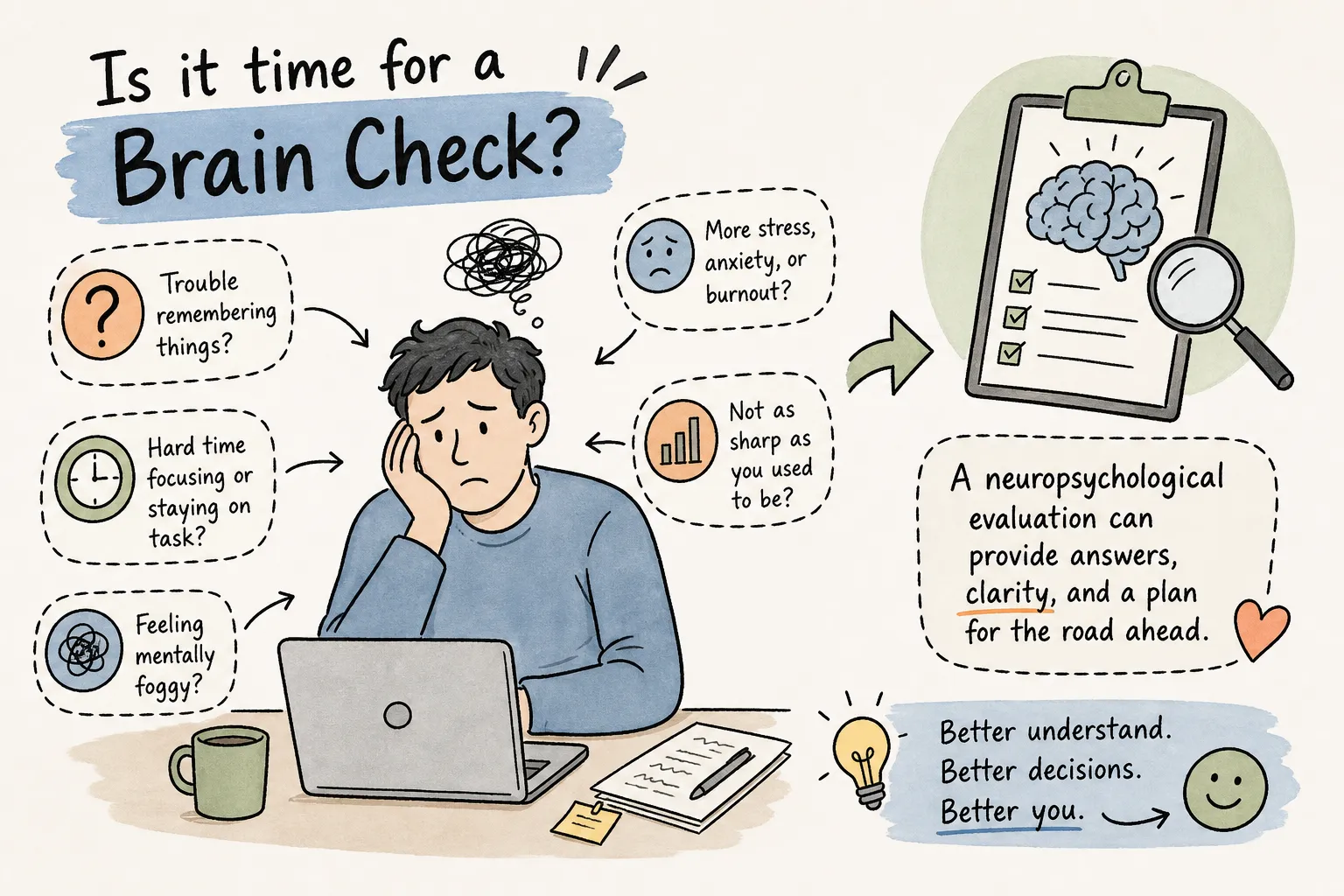
You’ve been forgetting names mid-conversation. You walk into rooms and lose the thought before you can act on it. Your mind feels slower than it used to, and you’ve been telling yourself it’s stress, poor sleep, or just getting older. Maybe it is. But maybe it’s worth finding out for certain.
If you’re wondering when an adult should get a neuropsychological evaluation, you’re not alone, and asking that question is already a meaningful step. Pursuing one isn’t about catastrophizing. It’s about applying the same rigor to your cognitive health that you’d apply to a concerning physical symptom. You wouldn’t ignore chest pain for six months and chalk it up to anxiety. Yet many adults do exactly that with cognitive changes, waiting years before asking whether something more specific is going on. Practices like River North Counseling in Chicago offer these evaluations for adults and can help you determine whether testing is the right move for your situation.
Several specific signs and life circumstances make formal cognitive testing not just reasonable, but genuinely useful. Understanding those signals is the first step.
What a neuropsychological evaluation actually involves
Before you can decide whether you need one, it helps to understand what you’d be signing up for. A neuropsychological evaluation is a structured, standardized assessment of how different parts of your brain are functioning. It isn’t a brain scan or a blood draw. It’s a detailed, human-administered examination of how you think, remember, and process the world around you. For a clinical overview of this process, see the Cleveland Clinic’s neuropsychological testing and assessment.
Evaluators administer a cognitive testing battery spanning multiple domains: memory, attention, executive function, processing speed, language, visuospatial ability, and emotional and behavioral functioning. Each domain maps directly to real-world skills, so results aren’t abstract numbers. They translate into practical insight about why you’re struggling to track conversations, manage your calendar, or stay focused through a workday. If you want a closer look at the specific tasks and domains assessed, our article on What a neuropsychological assessment tests for in adults breaks this down in detail.
Most comprehensive evaluations run between five and seven hours, often scheduled across one or two sessions. The process includes an intake interview, a review of your medical and psychiatric history, hands-on cognitive tasks, and written self-report measures. A separate feedback session follows where results and recommendations are discussed in full. You leave with a clear picture of your cognitive profile, not just a diagnosis.
Memory and attention changes that go beyond normal aging
Many adults assume memory lapses are simply part of getting older. Some are. Occasionally forgetting where you put your keys or taking a moment to recall a name falls within the range of typical aging. But certain patterns of change carry clinical weight, and knowing the difference matters. For more on mild cognitive concerns that merit evaluation, see resources on mild cognitive impairment.
The distinction centers on two things: how much your baseline has shifted, and how much your daily functioning is affected. Forgetting you own a car is not normal aging. Neither is consistently failing to remember appointments, getting lost on familiar routes, or losing track of medications. When memory problems interfere with the mechanics of daily life, that functional shift is the signal worth taking seriously.
Persistent difficulty staying on task, following multi-step instructions, or filtering out distractions can point to conditions beyond fatigue or stress. If these symptoms have lasted months rather than days, and especially if they represent a real departure from how you previously functioned, they qualify as a reason for formal cognitive evaluation. Brain fog that doesn’t clear with rest or lifestyle adjustments deserves a structured look, and that’s precisely when an adult should get a neuropsychological evaluation rather than keep waiting.
When adults with suspected ADHD or undiagnosed learning conditions should get a neuropsychological evaluation
A significant number of adults carrying ADHD or learning-related conditions were never diagnosed as children. According to 2023 CDC surveillance data, more than half of individuals with ADHD received their diagnosis in adulthood, with 61% of women and 40% of men identified during this period. Many of them found ways to compensate for years, often until the demands of their lives increased enough to make the gaps visible.
Adults who were high-achieving students sometimes didn’t meet the threshold for a childhood diagnosis, even when symptoms were present. Career changes, parenthood, or a shift to more complex responsibilities can unmask an attention profile that managed to stay hidden for decades. Chronic procrastination, emotional dysregulation, persistent lateness, and difficulty sustaining mental effort that doesn’t respond to typical strategies are all reasons to consider formal assessment. These aren’t character flaws. They’re patterns worth understanding.
Reading fluency, written expression, and working memory can also fall short in ways that affect work performance without ever receiving an explanation. A neuropsychological evaluation can identify specific cognitive patterns, including learning disabilities and processing disorders, that inform both accommodation strategies and treatment approaches. That clarity, even in adulthood, opens doors that stayed closed for years.
Medical events that make cognitive testing the right call
Certain health events carry documented risks for cognitive change. If you’ve experienced any of the following, pursuing an evaluation isn’t premature or excessive. It’s appropriate follow-up care.
After a mild traumatic brain injury or concussion, most people expect to recover fully within a few weeks. When cognitive symptoms, including memory difficulties, word-finding problems, or trouble concentrating, persist beyond 30 to 90 days, clinical guidance supports a referral for formal neuropsychological testing; see guidance on concussion and post-concussion care from professional sources like the clinical guidance on concussion management. The evaluation helps differentiate injury-related cognitive effects from anxiety or depression that can produce nearly identical symptoms on the surface. That distinction directly shapes treatment planning.
Stroke, even a mild one, can alter attention, memory, or processing speed in ways that don’t appear on imaging. Cancer treatment-related cognitive effects, sometimes called “chemo brain,” are documented across oncology research and well-supported in peer-reviewed literature. Post-COVID cognitive symptoms have emerged as a significant public health concern, with approximately 48% of long COVID patients reporting episodic memory deficits and 27% experiencing measurable impairment in overall cognitive function. Some of those deficits, particularly in processing speed and executive functioning, persist for years. If you’ve experienced any of these events and noticed a sustained change in how you think afterward, a neuropsychologist assessment provides the detail your care team needs to support your recovery.
- Persistent post-concussion symptoms beyond 30 to 90 days
- Stroke or transient ischemic attack with lingering cognitive effects
- Post-COVID brain fog that hasn’t resolved with time
- Cognitive changes following cancer treatment
- Unexplained personality or mood shifts with no clear psychiatric cause
How evaluation results shape diagnosis and real-life decisions
One of the most common reasons adults delay pursuing an evaluation is uncertainty about what it will actually change. The answer is quite a lot. Results don’t just identify deficits. They map a full cognitive profile of strengths and weaknesses, which allows clinicians to differentiate between conditions that present similarly on the surface but require very different interventions.
Early dementia, depression, and ADHD can all produce overlapping symptoms of forgetfulness and difficulty concentrating. Neuropsychological testing can differentiate between them with close to 90% accuracy when distinguishing conditions like Alzheimer’s dementia from non-dementia causes of cognitive decline. Treatment plans built on that level of detail are more targeted and more effective than those built on general symptom descriptions alone. To learn more about what those evaluations commonly reveal, see our piece on Neuropsych Testing for Adults: What the Evaluation Reveals.
Beyond the clinical setting, evaluations carry practical weight in everyday life. Results can inform recommendations about driving safety, financial decision-making capacity, and whether independent living remains appropriate. In workplace contexts, they provide objective support for accommodation requests, modified responsibilities, and return-to-work timelines. In legal and disability claim contexts, a valid neuropsychological report is treated as one of the strongest forms of documented evidence for cognitive impairment. These aren’t hypothetical applications. They’re routine outcomes of well-conducted evaluations.
How to find the right provider and prepare for testing
If any of the signs in this article resonate, the next step doesn’t have to feel overwhelming. It starts with a single conversation with a qualified provider, and knowing what questions to bring can make that conversation much more productive.
Not all providers offer the same scope of evaluation. Before you schedule, ask whether the practice conducts a comprehensive assessment or a brief cognitive screening for adults. Ask how results are communicated and whether the evaluator has experience with your specific concern, whether that’s ADHD, post-injury cognition, age-related changes, or another area. Insurance coverage varies widely: most private plans cover testing when it’s documented as medically necessary, but out-of-network costs for comprehensive evaluations typically range from $2,500 to $4,500. Many practices will help you navigate coverage questions before your first appointment, so don’t assume you have to figure it out alone. If you want a ballpark sense of fees and what to budget for, see resources on the cost of neuropsychological testing. You can also search for a licensed neuropsychologist near you through professional directories like the American Academy of Clinical Neuropsychology.
River North Counseling offers neuropsychological assessments for adults across the Chicago area, with in-person services at their River North and Skokie locations. If you’ve been sitting with unexplained cognitive changes and aren’t sure whether formal testing makes sense for your situation, their team can help you think it through. A consultation is a low-stakes way to ask the right questions and determine whether a full evaluation is the right next step for you. For practical information about preparing for testing and local options, see Cognitive Evaluation in Chicago: Costs, Clinics & Prep.
The bottom line: when an adult should get a neuropsychological evaluation
Knowing when an adult should get a neuropsychological evaluation comes down to recognizing a meaningful shift from your own baseline. Memory lapses that affect daily function, attention that won’t hold, suspected ADHD surfacing in adulthood, post-injury symptoms, and cognitive changes following serious illness all point toward testing as a reasonable and valuable tool. You don’t have to wait until things get significantly worse to take the question seriously.
An evaluation doesn’t confirm a worst-case outcome. It gives you information, and information leads to better decisions. If something has felt off and you’ve been wondering whether to take it seriously, the answer is yes. Reach out to a qualified provider, ask your questions, and let the data work for you.