
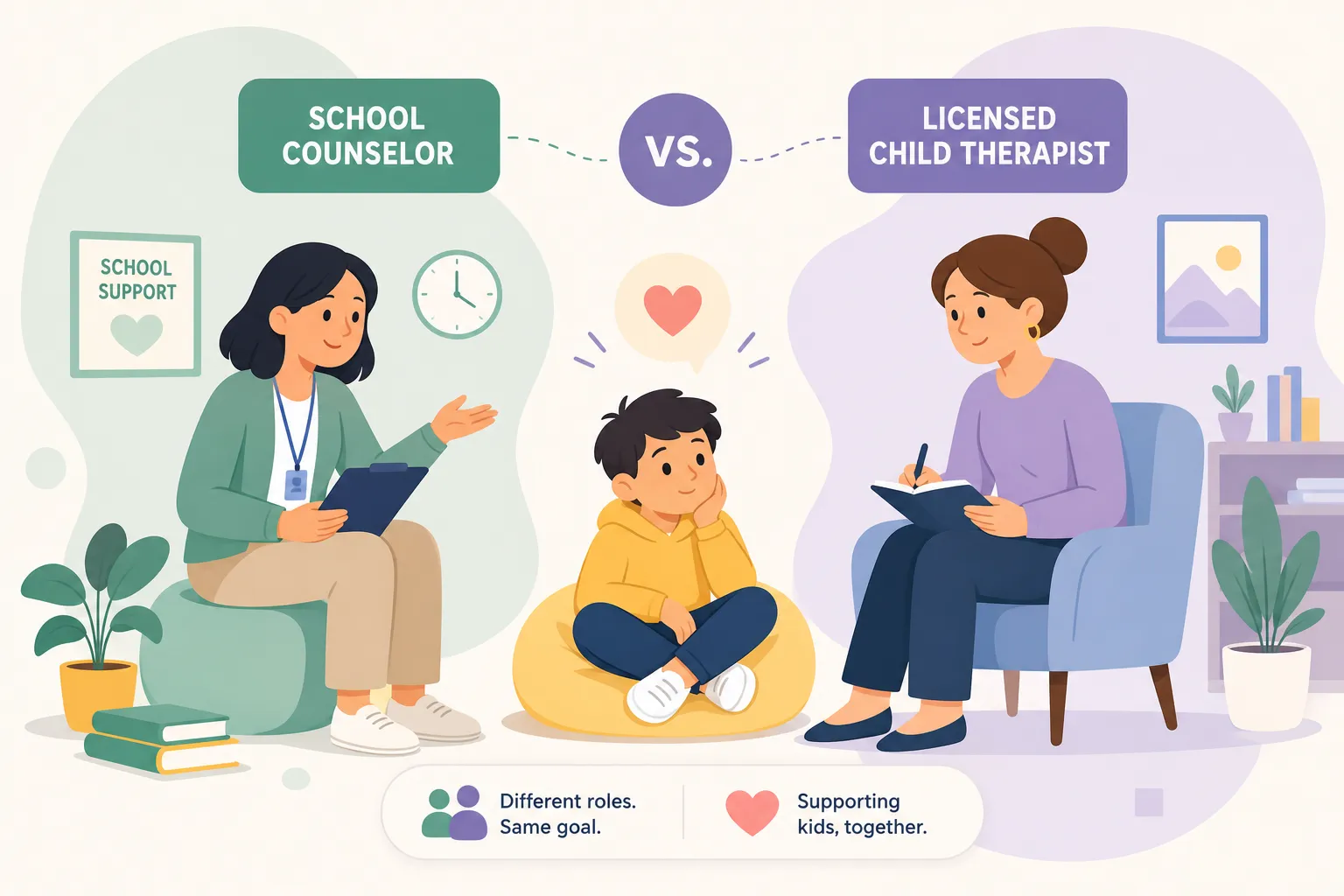
Understanding the difference between a school counselor and a licensed child therapist is one of the most important steps you can take when your child is struggling. Maybe it’s anxiety about school, a behavioral pattern you can’t quite explain, or a sadness that seems bigger than typical kid stress. Your first instinct is probably to call the school counselor, and that’s a reasonable place to start. But the question that follows is just as important: is the school counselor enough, or does your child need something more? It’s one of the most common questions families bring to the team at River North Counseling, and it deserves a clear, honest answer.
Both school counselors and licensed child therapists genuinely care about children’s well-being. But they hold different credentials, operate under different legal frameworks, and are equipped for different levels of concern. Understanding that distinction isn’t about criticizing either role. It’s about making sure your child gets the right support at the right time.
What school counselors actually do (and what they’re trained for)
School counselors are credentialed through their state’s department of education, not a behavioral health board. In Illinois, that means earning a master’s degree in school counseling, completing a supervised practicum and internship inside a school setting, and passing the state’s content exam (the ILTS 235) to receive a Professional Educator License with a school counselor endorsement. This is an education credential, not a clinical mental health license, and that distinction shapes everything about what a school counselor can offer. For more detail on typical training pathways and key steps to becoming a school counselor, see this guide on how to become a school counselor from LSU Online.
Within the school building, counselors do meaningful work every day. They support academic planning, college and career guidance, social-emotional learning, and short-term coping skills. They coordinate MTSS and PBIS frameworks, run small groups on topics like peer conflict or grief, consult with teachers, and serve as a first responder during school-based crises. For many students navigating a rough patch, this level of support is exactly what’s needed.
The key phrase here is short-term, solution-focused counseling. School counselors are not trained or licensed to provide ongoing psychotherapy or to diagnose and treat clinical mental health conditions. Caseload realities add another layer of limitation. According to ASCA data, the national average for the 2024, 2025 school year was approximately 372 students per school counselor, well above the 250-to-1 ratio the American School Counselor Association recommends. In some Illinois K, 8 schools, state-level data suggests those ratios climb considerably higher, with some analyses noting figures in the range of 600 to nearly 800 students per counselor. No counselor working at that scale can provide the depth of individual care that clinical treatment requires.
The difference between a school counselor and a licensed child therapist: training and scope
Licensed child therapists reach your child through a completely different pathway. The primary clinical credentials you’ll encounter include:
- LCSW, Licensed Clinical Social Worker
- LPC or LMHC, Licensed Professional Counselor / Licensed Mental Health Counselor
- LMFT, Licensed Marriage and Family Therapist
- Child psychologist, PhD or PsyD
Each credential requires a graduate-level clinical degree, typically 1,500 to 4,000 post-degree supervised clinical hours depending on the license and state requirements, and a license issued by a state behavioral health board. In Illinois, licensure and scope for clinical providers are governed by state boards and differ from education certifications, which is why their scope extends well beyond any school setting.
Child psychologist in Chicago: what every parent should know hold doctoral degrees and carry a distinct capability that school counselors do not: the ability to conduct formal psychological and neuropsychological assessments. These evaluations can clarify whether a child has an anxiety disorder, ADHD, a learning disability, or another condition that requires a specific treatment approach. That diagnostic clarity is often the turning point families have been waiting for.
In clinical practice, a licensed child therapist develops a formal case formulation, builds an evidence-based treatment plan, and delivers structured therapy over time. Take Cognitive Behavioral Therapy (CBT), for example: a therapist uses it to help a child identify and restructure anxious thinking patterns through structured sessions that build on each other week over week, something that simply can’t happen in a school hallway between classes. Other approaches include trauma-informed therapy for children who’ve experienced loss or family instability, and play therapy for younger children who process emotions through activity. Licensed child therapists treat the whole child, not just their performance at school. They also coordinate with pediatricians, psychiatrists, and school teams when a child’s care requires multiple providers.
If you’re exploring options in our area, our guide on Finding a Child Therapist in Chicago: A Parent’s Guide explains typical questions to ask when you call a practice and what to expect from an initial intake.
Confidentiality and privacy: what changes between settings
The privacy rules in school counseling and private licensed therapy operate under different legal frameworks, and parents are often surprised by this. School counseling records are typically governed by FERPA, the federal law that protects educational records. Because a school counselor’s notes can intersect with a student’s educational file, parents generally have broader access to that information than they do to private therapy records. FERPA does not create a special protected category for mental health information the way clinical law does. For more on confidentiality expectations in school settings, see this ASCA position statement on confidentiality.
Private licensed therapy, by contrast, is governed by HIPAA and state clinical licensure law. In Illinois, psychotherapy notes held by a licensed therapist carry a higher level of legal protection under both HIPAA and state statute. Parents typically consent to their child’s treatment, but once therapy begins, the therapist does not routinely share session content with parents. That’s not a barrier to family involvement, it’s a deliberate clinical design choice intended to protect the child’s trust. Clinicians commonly observe that children, especially adolescents, open up more when they trust that the therapy space is genuinely private. The therapist can still involve parents meaningfully through check-ins, parent coaching components, and coordinated care, while keeping the therapeutic relationship intact.
Safety exceptions exist in both settings. Any licensed professional, whether school-based or in private practice, is required to act when a child discloses risk of harm to themselves or others. That obligation does not change with the setting.
Signs your child has outgrown what school support can offer
School counselors are a genuine first line of support, but certain patterns signal that a child’s needs have crossed into clinical territory. Clinicians typically look for signs that persist beyond two weeks without improvement. Common referral thresholds include:
- Noticeable declines in grades or attendance
- Significant changes in sleep or appetite
- Withdrawal from friends, family, or previously enjoyed activities
- Intense anxiety or panic that disrupts daily functioning
- Any indication of self-harm or suicidal thinking
These signs don’t mean the school counselor has failed. They mean your child needs a different level of care.
Complexity and persistence are the two most reliable signals. Ask yourself whether the struggle follows your child home and into weekends, or whether it’s contained to the school day. Ask whether the concern shows up across multiple settings: at home, in social situations, during activities they used to enjoy. When problems extend beyond school hours and beyond school walls, the school counselor’s scope wasn’t designed to reach that far.
Specific presentations that consistently point toward licensed clinical care include suspected anxiety disorders, OCD, emotional dysregulation linked to ADHD, depression, grief, and exposure to trauma. Family transitions like divorce, a parent’s illness, or a significant loss often create emotional needs that require more than short-term school-based support. These are precisely the situations where a licensed child therapist, working with a full treatment plan and a longitudinal relationship with your child, can offer something fundamentally different.
When a licensed child therapist is needed vs. a school counselor: how to find the right fit
Unlike school counseling, which costs families nothing directly, private licensed child therapy is typically billed to health insurance or paid out of pocket. Most major commercial plans and Illinois Medicaid-based plans cover licensed child therapy when care is medically necessary and provided by an in-network clinician, though coverage varies by plan and prior authorization requirements differ. Prior authorization, when required, usually means submitting a diagnosis, a treatment plan, and sometimes a physician referral. Confirming your plan’s specific requirements before the first appointment saves families significant frustration.
To start the search, contact your insurance company for an in-network provider directory, ask your child’s pediatrician for a referral, or reach out directly to a licensed practice. Many group practices in the Chicago area offer telehealth alongside in-person sessions, which expands access considerably across the metro and suburbs. When you call, ask whether the therapist specializes in children or adolescents, what their primary treatment approaches are, and whether the practice offers neuropsychological assessment if that’s a need for your family.
Wait times for licensed child therapists in Chicagoland are estimated to range from about two to six weeks at many private practices, and longer for specialists or highly sought providers, though this varies by insurance type and availability. Starting the process now is nearly always the better choice rather than waiting to see if things improve on their own.
At River North Counseling, the clinical team includes licensed child therapists and child psychologists who specialize in the concerns most likely to bring a parent to this article: anxiety, behavioral challenges, emotional dysregulation, school avoidance, and the emotional impact of family transitions. With in-person offices in River North and Skokie, plus telehealth options across Illinois, families throughout Chicagoland can access personalized, evidence-based child therapy matched to their child’s specific needs. If you’re not sure whether your child’s situation calls for clinical care, reaching out to ask about the intake process is a completely reasonable first step, the team is used to having exactly that conversation. You can also read our overview on Kids therapy in Chicago: A complete parent’s guide for more local context and next steps.
Getting your child the right level of care
School counselors are a valuable resource, and for many students, their support is enough. But they are not clinical providers, and their scope has real limits. When a child’s emotional or behavioral struggles are persistent, complex, or spilling into every part of their life, a licensed child therapist is the more appropriate level of care.
The right match isn’t about ranking professionals, it’s about giving your child access to whoever is actually equipped to help them. Recognizing the difference between a school counselor and a licensed child therapist helps you make that call with clarity rather than guesswork. The sooner that match is made well, the sooner your child gets real support.
If you’re in the Chicago area and wondering whether your child’s needs have crossed that threshold, River North Counseling is here to help you think it through and take the next step with confidence.