

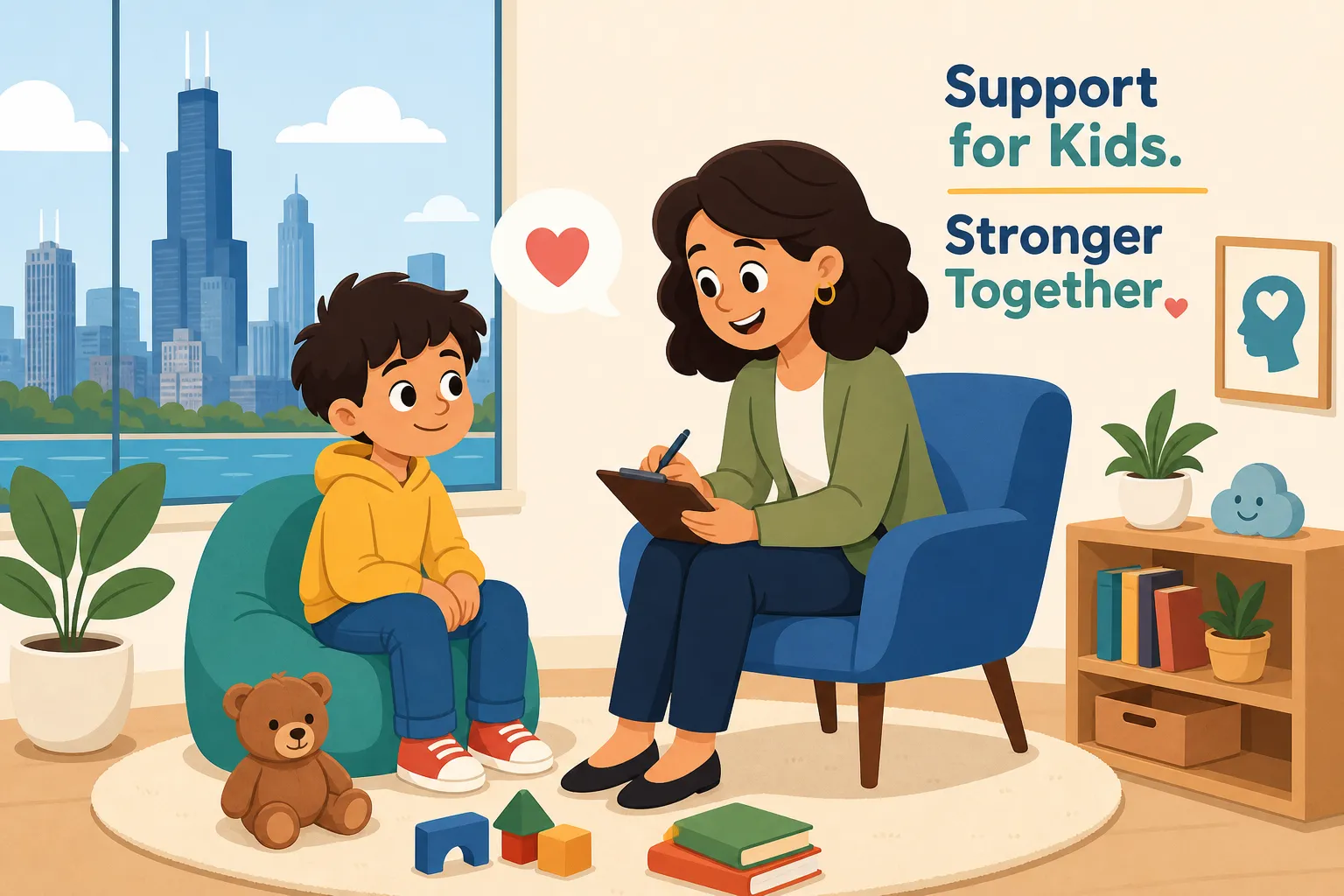
You’ve been watching your child for weeks now. Maybe they cry before school every morning, or they’ve stopped eating dinner with the family, or the meltdowns have become so frequent and intense that you’ve started rearranging your whole household around them. You’ve tried patience. You’ve tried routines, conversations, extra time together. And something still isn’t right. That feeling you can’t shake? Trust it. It isn’t a sign that you’ve failed as a parent. It’s a signal that your child needs a different kind of support than love alone can provide. If you’re searching for a child therapist in Chicago, this guide gives you a clear framework: what to look for, what to expect, and how to move forward without second-guessing yourself.
Finding the right child therapist in Chicago can feel like standing in front of a wall of options with no map. The city has many licensed mental health providers, but pediatric care is its own specialty within a specialty. The difference between a general therapist who occasionally sees children and a clinician trained specifically in child and adolescent development shows up in the quality and fit of care. Specialization is associated with better-tailored approaches and is widely regarded among clinicians as improving outcomes for children. That’s exactly why River North Counseling built its child psychology services around children at every developmental stage, serving families across Chicago and Skokie with clinicians whose entire focus is pediatric and adolescent mental health.
How to tell when your child needs more than reassurance
Every child has hard stretches. A new school year, a friendship falling apart, a family move, these are real stressors, and it’s normal for kids to show some distress around them. The question parents need to ask is not whether their child is struggling, but whether the struggle is resolving on its own or getting deeper. Clinical concern rises when symptoms are persistent, disproportionate to the trigger, and starting to interfere with daily functioning at school, at home, or with peers.
Specific warning signs worth taking seriously include persistent sadness or flat affect lasting more than two weeks, a threshold consistent with clinical screening guidelines for pediatric mood disorders, separation anxiety that’s well beyond what’s developmentally expected, dramatic shifts in eating or sleeping patterns, school refusal, escalating aggression, or any talk of self-harm. These aren’t character flaws. They aren’t phases a child will simply outgrow with enough time. They’re the nervous system communicating that something is beyond what the child can regulate alone.
School struggles often layer into this picture in ways that are easy to misread. A child who’s constantly in the nurse’s office with stomachaches, who’s falling behind despite obvious intelligence, or who’s getting sent home for behavior issues may be dealing with anxiety, undiagnosed ADHD, or trauma responses that look like defiance. A licensed pediatric clinician can help untangle what’s academic, what’s behavioral, and what’s clinical. School counselors are valuable, but their scope is generally limited to the school setting, and that scope varies by district and role. Independent, licensed pediatric care goes further and addresses the full picture.
Illinois credentials: what each license actually means
Not every therapist is licensed to practice independently, and not every license is the right credential for a child’s specific needs. In Illinois, parents will encounter a few common designations. The LCPC (Licensed Clinical Professional Counselor) and LCSW (Licensed Clinical Social Worker) are both independent clinical licenses that qualify a therapist to provide ongoing talk therapy, play-based work, and skill-building sessions with children. A PhD or PsyD designates a licensed psychologist, who holds doctoral-level training and is credentialed for formal psychological and neuropsychological assessments in addition to therapy. For specific details on scope of practice, Illinois’s Department of Financial and Professional Regulation publishes licensure summaries by credential type.
One credential distinction matters more in Illinois than most parents realize: the difference between LPC and LCPC. An LPC is a provisional, supervised license. In Illinois, an LPC cannot practice independently. If you’re researching providers, confirm that the therapist holds an LCPC, not just an LPC, before scheduling your child’s first session. When in doubt, ask the intake coordinator to confirm the license type before the first appointment.
When your child’s situation involves complex diagnostic questions, ruling out ADHD, evaluating learning disabilities, or supporting an IEP process, a licensed psychologist (PhD or PsyD) is the appropriate specialist. Psychologists provide therapy and also conduct formal assessments that generate diagnoses and documentation schools and physicians can act on. Note that billing and insurance implications can vary by license type, so it’s worth confirming coverage specifics with your insurer. A useful question to ask any provider directly: “How much of your current caseload is children, and in what age range?” The answer tells you more than the license alone.
The therapy approaches used most often with children and teens
Therapy for a seven-year-old looks very different from therapy for a fifteen-year-old, and it should. The method has to fit the developmental stage of the child, not just the diagnosis. Play therapy is a widely used approach with younger children, roughly ages three through ten, because children in that developmental range tend to process emotional experiences through play rather than verbal conversation. This isn’t recreational time. It’s structured, clinically guided work where the therapist observes themes, behaviors, and emotional patterns through the child’s natural language: play. For more on how clinicians approach assessment and intake in play-based work, see this resource on the intake process in play therapy.
For children who have experienced loss, abuse, family instability, or acute trauma, trauma-focused CBT (TF-CBT) is one of the most evidence-supported approaches available. Peer-reviewed research on TF-CBT consistently shows it outperforms supportive and non-directive approaches for trauma symptoms, and it has been adapted for children as young as three. For older children and adolescents managing anxiety, depression, or OCD, standard cognitive behavioral therapy applies more directly: identifying distorted thinking patterns, building coping skills, and practicing behavioral changes between sessions.
Family involvement is often essential in pediatric therapy. It’s a core part of what makes the work stick. When a child’s distress is connected to family dynamics, a divorce, or communication breakdowns at home, a family therapy component often runs alongside individual sessions. Parent coaching is a parallel track that’s particularly useful for parents of younger children who want to reinforce therapeutic progress at home between appointments. Any skilled Chicago child therapist should be able to explain their clinical approach clearly before your child’s first session. If a provider can’t articulate their methodology and why it fits your child’s situation, that’s a meaningful red flag.
What child therapy actually costs in Chicago
Self-pay rates for child therapy in Chicago typically run between $125 and $225 per session, consistent with market rates reported across licensed pediatric practices in the area. Initial evaluations, which often run 60 to 90 minutes to allow time for a parent interview and child rapport-building, can reach $250 at some practices. These are standard rates for licensed, specialized pediatric clinicians in an urban setting.
Most major insurers cover outpatient pediatric mental health services, but the details depend heavily on plan type. Blue Cross Blue Shield, Cigna, and Aetna all participate in behavioral health coverage, but restrictions apply. BCBS HMO plans, for example, often do not cover the same providers as BCBS PPO plans. Aetna PPO and Aetna Better Health, the Medicaid-managed-care version, are entirely separate networks. When you call to verify coverage, ask specifically: “Is this provider in-network for my plan, and does my plan cover outpatient pediatric mental health?” Don’t rely on a general answer about mental health coverage.
Teletherapy is widely available across Illinois and works well for older children and adolescents dealing with anxiety and depression. For younger children and those who need play-based interventions, in-person sessions are generally more effective. Many practices offering child counseling in Chicago, including youth mental health providers across the North Shore, offer both formats, so families in Skokie or other suburban areas don’t need to drive downtown for every appointment.
How to evaluate a child therapist in Chicago before you commit
Before booking a first appointment, ask these five questions directly:
- What is the therapist’s Illinois license, and is it current? Confirm LCPC, LCSW, or PhD/PsyD, not a provisional LPC.
- What age range and presenting concerns do they specialize in? A practice built around pediatric care should be able to answer this precisely.
- What therapy model do they use, and why is it the right fit for your child? Look for specific reasoning, not a generic list of modalities.
- How do they involve parents in the process? Parent involvement is a quality indicator, especially for younger children.
- Do they have direct experience with your child’s specific concern, whether that’s anxiety, trauma, ADHD, grief, or something else?
A confident, transparent answer to all five is itself a quality signal. For guidance on searching and choosing a clinician step-by-step, see How to Find the Right Therapist in Chicago.
There’s a meaningful difference between a general adult therapy practice that “also sees kids” and a practice built specifically around pediatric and adolescent mental health. The former might have one or two therapists who are comfortable with children. The latter has built its clinical team, intake process, and service model around exactly this population. River North Counseling’s child psychology team works with children and families across Chicago and Skokie, pairing each child with the right clinician based on age, presenting concern, and therapeutic approach. That matching process matters because a specialist in adolescent trauma may not be the best fit for a six-year-old with separation anxiety, even if both are technically “child therapists.”
When vetting any practice, look for this kind of specificity. A practice that can tell you exactly which clinicians see which age ranges, what modalities they use, and why a particular therapist would be a good fit for your child’s needs is demonstrating clinical depth. That’s the standard worth holding out for.
What to expect at your child’s first therapy appointment
Most practices begin with a parent-only intake call or session before the child comes in. This is standard clinical practice. It gives the therapist essential context, developmental history, school situation, family dynamics, previous diagnoses or therapy, without putting your child in an unfamiliar room and asking them to explain themselves on day one. Come prepared with a brief summary of your child’s history and current stressors. The more specific you can be, the faster the therapist can form an accurate picture. For a practical overview of what happens during that intake step, you may find this description of a child therapy intake session helpful.
The first session with your child is typically low-stakes by design. The therapist’s job in that appointment is to build rapport and help your child feel comfortable with the space and the person. There’s no heavy clinical assessment happening on day one. For younger children, this might involve play materials and minimal structured conversation. For adolescents, it’s often a casual getting-to-know-you exchange. The therapeutic work builds from there.
How you frame therapy to your child before that first appointment matters. Simple and honest works best: “This is a person whose job is to help kids work through hard feelings.” Avoid framing therapy as a consequence for behavior or something that happens because they’re “bad” or “broken.” And remind both your child and yourself that one session is not a commitment to anything. It’s a conversation, and it can lead somewhere that changes everything.
The first step is the hardest one
Finding the right pediatric therapist in Chicago comes down to three things: verified credentials, a therapy approach matched to your child’s developmental stage and specific needs, and a practice genuinely built around pediatric care rather than treating children as a secondary service. In our experience working with families, many parents say the same thing once things are going well: they wish they had started sooner.
Most parents describe the hardest part of this process as simply beginning. The search feels daunting, the options are many, and there’s always a reason to wait another month and see if things improve. Early mental health support is associated with better long-term outcomes, children who get the right help at the right developmental stage tend to build coping skills they carry forward. Waiting, on the other hand, can mean more time spent catching up later.
If your child is showing signs of emotional distress, behavioral changes, or school struggles that aren’t resolving, a child therapist in Chicago can help you find the right path forward. River North Counseling’s child psychology team serves families across Chicago and Skokie, both in-person and virtually. Reach out to Find a therapist in Chicago: Your step-by-step guide to schedule an intake consultation and take the first step toward getting your child the care they deserve.