
Psychological testing is a structured process where a licensed psychologist administers standardized tools to measure specific mental and cognitive abilities, personality traits, emotional symptoms, or diagnostic patterns. It is not a single questionnaire or a quick screening form you fill out in a waiting room. Rather, it is a component of a full clinical evaluation, one that produces data-backed answers to specific questions about how someone thinks, feels, and functions across multiple domains. A complete psychological assessment integrates those test scores with clinical interviews, behavioral observations, and relevant records to form a comprehensive picture.
For Chicagoans who have been referred for testing, or who are wondering whether they need an evaluation, River North Counseling provides comprehensive psychological and neuropsychological assessments for both adults and families at their River North and Skokie locations, as well as virtually throughout Illinois. By the end of this article, you will understand what mental health testing actually measures, how it differs from a neuropsychological evaluation, who it helps most, and what the process looks like from the first appointment to the final feedback session.
Key takeaways
- Testing versus intake: Psychological testing uses standardized instruments and scores; a therapy intake generally focuses on treatment planning and may not include comprehensive standardized testing, though clinicians may form preliminary diagnostic impressions during that conversation.
- Multiple test types: Cognitive, neuropsychological, personality, and achievement tests each answer a different clinical question and are not interchangeable.
- Purpose-built process: Every evaluation is built around a specific referral question, not a generic checklist.
- Timeline to expect: From intake to feedback, most evaluations run two to six weeks, depending on complexity.
- Credentials matter: A state-licensed PhD or PsyD psychologist should interpret results and sign the final report; trained psychometrists may assist with administration under supervision.
- Insurance coverage: Testing is often covered when it is medically necessary; verify with your insurer before scheduling.
What a psychological evaluation actually measures
The terms “testing,” “assessment,” and “therapy intake” get used interchangeably, but they describe three distinct things. Psychological testing refers to the standardized administration and scoring of specific instruments, tests with established norms that allow a clinician to compare your performance or responses against a relevant reference group. A psychological assessment is broader, integrating those test scores with clinical interviews, behavioral observations, medical records, and collateral information to form a complete picture. A therapy intake is neither: it is an onboarding conversation where a therapist learns about your goals and history to begin treatment planning. While a clinician may form initial diagnostic impressions during an intake, it is not the same as a comprehensive diagnostic psychological testing process.
It is also worth clarifying what psychological testing is not. It is not a pass/fail exam, and a lower score on one measure does not mean something is “wrong” with you. It is not limited to IQ testing, and it is not the same as a psychiatric evaluation. A psychiatric evaluation focuses on medication, medical history, and symptom diagnosis through a clinical interview conducted by a psychiatrist. Psychological and psychometric testing, by contrast, is data-driven: it generates interpretable scores across multiple domains, and then a clinician synthesizes those scores into meaningful clinical conclusions.
The main types of psychological tests
Cognitive and intellectual ability tests
Cognitive and intellectual ability tests measure how someone reasons, processes information, holds things in working memory, and handles visual-spatial tasks. Common instruments include the WAIS for adults and the WISC for children. These tests address one foundational question: what are this person’s general thinking abilities, and where are the relative strengths and weaknesses?
Personality and emotional functioning tests
Personality and emotional functioning tests reveal patterns of thinking, behavior, and emotional health. Objective inventories like the MMPI-3 are especially useful for diagnostic clarification involving mood disorders, trauma responses, and personality-related concerns. These tests include validity scales designed to detect many forms of inconsistent or biased responding, which makes the results more trustworthy. No instrument is entirely immune to intentional distortion, but those validity indicators meaningfully strengthen the reliability of the findings.
Achievement tests
Achievement tests measure what someone has actually learned in areas like reading, writing, and math, using instruments such as the WIAT or Woodcock-Johnson. These are most common in evaluations for learning disabilities, dyslexia, or when a student needs documentation to qualify for academic accommodations. A complete educational evaluation often combines cognitive and achievement tests to compare potential with actual performance.
How psychological testing differs from neuropsychological testing
Neuropsychological testing zeroes in on how specific brain systems are functioning. It evaluates attention, memory, language, executive functioning, processing speed, and motor coordination with considerably more granularity than a standard cognitive assessment. A cognitive test asks what a person’s general abilities look like overall; a neuropsychological evaluation asks how specific brain-related cognitive systems are working and where the precise gaps lie.
The two types of evaluation are not interchangeable, and knowing which one you need matters. Psychological testing is typically the right fit for diagnosing ADHD, mood disorders, autism spectrum conditions, learning disabilities, or personality-related concerns. Neuropsychological testing is indicated after a concussion, stroke, or head injury; for age-related cognitive changes or concerns about dementia; for complex adult ADHD evaluations where brain-related factors may be involved; or when a neurological condition may be affecting daily functioning. A specialist should help you determine which evaluation addresses your actual clinical question.
| Feature | Psychological testing | Neuropsychological testing |
|---|---|---|
| Primary focus | Emotional, behavioral, personality, intellectual, and psychiatric functioning | Detailed cognitive functioning and its relationship to brain or nervous-system functioning |
| Typical questions answered | Is depression, ADHD, autism, or a personality disorder present? | Is there cognitive impairment? Which abilities are affected and why? |
| Common uses | Psychiatric diagnosis, treatment planning, educational decisions | Post-injury baseline, cognitive decline, neurological conditions, rehabilitation |
| Typical duration | Often shorter, depending on referral question | Commonly several hours across multiple sessions |
| Specialist | Licensed clinical psychologist | Neuropsychologist with specialized postdoctoral training |
Who actually needs a psychological evaluation
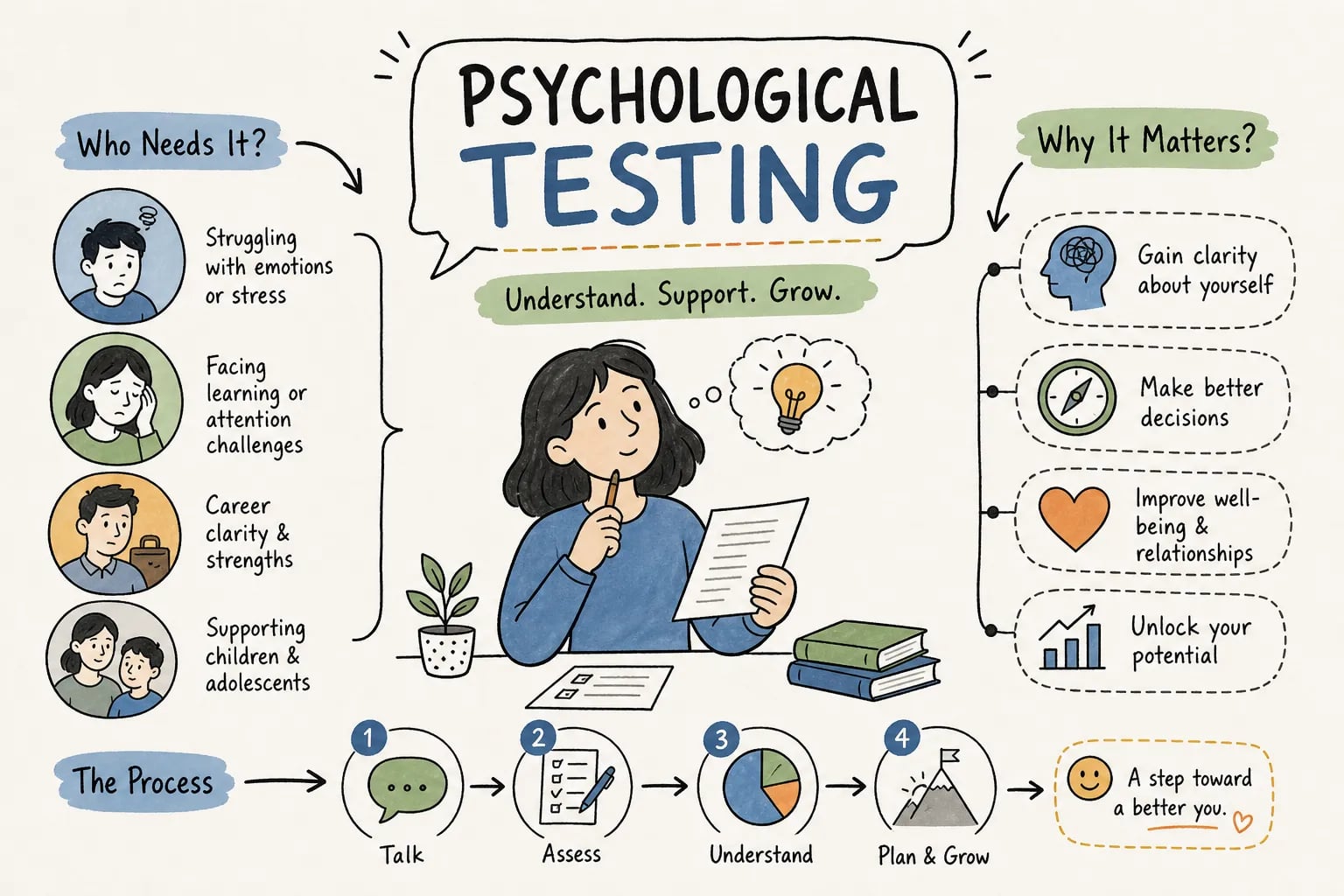
Adults most often seek testing when they have been struggling without a clear explanation. Some have seen multiple providers without resolution and need diagnostic clarification. Others are pursuing adult ADHD evaluations, documentation for workplace accommodations, or answers about memory changes they have been quietly tracking for months. Many adults arrive at a psychologist’s office after years of feeling like something was off, but without the language or data to describe it precisely.
For children and families, the most common drivers include suspected learning disabilities, school accommodation needs, and behavioral difficulties that have not responded to standard support. Autism assessments and situations where school and clinical teams are offering conflicting guidance are also frequent reasons families seek an evaluation. Parents often arrive feeling overwhelmed, unsure whether they are overreacting or missing something important. A well-conducted evaluation replaces that uncertainty with a clear clinical picture and specific, actionable recommendations.
The referral question is the anchor of any good evaluation. Every psychological assessment is built around a specific clinical question the evaluation is designed to answer: Is this ADHD or anxiety? Is there a learning disability affecting reading? What is driving these behavioral changes? A thorough psychologist will discuss that question with you before selecting a single test, because the battery of instruments should be designed to answer it directly, not assembled generically.
What the testing process looks like from start to finish
The intake
Testing always begins with a thorough intake covering history, symptoms, daily functioning, prior evaluations, medical background, and the specific concerns driving the referral. This is not a formality. The intake shapes which tests are selected and provides the contextual backdrop against which all scores are later interpreted. Skipping a thorough intake is a red flag in any testing practice.
The testing sessions
The testing sessions themselves typically span one to three appointments, each lasting two to four hours with scheduled breaks. The tasks may feel like puzzles, memory exercises, written inventories, or structured question-and-answer activities. The process requires mental effort, but it is not painful or intimidating. Many people find it surprisingly engaging once they understand what each task is measuring.
Scoring, integration, and the feedback session
After testing ends, the work continues behind the scenes. The psychologist spends days scoring instruments, comparing results to norm groups, integrating findings across all data sources, and writing a detailed report. This phase commonly takes two to four weeks. The process concludes with a feedback session, typically 60 to 90 minutes, where the clinician explains results in plain language, walks through diagnostic impressions, and provides specific recommendations for treatment, school supports, workplace accommodations, or further evaluation. The full timeline from intake to feedback generally runs two to six weeks for most evaluations.
How to find a qualified provider for psychological testing in Chicago
A state-licensed psychologist holding a PhD or PsyD should interpret results and take clinical responsibility for the final report. Trained psychometrists or technicians may administer specific instruments under supervision, but clinical interpretation and the signed report belong with the licensed psychologist. For neuropsychological evaluations specifically, look for additional postdoctoral training in neuropsychology and, when relevant, board certification through the American Board of Clinical Neuropsychology (ABCN). You can verify a provider’s license through the Illinois Department of Financial and Professional Regulation before booking.
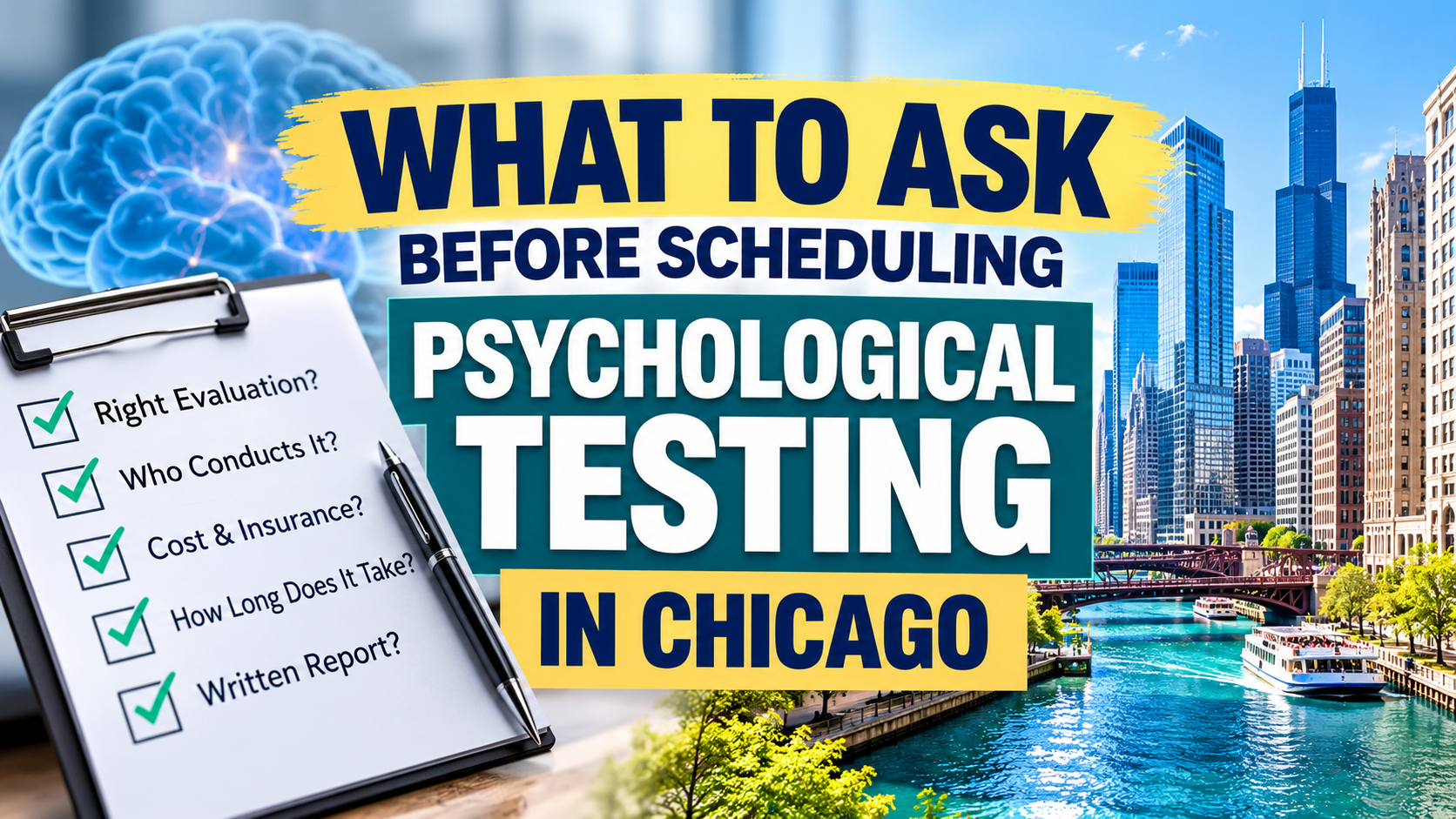
A few questions are worth asking before you commit to any practice. How often do you evaluate adults or children with my specific concern? Does your fee include a written report and a dedicated feedback session? Who will I speak with if I have questions after the report is delivered? These questions separate thorough, transparent practices from rushed ones, and any qualified provider should answer them without hesitation.
River North Counseling offers psychological and neuropsychological assessment services for adults and families across the Chicagoland area, with in-person appointments at their River North and Skokie locations and virtual formats available throughout Illinois. Their evaluations address questions about cognitive functioning, personality, and emotional health, and their team takes time to explain findings in plain language and provide recommendations clients can act on. If you or someone you care about has been referred for testing, or has been managing unanswered questions about thinking, learning, or emotional functioning, reaching out to their team is a straightforward next step toward getting real data and a clear direction forward.
Getting clear answers is the point
Psychological testing is not about labeling people. It is about replacing guesswork with evidence. Whether you are pursuing a diagnosis, seeking workplace accommodations, supporting a child through school challenges, or finally investigating longstanding struggles that have never been fully explained, a well-conducted evaluation gives you real data and real direction.
When you are ready to move forward, connect with a state-licensed psychologist who specializes in the type of evaluation that fits your situation. A good evaluation does not just name what is happening, it tells you what to do about it, and that clarity tends to make the path ahead look considerably more manageable.
Frequently Asked Questions
Will my insurance cover psychological testing?
Often, yes, testing is frequently covered when it is medically necessary, but you should verify coverage with your insurer before scheduling. I advise calling your insurance to confirm whether specific assessment codes and provider types are covered to avoid unexpected costs.
How long does the full testing process take from start to finish?
From intake to feedback, most evaluations run two to six weeks. Testing sessions themselves usually occur across one to three appointments of two to four hours each, and scoring and report writing commonly take an additional two to four weeks.
Can psychological testing be done virtually or only in person?
Yes, virtual formats are available throughout Illinois in addition to in-person appointments at River North and Skokie locations. I offer both options so evaluations can fit clients’ needs and geographic constraints.
Who will interpret the results and sign the final report?
A state-licensed psychologist holding a PhD or PsyD should interpret results and sign the final report, while trained psychometrists may assist with test administration under supervision. I ensure clinical responsibility and interpretation remain with the licensed psychologist for accuracy and compliance.