
When you’re trying to decide when to take your child to a therapist vs. a school counselor, the stakes feel high, and they are. The call comes on a Tuesday afternoon. The school counselor tells you your child has been crying at lunch, pulling away from friends, and struggling to focus in class. You hang up and stare at your phone, wondering: does the school have this covered, or do you need to do something more? This is one of the most common questions the child therapists at River North Counseling hear from Chicago parents every week, and the answer matters more than most parents realize.
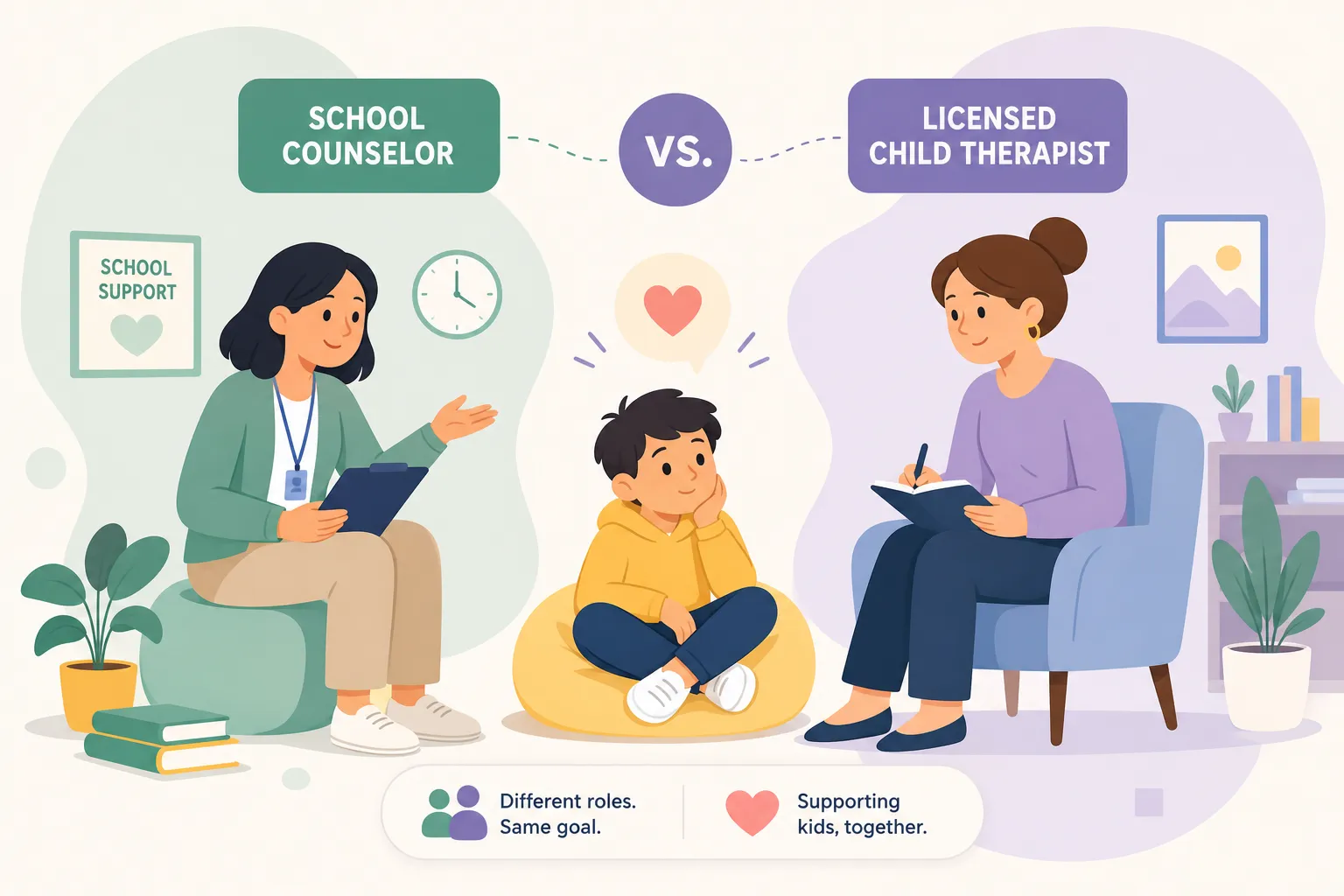
School counselors and licensed child therapists are not interchangeable. They serve different functions, hold different credentials, and are legally authorized to do very different things. Choosing the wrong path doesn’t just delay progress; it can leave real clinical needs without the structured, professional treatment they require. The good news is that once you understand what each role actually covers, the right next step becomes much clearer.
By the end of this article, you’ll know exactly what a school counselor is trained to handle, what a licensed child therapist is equipped to do, which warning signs point clearly toward clinical care, and what the first concrete step looks like for a Chicago-area family.
What school counselors are actually trained to do
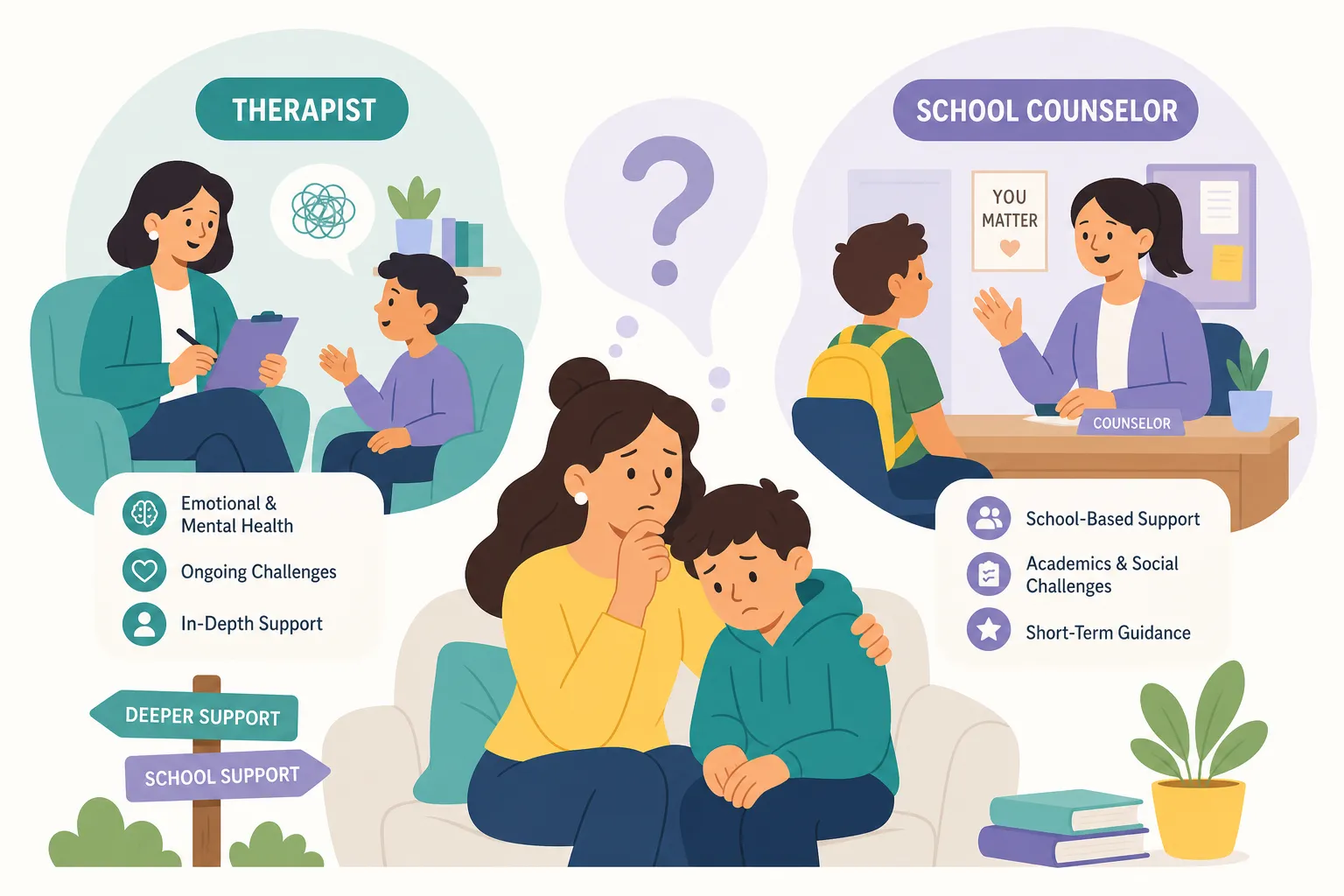
School counselors are genuinely valuable professionals, and understanding their real role helps you use them well rather than expecting more than their training supports. Most hold a master’s degree in school counseling and carry state certification for educational settings, not clinical practice. Their curriculum is built around the school environment: academic planning, career exploration, social-emotional learning, classroom guidance lessons, and short-term check-ins with students who are struggling.
The structural reality of the job shapes what’s possible. A school counselor is typically responsible for an entire student population, sometimes several hundred students per counselor in a single building. That ratio makes deep, individualized, ongoing work with any one child genuinely difficult, even when the counselor is skilled and motivated. Their mandate is broad support and early intervention across the whole school, not weekly one-on-one clinical treatment.
What they are not trained or licensed to provide is equally important to understand. School counselors do not conduct formal psychological assessments, diagnose mental health conditions, or deliver ongoing psychotherapy. This isn’t a failure; it’s simply not what the role was built for. It also helps to know that a school building may actually have three separate professional roles: the school counselor, a school psychologist (who focuses on psychoeducational testing and IEP-related evaluation), and any outside clinical providers brought in through the district. These are distinct positions with different scopes, and the differences matter when you’re trying to figure out who can actually help your child.
Where school-based counseling reaches its limit
School counselors are well-designed for school-specific, short-term concerns: a conflict with a teacher, test anxiety before finals, a friendship falling apart after spring break. When those concerns resolve and the child stabilizes, school mental health services have done exactly what they were meant to do. The problem arises when a child’s distress stops being a school-only issue and starts bleeding into the rest of their life.
When you’re seeing changes at home, disrupted sleep, altered eating habits, tension with siblings, or a child who can’t get through basic daily tasks without shutting down or exploding, the school counselor was not designed to address that level of cross-setting impairment. Their schedule typically doesn’t allow for weekly clinical sessions, and they don’t carry the licensure to manage ongoing mental health conditions, even when they’re the first person in the building to notice something is wrong.
There’s also a confidentiality reality that most parents don’t think about until it becomes relevant. In a school setting, what a child shares with a counselor can be shared with teachers, administrators, and parents under certain circumstances because schools carry an educational duty of care. Private therapy operates under stricter HIPAA-aligned confidentiality protections: what happens in a session stays between therapist and client unless a specific release is signed or a safety concern requires disclosure. For teenagers especially, this distinction is significant. Adolescents open up more readily when they trust that what they say won’t automatically make its way back to their homeroom teacher or their parents by default. For more on school counseling confidentiality, see the ASCA guidance on school counselor confidentiality: school counselor confidentiality.
Warning signs your child needs a therapist, not just school support
This is the question most parents are really asking: how do I know if what I’m seeing is serious enough to warrant professional clinical care? The threshold isn’t perfection. Children have hard weeks, rough patches, and adjustment periods. One difficult stretch doesn’t mean your child needs a therapist. A pattern that doesn’t lift does.
Emotional and behavioral signs
Emotional and behavioral warning signs that point toward clinical evaluation include:
- Persistent sadness, anxiety, or irritability lasting more than two to three weeks with no clear, passing cause
- Frequent emotional outbursts, aggression, or complete emotional shutdowns that are disproportionate to what triggered them
- Loss of interest in activities your child used to love, or a noticeable shift in personality
- Social withdrawal from both friends and family
- Any statements about not wanting to be alive, feeling hopeless, or harming themselves or others
Functional signs at home and school
Changes in daily functioning are equally important signals. Sleep disruption (nightmares, difficulty falling asleep, sleeping far more than usual) and significant changes in appetite or hygiene are worth noting. An inability to complete age-appropriate tasks without extreme distress also indicates that the problem has moved beyond school-based support. When a child can’t get dressed, can’t sit in a social setting, or can’t do homework without a full breakdown, the issue is no longer just about academic performance. It’s about how your child is functioning as a person. That’s the clearest sign it’s time to seek a child therapist for clinical evaluation.
Any mention of self-harm or not wanting to be alive is an immediate signal for clinical assessment. This is not a wait-and-see situation, and it’s beyond what school counseling was built to address.
Situations that clearly call for a licensed child therapist
Some clinical situations are clear matches for private therapy regardless of what school counseling is offering. Anxiety disorders, depression, OCD, trauma-related symptoms, ADHD-related emotional dysregulation, and eating disorders all require evidence-based clinical treatment. A child therapist trained in cognitive behavioral therapy (CBT) or trauma-informed approaches brings specific, structured interventions that school counselors are neither trained nor licensed to deliver. Attempting to manage these conditions with school-level support doesn’t just slow progress; it often allows the condition to become more entrenched over time.
A child who has experienced significant trauma, whether that’s loss, abuse, a family crisis, or a frightening medical event, needs a therapist trained in trauma-focused approaches. Check-ins between classes don’t come close to meeting that need, and there’s no version of good intentions that substitutes for clinical training in this area.
If your child has been seeing the school counselor regularly with little or no improvement, that’s a signal to escalate the level of care, not a reflection of your child’s effort or the counselor’s care. Private therapy versus school counseling isn’t a competition between two options where one wins. It’s about matching the intensity of the intervention to the intensity of the problem. Importantly, both can happen at the same time: a licensed therapist handles clinical treatment while the school counselor continues supporting your child’s day-to-day functioning in the classroom.
How to decide: therapist vs. school counselor, costs and access in Chicago
School-based counseling and school psychology services are provided at no direct cost to families through the public school system. To access those services, you can contact your child’s school counselor directly or request a meeting with the student support team. You don’t have to wait for the school to flag a concern; parents can initiate that conversation themselves. Keep in mind that availability depends on what your specific district offers, and specialized school-based services often involve eligibility determinations that take time. For examples of school-based therapy programs and how districts partner with providers, see this overview of a school-based therapy program: school-based therapy programs.
Private child therapy typically runs between $100 and $200 per session depending on the provider, location, and type of service. Neuropsychological assessments are priced separately and can be significantly higher. Most major insurance plans cover mental health therapy under federal parity rules, including plans from Blue Cross Blue Shield, Aetna, Cigna, and UnitedHealthcare, as well as Illinois Medicaid/All Kids. Copays, deductibles, and in-network versus out-of-network status all affect what you pay out of pocket, so confirming your specific coverage before the first session is a practical first step.
On timing, private therapy in Chicago is often faster to start than families expect. Many private practices can schedule an intake appointment within one to two weeks because families contact providers directly without an eligibility process in between. Wait times at large hospital systems tend to be longer, often several months. For families who need clinical care, reaching out to a private practice now typically gets your child seen far sooner than navigating a larger institutional system.
How to get your child the right support in Chicago
Start with the school if you haven’t already. Contact your child’s school counselor this week and ask specifically what services are available, whether a referral is needed for anything beyond brief check-ins, and how often your child would actually be seen. Use that conversation as information-gathering. If the counselor identifies something clinical or recommends that you seek outside support, treat that as a clear green light to pursue private therapy without delay.
You also don’t need the school’s confirmation before reaching out to a child therapist. If your instinct tells you the concern is serious, that’s enough reason to make a call. Gut instincts about your child’s wellbeing are worth acting on, not setting aside while you wait to see if things improve.
When the situation calls for clinical-level care, River North Counseling’s child therapists in Chicago specialize in exactly the kinds of concerns that fall outside what school counselors are equipped to address: anxiety, depression, trauma, emotional dysregulation, and behavioral challenges that affect the whole family’s daily life.
With in-person offices in River North and Skokie, as well as virtual therapy options across Illinois, River North Counseling is structured to make that first step straightforward for Chicago-area families, no complicated referral process and typically no long wait. The first step is a consultation call where a therapist can help you assess whether your child’s needs match what clinical therapy offers and connect you with the right fit on the team. Note that neuropsychological assessments and specialist evaluations are separate services and may have different timelines and costs.
The decision is simpler than it feels
Choosing between a school counselor and a licensed child therapist isn’t about dismissing one or elevating the other. It’s about being honest about what your child actually needs right now, and understanding what each professional role was built to deliver. School counselors provide genuine, meaningful support within an educational context. Licensed child therapists provide structured, evidence-based clinical treatment for mental health conditions that have moved beyond that scope.
Knowing when to take your child to a therapist vs. a school counselor comes down to one honest question: has the problem crossed into home life, persisted beyond a few weeks, or started impairing how your child functions as a person? When the answer is yes, that’s when to seek clinical care. Waiting for things to deteriorate further is the one approach guaranteed not to help.
If you’re not sure which path fits your child’s situation, River North Counseling’s team is available to talk it through with you. One intake conversation can give you more clarity than weeks of uncertainty, and it’s always the right time to ask.
Frequently asked questions
When should I take my child to a therapist vs. a school counselor?
Take your child to a licensed therapist when the problem is persistent (more than two to three weeks), crosses into home life, or involves real emotional or functional impairment. A school counselor is the right first contact for school-specific, short-term concerns. If your child’s distress shows up at home as well as at school, private therapy vs. school counseling is no longer an either/or, clinical care is the appropriate next step.
Can my child see both a school counselor and a private therapist at the same time?
Yes, and for many children this is the best arrangement. The school counselor supports your child’s day-to-day functioning in the classroom while the licensed therapist addresses the underlying clinical concern. The two roles complement each other rather than compete.
What are the signs my child needs therapy rather than school-based support?
Key signs include persistent sadness or anxiety lasting more than two to three weeks, changes in sleep or appetite, withdrawal from friends and family, declining hygiene, and any statements about self-harm or not wanting to be alive. When these patterns appear, it’s time to take your child to a therapist for a clinical evaluation rather than waiting on school-based support alone.
How long does it take to get a child therapy appointment in Chicago?
Many private practices, including River North Counseling, can schedule an initial consultation within one to two weeks. Wait times at large hospital systems are typically longer. Contacting a private practice directly is usually the fastest path to getting your child seen.