
You know something is wrong. You’ve known for a while. But when you finally decide to get help, you hit an immediate wall: do you call a therapist, a psychiatrist, a psychologist, a counselor? The terminology alone is enough to make someone put off the search for another month. Most people have only a vague sense that therapists and psychiatrists are different, and almost no idea which one to contact first.
At River North Counseling, this question comes up in nearly every initial conversation we have with new clients. People arrive already overwhelmed, and adding a mental health credential glossary to the mix doesn’t help. So consider this a practical inside view: by the time you finish reading, you’ll know exactly who does what, who to call first based on your specific situation, and which signs mean you need to skip the scheduling process entirely and get immediate help.
What a therapist and a psychiatrist actually do
“Therapist” is an umbrella term, not a single credential. It covers psychologists (who hold a PhD or PsyD), licensed clinical social workers (LCSWs), and licensed professional counselors (LPCs), all of whom completed graduate or doctoral-level training in psychotherapy, assessment, and human behavior. The term “psychotherapist” is not legally protected in most states; LCSW, LPC, and PhD/PsyD are the credentials that carry specific state licensing requirements and accountability structures.
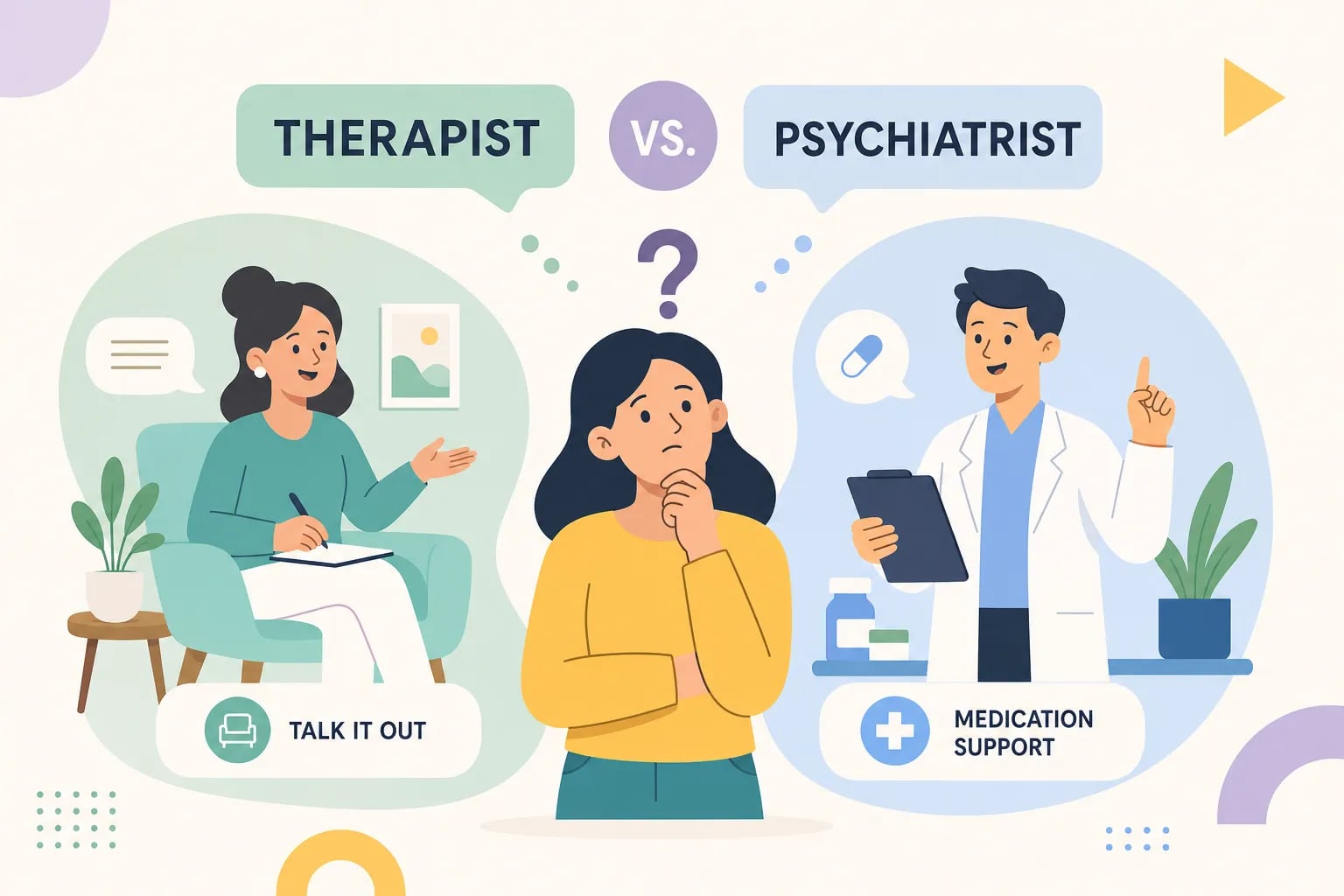
Psychiatrists are medical doctors, either MD or DO, who completed four years of medical school followed by a psychiatry residency. That medical training is the key distinction: it gives them full physician authority to diagnose complex medical-psychiatric conditions and prescribe medication. They approach mental health from a medical model, which shapes what happens when you walk into their office.
The difference becomes concrete inside the appointment itself. A therapy session typically runs 45 to 60 minutes and is built on conversation, skill practice, and exploring the patterns driving your symptoms over weeks or months. A follow-up psychiatry appointment often runs 15 to 30 minutes and centers on medication management: reviewing how your symptoms have changed, assessing a medication’s tolerability, and adjusting dosage. (Initial psychiatric evaluations are usually longer, often 45 to 90 minutes.) Many psychiatrists focus primarily on evaluation and prescribing in practice, though some do provide psychotherapy as well.
Therapist vs. Psychiatrist: Who Can Prescribe?
When it comes to prescribing psychiatric medication, psychiatrists can do so nationwide. In many states, psychiatric nurse practitioners (PMHNPs) and physician assistants (PAs) can also prescribe, though their scope and any supervision requirements vary by state. A small number of states allow specially trained psychologists limited prescribing authority under narrow conditions. If you need a prescription, a psychiatrist is always able to provide it; in many states, PMHNPs and PAs are additional paths depending on where you live.
Therapists, psychologists, LCSWs, and LPCs cannot prescribe medication in the vast majority of U.S. states, regardless of how experienced they are. This doesn’t make them less qualified; it simply reflects a different training path. Medication authority is a medical-school-level issue, not a status hierarchy. A therapist with 20 years of experience is deeply qualified to treat your anxiety, they just can’t write you a prescription.
Among the non-prescribing providers, the distinctions matter in more subtle ways. Psychologists have the deepest training in psychological assessment and testing, and their diagnostic evaluations carry significant clinical weight. LCSWs bring a person-in-environment lens, with training in family systems, community resources, and case management alongside therapy. LPCs are trained primarily in counseling and psychotherapy, making them well-suited for individual work on anxiety, depression, relationship difficulties, and life transitions.
You don’t need to memorize all of this. The practical shortcut: if you need medication, a psychiatrist is your clearest path, with PMHNPs and PAs as state-dependent options; for everything else, a licensed therapist is your starting point.
Most people should start with a therapist, here is why
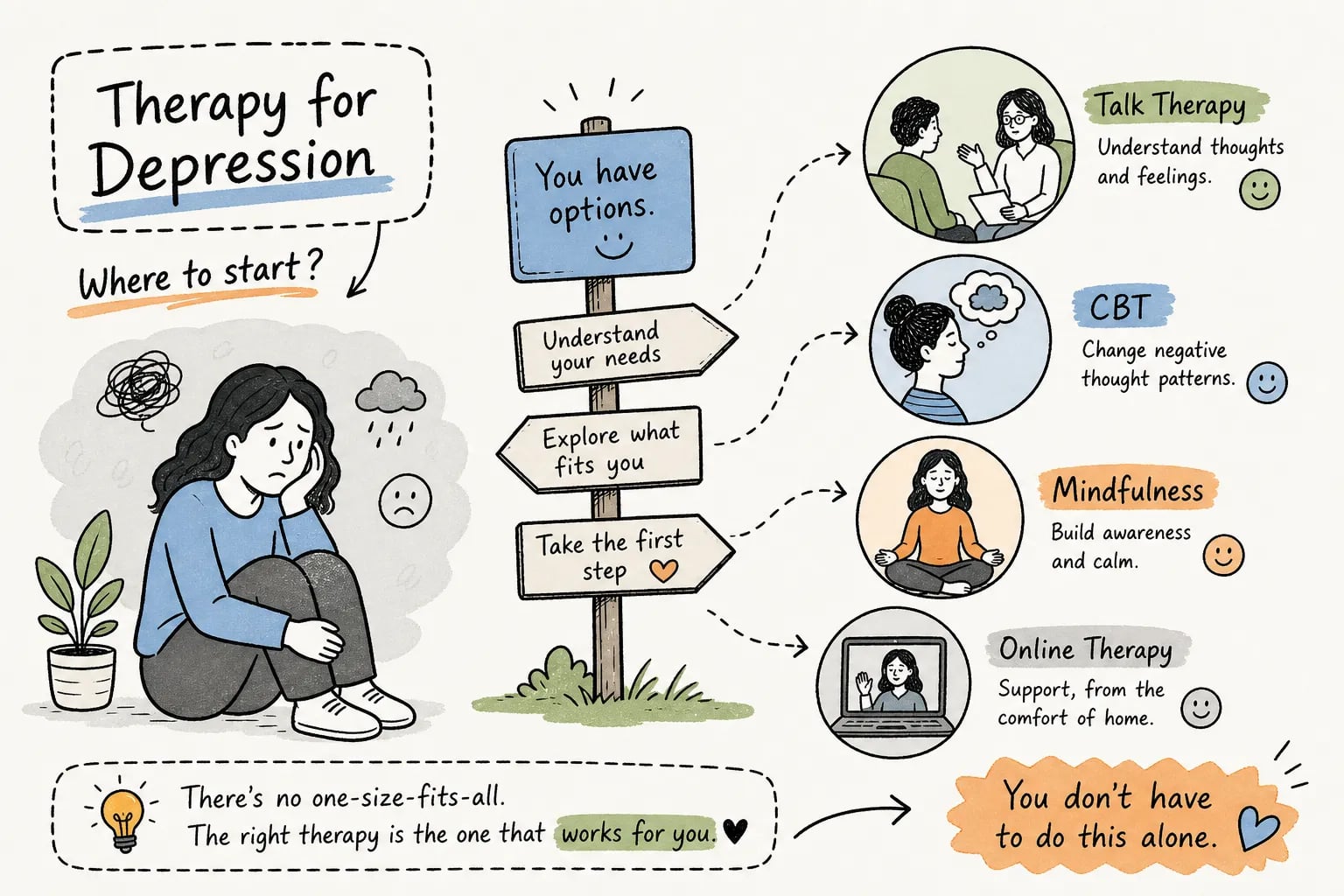
For mild-to-moderate depression and generalized anxiety disorder, clinical guidelines support psychotherapy as a first-line treatment. Medication is not always necessary to start, and in many cases it’s not necessary at all. Studies consistently show that Cognitive Behavioral Therapy (CBT) produces durable change for anxiety and depression, often with longer-lasting effects than medication alone. Clients build skills they continue using after treatment ends, rather than depending on an ongoing prescription.
Starting with a therapist also gets you into care faster. The national median wait time for a new psychiatry appointment is around 25 to 67 days, depending on location and practice setting. Therapy appointments are often available within days, at many practices, within a week. That gap in access matters when you’re already struggling.
At River North Counseling, therapists conduct detailed intake assessments, covering your symptom history, a diagnostic interview, and a safety screening, to identify what’s driving your concerns and whether a psychiatric referral makes sense. Starting with therapy doesn’t mean you’ll miss out on medication if you need it. A therapist who identifies symptoms suggesting bipolar disorder, treatment-resistant depression, or psychosis will coordinate a referral directly. You get both a clear picture of your care pathway and a faster entry into support.
When a Psychiatrist Should Be Your First Call
Bipolar disorder is the clearest case where psychiatric evaluation should come first. Clinical guidelines are specific on this: antidepressants prescribed without a full evaluation can trigger manic episodes in people with undiagnosed bipolar disorder. Starting with a psychiatrist ensures the diagnosis is accurate before any medication is introduced. If you have a family history of bipolar disorder or have ever experienced periods of unusually elevated energy, decreased need for sleep, or impulsive decision-making alongside depressive episodes, a psychiatric evaluation should precede therapy.
Psychosis requires immediate psychiatric assessment. Hallucinations, delusions, and disorganized thinking are not appropriate targets for psychotherapy alone as a first-line intervention. Severe depression with significant functional impairment, a history of multiple treatment attempts that haven’t worked, or a strong family history of complex psychiatric conditions are also situations where starting with a psychiatrist rather than a therapist makes clinical sense.
Some situations require skipping the scheduling process entirely. If someone is experiencing suicidal thoughts with a specific plan or intent, a recent suicide attempt, or active self-harm, this is a psychiatric emergency. Call 988 (the Suicide and Crisis Lifeline), go to the nearest emergency room, or call 911. Command hallucinations, severe intoxication combined with suicidal ideation, and an inability to care for oneself all require emergency psychiatric evaluation. When safety is in question, the therapist-vs.-psychiatrist question doesn’t apply. Get to the emergency room or crisis line first.
When combining therapy and medication produces the best outcomes
Combined treatment consistently outperforms medication alone for moderate-to-severe depression, panic disorder, and OCD, at least in the short term. The effect is meaningful, not marginal. Medication can stabilize symptoms enough that a person is able to engage productively in therapy, and therapy builds the skills that sustain progress once medication is eventually reduced or stopped.
The picture shifts over time. For depression specifically, psychotherapy alone often performs comparably to combined treatment at six months and beyond, the incremental advantage of adding medication to therapy narrows the longer treatment continues. Combination care is most valuable when symptoms are moderate-to-severe, when a single approach has plateaued, or when someone needs stabilization before they can engage meaningfully in talk therapy.
Coordinating two providers is less complicated than it sounds. Most therapists and psychiatrists are experienced in co-treating the same client. With your written consent, they share relevant clinical updates, flag changes in symptoms or medication response, and adjust the care plan together.
Insurance typically covers both types of appointments under mental health benefits, though cost-sharing varies by plan and parity rules don’t guarantee identical copays or that every plan covers both services. A therapy practice’s intake team can usually help clarify your coverage before your first session. Your job is not to manage the coordination yourself, once you’re in care, the providers handle that communication, and you benefit from both layers of support running in parallel.
The clear path forward
Here is the decision in plain language. Start with a therapist if your symptoms are mild to moderate, safety is not a concern, and you haven’t tried treatment before. Go to a psychiatrist first if your symptoms suggest bipolar disorder, psychosis, or a level of severity or diagnostic complexity that warrants medical evaluation from the start. Call 988 or go to the emergency room if there is any immediate safety risk. These aren’t rigid rules, but they cover the vast majority of situations people face when deciding between a therapist vs. a psychiatrist.
Neither provider is better. They serve different functions and often work best in combination. A therapist who knows when to refer and a psychiatrist who values the therapeutic work happening alongside medication, both are part of effective mental health care. You don’t have to figure out which one you need before you reach out.
Taking that first step is hard, especially when you’re already worn down. If you’re in Chicago or anywhere across Chicagoland and ready to move forward, reach out to River North Counseling to schedule an intake consultation. A licensed therapist will meet with you, complete a thorough assessment, and help you understand exactly what your care pathway looks like from day one. You don’t need to arrive with a diagnosis or a plan. You just need to make the call.
Frequently asked questions: therapist vs. psychiatrist
What is the actual difference between a therapist and a psychiatrist, and which one should I see first?
The core difference comes down to training and tools. Therapists are trained in talk therapy, helping you understand and change the thoughts, behaviors, and patterns driving your symptoms. Psychiatrists are medical doctors trained to diagnose and treat mental health conditions using medication. For most people with mild-to-moderate symptoms and no history of complex psychiatric conditions, starting with a therapist is the right first step. If your symptoms are severe, involve possible bipolar disorder or psychosis, or you’ve already tried therapy without relief, a psychiatrist should come first.
Is a psychologist the same as a psychiatrist?
No. Psychologists hold a PhD or PsyD and specialize in assessment, testing, and psychotherapy. They are not medical doctors and cannot prescribe medication in most states. Psychiatrists are MDs or DOs with full prescribing authority. Both are highly trained, but they play different roles in a care team.
Can I see a therapist and a psychiatrist at the same time?
Yes, and for moderate-to-severe conditions, this is often the most effective approach. The two providers coordinate with your consent, sharing relevant updates and adjusting the care plan as needed. Many clients at River North Counseling work with a therapist here while also seeing a prescribing provider, the two services complement each other rather than compete.