
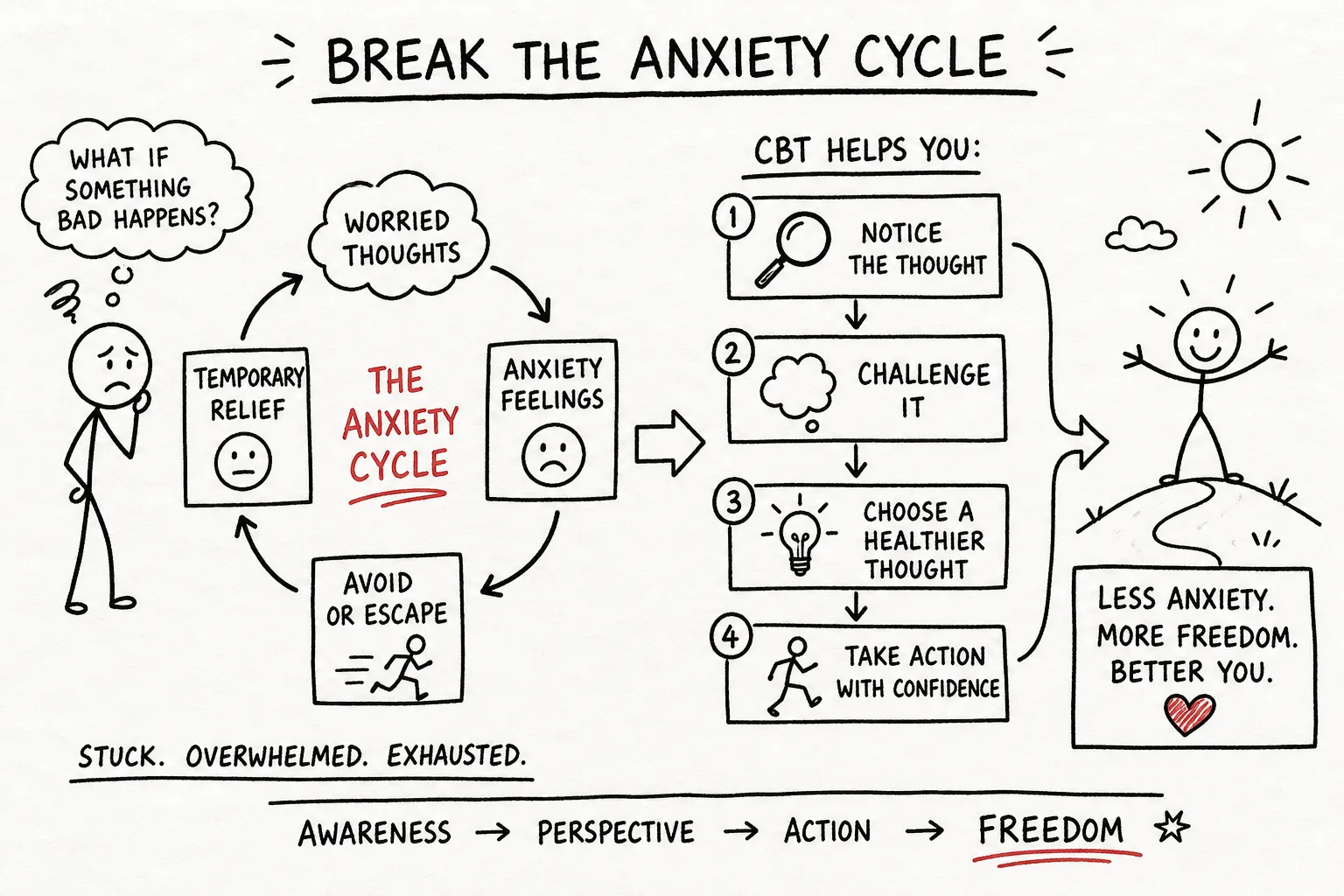
You know the feeling. A thought appears out of nowhere, your chest tightens, and suddenly your mind is three steps ahead running worst-case scenarios you can’t stop. You cancel the commitment, feel a brief wave of relief, and then the same cycle starts all over again tomorrow. That’s not a character flaw. That’s the anxiety cycle at work: a learned pattern your brain has practiced so many times it runs almost automatically.
If you’ve been wondering how cognitive behavioral therapy helps reduce anxiety symptoms, you’re in the right place. CBT was built specifically to interrupt that cycle, not by suppressing what you feel or forcing yourself to “think positive,” but by changing the thought patterns and behaviors that keep anxiety fueled. Research supports it as a first-line treatment across generalized anxiety, social anxiety, and panic disorder. Understanding exactly how it works makes the process less intimidating and significantly more effective.
This article breaks down the core mechanisms, walks through the most practical techniques, and grounds the approach in real clinical evidence. It also gives you a clear path forward. Whether that means starting on your own or working with a CBT therapist, you’ll finish with a concrete sense of what to do next.
Why anxiety stays stuck: the thought-feeling-behavior loop
Anxiety persists because it feeds itself. An anxious thought triggers a physical response (like a racing heart or tight chest), which your brain reads as confirmation that the threat is real. That perceived threat then drives avoidance. You skip the meeting, cancel the social event, or put off the difficult conversation. Temporarily, you feel better. But each time you avoid, you send your brain one clear message: the situation was genuinely dangerous, and avoidance kept you safe.
That message strengthens the anxiety loop every time it’s sent. Consider someone who avoids speaking up during team meetings because they fear looking incompetent. Each time they stay quiet, the belief “it’s dangerous to speak up” gets reinforced, not disproven. The anxiety doesn’t shrink; it grows a little more confident in itself.
How avoidance makes anxiety stronger
Avoidance is the primary engine that keeps anxiety disorders running. The temporary relief it produces is real, which is exactly what makes it so effective at reinforcing the habit. Your nervous system gets rewarded for the avoidance, which increases the probability you’ll avoid again next time. CBT for anxiety interrupts this by making avoidance unnecessary: you build the skills and tolerance to face feared situations, which teaches your brain a new, more accurate lesson about threat.
What CBT changes at the root
CBT targets the anxiety cycle at three levels simultaneously: thoughts, behaviors, and physical responses. Strategies that only address one layer, deep breathing alone or pure willpower, for example, can’t fully disrupt a cycle that operates across all three. When one layer shifts, it creates movement in the others. A thought becomes less catastrophic, so a behavior changes; a behavior changes, so the physical response settles. That interconnection is what gives CBT its durability. For an overview of how cognitive behavioral therapy works in practice, see How cognitive behavioral therapy helps with anxiety.
How cognitive behavioral therapy helps reduce anxiety symptoms through cognitive restructuring
Cognitive restructuring is the practice of identifying distorted or catastrophic thoughts and replacing them with more accurate ones. This is not about positive thinking. The goal is not optimism; it’s accuracy. When anxiety convinces you that the worst outcome is the most likely one, restructuring examines that belief against actual evidence and finds a more proportionate interpretation.
Spotting the distortions that amplify fear
In generalized anxiety disorder, the most common distortions are catastrophizing (“this will definitely go wrong”), overgeneralizing danger, and severely underestimating your ability to cope. In social anxiety, the pattern shifts toward mind reading (“they think I’m incompetent”) and personalization (“everyone noticed that I stumbled over my words”). Both involve the brain making confident predictions that aren’t grounded in evidence. Noticing which distortion is operating gives you the starting point for restructuring it.
Thought records: the CBT tool that makes restructuring practical
A thought record is a simple three-column tool: write down the automatic thought, identify the distortion it represents, then generate a balanced response. For example, the automatic thought “if I give this presentation and stumble, my career is over” gets examined against what you actually know, that stumbling in a presentation is common, recoverable, and far less career-defining than anxiety insists it is. Repeated use of thought records supports lasting cognitive change and reduced threat appraisal, not through force, but through accumulated evidence. Therapists practice this in session, and clients use it at home after anxiety-provoking events.
How CBT helps reduce anxiety symptoms through behavioral experiments and exposure
One of CBT’s most powerful tools is the behavioral experiment. Instead of just challenging an anxious thought in your head, you design a real-world test of the prediction. You and your therapist agree on what anxiety is forecasting, you go test it, and then you compare the prediction to what actually happened. The mismatch between “I believed this would happen” and “here’s what actually happened” is what drives lasting belief change.
How a behavioral experiment is structured
The process is concrete and collaborative. Start by identifying the feared prediction: “If I ask a question in the meeting, people will think I’m incompetent.” Then design a specific, real-world test, predict the specific outcome you expect, run the experiment, and record the actual result. The structure matters because it transforms vague anxiety into a testable hypothesis, one your brain can update based on evidence rather than fear.
Graduated exposure and fear extinction
Graduated exposure takes behavioral experiments further by building a structured hierarchy of feared situations, starting with lower-anxiety scenarios and progressing toward harder ones as confidence and tolerance build. For social anxiety, this might begin with making brief small talk with a cashier, move to asking a question in a small group setting, and eventually progress to speaking at a team meeting. Each successful exposure teaches fear extinction: the learning that the feared outcome is less likely or less catastrophic than anxiety predicted. Studies comparing graded exposure to more intensive flooding approaches consistently find that graduated exposure balances effectiveness with tolerability, producing durable fear reduction without overwhelming the nervous system. For practical steps on designing exposures and reducing avoidance, see Exposure Therapy Basics: Reduce Anxiety Without Avoidance, River North Counseling.
Relaxation and self-monitoring techniques that regulate the body
CBT doesn’t only work from the top down, changing thoughts to change feelings. It also includes techniques that address the physiological arousal that fuels anxiety in real time. In CBT, relaxation techniques are strategic tools that build the tolerance needed to do cognitive and exposure work, especially when anxiety is high.
Box breathing for acute anxiety regulation
Paced breathing is among the most well-supported tools for quickly reducing acute anxiety symptoms. Box breathing is one practical method: inhale through the nose for four counts, hold for four, exhale for four, hold for four, then repeat. This activates the parasympathetic nervous system, engaging your body’s built-in brake pedal on the stress response. Reviews of slow-paced breathing interventions consistently document short-term reductions in physiological arousal markers, including heart rate and blood pressure. The key to making it effective is practicing daily, not just during anxiety spikes, so your nervous system builds familiarity with the state of calm.
Progressive muscle relaxation and self-monitoring
Progressive muscle relaxation works by systematically tensing and releasing muscle groups from the feet upward, teaching your body to notice and reduce tension it’s been holding without your awareness. Clinical trials and systematic reviews have documented measurable physiological relaxation from PMR practice, and it is especially useful when anxiety has a strong somatic component. Paired with self-monitoring, tracking thoughts, body sensations, and behaviors after anxious episodes, these tools help clients identify their personal anxiety triggers before they escalate into full avoidance cycles. For stress-specific CBT strategies, see CBT for Stress: Evidence-Based Techniques That Actually Work.
What the research actually shows about CBT for anxiety
CBT’s reputation as an evidence-based treatment is earned through decades of rigorous research. A 2023 systematic review and network meta-analysis of 65 randomized controlled trials found that CBT reduced generalized anxiety disorder symptoms versus treatment as usual with a standardized mean difference of −0.74 (favoring CBT), rated at moderate certainty by the review authors. More notably, CBT was the only psychotherapy that demonstrated long-term effectiveness at the 3-to-12-month follow-up mark, making it not just effective but durable. (See the 2023 systematic review and network meta-analysis for details.)
Evidence across anxiety disorders
For social anxiety, meta-analytic findings show medium-to-large effect sizes for CBT versus waitlist control, with gains maintained at follow-up and evidence that CBT outperforms pharmacotherapy in long-term outcomes. For panic disorder, exposure-based CBT protocols produce consistent benefits over no treatment or placebo. Across all three major anxiety presentations, CBT is recognized as a first-line treatment in clinical guidelines, a designation grounded in a large evidence base spanning many RCTs and meta-analyses, not a marketing claim. A recent randomized clinical trial of digital CBT found significantly lower GAD-7 scores compared to psychoeducation alone at both 10 and 24 weeks, with higher remission rates at both time points; see the trial report on the effectiveness of digital CBT here.
Realistic timelines for improvement
Early shifts, like reduced avoidance or shorter periods of rumination, often appear within the first four to six weeks. Meaningful improvement is commonly observed around 12 to 16 weekly sessions in standard CBT formats, though focused presentations can respond to shorter courses of four to eight sessions. The variable that most consistently affects speed of progress is between-session practice. Clients who complete thought records, follow through on planned exposures, and use breathing techniques outside of session tend to progress faster than those who only engage with the work during appointments.
Moving from self-help to working with a CBT therapist
Self-guided CBT resources are genuinely useful for mild to moderate anxiety. Apps like MindShift CBT (developed by Anxiety Canada and informed by anxiety researchers) offer structured thought records and exposure planning tools. Worksheets from the Anxiety and Depression Association of America provide clinician-developed graded exposure hierarchies and thought diary formats. For someone just beginning to understand their anxiety patterns, these tools can build real momentum. For a clear, clinician-oriented overview of what CBT entails, consult the Harvard Health overview of CBT.
The limits of self-help become clear when anxiety is persistent, significantly affecting daily functioning, or tied to complex personal history. A worksheet cannot ask a follow-up question. It cannot notice that your exposure hierarchy is too steep in one place and too gentle in another. It cannot calibrate the pace of treatment to what your nervous system can actually tolerate this week.
What professional CBT looks like in practice
A structured CBT engagement begins with intake and case formulation, where the therapist maps your specific anxiety pattern, its triggers, maintenance mechanisms, and history. From there, the work involves personalized exposure planning, in-session skill practice with real-time feedback, and customized homework that targets your exact presentation. That precision is what separates professional CBT from generic self-help, and why it consistently outperforms workbooks alone for moderate-to-severe anxiety. The therapist doesn’t just teach techniques; they calibrate those techniques to your specific thought patterns, avoidance habits, and readiness to engage.
Finding CBT support in Chicago
For readers in the Chicago area, River North Counseling offers structured, evidence-based CBT through in-person sessions at their River North and Skokie offices, as well as virtual appointments across Illinois. Whether your anxiety is tied to work performance, social situations, persistent worry, or something more complex, the team at River North Counseling builds care plans tailored to your specific pattern, not a generic protocol. Reaching out for an intake appointment is a concrete next step for anyone who has recognized their anxiety cycle in what they’ve read here.
Understanding how cognitive behavioral therapy helps reduce anxiety symptoms, and breaking the cycle for good
Anxiety is persistent because the cycle that maintains it is self-reinforcing. Anxious thoughts create physical arousal, which drives avoidance, which confirms the threat, which produces more anxious thoughts. CBT disrupts that cycle not by fighting anxiety head-on, but by changing the elements that keep it running: the thoughts, the behaviors, and the body’s alarm response.
The techniques covered here, cognitive restructuring, behavioral experiments, graduated exposure, box breathing, and progressive muscle relaxation, are not abstract concepts. They are practical, repeatable skills that build on each other over time. Progress is not linear, and none of this happens overnight. But every thought record completed, every avoided situation approached, every anxious prediction tested against reality is a step toward a brain that has learned something new.
Understanding how cognitive behavioral therapy helps reduce anxiety symptoms is the first step. The second is choosing to practice. Whether that starts with a three-column thought record after your next anxiety spike or an intake call with a CBT therapist at River North Counseling, the pattern can change. It changes through practice, and it starts with a single decision to try something different than avoidance.
Frequently asked questions about CBT for anxiety
How does cognitive behavioral therapy help reduce anxiety symptoms?
CBT targets the three components that keep anxiety going: distorted thoughts, avoidance behaviors, and physical arousal. By using tools like thought records and graduated exposure, CBT teaches your brain more accurate responses to perceived threats, reducing both the frequency and intensity of anxiety over time.
How many CBT sessions does it take to see results?
Many people notice early changes, reduced avoidance, shorter rumination, within four to six weeks. Full, meaningful improvement typically comes after 12 to 16 weekly sessions, though some focused anxiety presentations respond to shorter courses. Between-session practice is the biggest factor in how quickly progress comes.
Can I practice CBT techniques on my own?
Yes, for mild to moderate anxiety. Thought records, box breathing, and self-monitoring are all skills you can begin without a therapist. However, for persistent or severe anxiety, working with a trained CBT therapist provides the personalized calibration that self-help tools can’t replicate.