

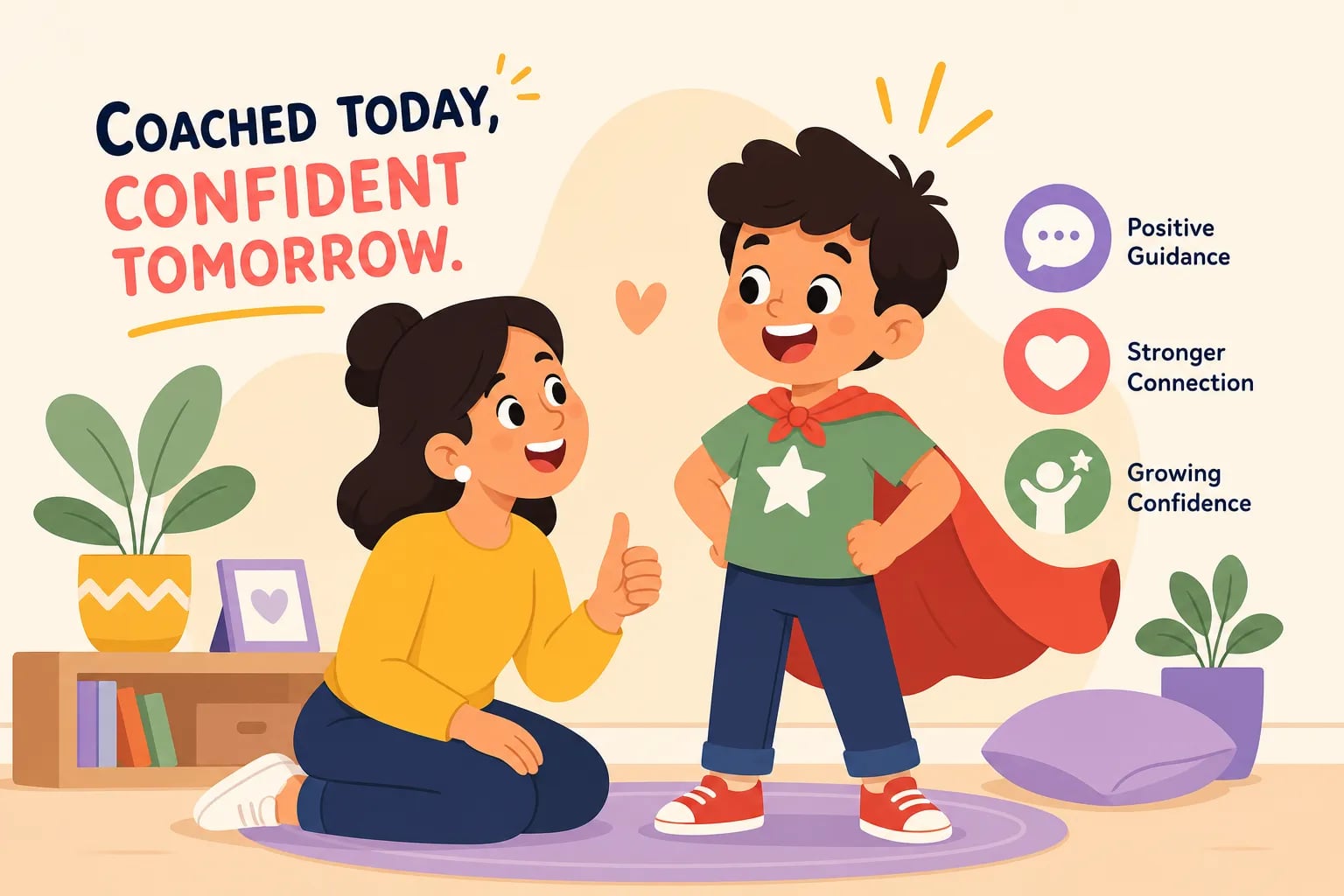
You’ve read the books. You encourage your child, celebrate their wins, and try to stay patient when they fall apart. And yet you still watch them back away from a challenge, spiral after a small mistake, or ask for reassurance you’ve already given a dozen times. That gap between the parent you’re trying to be and the confident child you’re hoping to raise is one of the most quietly exhausting experiences in parenting.
If you’ve ever asked yourself, how can parent coaching help me raise a more confident child?, you’re asking exactly the right question. Research indicates that self-esteem and confidence are malleable and strongly influenced by parenting behaviors, not fixed personality traits. A child’s confidence is built through specific parenting behaviors practiced consistently over time. Parent coaching is the structured process that teaches you evidence-based behaviors shown to be associated with better child outcomes, and how to apply them in the moments that count. At River North Counseling, we work with Chicago-area parents on precisely this, helping them move from reactive to intentional using the same techniques the research supports.
This article covers seven concrete confidence-building strategies coaches teach, what a realistic timeline looks like, and how to decide whether coaching is the right fit for your family right now.
Why confidence in children has to be built, not handed over
What research actually shows about parenting and child self-esteem
A 2019 meta-analysis of 116 studies found a small-to-moderate positive association between authoritative parenting and child and adolescent self-esteem. The key word is “authoritative,” and the distinction matters: warmth alone doesn’t move the needle. That same body of research consistently points to a combination of warmth, clear expectations, and coaching children through setbacks as the driver of higher self-esteem. A 2025 study reinforced this further, finding that parental encouragement had a direct, significant path to adolescent self-esteem even after controlling for other variables.
What this means practically is that reassurance alone isn’t enough. Children need parents who can hold steady expectations while also teaching them how to recover when things go wrong. That specific combination is a learnable skill set, and it’s exactly what parent coaching develops.
How parent coaching helps you build confidence in your child every day
Parent coaching is not a lecture series or a self-help book. It’s a structured process where a trained coach teaches you to practice new responses, observe what changes in your child’s behavior, and adjust from there. The focus is on the parent’s behavior first, because that’s what you can actually control. The seven techniques below are the practical output of that process: specific, repeatable actions that compound into lasting confidence in your child. Understanding how parent coaching helps, and why it works, starts here.
How parent coaching helps you raise a more confident child: the first three techniques
1. Process praise: rewarding effort, not the label
“You’re so smart” feels like a compliment, but it quietly teaches children that ability is fixed. If they’re “smart,” they must protect that label, which means avoiding challenges where they might fail. Process praise breaks that pattern entirely. Instead of labeling the child, you name the specific behavior and the strategy behind it: “You worked through that step by step, and that’s what got you there.” This three-step sequence, notice the specific behavior, name the strategy used, connect it to the possibility of growth, teaches children that their capabilities are expandable through actions they can repeat.
2. The Truth Meter: a quick tool for negative self-talk
When a child says “I always mess up,” most parents either argue against it or dismiss it. Coaches teach a more effective move: walk the child through three questions. Is this thought actually true? Is this thought helpful right now? What’s a more honest, empowering thought you could choose instead? This tool, often called the Truth Meter, trains children to audit their inner critic rather than be run by it. Run through it once with a child who’s convinced they’re hopeless at math, and they often land somewhere like: “I’m struggling with fractions right now, but I’ve figured out hard things before.” That’s not toxic positivity; it’s accuracy.
3. Using mistakes as coaching moments, not crisis points
The four-step reset coaches teach goes like this: identify what the mistake actually taught, help the child release the error rather than replay it, use a physical or mental reset cue such as shaking it off or taking three slow breaths, then return to confident self-talk and body language. This reframes failure as information, the core cognitive shift that underlies resilience. It’s especially useful after academic setbacks or social stumbles, situations where a child’s default is to either shut down or catastrophize. Many families report that children start applying this reset independently within a few weeks, a timeline consistent with the behavioral-shift research cited above.
Four more confidence-building strategies for kids that work over time
4. Open-ended coaching questions parents ask at home
The instinct to fix a problem for your child is strong and understandable. Coaches teach parents to resist it long enough to ask instead: What happened? How did that feel? What could you try next? What’s your plan? Keeping the child in the driver’s seat of their own problem-solving is exactly where confidence gets built. The outcome matters less than the process. A child who works through a solution, even imperfectly, develops something more durable than a child who receives a correct answer from a parent.
5. Role-play and breaking challenges into small wins
For a child anxious about introducing themselves at a new school, the gap between “just go say hi” and actually doing it can feel enormous. Coaches help parents close that gap by structuring gradual exposure: pick the specific social situation, practice the exact words and body language at home, rehearse it until the child feels ready, then increase the difficulty incrementally as confidence grows. The small-wins principle works because each successful step becomes evidence the child can draw on the next time. Repeated small successes build the internal reference point that “I can handle things”, and that reference point is what confidence actually feels like from the inside.
6. Assigning real responsibilities and modeling recovery out loud
Age-appropriate duties, making breakfast, managing a homework schedule, handling their own laundry, give children direct evidence of their own competence that no amount of reassurance can replicate. When a child completes a real task without help, they know it. Coaches pair this with modeling: parents verbalize their own calm problem-solving and failure recovery out loud in front of their children. “I messed that up. Here’s what I’m going to do differently next time.” Hearing a trusted adult treat mistakes as normal and recoverable is one of the most powerful lessons a child can receive, and it costs nothing except a moment of honesty.
7. Coping scripts and reflection routines after setbacks
Short, specific phrases practiced when a child is calm become accessible when the pressure is on. “I can try again one step at a time.” “I can handle hard things.” Coaches help parents choose a few that fit naturally, practice them during low-stakes moments, and then reinforce their use after real-world challenges. The post-setback reflection routine strengthens this further: name what happened, identify one thing that went well, identify one thing to improve, set the next practice goal. Consistency in this routine, practiced over weeks, is where lasting confidence change actually happens. It’s not one breakthrough conversation; it’s the accumulation of dozens of short reflections that rewires how a child processes difficulty.
How long before you see real changes in your child
What parents typically notice in the first 4, 8 weeks
Most families working with a parenting coach notice the first behavioral shifts within four to eight weeks of consistent practice. The changes are usually specific and small: a child attempts something they would have avoided before, recovers from a setback faster than usual, or asks for reassurance less frequently. These early signs are meaningful data even when they feel minor. They confirm that the techniques are working and that the child’s internal narrative is beginning to shift.
Why lasting confidence takes 3, 6 months to stabilize
Deeper changes in self-esteem and resilience require a child to accumulate repeated evidence over time, not just one or two new experiences. This is why structured coaching programs are typically built around 12-week formats, and why real results require several months of consistent home practice. The coach teaches the techniques, but the daily application happens between sessions, in the kitchen, in the car, at the homework table. That’s actually good news: it means you become the active agent of change, and the positive effects continue to build without requiring ongoing coaching indefinitely. Long-term effects into adolescence are less well documented across randomized trials, so some follow-up or booster support may be helpful for families who want to sustain those gains.
Is parent coaching the right fit for your family right now
Children and situations where coaching tends to have the most impact
Coaching works best for children who are generally well but consistently avoid challenges, underestimate themselves, or struggle to recover from setbacks and performance anxiety. It’s also well-suited for parents who feel reactive in the moment, unsure how to respond when a child spirals, or stuck in patterns they recognize but can’t seem to break. Family coaching is a growth-oriented process, not crisis intervention. Starting before a situation becomes acute gives the techniques room to take hold before the stakes are high.
When family therapy or child therapy is a better starting point
If a child is showing signs of clinical anxiety, depression, or trauma, a licensed therapist is the right first step, not a coach. This is especially true for coaching for anxious children whose symptoms go beyond everyday worry or performance nerves. A qualified parenting coach should be transparent about this boundary and willing to make referrals when needed. At River North Counseling, both parent coaching and licensed child therapy are available under one roof. That structure means families can access the appropriate level of care from the start and move between services as needed, without having to rebuild trust with an entirely new provider.
How to find and vet a qualified parenting coach
Credentials, training, and questions to ask before committing
Parenting coaching is not a regulated profession in the United States, so credentials vary widely and marketing language can be misleading. Look for a parenting-specific certification from a recognized program, an ICF-style coaching credential, and documented supervised practice hours. A strong benchmark is 100 or more supervised coaching hours; the Parent Coaching Institute, for example, requires exactly that. Ask every prospective coach these four questions before committing:
- What training have you completed, and from which program?
- How many supervised coaching hours do you have?
- How do you measure progress during a coaching engagement?
- At what point would you refer my family to a licensed therapist?
A coach who can answer all four clearly and without hesitation is worth serious consideration. One who deflects or can’t address the third question is a red flag.
What to expect from a well-structured coaching engagement
Individual sessions typically run 60 to 90 minutes, with most engagements structured as a 4- to 12-session package. Individual sessions in Chicago average around $100 to $200, with packages generally ranging from $450 to $1,200 for four to eight sessions. Group programs, similar to structured parenting classes for confidence-building, run six to ten weeks and tend to cost less per parent. For families in the Chicago area, River North Counseling offers parent coaching in person at our River North and Skokie locations as well as virtually across Illinois, backed by the same licensed clinical team that handles child therapy and neuropsychological assessment when a higher level of care is needed.
It helps to frame the cost clearly: a well-structured coaching engagement is an investment in a skill set you carry and continue applying long after the sessions end, not an ongoing service dependency. Many parents find that the techniques they practice over 12 weeks remain useful through their children’s adolescent years, though maintaining those habits over time may occasionally call for a booster session or two.
Start where you are
The frustration that opens most parenting coaching conversations is almost always the same: “I’m doing everything I can think of, and it’s still not working.” That frustration is valid, and it’s also exactly the right starting point. Parent coaching doesn’t change your child directly. It changes what you do consistently, and that’s what changes your child.
The seven techniques covered here reflect commonly used, evidence-informed practices at the core of good coaching. Any parent can begin with two or three of them this week, starting with process praise and the Truth Meter. Both require nothing except intention and a bit of practice. You’ll likely notice small changes sooner than you expect, because children respond quickly when the patterns around them shift.
For parents who want structured support and a shorter path through the trial-and-error phase, working with a trained coach makes a real difference. If you’re wondering how parent coaching can help you raise a more confident child, and you’re ready to find out firsthand, reach out to River North Counseling. Our parent coaching services in Chicago are built around the evidence-based principles covered in this article, and our team can help you find the right level of support for your family, whether that’s coaching, child therapy, or both. Contact us today to get started.
Frequently asked questions about parent coaching and child confidence
How can parent coaching help me raise a more confident child?
Parent coaching teaches you specific, evidence-informed behaviors, like process praise, open-ended coaching questions, and structured reflection routines, that research associates with higher child self-esteem. A coach helps you practice these techniques consistently so they become your default response in high-pressure moments. Over time, that consistency is what builds durable confidence in your child.
How quickly does parent coaching produce results?
Most families notice early behavioral shifts within 4, 8 weeks of consistent practice. More durable changes in self-esteem and resilience typically take 3, 6 months to stabilize. Long-term effects vary, and some families benefit from occasional follow-up sessions to maintain their gains.
Is parent coaching the same as child therapy?
No. Parent coaching is a growth-oriented process focused on changing parent behaviors associated with better child outcomes. Child therapy, delivered by a licensed clinician, is appropriate when a child shows signs of clinical anxiety, depression, or trauma. Some practices, including River North Counseling, offer both under one roof, so families can access the right level of care without starting over with a new provider.
Where can I find a parenting coach in Chicago?
River North Counseling offers parent coaching in Chicago at our River North and Skokie locations, as well as virtually across Illinois. If you’re searching for a parenting coach in Chicago or nearby, our team can help you determine whether coaching, child therapy, or a combination is the best fit for your family.