
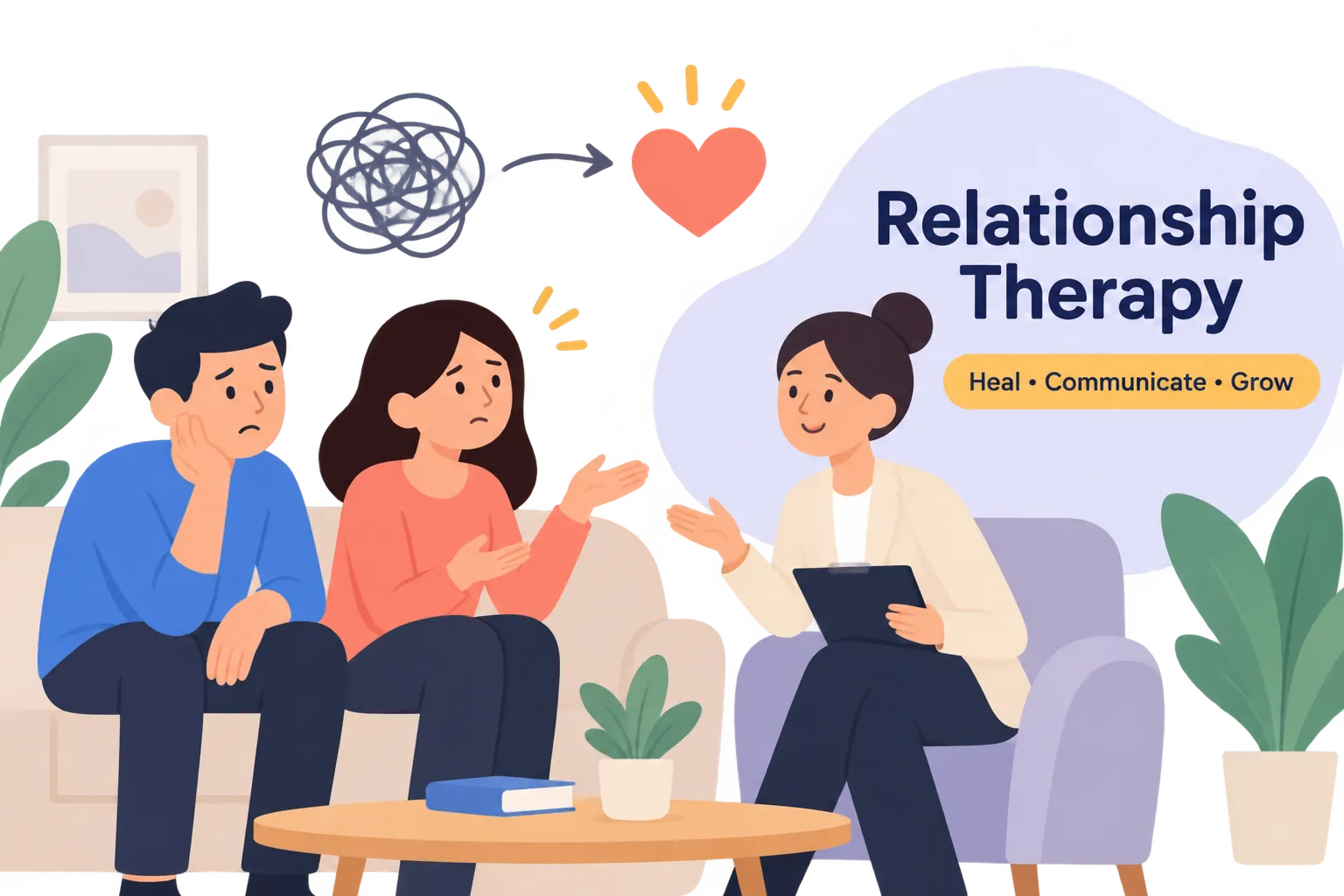
Relationship therapy is structured psychotherapy that treats the relationship, rather than one “guilty” partner, as the client. A common course starts with an assessment, moves through conflict de-escalation and skill-building, and, when needed, works on rebuilding trust. This article focuses on couples, so couples therapy and relationship counseling are used to mean the same thing.
Many couples notice early shifts, such as calmer conversations, within the first several sessions, though timing varies with the couple and the concern. The therapist’s training and your fit with them matter as much as the brand-name method. If fear or abuse is present, a safety screening comes first.
At River North Counseling, our therapists in Chicago’s River North and in Skokie offer personalized couples care, in person or virtually. Below, we cover who relationship therapy helps, what the first session looks like, one common treatment arc, which approaches have evidence behind them, and how to choose a qualified therapist.
Key takeaways
- Pattern, not blame: Therapy targets the cycle between partners, not one person’s faults.
- A common arc, not a fixed script: Many couples work through de-escalation, then communication skills, then trust and connection work, but the sequence and pace vary, and not every couple needs every stage.
- Fit matters: Research finds similar average results across major models, so training and alliance count heavily.
- Safety first: Abuse or fear of retaliation calls for individual support before joint sessions.
- Start early: You don’t need to be in crisis to benefit.
What is relationship therapy, and who does it help?
Relationship therapy is psychotherapy focused on the interaction between two or more people. Some forms include family members, but this article centers on romantic partners. It helps couples with communication problems, recurring conflict, trust, intimacy, and major life changes. It also helps couples who want to strengthen a bond that is already working.
How is it different from individual therapy?
Individual therapy focuses on one person’s thoughts, history, and symptoms. Relationship therapy watches how two people communicate in real time and how their conflict cycles unfold. The therapist facilitates balanced dialogue without fault-finding.
The two can run side by side. One partner might attend couples sessions while also working on anxiety, depression, or trauma in individual therapy.
Which concerns bring couples in?
- Repeated arguments and communication breakdowns
- Emotional distance or loneliness in the relationship
- Damaged trust, secrecy, or infidelity
- Intimacy concerns
- Disagreements about parenting, finances, or household roles
- Transitions such as marriage, new parenthood, relocation, illness, or job stress
Couples juggling demanding careers alongside big life changes often find these pressures compound one another. Couples also don’t have to be in crisis to seek help; therapy can strengthen a connection before problems harden.
When is another kind of support the better first step?
Joint therapy isn’t the right first step when there is abuse, coercive control, intimidation, or fear of retaliation. In those situations, confidential individual support and safety planning come first, a recommendation echoed in safety guidance from sources such as Relationship HQ. For other severe or urgent individual needs, such as untreated addiction or an acute crisis, individual or medical care may need to come before or alongside couples sessions, depending on the situation. Joint work also becomes difficult when one partner is unwilling to take part.
A qualified therapist screens for this early. If you are in immediate danger, contact emergency services or a domestic-violence crisis line.
What happens in the first relationship therapy session?
The first session is orientation and assessment, not a rush to fix everything. Your therapist explains how therapy works and covers confidentiality and consent. Each partner then shares what brought you in now, your relationship history, recurring conflicts, any past counseling, and what you hope will change.
You don’t need perfectly defined goals or an agreed-upon story to begin. Before you come, think about what you want to change and one or two recurring problems.
While you talk, the therapist watches for interruptions, withdrawal, defensiveness, and attempts to repair. Those moments reveal the pattern that keeps you stuck. Some therapists also include a private safety screening and discuss logistics such as session frequency and cancellation policies.
Practical details vary by therapist and practice. Sessions commonly run about 50 to 90 minutes, and many couples meet weekly or every other week at the start. Overall length depends on your goals and concerns, and cost depends on the therapist’s fees, session length, and how often you meet. Ask about all of this when you book. At River North Counseling, we match clients with therapists suited to their needs and goals, whether you meet at our River North office, our Skokie office, or by teletherapy.
What does a typical course of couples counseling look like, from conflict to rebuilding trust?
One common way to picture treatment is as three overlapping stages: slowing down the fights, building communication skills, and rebuilding trust and connection. This is an illustrative framework rather than a fixed sequence. Your pace depends on your concerns and how entrenched the patterns are, and not every couple needs trust-repair work.
Stage one: slowing down the fights
Sessions often begin with a check-in, then pick one specific interaction to unpack. The therapist helps each of you notice what you felt, did, and assumed, and you’ll learn to name common cycles such as pursue/withdraw and criticize/defend.
The first goal is interrupting those cycles. A constructive time-out is often the first practical skill: you pause a heated moment and agree to return to it calmer.
Stage two: building communication and problem-solving skills
Next, you practice listening without interrupting, voicing needs without blame, and validating each other’s feelings. Exercises between sessions help the skills carry into daily life. Cognitive-behavioral therapy (CBT) is among the services we offer at River North Counseling, and it builds practical coping skills for managing thoughts, emotions, and behaviors.
Progress is usually gradual. Couples first recognize the pattern, then interrupt it, and eventually respond to each other differently.
Stage three: rebuilding trust and connection
After infidelity or secrecy, therapy can work on accountability, transparency, and emotional repair at a pace both partners can sustain. Trust returns through repeated reliability and honesty over time, rather than through a single apology. Therapy can’t erase a betrayal or guarantee reconciliation, but it gives you a structured way to repair.
This stage can also strengthen intimacy and friendship and address parenting, finances, or family boundaries. If you’re unsure whether to stay together, therapy can help you decide clearly and respectfully. Throughout, you and your therapist review progress and decide together when to taper sessions.
Which couples therapy approaches work, and does the method matter?
Several approaches have research support, but the method matters less than you might expect. The table below summarizes how the research literature broadly describes each approach. These descriptions are general and use looser language than the strict rating standards of formal evidence reviews, so read them alongside the paragraph that follows.
| Approach | What it focuses on | General research picture |
|---|---|---|
| Behavioral couples therapy | Communication training, problem-solving, behavior change | Many randomized trials |
| Cognitive-behavioral couples therapy | How thoughts and interpretations drive conflict | Widely studied |
| Emotionally focused therapy | Attachment needs and emotional cycles | Comparatively large body of research |
| Integrative behavioral couples therapy | Behavior change plus acceptance of enduring differences | Supported, including long-term follow-up |
| Gottman-informed therapy | Conflict management, friendship, repair attempts | Smaller, less independently replicated |
| Insight-oriented or psychodynamic | How personal history shapes current patterns | Promising, less extensive |
The review “Empirically Supported Couple Therapy Models for Couple Relationship Distress” applied a strict standard for strong empirical support, and no model met it. Seven approaches, including behavioral, cognitive-behavioral, emotionally focused, Gottman, integrative behavioral, insight-oriented, and strategic therapies, showed modest support under that standard. In other words, the table describes how widely each approach has been studied, while the review asks a harder question about the strength of that evidence. Comparative studies generally find similar average outcomes across the major models, with no consistent winner.
The models share active ingredients: mutual empathy, spotting destructive cycles, constructive communication, and emotional regulation. That’s why therapist training, alliance with both partners, and progress monitoring weigh as heavily as the label. A good therapist adapts their methods to each couple rather than forcing one script.
How do you choose a qualified couples therapist in Chicago or Skokie?
Choose a therapist with verifiable licensure, specific training in couples work, and a style that suits both of you. Look for an LMFT, LCSW, LPC, or licensed psychologist, and confirm the license through the state licensing board. Directories such as Psychology Today or the American Association for Marriage and Family Therapy are a good starting point, and whichever route you use to find a couples therapist near you, vet every result.
What should you ask before booking?
- What share of your practice involves couples?
- What formal training do you have in couples therapy?
- How would you approach our specific concerns?
- How do you structure sessions: jointly, individually, or both?
- How do you measure progress and adjust treatment?
- How do you screen for domestic violence or safety concerns?
Also ask about fees, availability, and telehealth options. A good therapist welcomes these questions and explains their approach plainly.
How do you know it’s the right fit after a few sessions?
Use the first two to four sessions to judge fit. Look for balanced attention, specific shared goals, clear explanations, and practical strategies. Both of you should feel heard and respected.
Red flags include feeling dismissed, blamed, pressured to stay or leave, or unsafe. Switching therapists is a reasonable choice, and if progress stalls after several sessions, raise it with your therapist directly.
Why do couples choose River North Counseling?
We’re a licensed group practice with a multi-specialty team in River North and Skokie. Our in-person and virtual sessions fit demanding work schedules, and we match each couple with a therapist suited to your needs and goals.
Taking the first step toward a stronger relationship
Relationship therapy works on the pattern between partners. For many couples it follows an arc from de-escalation to skill-building to, where needed, repaired trust, and it depends on a qualified, well-matched therapist. Couples counseling isn’t a last resort.
You don’t need to be on the brink to begin, and the right time is usually sooner than couples think. Reach out to River North Counseling to book an intake and schedule a first session in River North, in Skokie, or online.
Frequently Asked Questions
Do we need to agree on our problems before starting couples therapy?
You don’t need to agree on your problems or have perfectly defined goals before starting couples therapy. Before your first session, you can each think about what you want to change and one or two recurring problems.
How soon might we notice progress in couples therapy?
You may notice early shifts, such as calmer conversations, within the first several sessions, though timing varies. Progress is usually gradual: you may first recognize a pattern, then learn to interrupt it and respond differently.
Can couples therapy help us decide whether to stay together?
Yes, couples therapy can help you decide whether to stay together clearly and respectfully. Therapy provides a structured way to work on repair, but it can’t guarantee reconciliation.
What can we do between couples therapy sessions?
You can practice exercises between sessions to help communication skills carry into daily life. These skills may include listening without interrupting, voicing needs without blame, and validating each other’s feelings.