

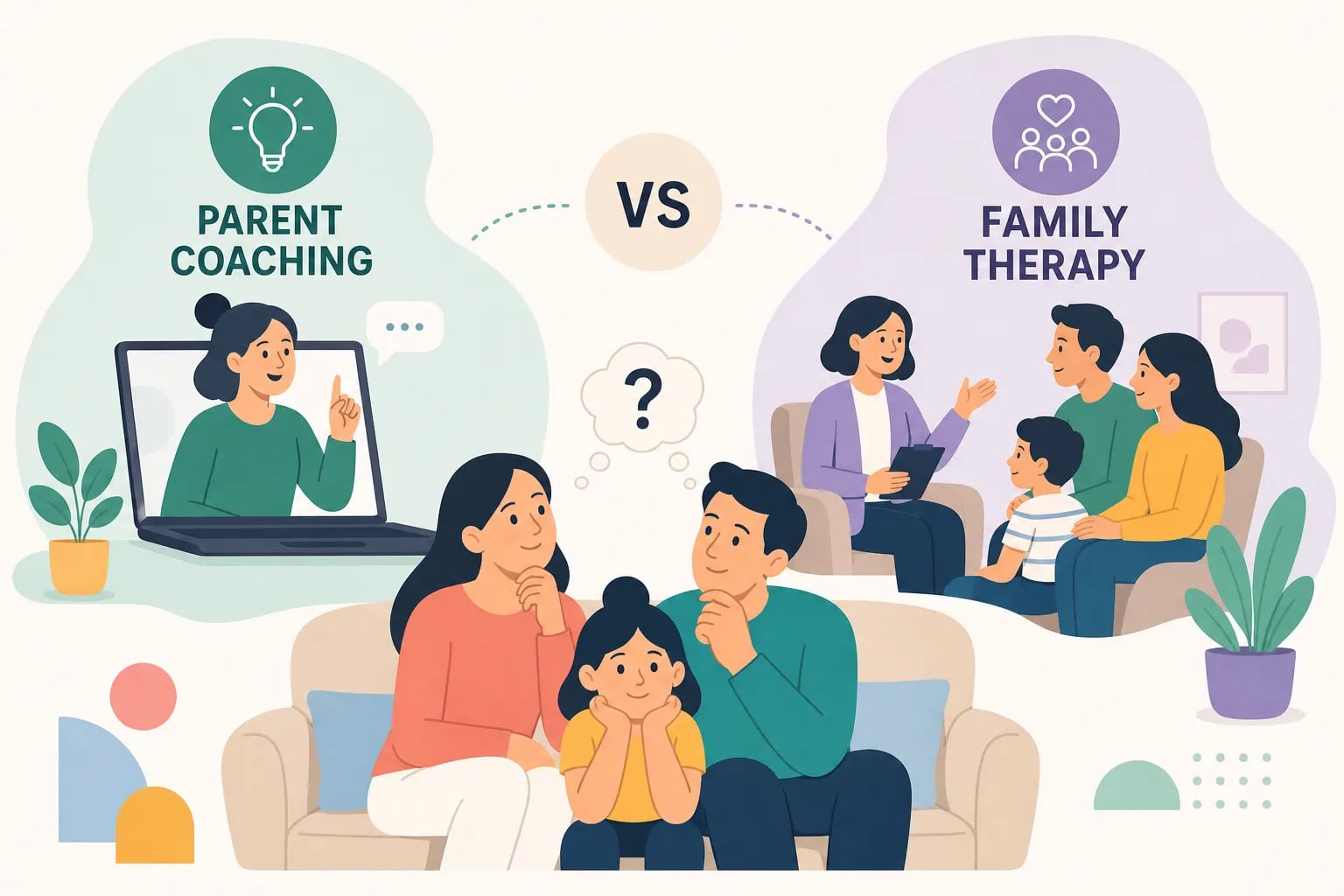
You’ve tried the calm voice. You’ve tried the firm voice. You’ve read the parenting books, downloaded the apps, and spent more Sunday evenings than you can count Googling phrases like “why won’t my ten-year-old listen” or “how to help my teenager after divorce.” Eventually, two options keep surfacing: parent coaching and family therapy. So what is the difference between parent coaching and family therapy, and which one does your family actually need? That confusion is completely normal, and it means you’re asking exactly the right question.
Families who come to River North Counseling ask this constantly. The honest answer is that these two services are genuinely different in purpose, scope, and who they’re designed to help. Once you understand those differences, the right starting point becomes much clearer.
By the end of this article, you’ll know what each approach actually does, how to recognize which one fits your situation, what to look for in a provider, and what you can do this week to take the first step.
What is the difference between parent coaching and family therapy?
The distinction between these two services starts with purpose. One is about building skill; the other is about clinical treatment. Knowing that upfront prevents mismatched expectations and wasted time.
Parent coaching: building skills for the day-to-day
Parent coaching is a structured, education-forward service focused on helping caregivers apply better strategies at home. It’s future-oriented and practical, with the parent as the primary client. Sessions center on goals like setting consistent limits, building predictable routines, and improving follow-through across the situations that tend to go sideways.
A parent coach does not diagnose or treat mental health conditions. This is nonclinical support designed for parents who need a reliable, well-practiced plan and someone to help them stay accountable to it. If the main frustration is behavioral and specific, coaching is often the right fit.
Family therapy: treating the whole system
Family therapy is clinical care delivered by a licensed mental health professional. Its goal is to assess and treat emotional, relational, or behavioral problems affecting the family as a system. It looks at patterns: who escalates conflict, who withdraws, how past events shape present reactions, and how the family’s responses to one member’s behavior can keep a problem in place.
Unlike coaching, family therapy can involve diagnosis, trauma processing, and evidence-based interventions tailored to specific conditions. The family relationship itself is often the patient. A licensed therapist in Illinois, such as an LMFT or LCSW, must meet rigorous training and supervised-hours requirements before practicing independently, which means the clinical depth behind family therapy is substantial.
How sessions actually work in each approach
Definitions are useful, but most parents want to picture what these sessions actually look like before they can commit to scheduling one. Seeing the format helps remove the uncertainty that keeps families from booking.
What a parent coaching session looks like
Sessions typically run 45 to 60 minutes and focus on a specific parenting challenge. A coach might walk a parent through a behavior plan, role-play a difficult bedtime conversation, or debrief what happened after last week’s homework showdown. Homework between sessions is common. Parents leave with something concrete to try that week, not just a new perspective.
What a family therapy session looks like
Family therapy sessions run 50 to 60 minutes, though some extend to 75 or 90 minutes when the full household is present. A licensed therapist might facilitate a conversation between a parent and teenager who haven’t spoken openly in months, guide a family through processing a recent loss, or use play therapy techniques with a younger child. The work moves between the emotional and the relational, not just the behavioral. Progress feels different than coaching, it’s measured in understanding and connection as much as in behavior change.
Who’s in the room and why it matters
In parent coaching, the adults are the focus. Children may occasionally join for observation or practice, but caregivers are the primary participants. In family therapy, the composition shifts based on treatment needs: the whole family one week, just the parents the next, or individual sessions running alongside family sessions. This flexibility is intentional. A skilled therapist decides who’s in the room based on what the family system needs most at that stage of treatment.
Real parenting challenges and which approach fits
This is where the theory meets your actual Tuesday morning. The scenarios below reflect the situations families most commonly bring to us at River North Counseling.
Defiant behavior and discipline struggles
When a child is throwing daily tantrums, refusing school rules, or cycling through meltdowns, many parents assume they need therapy immediately. But if the behavior is moderate and caregivers mainly need a consistent, well-practiced response plan, parent coaching is often the right first step. Evidence-based programs like Parent-Child Interaction Therapy and Parent Management Training typically run 8 to 16 sessions and show strong outcomes for meaningful, lasting behavior change when the core issue is skill and consistency.
However, if the defiance is severe, the family is stuck in escalating cycles that don’t improve despite consistent effort, or the behavior affects siblings and both parents differently, family counseling brings in the whole system rather than adjusting one parent’s technique. If aggression, self-harm, or safety concerns are present, skip coaching entirely and seek a licensed clinician first.
School anxiety and emotional withdrawal
A child who has stopped eating lunch with friends or is crying every morning before school likely needs a therapist, not a parenting coach. School anxiety often requires clinical intervention: cognitive behavioral therapy, gradual exposure work, coping-skills training, and coordination with the school. These are clinical services that fall outside the scope of coaching.
Parent coaching can play a supporting role once a therapist is involved, helping caregivers avoid accommodation patterns that reinforce anxiety at home. When the child’s symptoms are the primary concern, start with a licensed child and family therapist. The right practice can coordinate both layers of care without requiring the family to manage two separate providers.
Post-divorce adjustment and blended family tension
Divorce reshapes every relationship in a household. When kids are struggling with loyalty conflicts, a parent is undermining the other’s authority, or a blended family can’t agree on basic rules, the issue is systemic. Family therapy addresses the relational dynamics driving the tension, not just the behaviors on the surface. Parent coaching can help once the system stabilizes, giving co-parents practical tools for consistent communication. In many cases, both are useful, sequenced that way based on where the family is in its adjustment.
Clear signs your family needs one, the other, or both
If you’re still sorting through the difference between parent coaching and family therapy for your specific situation, these signals point the way.
When parent coaching is the right starting point
Parent coaching fits best when the main frustration is behavioral and specific. Think of a child who won’t follow the morning routine, a parent who yells and regrets it, or co-parents who need a shared discipline language. These are coaching problems. The distress is real, but it isn’t a symptom of something clinical. Caregivers are functional and looking for tools, not treatment. Many families in this category benefit from 10 to 12 focused sessions and come away with routines and discipline strategies that actually hold, though outcomes vary depending on consistency of home practice and the complexity of the presenting challenge.
When family therapy is the clinical call
Seek a licensed family therapist when significant emotional distress is present in more than one family member, when a child’s symptoms are causing meaningful impairment such as missed school, refused meals, or persistent sleep problems, or when a major transition like trauma, grief, or divorce is affecting the whole household. If a parent has tried consistent strategies without durable change, that’s often a sign the maintaining problem is relational or systemic, not a gap in technique. Coaching teaches you what to do; therapy addresses why it isn’t working.
When both approaches make sense together
Some families benefit from running both in parallel. A child receives therapy for anxiety or a mood disorder while the parents work with a coach to implement consistent, anxiety-reducing routines at home. These two services aren’t redundant, they address different layers of the same problem. A practice that offers both parent coaching and family therapy under one roof can coordinate this kind of layered support, reducing the burden of managing two separate providers and two separate treatment tracks.
Credentials and cost: what to expect from each provider
Before you book anything, get clear on who you’re seeing and what it will cost. The difference in credentials between coaches and therapists has real implications for what they can legally and ethically do for your family.
Credentials that matter for each type of provider
Family therapists in the United States must hold a state license to practice. In Illinois, that means completing a qualifying graduate degree, at least 3,000 post-graduate supervised hours including 1,000 hours of direct client contact, and passing a national licensing exam, requirements set by the Illinois Department of Financial and Professional Regulation (IDFPR). Look for designations like Licensed Marriage and Family Therapist (LMFT), Licensed Clinical Social Worker (LCSW), or Licensed Professional Counselor (LPC). These aren’t just titles; they represent years of rigorous clinical training.
Parent coaches have no single required license in the U.S. Some hold coaching certifications, family life education credentials, or backgrounds in psychology or social work. The variation in training is wide. Ask any coach directly about their experience with your specific challenge, their approach to the work, and whether they will refer to a licensed therapist if the situation calls for it. A good coach knows the boundaries of their scope.
What to budget and whether insurance applies
Parent coaching typically runs $65 to $200 per session and is usually not covered by health insurance, since it is not billed as clinical treatment. A structured coaching program of 8 to 16 sessions can cost between $2,000 and $5,000 total. Family therapy runs $100 to $300 per session at private-pay rates but is often covered by insurance when tied to a mental health diagnosis and delivered by a licensed, in-network provider. In-network copays typically range from $20 to $75, depending on your plan.
Before booking, call your insurer and ask specifically whether family therapy is covered under your plan, what diagnosis or documentation is required, and whether your provider is in-network. Some plans reimburse out-of-network care at 40% to 80% of the allowed amount after a deductible. Don’t assume, verify before your first session.
How to find the right starting point for your family
Understanding the difference between parent coaching and family therapy is useful. Acting on that knowledge is what actually helps your family.
Questions to ask before you book
Before choosing a provider, ask these directly. Do you offer parent coaching, family therapy, or both? What does your intake process look like, and how do you determine what a family needs? Are you a licensed clinician or a coach, and what does that mean for what we can address together? If coaching turns out to be insufficient, how do you handle that transition? A practice that answers all of these clearly, with a structured intake process and access to both services, takes the guesswork out of the decision from the start.
A simple next-step checklist
Walk through these five steps before you book anything:
- Clarify whether your primary concern is behavioral skill-building or emotional and relational distress in the family system
- Check whether the child’s symptoms are affecting daily functioning: school attendance, sleep, meals, friendships, or household routines
- Confirm that the provider’s credentials match the type of support you need, whether clinical or coaching
- Call your insurance to verify whether family therapy is covered under your plan and what the out-of-pocket cost will be
- If you’re still unsure which path fits, schedule a consultation with a practice that offers both services and can make a recommendation based on your specific situation
That last step is worth emphasizing. A consultation with River North Counseling, which offers both parent coaching and licensed family therapy, serving families in the Chicago area as well as virtually, is a low-stakes starting point, not a commitment. The right team will ask the right questions and tell you honestly which path makes sense for your family right now.
Taking one step is enough to get started
The core distinction is straightforward: parent coaching builds skills, and family therapy treats the system. Both are valuable. Neither is a sign that something is seriously wrong with your family. Research consistently shows that early parental engagement and family support improve child and family outcomes, so reaching out, in whatever form fits your situation, is a meaningful step.
Most families don’t need to arrive with the answer already figured out. The right provider will ask thoughtful questions during an intake or consultation and guide you toward the fit that makes clinical sense. When you’re still weighing parent coaching vs. family therapy, a single conversation with a qualified practice is often enough to move from uncertainty to a clear next step.
If you’re in the Chicago area and ready to get clarity, reach out to River North Counseling. A brief conversation with our team is enough to start pointing your family in the right direction. Making the call is the whole first step.