

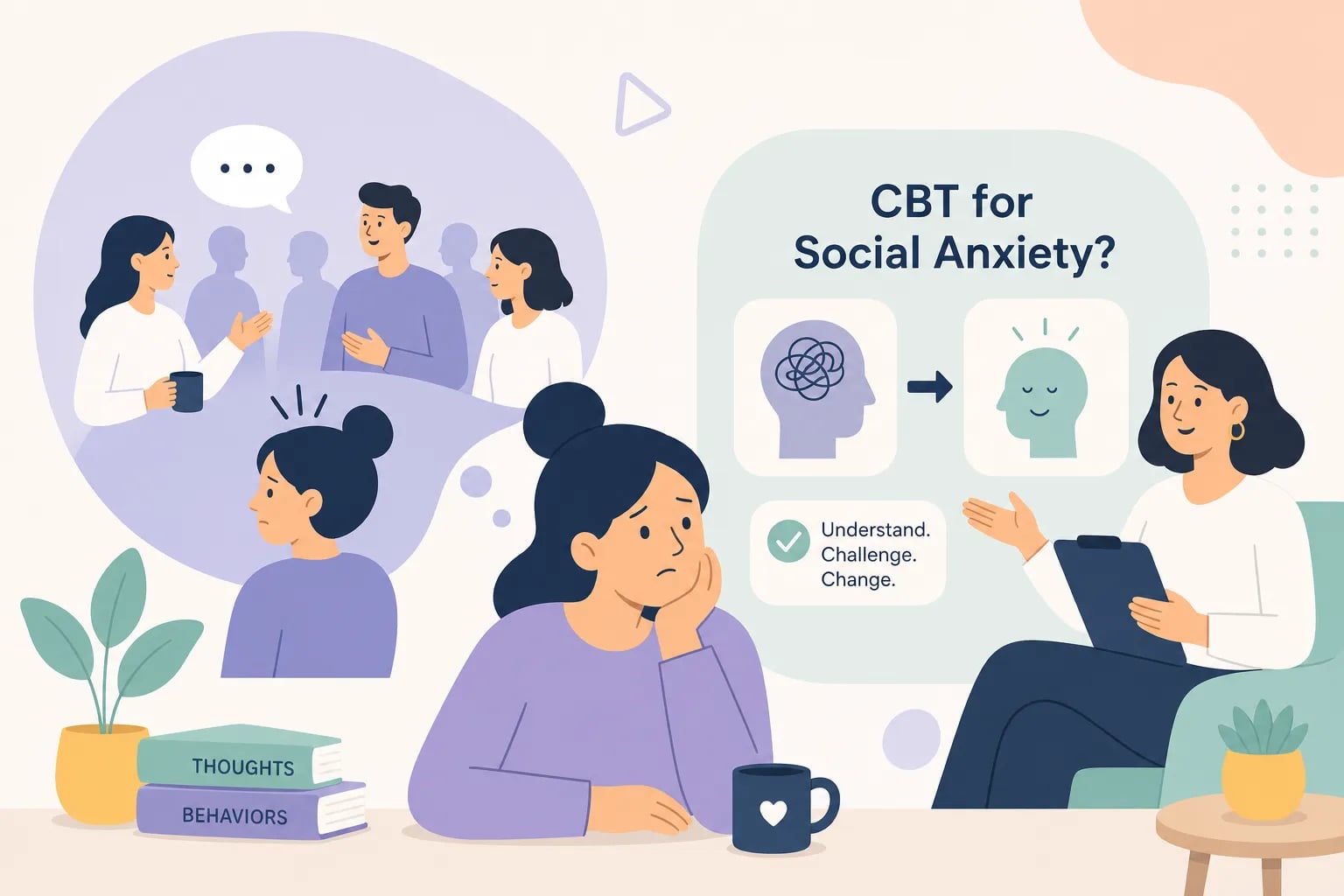
If you’re asking whether CBT is the right treatment for social anxiety disorder, here’s what the evidence actually shows. You spend three days dreading a work presentation. You leave a dinner party and spend the drive home replaying every word you said. You decline invitations, avoid phone calls, and quietly shrink the perimeter of your daily life to sidestep situations that trigger that familiar flood of self-consciousness. Social anxiety disorder isn’t shyness. It’s an exhausting, often invisible loop of anticipation and dread that most people carry alone for years before seeking help.
Two questions come up constantly with clients at River North Counseling who are navigating social anxiety: does treatment actually work, and is cognitive behavioral therapy the right approach? Those are fair questions, and they deserve a direct answer grounded in clinical evidence rather than optimistic generalities. This article walks through what the research says about CBT’s effectiveness for social anxiety disorder, which components of treatment drive real change, how CBT compares to medication, who tends to benefit most, and what treatment realistically looks like from session one through the end of a full course of care.
Is CBT the Right Treatment for Social Anxiety Disorder? What the Research Says
CBT is the most studied and most consistently supported psychological treatment for social anxiety disorder, a distinction it has earned across decades of rigorous research. That’s not a marketing claim. It reflects randomized controlled trials and meta-analyses conducted across large, diverse patient populations. Few psychological interventions carry an evidence base this strong.
A systematic review and individual patient data meta-analysis of 12 randomized controlled trials found a waitlist-controlled effect size of Cohen’s d = 0.95 for CBT on social anxiety symptoms. In plain terms, that’s a large effect: people who completed CBT improved substantially more than those who received no treatment. Gains showed up across self-reported anxiety, fear of negative evaluation, and functional impairment.
The more rigorous comparison is CBT against active placebo conditions, which control for factors like therapist attention and the expectation of improvement. Here, the effect shrinks but holds. A network meta-analysis found individual CBT produced an SMD of -0.56 compared to psychological placebo controls. More importantly, individual CBT was the only psychological intervention that consistently outperformed placebo across these analyses. That distinction matters when you’re trying to sort genuine therapeutic mechanisms from nonspecific factors.
The durability question is equally important. Average remission rates after a standard course of CBT sit around 51%, with relapse rates of just 0 to 14% across 3 to 12 month follow-up periods. At the 6 to 12 month mark, treated individuals still showed meaningful symptom advantages over controls, with a pooled effect size of Hedges’ g = 0.34. The gains don’t evaporate when treatment ends. That staying power is a meaningful part of the story.
Which CBT Components Drive the Most Meaningful Change
CBT is a family of related strategies, not a single fixed technique. Understanding which components carry the most weight for social anxiety helps explain what a strong, well-designed treatment plan should actually prioritize.
Exposure Therapy
Exposure therapy is the core ingredient. Meta-analytic evidence found exposure alone produced an effect size of ES = 0.89 for social anxiety disorder, the largest of any single CBT component. Exposure works through systematic, graduated confrontation with feared social situations, both inside sessions and through real-world practice between appointments. The mechanism is direct: avoidance maintains anxiety, and breaking that avoidance cycle is what produces lasting relief. A well-built exposure hierarchy starts with manageable steps, making eye contact with a cashier or asking a coworker a question, and moves progressively toward higher-distress situations like giving a presentation or speaking up in a group.
Cognitive Restructuring
Cognitive restructuring plays a supporting role. The process involves identifying and challenging distorted beliefs about social evaluation: the conviction that pausing in conversation signals incompetence, or that one awkward moment will permanently damage how others see you. Across the broader meta-analytic literature, cognitive restructuring generally performs comparably to exposure when the two are combined, and somewhat below it when used alone. That evidence positions cognitive restructuring as an important complement to exposure, not a substitute.
Behavioral Experiments
Behavioral experiments extend the work of both. These are structured tests of anxious predictions in real situations. A person who believes “if I disagree with someone at work, they’ll think less of me” might deliberately offer a mild counterpoint in a meeting and observe what actually happens. Behavioral experiments take cognitive work out of the therapy room and apply it to lived experience, which is where generalization actually occurs.
How CBT Compares to Medication and Combined Approaches
People weighing their options often want to know whether they need medication, whether therapy alone is enough, and which approach holds up better over time. The research provides useful guidance on all three questions.
SSRIs are the strongest evidence-based medication option for social anxiety disorder and represent a reasonable alternative for people who prefer not to pursue psychotherapy or cannot access it. That said, clinical guidelines consistently position individual CBT as the first-choice intervention. In network meta-analysis, it’s the only treatment shown to outperform both waitlist and active placebo conditions. For adults who are willing and able to engage in structured therapy, CBT is generally the preferred starting point.
Combining CBT with an SSRI produces greater short-term symptom reduction than either treatment alone, according to meta-analytic evidence. A clinician might recommend combination treatment in cases of severe functional impairment, significant comorbid depression, or when early symptom relief is a priority. The two approaches are not mutually exclusive, and for some people, medication can lower the baseline enough that engaging with exposure feels more accessible.
Where CBT for SAD holds a clear and clinically meaningful advantage is long-term durability. Reviews consistently show that CBT offers better protection from relapse after treatment ends than medication alone. Medication benefits can diminish after discontinuation. The skills built through CBT continue working after sessions have ended: the ability to tolerate anxious predictions, move through discomfort, and test feared outcomes. For anyone thinking about long-term wellbeing, that’s a practical consideration worth weighing carefully.
Is CBT the Right Treatment for Social Anxiety Disorder? Who Benefits Most
A common concern people raise in an initial consultation is whether their specific situation makes them a poor candidate for CBT. The worry often sounds like: “My anxiety is too severe,” or “I also struggle with depression,” or “I’ve had this so long that I’m probably beyond help.” The evidence addresses these fears directly.
Higher baseline severity actually predicts greater absolute symptom improvement after CBT. The individual patient data meta-analysis is clear: people with more severe presentations have more room to improve, and they do improve more in absolute terms. Severity is not a disqualifier. It’s an indicator that treatment can produce meaningful change. People with more severe social anxiety who complete a full course of CBT often show the largest shifts in symptom burden.
Comorbid depression and age did not predict differential benefit from CBT in the trials analyzed. People entering treatment with a comorbid diagnosis may carry a higher symptom burden throughout, but the evidence doesn’t support the idea that CBT stops working because of comorbidity. You don’t need to be a straightforward, uncomplicated case to benefit from structured cognitive behavioral treatment. That’s a clinically important finding, because most people seeking help for social anxiety are carrying more than one thing.
What a CBT Treatment Plan for Social Anxiety Looks Like in Practice
Knowing the research is one thing. What actually happens session by session is another. A reader who’s convinced CBT can help needs a concrete picture of what “starting CBT” actually involves so it doesn’t remain abstract.
Most structured CBT protocols for social anxiety disorder run between 12 and 20 sessions, delivered weekly. Clinical guidelines from NICE specifically reference 14 to 16 sessions as the recommended range for adults. The arc of treatment has a logical shape. Early sessions focus on psychoeducation, developing a personalized fear hierarchy, and introducing cognitive monitoring. Middle sessions are exposure-heavy, with in-session practice and between-session assignments that build on each other. Later sessions shift toward relapse prevention: consolidating skills, troubleshooting difficult situations, and developing a maintenance plan for after treatment ends.
Online CBT for Social Anxiety
Online and telehealth delivery of CBT for social anxiety has a strong independent evidence base. Research confirms that internet-based CBT produces significant symptom improvement, including protocols with exposure delivered remotely, and direct comparisons with in-person treatment generally show non-inferior outcomes. Virtual therapy is a fully viable option, not a compromise. This matters for people in Illinois outside of Chicago, for those with demanding schedules that make consistent in-person attendance difficult, and for people whose social anxiety makes the idea of walking into a therapy office feel like too high a first hurdle.
What to Look for in a CBT Therapist
What distinguishes a specialist from a generalist is structure: a clear treatment plan from the start, use of validated exposure hierarchies, session-by-session skill building, and familiarity with the specific protocols developed for social anxiety disorder. The therapists at River North Counseling specialize in CBT for anxiety disorders and work with clients dealing with social anxiety both in person at the Chicago and Skokie offices and virtually across Illinois. Treatment is tailored to each client’s specific fear profile rather than applied as a one-size-fits-all approach.
Taking the Next Step Toward Treatment
If you’ve been living with social anxiety for years, reading about treatment timelines and effect sizes can feel both hopeful and a little overwhelming. The gap between “this can help” and “I made an appointment” is where many people get stuck, and closing that gap is the point of this section.
An initial consultation is a conversation, not a commitment. You share what you’re experiencing, get your questions answered, and hear how treatment would actually work for your situation. For someone with social anxiety, even scheduling that first call can feel like a significant ask, and any therapist who specializes in this area will recognize that. The first session is as much about figuring out fit as it is about anything clinical.
River North Counseling’s CBT therapists in River North and Skokie work with clients across the full range of social anxiety severity. Virtual sessions are available for clients throughout Illinois who prefer remote care or can’t easily reach an office location. Reach out to the team directly to start that conversation, no commitment required before you do.
The Bottom Line
So, is CBT the right treatment for social anxiety disorder? For the majority of people who engage with it fully, yes. The evidence is robust, replicable, and clinically meaningful. Exposure is the active ingredient that drives the largest gains, cognitive restructuring supports and extends that work, and the benefits hold well after treatment ends. CBT vs. medication for social anxiety is not a close call on long-term outcomes: CBT outperforms doing nothing by a wide margin and consistently shows stronger durability than medication alone. It works across a range of severity levels and comorbidities.
Social anxiety doesn’t have to keep shrinking the perimeter of your life. The right treatment exists, the evidence supports it, and the process, while not always easy, is navigable. River North Counseling’s CBT therapists are available to help people in Chicago and across Illinois take that first step, at whatever pace works for them.