

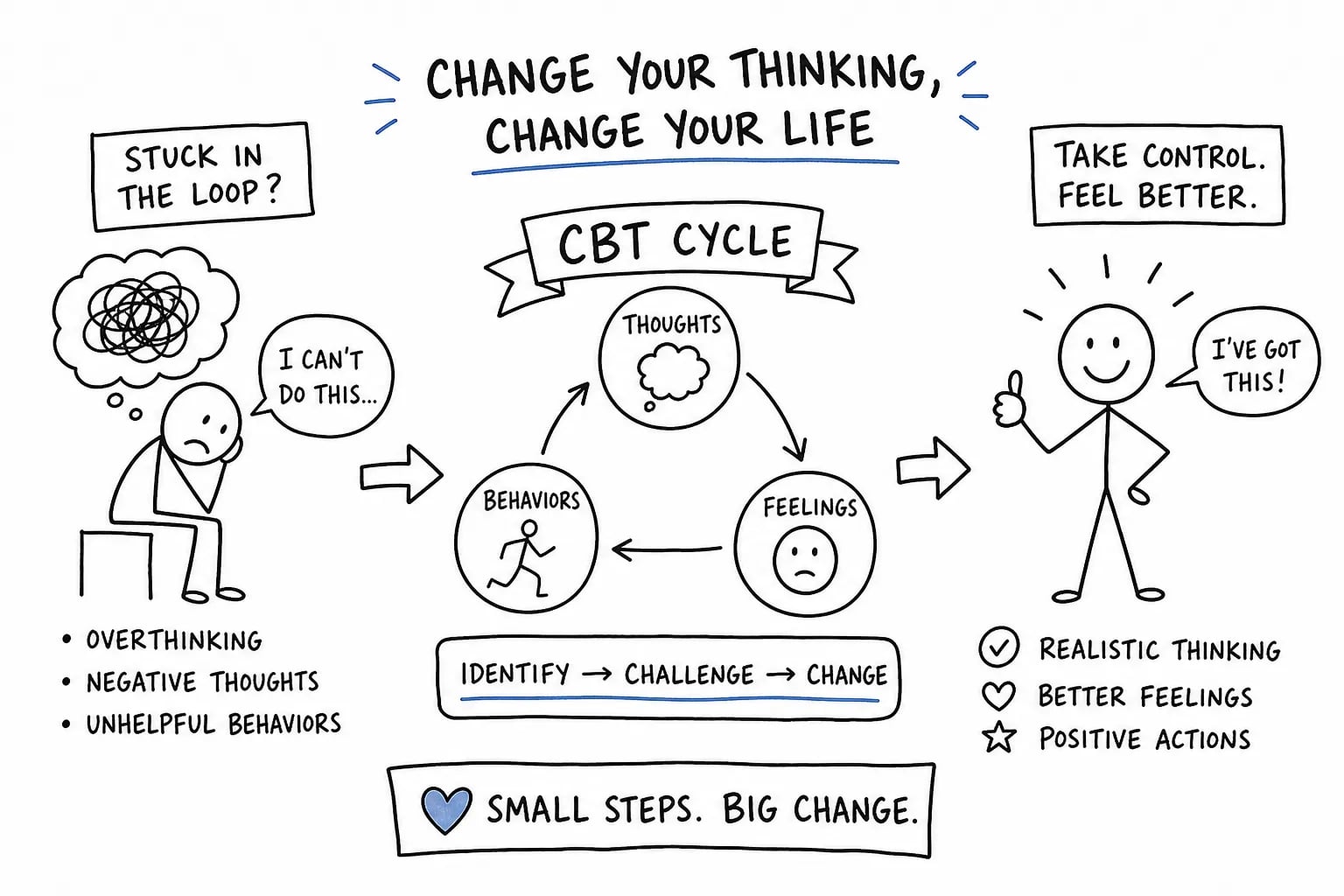
If you’ve ever searched for therapy and found yourself more confused after reading about it than before, you’re not alone. The mental health space is full of acronyms, competing modalities, and clinical language that can make a simple question feel impossibly complicated. At River North Counseling, one of the most common things people say during a first call is some version of: “I keep seeing CBT mentioned everywhere, can you just explain what it actually is?” Consider this the plain-language answer. Cognitive behavioral therapy explained clearly: by the end of this guide, you’ll understand how CBT works, which techniques it uses, which conditions it treats most effectively, and what to expect if you decide to try it.
Cognitive behavioral therapy explained in one sentence sounds deceptively simple: it’s a structured, skills-based approach that helps you change the thoughts and behaviors maintaining your distress. But that sentence doesn’t quite capture why CBT has become the most researched form of psychotherapy in history, or why so many people who tried other approaches and felt stuck find real traction with it. The details matter, and they’re worth understanding before you commit to a therapist or a treatment plan.
Cognitive behavioral therapy explained: what it actually is
The core idea: thoughts, feelings, and behaviors are connected
CBT is built on a straightforward observation: psychological distress is shaped less by what happens to us and more by how we interpret what happens to us. Two people can receive the same curt text message from a friend and have completely different emotional experiences. One reads it as “she’s busy,” shrugs, and moves on. The other reads it as “she’s annoyed with me,” spirals into self-doubt, and avoids reaching out for a week. Same event, very different outcomes, driven entirely by the thought in between. CBT targets that middle step.
This is called the cognitive model, and it’s the foundation everything else in CBT builds on. When distorted interpretations become habitual, they drive emotional distress and avoidant behavior that reinforces the original belief. The goal of CBT isn’t to make you think positively; it’s to help you think accurately, and then act in ways that align with your actual values and goals rather than your fears.
How CBT differs from open-ended talk therapy
CBT is structured and goal-oriented in a way that sets it apart from more exploratory forms of therapy. Sessions follow an agenda, progress is tracked, and treatment has a defined beginning, middle, and end. For people who have tried therapy before and felt like they were just venting without any real direction, this structure is often a significant relief. You aren’t talking at a therapist indefinitely; you’re learning skills alongside one.
The other defining feature is that CBT is time-limited by design. Most courses run 8 to 12 weekly sessions, which appeals to adults who want measurable progress on a defined timeline rather than open-ended treatment. The skills you develop in CBT belong to you when therapy ends, which is the entire point.
Why CBT carries the strongest evidence base in psychotherapy
CBT has more published clinical trials behind it than almost any other form of psychotherapy. That’s not an accident: it was designed from the beginning to be testable, with measurable outcomes and replicable protocols. When researchers report effect sizes for CBT, they’re drawing on decades of rigorous randomized controlled trials, not clinical intuition. Those specifics are worth understanding, and the condition-by-condition breakdown below covers them.
The key techniques used in CBT sessions
Cognitive restructuring: examining the thoughts driving distress
Cognitive restructuring uses a structured format called a thought record to help you examine the accuracy of a distressing thought rather than accepting it as fact. You write down the situation, the automatic thought it triggered, the emotion that followed, and then work through the evidence for and against that thought before arriving at a more balanced alternative. A simple example: you forget to run an errand and think, “I’m useless and can’t be trusted with simple tasks.” A thought record asks you to list the evidence for that belief, then the evidence against it (“I handled everything else today; this is one mistake, not a character verdict”), and then write a more accurate conclusion. The emotion typically softens, not because you talked yourself into false optimism, but because you replaced a distorted thought with an honest one.
Behavioral activation: rebuilding momentum when mood has stalled
Depression creates a withdrawal loop that feels almost mechanical: low mood leads to inactivity, inactivity deepens the mood, and the cycle continues. Behavioral activation breaks this cycle by scheduling small, meaningful activities before motivation returns, rather than waiting for motivation as a prerequisite. You don’t plan a morning walk because you feel like it; you plan it because behavior drives mood, not the other way around. A client might schedule a 10-minute walk at 9 a.m., breakfast at 9:30, and one brief text to a friend in the afternoon. The activity itself often generates just enough momentum to interrupt the withdrawal cycle.
Exposure and behavioral experiments: testing what you’re avoiding
Graded exposure is a step-by-step approach to facing feared situations, starting with the least threatening version and building gradually. Someone afraid of elevators might start by standing near one for 30 seconds, then pressing the button and walking away, then riding one floor with a friend, then riding alone. Each step teaches the nervous system that the feared outcome is tolerable and usually far less catastrophic than anticipated. Behavioral experiments work differently: instead of habituating to a fear, you design a small real-world test to check whether a specific belief is actually true. If you believe “If I speak up in a meeting, people will think I’m stupid,” you make one brief comment and observe what actually happens. The experiment replaces assumption with evidence.
Which conditions CBT treats, and what the research shows
Anxiety disorders, PTSD, and OCD
The evidence for CBT in anxiety disorders is among the strongest produced by any psychotherapy approach. For generalized anxiety disorder, a 2024 JAMA Psychiatry network meta-analysis found a standardized mean difference of approximately 0.74 to 0.80 for CBT versus waitlist controls, a large effect (to put that in plain terms, it means the average person receiving CBT improved more than roughly 77% of those who didn’t). For PTSD, recent meta-analyses report effect sizes above 1.0, with some estimates reaching Hedges’ g of 1.27, which qualifies as very large. For OCD, CBT with exposure and response prevention is the gold-standard first-line treatment, not a secondary option. These numbers reflect clinically meaningful symptom reduction, not marginal improvements.
Depression: what CBT for depression actually involves
For depression, CBT leans heavily on behavioral activation combined with cognitive restructuring, with effect sizes around g = 0.79 versus usual care or waitlist. A common misconception is that CBT for depression is about forcing positive thinking; it’s the opposite. The work involves examining pessimistic beliefs against actual evidence and rebuilding daily structure and engagement with life when both have eroded. If you believe “nothing I do matters,” CBT doesn’t ask you to chant affirmations; it asks you to run a behavioral experiment and see whether the belief holds.
Other conditions with strong evidence
CBT also has solid evidence for insomnia, eating disorders, social anxiety, and health anxiety. For conditions like bipolar disorder and psychosis, CBT is used as an effective complement to medication rather than a standalone treatment. This positions CBT as a flexible, adaptable tool rather than a rigid protocol applied identically regardless of what someone is dealing with.
What a real course of CBT looks like
How a single session is structured
A standard CBT session follows a consistent structure: a brief mood check-in, a bridge from the previous session, collaborative agenda setting, homework review from the prior week, focused skill work, a new homework assignment, and a short closing summary. The word “collaborative” matters here. You’re not sitting passively while a therapist delivers insights about your psyche; you’re setting the agenda together and working through specific problems with structured tools. Sessions feel productive in a way that’s qualitatively different from open-ended conversation.
Between-session work: why homework is central
CBT requires practice outside the therapy room, and this is not optional. Thought records, behavioral experiments, exposure steps, and activity schedules are assigned between sessions because that’s where meaningful change actually happens. The session is where you learn the skill; the week between sessions is where you apply it. Clients often find that the between-session work accelerates progress significantly, because the skills compound with repetition. The goal is for you to leave therapy with tools you can use independently, not a standing dependency on weekly appointments.
Duration: how many sessions to expect
Most standard CBT courses run 8 to 12 weekly sessions of 50 to 60 minutes each. Some protocols, particularly for depression under APA guidance, range from 6 to 20 sessions depending on severity and complexity. Trauma-focused CBT for PTSD typically runs 10 to 12 sessions. These are meaningful numbers for adults who want to know what they’re committing to before starting. CBT is intentionally time-limited, and that structure is a feature, not a limitation.
How to find a qualified CBT therapist
Credentials and training to look for
“CBT therapist” is not a standalone license. It describes a licensed clinician, such as a psychologist, licensed clinical professional counselor (LCPC), or licensed clinical social worker (LCSW), who has received specific training in cognitive and behavioral techniques. State licensure is the baseline. Beyond that, look for supervised CBT training, graduate education in psychopathology and human development, and documented experience treating your specific concern. Clinicians trained rigorously in CBT generally point to approximately 2,000 supervised clinical hours as a meaningful competency benchmark, worth asking about directly during an intake call.
Reputable directories like the ABCT Find-a-Therapist tool and the Psychology Today therapist search allow you to filter by CBT and location. Keep in mind that listing CBT as a modality on a directory profile is not the same as specialized training. A brief intake conversation will tell you far more than a profile will.
Questions to ask before committing to a therapist
You have every right to evaluate a therapist before deciding to work with them. During an initial call or intake, ask these directly:
- How do you use CBT in sessions? Do you assign thought records, homework, or exposure steps?
- What does a typical treatment course look like for my specific concern?
- How will we measure progress, and how will we know when treatment is working?
- What between-session work do you typically assign?
- If the fit doesn’t feel right after a few sessions, how do you handle that?
A well-trained CBT therapist will answer these questions specifically and comfortably. Vague answers about “using a blend of approaches” without any description of structure or homework are worth probing further. Clinicians trained in CBT generally recommend that clients develop a reasonable sense of fit within three to four sessions, you don’t need to commit indefinitely to find out.
Starting CBT at River North Counseling in Chicago or Skokie
For Chicago-area readers looking for a CBT therapist in Chicago or Skokie, River North Counseling offers licensed CBT therapists at both the River North office and the Skokie location, with virtual therapy available across Illinois. The intake process is designed to match you with a therapist whose training and experience align with your specific concern, whether that’s anxiety, depression, PTSD, relationship stress, or something else entirely. You don’t need to arrive with your situation perfectly sorted out before reaching out. That’s what the first conversation is for.
If you’re ready to take the next step, get in touch with our team to schedule a consultation. The process is straightforward, low-pressure, and designed to help you find the right fit from the start.
Cognitive behavioral therapy explained, the short version
CBT is a structured, skills-based therapy grounded in the connection between thoughts, feelings, and behavior. Its core techniques include cognitive restructuring, behavioral activation, exposure, and behavioral experiments, practical tools you use in sessions and between them. The evidence for anxiety disorders, depression, PTSD, and OCD is among the strongest in all of psychotherapy, with large to very large effect sizes across recent meta-analyses. A standard course runs 8 to 12 sessions, with clear goals and a defined endpoint.
Having cognitive behavioral therapy explained in plain language is a real starting point. The next step doesn’t have to be complicated. Whether you’re navigating persistent anxiety, a depressive episode that’s lasted longer than it should, or a pattern of thinking that keeps getting in your way, CBT gives you practical tools, not just insight. For Chicago and Skokie residents, River North Counseling’s licensed CBT therapists are available in person and virtually, ready to help you find the right fit and get started.