

You know the feeling. Your mind locks onto a “what if” and starts building a case. Your chest tightens, your thoughts race, and before you know it, you’ve canceled plans, avoided a conversation, or spent hours rehearsing an outcome that never even happens. Anxiety doesn’t feel like a thinking problem in those moments. It feels like a threat.
Cognitive behavioral therapy for anxiety is built precisely for that experience. CBT is one of the most studied, most practiced approaches in mental health care, with decades of clinical research, including broad systematic reviews and the 2024 network meta-analysis discussed below, confirming its effectiveness across anxiety disorders. Licensed CBT therapists at practices like River North Counseling in Chicago use these same evidence-based methods with clients every day, helping people move from avoidance and dread toward genuine, lasting relief.
What follows covers how cognitive behavioral therapy for anxiety actually works, the core techniques you can start understanding today, what sessions look like in practice, and how to decide whether self-help, an online program, or a licensed therapist is the right fit for you.
How the cognitive model explains your anxiety
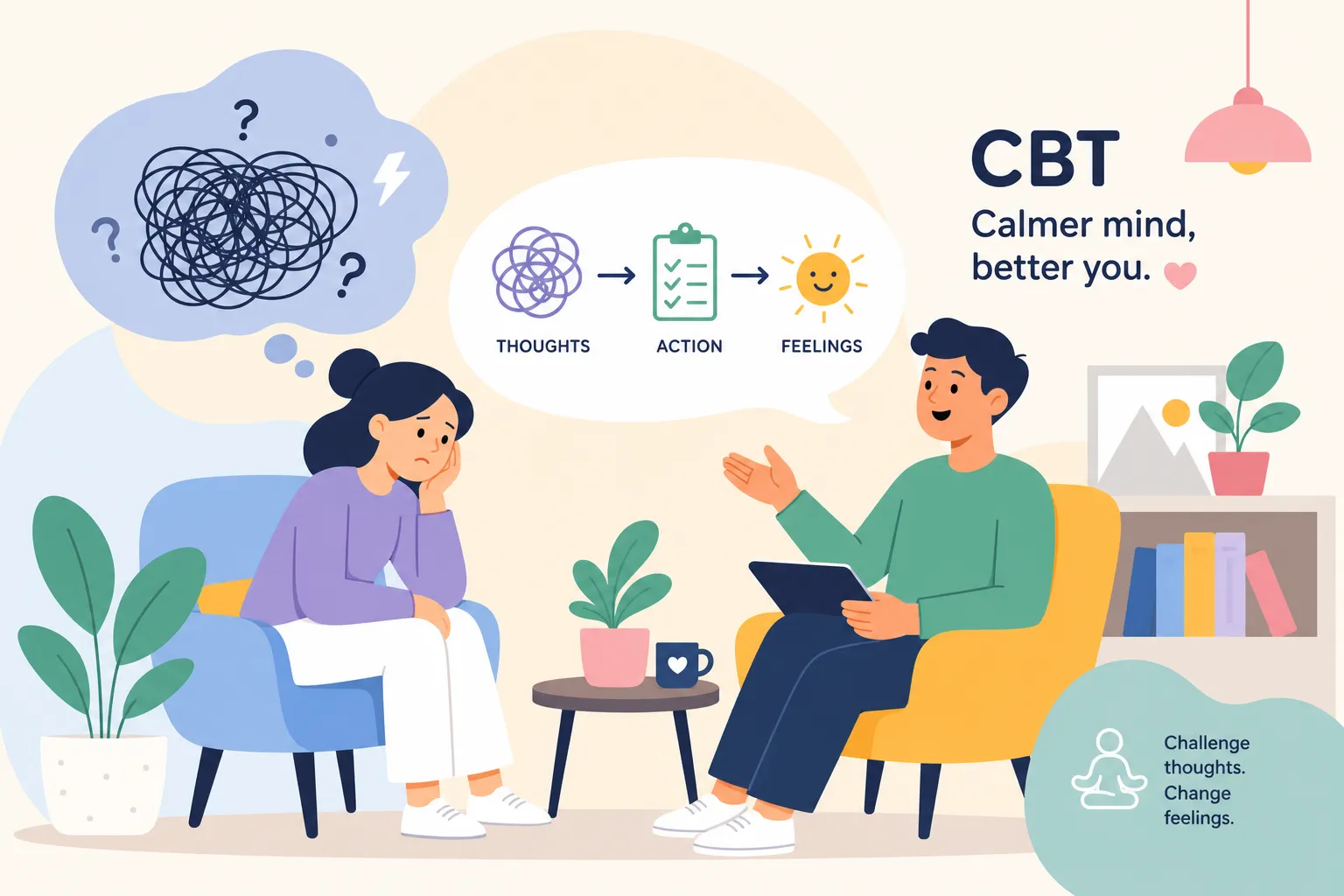
CBT for anxiety rests on a straightforward but powerful idea: anxiety is maintained by the way you interpret situations, not just by the situations themselves. The cognitive model describes a triangle of thoughts, emotions, and behaviors that feed each other continuously. A thought triggers a feeling, the feeling drives a behavior, and that behavior loops back to reinforce the original thought.
Consider someone with social anxiety who dreads an upcoming work presentation. Their mind produces thoughts like “everyone will see I’m incompetent” before they’ve said a word. The body responds with physical dread. And then comes the behavior: finding a reason to cancel. Each time they avoid, the brain registers the situation as genuinely dangerous. The anxiety grows stronger, not weaker.
The thoughts-feelings-behaviors loop
Automatic negative thoughts fire quickly and feel like facts. They aren’t dramatic internal monologues; they’re fast, half-formed conclusions that slip in before you can question them. CBT treats these thoughts as hypotheses worth examining, not verdicts to accept. That shift alone is empowering: if thoughts can be tested, they can also be changed.
Why avoidance is the engine of anxiety
Avoidance offers real short-term relief, which is exactly what makes it so persistent. But every time you sidestep a feared situation, you deny your nervous system the chance to learn that the outcome was survivable, or unlikely in the first place. Research consistently shows that avoidance maintains and strengthens anxiety over time rather than resolving it. Short-term relief from avoidance comes at the cost of long-term freedom. CBT for anxiety interrupts that cycle by deliberately and gradually approaching what anxiety tells you to flee.
Cognitive behavioral therapy anxiety techniques
CBT is a skill-based therapy. You don’t just talk about anxiety; you learn specific tools to respond to it differently. Below are the three core techniques that appear most consistently across cognitive behavioral therapy for anxiety disorders.
Thought records and cognitive restructuring
A thought record is a structured way to slow down automatic thinking so you can examine it. The process works like this: write down the triggering situation, identify the automatic thought, and rate how strongly you believe it. Then look for evidence that supports it and evidence that contradicts it.
From that review, you construct a more balanced thought and re-rate your anxiety. Common distortion patterns to watch for include catastrophizing (“this will be a disaster”), overgeneralization (“I always mess this up”), and mind reading (“I know exactly what they think of me”). Spotting these patterns is half the work, because naming the distortion puts distance between you and the thought.
Building an exposure hierarchy
Exposure is considered the most powerful component of CBT for anxiety. A therapist helps you build a fear ladder: a ranked list of avoided situations from least to most anxiety-provoking, each assigned a rough distress rating from 1 to 10. You start at the bottom and work upward through repeated, structured exposures, staying in each situation long enough for anxiety to drop before moving to the next rung. The goal is not to eliminate fear but to give your brain new data: this situation is manageable. Exposure is gradual by design; there’s no pressure to jump to the hardest step before you’re ready.
Breathing retraining and progressive muscle relaxation
Anxiety is as physical as it is mental. Controlled breathing techniques, such as the 4-7-8 method (inhale for 4 counts, hold for 7, exhale for 8), can increase parasympathetic tone and reduce physiological arousal for many people. Research on paced breathing supports its role in calming the body’s alarm response, though individual responses vary. Progressive muscle relaxation teaches you to systematically tense and release muscle groups from your feet upward, helping you recognize and discharge the physical tension anxiety builds. These are bridging skills: they don’t resolve the underlying thought patterns, but they create enough calm to make the deeper cognitive and behavioral work more accessible.
What a real CBT session actually looks like
A lot of people avoid starting therapy because they genuinely don’t know what they’re walking into. CBT has a clear, predictable structure, which most clients find reassuring rather than rigid.
How therapists structure the work
A standard 50-minute CBT session typically opens with a brief mood check-in and a few minutes of agenda-setting. From there, the therapist reviews the homework from the previous week, then moves into one or two focused skill-building exercises, a cognitive restructuring exercise, or a planned exposure. The session closes with a summary of what was covered and a clear between-session assignment. CBT is more directive than some other therapy styles; every session has a purpose, and both you and your therapist know what it is.
The role of homework between sessions
CBT is not a passive process. The real change happens between sessions, not during them. Clients typically complete thought records, attempt small steps on their exposure hierarchy, and track mood or anxiety levels throughout the week. A good therapist reviews that homework at the start of each session and adjusts the plan based on what you experienced. This between-session practice isn’t optional: it’s where the skills become habitual rather than theoretical.
Cognitive behavioral therapy anxiety timeline and research
Knowing what to expect in terms of timeline helps you commit to the process rather than pulling back when early sessions feel hard.
Typical session counts and treatment timelines
A standard CBT course for anxiety generally runs 12 to 20 weekly sessions, each lasting 30 to 60 minutes. The first few sessions focus on assessment and building a shared understanding of your anxiety. Active skill-building and exposure work typically begin by sessions four through six, and many people notice meaningful shifts in that middle phase. Progress is rarely linear; some weeks feel like two steps forward, others like one step back. Later sessions focus on consolidating gains and planning for how to maintain them after treatment ends.
What the research says about effectiveness
The evidence for cognitive behavioral therapy for anxiety is substantial. A 2024 network meta-analysis found that CBT reduced generalized anxiety disorder (GAD) symptoms versus treatment as usual with a standardized mean difference of -0.74, a moderate-to-large effect. Remission rates for GAD completers reach around 65% at follow-up, and gains are generally maintained 12 months after treatment ends. For social anxiety disorder and panic disorder, the broader evidence base shows small-to-moderate effects versus placebo, still clinically meaningful results that represent real, lasting improvement. Unlike short-term symptom relief, CBT builds durable skills that continue working after therapy ends.
Choosing between self-help, online CBT, and a licensed therapist
Not every person with anxiety needs the same level of support, and the research gives you a clear framework for deciding.
When self-guided CBT resources can help
CBT workbooks and structured online CBT programs do have a research base for mild-to-moderate anxiety. They’re accessible, low-cost, and flexible with scheduling. They work best for people with mild symptoms, strong self-discipline, and the ability to push through hard exposure steps without external accountability. The main limitation is real: dropout rates in unguided programs are significantly higher than in therapist-supported formats, and the exposure work, which is the most effective component, is also the easiest to quietly skip when no one is tracking your progress.
Why working with a licensed CBT therapist gets stronger results
Therapist-guided CBT consistently outperforms self-directed programs in adherence and clinical outcomes. A licensed therapist calibrates the pace of exposure to your specific fear profile, catches cognitive distortions you’ve normalized to the point of invisibility, and provides the kind of structured accountability that makes the hard work sustainable week after week. Research comparing guided online CBT to in-person CBT finds little meaningful difference in outcomes, which means format flexibility doesn’t have to compromise quality. Having a skilled therapist in the process is what makes the difference.
For readers in Chicago or the surrounding area, River North Counseling offers licensed CBT therapists who specialize in anxiety treatment. The practice sees clients in-person at offices in River North and Skokie, and offers virtual sessions across Illinois for those who need flexibility around work schedules or commute. Their therapists work collaboratively with clients to build lasting coping skills, focusing on real change rather than symptom management alone.
The work is demanding. The results are worth it.
Anxiety is not a character flaw or a permanent state. It’s a learned pattern of thought and behavior, and cognitive behavioral therapy for anxiety is specifically designed to interrupt and retrain that pattern. The research is strong, the techniques are learnable, and the process produces durable change that avoidance and self-medication never can.
If you’ve been managing anxiety on your own and aren’t gaining ground, working with a licensed CBT therapist is often the most efficient path forward. The skills you learn don’t disappear when sessions end; they become part of how you think and respond under pressure for the rest of your life.
Starting therapy isn’t a last resort. It’s a decision to take your mental health seriously. If you’re in the Chicago area and ready to take that step, reach out to River North Counseling to connect with a therapist who specializes in cognitive behavioral therapy for anxiety. You don’t have to keep managing this alone.
Frequently asked questions about cognitive behavioral therapy for anxiety
How does cognitive behavioral therapy treat anxiety?
CBT for anxiety works by targeting the thoughts, feelings, and behaviors that keep anxiety locked in place. Therapists use techniques like thought records, exposure hierarchies, and relaxation training to help clients examine automatic thinking, approach feared situations gradually, and build skills that reduce anxiety over time.
How many CBT sessions does it take to see results for anxiety?
Most people begin noticing meaningful shifts between sessions four and six, once active skill-building and exposure work are underway. A full course of cognitive behavioral therapy for anxiety typically runs 12 to 20 sessions, with gains that hold well beyond the end of treatment.
Is CBT for anxiety better than medication?
Research supports both CBT and medication as effective treatments for anxiety disorders, and they are sometimes combined. A key distinction is durability: cognitive behavioral therapy builds skills that continue working after treatment ends, whereas symptom relief from medication typically depends on continued use. A licensed therapist or psychiatrist can help you weigh the options for your specific situation.
Can I do CBT for anxiety on my own?
Self-guided CBT workbooks and online CBT programs have a modest research base for mild-to-moderate anxiety. Their main limitation is adherence, dropout rates in unguided formats are considerably higher than in therapist-supported treatment. For moderate-to-severe anxiety, working with a licensed therapist produces stronger and more consistent outcomes.