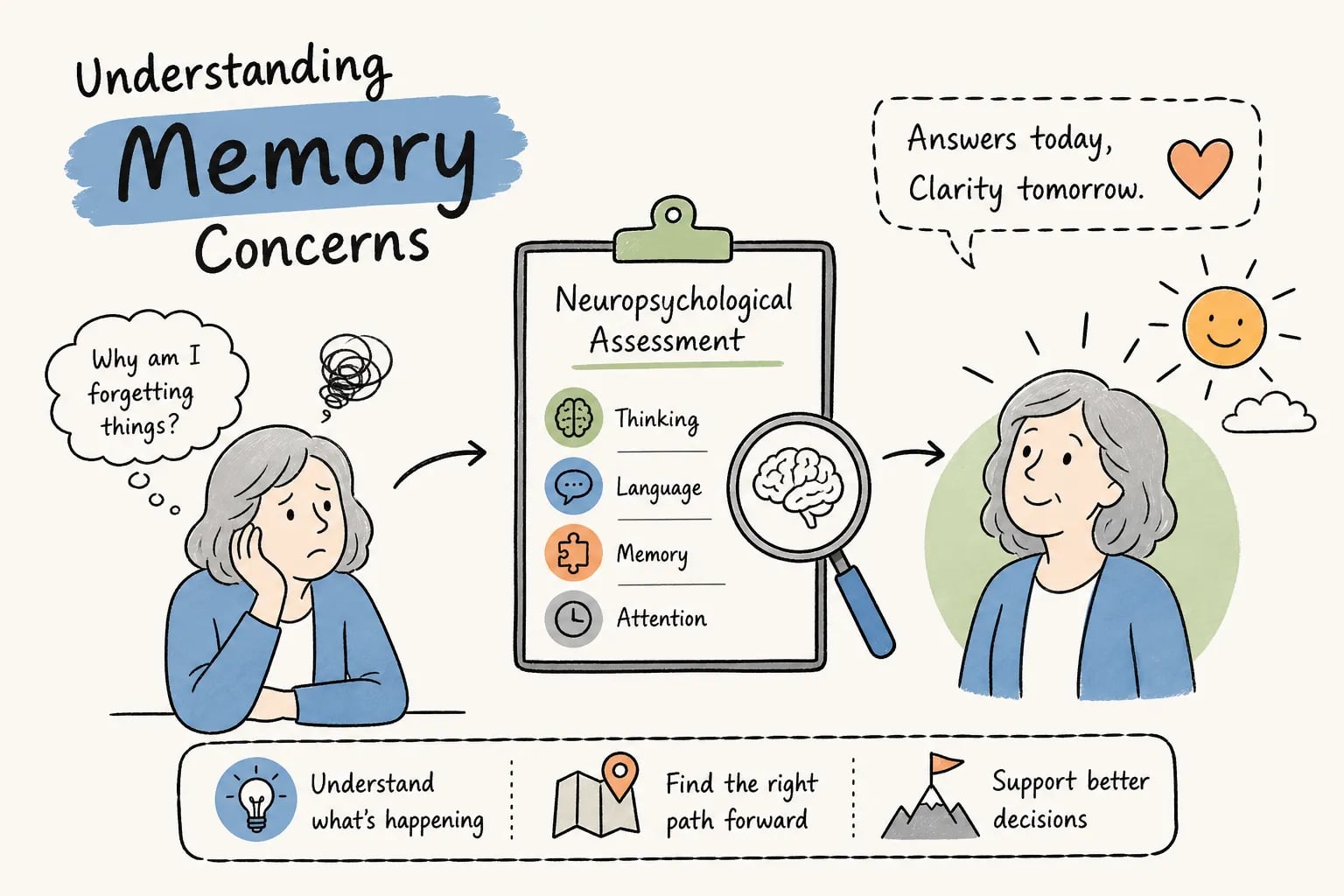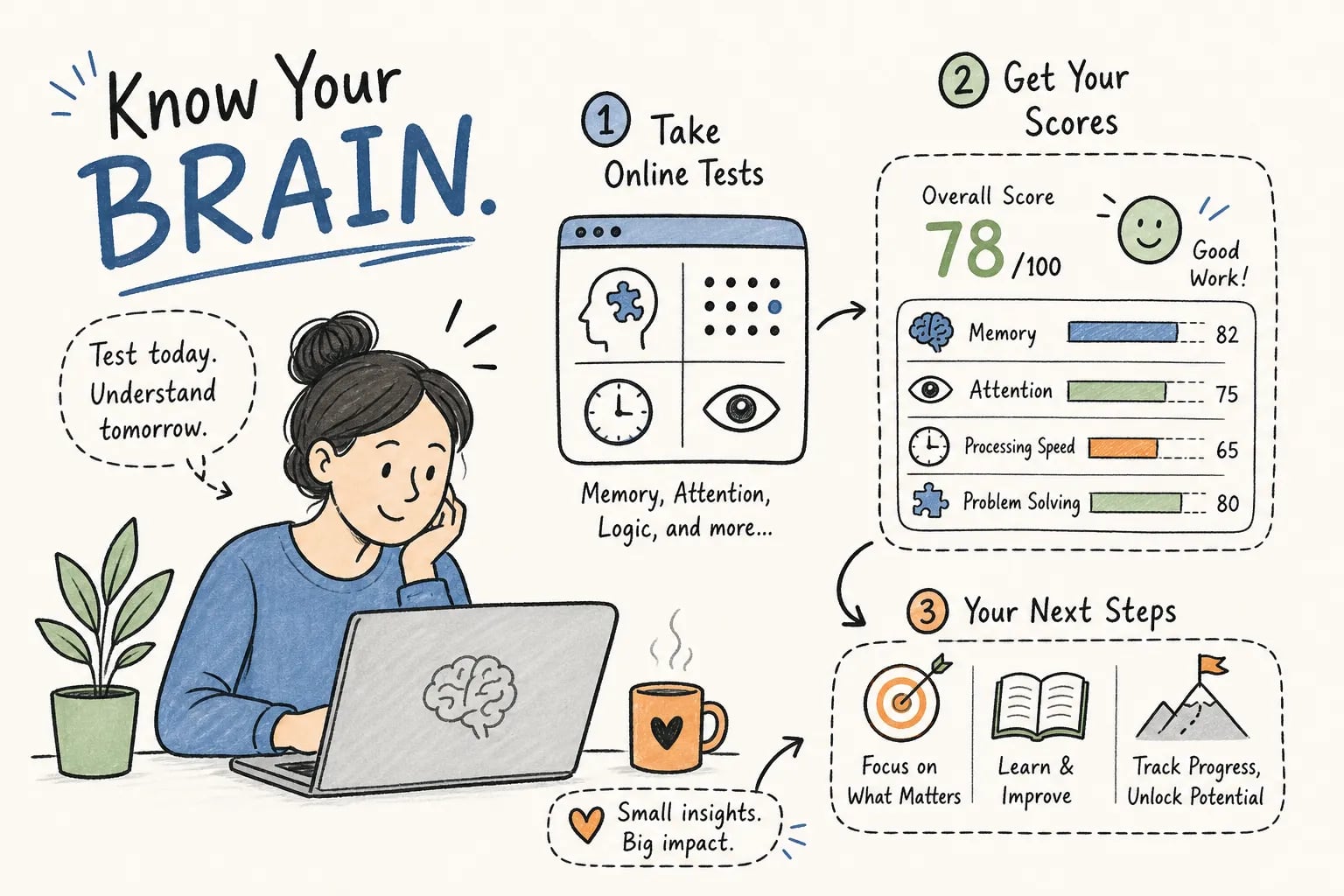

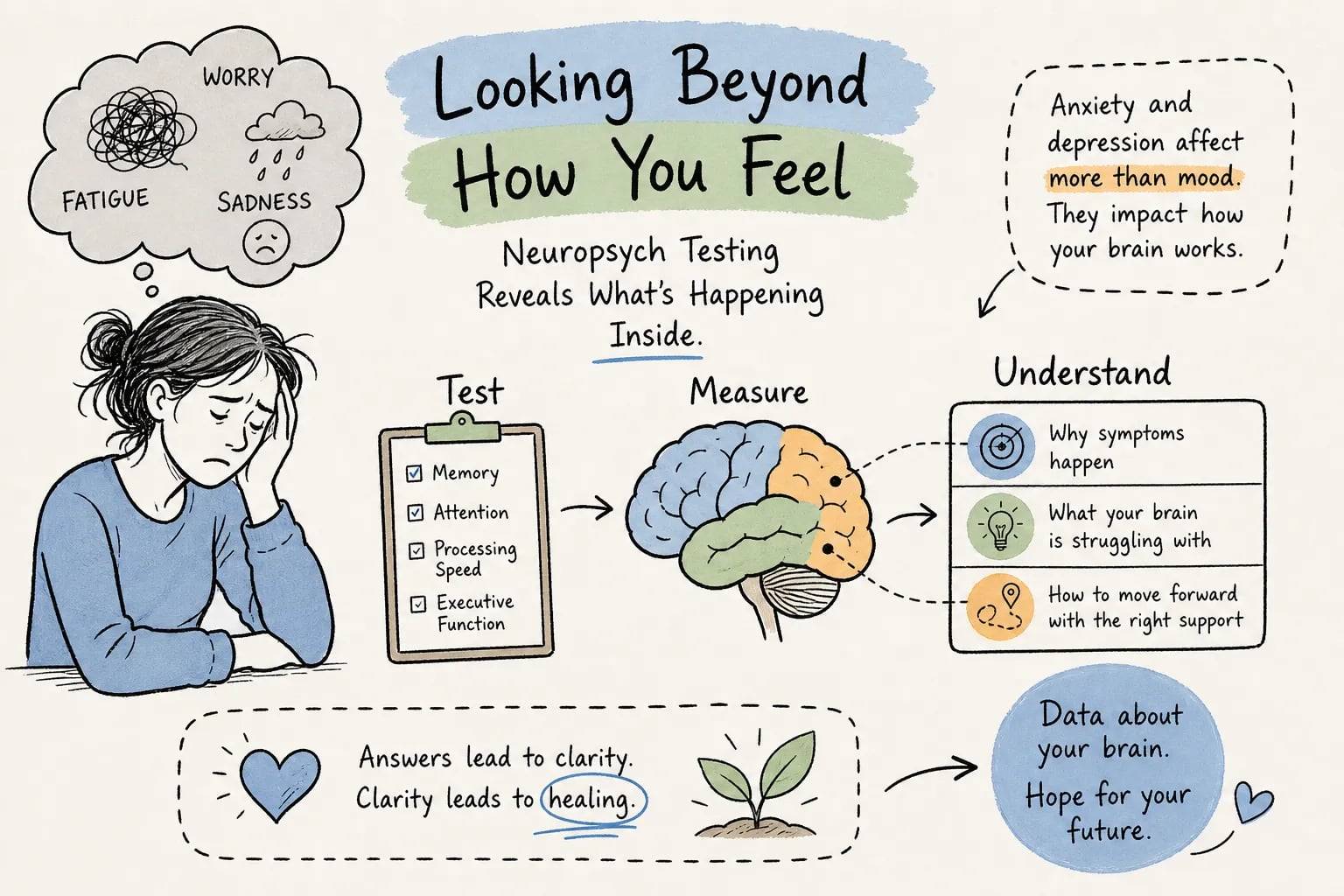
There’s a particular kind of frustration that brings many adults to a neuropsychologist’s office. They feel foggy. Words slip away mid-sentence. They walk into a room and forget why they came. Their concentration frays after twenty minutes of focused work, and by the afternoon they feel like they’re thinking through wet concrete. Their doctor says it might be depression. Their therapist suspects anxiety. But underneath both of those explanations sits a harder question: is this my mood, or is something actually wrong with my brain?
That question deserves a real answer, not another symptom checklist. Adult neuropsychological testing for anxiety, depression, and cognitive functioning exists precisely to provide one. It’s a structured, multi-hour clinical evaluation that measures how your brain is actually performing across attention, memory, processing speed, and executive control, then places those results alongside your emotional state to figure out what’s driving what. It replaces guesswork with data.
For adults in Chicago navigating this kind of diagnostic uncertainty, that level of clinical clarity often starts with a comprehensive neuropsychological assessment. At River North Counseling, that’s exactly the kind of evaluation we offer: thorough, clinician-led, and integrated with whatever care comes next. But first, it helps to understand what this evaluation actually involves.
What adult neuropsych testing for anxiety, depression, and cognition actually measures
A neuropsychological evaluation is not a mood questionnaire, and it’s not a basic cognitive screening. It’s a comprehensive battery of standardized tests administered over multiple hours, each designed to probe a specific domain of brain function. The results don’t just tell you whether something is wrong; they show where performance is strong, where it breaks down, and how those patterns map onto your reported symptoms.
The cognitive domains covered in a full battery
A standard adult battery covers several core areas of brain function. Among the domains and instruments typically included:
- Attention and working memory, measured with tasks like Digit Span, where you repeat number sequences forward and backward
- Executive functioning, the brain’s capacity for planning, cognitive flexibility, and inhibition, evaluated using the Trail Making Test and tasks from the Delis-Kaplan Executive Function System
- Verbal and visual memory, assessed through list-learning tasks like the California Verbal Learning Test or the Rey Auditory Verbal Learning Test
- Processing speed, language, and visuospatial skills, rounding out the core domains alongside verbal fluency and naming tasks
The Wechsler Adult Intelligence Scale often anchors the whole battery, providing a baseline measure of general intellectual functioning against which other scores are compared.
How mood and personality are assessed alongside cognition
Performance-based testing tells you what your brain can do under controlled conditions. But to interpret those results meaningfully, the evaluator also needs to understand how you’re feeling. Self-report scales like the PHQ-9, the Beck Anxiety Inventory, and the GAD-7 quantify the severity of depression and anxiety symptoms on the day of testing and in the preceding weeks. Broader personality and psychological measures, such as the Minnesota Multiphasic Personality Inventory (MMPI) or the Personality Assessment Inventory (PAI), provide a more complete picture of emotional functioning, coping style, and any co-occurring psychological features. Both types of data are essential: performance tests show how the brain functions, while symptom scales help explain why it’s functioning that way.
How anxiety and depression show up on adult neuropsych testing
Most people assume mood disorders affect only how they feel, not how they think. Decades of cognitive research tell a different story. Depression and anxiety produce measurable, reproducible patterns on cognitive testing, and understanding those patterns is a large part of what makes a neuropsychological evaluation clinically valuable.
The cognitive fingerprint of depression
Major depressive disorder doesn’t just slow down your mood, it slows down your brain. Meta-analyses consistently identify processing speed, executive function, attention, and memory retrieval as the domains most reliably impaired in adults with depression. Clinicians often frame this using a “hot vs. cold cognition” distinction: cold cognition refers to the measurable slowdowns in speed and executive efficiency; hot cognition refers to the depressive biases that distort how the brain evaluates information, making neutral situations read as threatening or hopeless.
What the data also shows, however, is significant heterogeneity. Some adults with depression test close to the norm, while others show marked impairment across multiple domains. One large research trial identified a distinct “cognitive biotype” in roughly 27% of depressed adults, characterized by prominent executive dysfunction and poor response inhibition. That variability is exactly why standardized cognitive testing for depression matters: it replaces self-report with objective measurement.
How anxiety disrupts attention and working memory
Anxiety operates differently on the brain than depression, though the two often co-occur. The core mechanism is attentional resource depletion: an anxious brain is chronically occupied scanning for threat, which leaves substantially less capacity for concentration, working memory, and learning. On cognitive testing, this often shows up as inconsistent performance, scores that vary across similar tasks, difficulty sustaining attention, and slowed processing speed, even when memory encoding is relatively intact once the person manages to focus. The brain isn’t broken; it’s occupied. But when that occupation is constant, the functional consequences look very much like cognitive impairment to the person experiencing them.
Telling mood-related cognitive symptoms apart from early cognitive decline
This is the question that genuinely worries many adults seeking evaluation: what if this isn’t anxiety or depression at all? What if something is actually wrong with my brain? Adult neuropsych assessment is one of the few clinical tools that can begin to answer that with real data rather than reassurance.
The patterns neuropsychologists look for
The pattern of impairment matters as much as the scores themselves. Depression-related cognitive difficulties tend to be inconsistent, tied to mood severity, and sensitive to effort, meaning performance can vary across sessions and often improves with treatment. Early cognitive decline, such as mild cognitive impairment (MCI), tends to produce more reproducible deficits on standardized testing, particularly in episodic memory, that persist even when mood is accounted for. Functional decline in everyday life is one of the clearest distinguishing markers: difficulty managing finances, losing track of medications, or getting disoriented in familiar areas points more strongly toward neurodegenerative causes than toward mood disorders alone. Collateral history from a family member or close partner is also critical, since they can often describe a timeline of change that the person being evaluated cannot fully access themselves.
Why the right diagnosis changes everything
A misdiagnosis in this space has real clinical consequences. Treating what looks like depression when early cognitive impairment is actually present leads to the wrong interventions and delays an appropriate neurology referral. Conversely, treating someone for cognitive decline when the real driver is untreated major depressive disorder can deny them access to therapy and antidepressant treatment that would genuinely help. When the picture is ambiguous, neuropsychologists often rely on repeat testing over time: improvement following mood treatment supports a mood-related cause, while stability or progression of deficits points toward MCI or early dementia. This is why assessment-level clarity isn’t an academic exercise; it’s the difference between the right treatment and the wrong one.
What the evaluation process looks like and how to prepare
In clinical practice, many adults delay getting tested because they’re not sure what to expect. The process is more structured than most clinical appointments, but it’s also more straightforward than many people anticipate.
What to expect: structure, duration, and cost
A comprehensive adult neuropsychological evaluation typically involves 6 to 8 hours of direct testing, often spread across one long appointment or two shorter sessions. The full process includes a clinical intake interview, the standardized testing battery itself, a period of scoring and report writing, and a feedback session where results are explained in plain language. In Chicago, out-of-pocket costs for a full evaluation typically range from $2,500 to $5,000, with more complex cases reaching higher. Insurance coverage is variable: PPO plans may reimburse a portion of out-of-network costs through a superbill, and coverage is more likely when the evaluation is tied to a documented medical or psychiatric need rather than academic or administrative purposes. It’s worth calling your insurer in advance to understand what your specific plan covers.
How to show up so your results reflect your real functioning
The goal of neuropsychological testing is to capture your typical functioning, not to catch you performing at your peak or your worst. Sleep the night before, eat a real meal beforehand, and take your prescribed medications as usual, including psychiatric medications, unless your evaluating clinician has specifically instructed otherwise. Bring a full medication list with dosages, any prior psychological or neuropsychological testing records, relevant medical history, and your glasses, hearing aids, or other assistive devices if you use them. If a trusted family member or partner is able to attend, their observations about your functioning over time can provide genuinely useful collateral information. Don’t try to “pass” the test. The information only helps if it accurately reflects where you actually are.
How results shape your diagnosis, treatment plan, and next steps
Getting tested isn’t the end of the road; it’s a diagnostic starting point that changes what happens next. The value of a comprehensive neuropsychological report lies in how precisely it redirects care.
How a neuropsych report changes the direction of care
A report showing depression-driven cognitive slowing, with processing speed and executive function as the most affected domains, might point toward CBT combined with a pharmacological evaluation. Research on antidepressant treatment in MDD suggests effects on both mood and, in some studies, cognitive outcomes, though the evidence varies, and individual response differs. A pattern consistent with ADHD, which can look remarkably similar to anxiety-related inattention on the surface, would redirect treatment toward a very different set of interventions. A profile that raises concern about early MCI would trigger a neurology referral and fundamentally different care planning. The report doesn’t just name the problem; it identifies which door to walk through next. That specificity is what separates a comprehensive adult neuropsych assessment from a basic cognitive screening tool.
Getting evaluated in Chicago: working with River North Counseling
For adults in Chicago and the surrounding Chicagoland area who want this level of diagnostic clarity, River North Counseling offers neuropsychological assessments that go well beyond a standard intake evaluation. Every evaluation is conducted by a licensed clinician and built around your specific presentation, and the assessment doesn’t exist in isolation. When therapy or ongoing support is indicated following the evaluation, we integrate that care within the same practice so nothing gets siloed. You’re not handed a report and sent elsewhere to figure out what to do with it.
Whether you work in River North, live on the North Shore, or prefer a virtual appointment, our team can walk you through the process and determine whether a full evaluation is the right next step for your situation.
Clarity is the starting point, not the finish line
The question that brought you to this article, whether what you’re experiencing is your mood, your attention, or something more serious, is a real and important one. It deserves a real answer. Adult neuropsychological testing for anxiety, depression, and cognitive functioning is the clinical tool built to provide one, mapping your brain’s actual performance against your emotional state with precision rather than inference.
If you’ve been living with that uncertainty, the next step isn’t another Google search or another round of wondering. It’s a conversation with a provider who can actually evaluate what’s going on and help you make sense of it. If you’re in Chicago or the Chicagoland area, that conversation can start at River North Counseling. Reach out to our team to learn more about our neuropsychological assessment services and what the process looks like for you specifically.