

Knowing how to find the right therapist in Chicago is the first step toward actually getting help, and it’s harder than it looks. You pull up a directory, type in your ZIP code, and suddenly you’re scrolling through hundreds of profiles, each one promising the right kind of care. Having more options doesn’t make the decision easier. It makes it harder. Many people report either picking someone at random and hoping for the best, or getting so overwhelmed they put it off entirely.
Neither of those is a good path. The good news is that finding the right fit is a learnable process, not a guessing game. This guide covers exactly where to look, what Illinois credentials actually mean, how to screen for specialty and cultural fit, what to ask before you book, and how to navigate cost and insurance. By the end, you’ll know how to move from “I need someone” to a confirmed first appointment with a therapist you actually trust.
Practices like River North Counseling are built around exactly this problem. Their intake process matches clients with therapists based on clinical need, schedule, insurance, and fit, rather than asking you to figure it all out yourself. But even if you’re searching more broadly, the framework below applies.
How to Find the Right Therapist in Chicago: Where to Start
The major directories and what their filters actually do
Five directories dominate how Chicagoans find therapists right now: Psychology Today, TherapyDen, Headway, GoodTherapy, and Open Path Collective. Each one does something slightly different. Psychology Today has the most robust insurance filter, letting you search by specific insurer and in-network status, plus neighborhood radius and a long specialty list. TherapyDen is stronger for identity-affirming and values-driven searches, with filters for queer-competent, neurodiversity-affirming, and anti-racist frameworks. Headway is purpose-built for insurance matching: you enter your plan, and it surfaces only therapists in-network with that carrier.
GoodTherapy covers broad clinical categories and lets you filter by treatment orientation (CBT, DBT, psychodynamic), which is useful once you know what approach you’re looking for. Open Path Collective is the go-to for sliding-scale searches, with sessions typically listed at $40, $70 for qualifying clients. The critical thing to understand about all of these: profiles are self-authored. Because clinicians complete their own listings, directories are a starting point, not a vetting system. A therapist listing “trauma” as a specialty doesn’t tell you how much clinical experience they actually have with trauma, ask about it directly during intake.
Why going directly to a group practice often saves time
The most efficient path to the right therapist is often skipping the directory altogether. A well-run group practice does the matching work on your behalf. When a practice like River North Counseling has clinicians across individual therapy, couples counseling, child psychology, and performance coaching under one roof, a skilled intake coordinator can align you with the right person based on your specific concern, your schedule, and your insurance, rather than leaving you to interpret bios on your own.
That matters because the variables that determine fit, therapeutic approach, lived experience with your issue, and personality, don’t always come through in a three-paragraph profile. A direct intake conversation can surface those details in a matter of minutes, surfacing things a bio simply can’t convey.
When a referral from your doctor or insurer makes sense
If cost is your primary constraint, starting with your insurance company’s provider finder or asking your primary care physician for a referral is a reasonable first step. The limitation is real, though: in-network lists are frequently outdated, and “listed as available” doesn’t mean a therapist is accepting new clients or is a good match for what you’re dealing with.
Treat insurer lists as a lead source, then screen candidates the same way you would from any directory. Always call to confirm that the therapist is currently accepting new clients before investing more time in the process. For a structured approach to beginning the search, see Finding a Therapist: Steps to Choose the Right One, River North Counseling.
How to read therapist credentials before booking
The difference between LPC/LCPC, LCSW, and LMFT in Illinois
Illinois has three common master’s-level therapy licenses, and they’re not interchangeable. An LPC (Licensed Professional Counselor) is the entry-level counseling credential; an LCPC (Licensed Clinical Professional Counselor) is the advanced version, requiring additional supervised clinical hours. Both are specifically counseling licenses. An LCSW (Licensed Clinical Social Worker) comes from a social work background, not a counseling program, though LCSWs routinely provide therapy and are trained to do so. An LMFT (Licensed Marriage and Family Therapist) specializes in relational and family systems work and is typically the strongest credential for couples or family therapy. All three require a master’s degree, supervised experience, and a licensing exam.
For most individual therapy goals, any of these licenses is appropriate. The license type matters more when the issue is highly specific: relational conflict points toward an LMFT, while a clinical social work background often brings additional case management and resource knowledge alongside therapy skills.
When you need a psychologist (PsyD or PhD) instead
PsyD and PhD are doctoral degrees, not license titles in themselves. You need a licensed psychologist specifically if you’re seeking neuropsychological testing, a formal cognitive evaluation, or a psychological assessment for ADHD, learning differences, or memory concerns. For standard talk therapy goals, a master’s-level clinician is fully appropriate and often more accessible in terms of availability and cost. More degrees means a different scope of practice, not necessarily better therapy. For details on assessment scope and common questions about testing, see Psychological Testing in Chicago: What It Answers and What It Doesn’t, River North Counseling.
How to verify an Illinois therapy license
Use the IDFPR (Illinois Department of Financial and Professional Regulation) license lookup tool at idfpr.illinois.gov. Search by the therapist’s name, confirm the license type matches what they’ve listed in their profile, and look for an active status with a valid expiration date. If disciplinary action appears, it will be noted there as well. The lookup is usually quick, often just a few minutes, and worth doing before a first session.
Matching on specialty, therapy style, and cultural fit
Aligning your concern with the right therapy approach
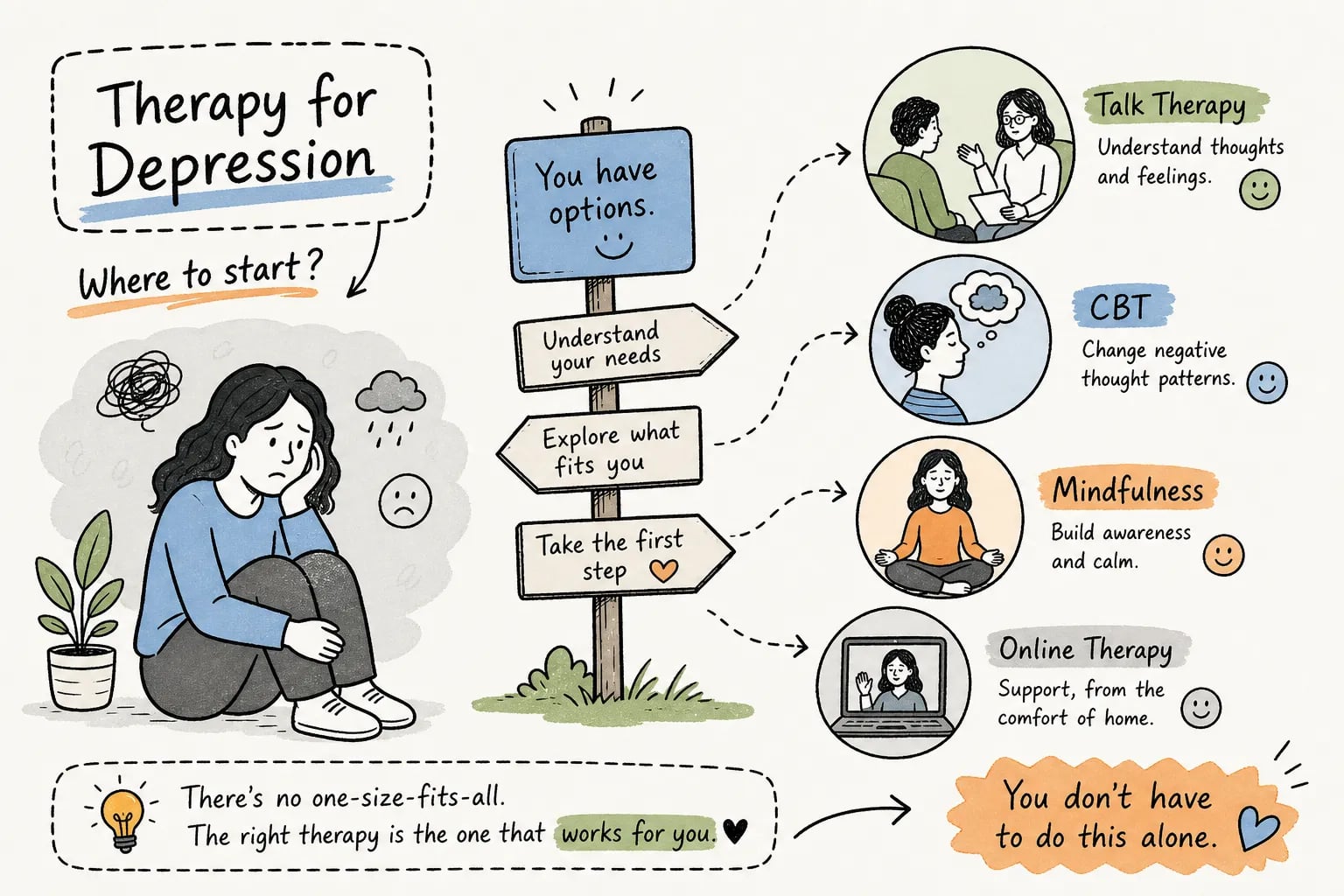
Therapy style matters as much as the person’s license. Cognitive Behavioral Therapy (CBT) is among the most evidence-supported approaches for anxiety, depression, stress, and OCD, making it a strong starting point if those are your primary concerns. Trauma-informed care is the right priority if your history includes adverse or traumatic experiences; look for clinicians trained in EMDR or trauma-focused CBT specifically. ACT (Acceptance and Commitment Therapy) is often used for avoidance-related problems and issues like perfectionism, ask a clinician about their specific ACT experience. DBT is designed for emotional regulation difficulties. Psychodynamic approaches are better suited for longer-term exploration of patterns rooted in early experience.
Most therapist profiles will list their primary approaches. If a profile says only “eclectic,” ask what that means during an intake call. A well-trained therapist can explain clearly why they use the approaches they do for clients with your specific concerns. For a concise guide to different therapy types and how they’re used, see Explaining different therapy types and their benefits, River North Counseling.
Finding culturally competent and bilingual therapists in Chicago
Chicago has a strong network of culturally affirming providers if you know where to look. Rush University Medical Center offers adult psychotherapy with multiple bilingual Spanish-English providers who emphasize culturally sensitive care. The Midwest Asian Health Association (MAHA) Community Mental Health Clinic provides services in English, Mandarin, and Cantonese. Mind Body Co-Op offers bilingual therapy at locations in Lakeview and the Loop. Organizations like Centered Therapy Chicago explicitly identify as anti-racist and affirming across identities.
To find providers by neighborhood, use ZIP-code filters on TherapyDen or Psychology Today alongside search terms like “Lincoln Park bilingual therapist” or “Chinatown mental health.” You can also search “Chicago therapist near me” with a specific ZIP code to narrow results by proximity. Always confirm language availability directly, profiles can be outdated, and clinician availability changes. Ask about cultural competency during the intake call rather than assuming it from a profile label.
Why therapeutic alliance often outweighs specialty on paper
Psychotherapy research, including meta-analyses by Flückiger and colleagues, consistently identifies the quality of the working relationship between client and therapist, what clinicians call therapeutic alliance, as one of the strongest predictors of outcome. A therapist can check every box on paper and feel completely wrong in the room. Treat your first session as a mutual evaluation, not a commitment. You are assessing them as much as they are getting to know you. If something feels off after two or three sessions, it’s worth saying so or finding someone else. That’s not failure; it’s how the process is supposed to work.
Questions to ask during your intake or first call
What to ask about approach, experience, and availability
These six questions reveal clinical alignment far better than reading a bio. Ask: What is your primary therapeutic approach and why do you use it? Have you worked with clients dealing with this specific concern? What does a typical session look like? How do you track progress over time? What is your cancellation and rescheduling policy? How long do you typically work with clients before reassessing goals? A confident, specific answer to each of these is a good sign. Vague answers or defensiveness are worth noting.
How to ask about insurance and fees without feeling awkward
The financial conversation is routine, and a good therapist expects it. Ask directly: Do you accept my insurance? What is your self-pay rate? Do you offer a sliding scale based on income? If you’re out of network, can you provide a superbill for reimbursement? At River North Counseling, the intake process includes a complimentary insurance check so clients know their costs before committing to anything. That kind of upfront transparency is what a well-run practice looks like. If a practice makes this conversation difficult, that tells you something about how it operates.
Understanding therapy costs and insurance in Chicago
What Chicago therapy typically costs by provider type
Private-pay rates in Chicago in 2026 follow a clear pattern by credential level. LPC and LCPC clinicians typically charge $125, $165 per session. LCSWs run slightly higher, generally $130, $170. Doctoral-level psychologists (PsyD or PhD) commonly charge $170, $240, and sometimes more for specialized assessment work. The citywide average across provider types sits around $145, $155 per session, with a broader market range of roughly $70, $275 depending on specialization and experience. These numbers help you calibrate what you’re quoted before you assume a rate is unusually high or low.
Major insurers, telehealth coverage, and out-of-network reimbursement
The most commonly accepted plans at Chicago therapy practices are Blue Cross Blue Shield PPO, Aetna PPO, UnitedHealthcare/Optum, and Cigna/Evernorth. Telehealth coverage generally follows the same benefits as in-person therapy under these plans, but you should confirm your specific copay, deductible, and whether telehealth is explicitly included before booking. Illinois has telehealth parity requirements directing insurers to reimburse telehealth services equivalently to in-person care, though your actual out-of-pocket costs, copays, deductibles, and reimbursement rates, still depend on your individual plan details. Always verify directly with your insurer before your first session.
Out-of-network reimbursement works like this: you pay the therapist directly at the time of service, then the therapist provides a superbill, an itemized receipt you submit to your insurer. Some PPO plans reimburse up to 80% of the allowed amount after your deductible is met. Call your insurer before your first session, confirm your out-of-network behavioral health benefits, and ask specifically about deductible status and whether prior authorization is required.
Low-cost and sliding-scale options for Chicago residents
Several routes lead to more affordable care in the Chicago area. Sliding-scale private therapists adjust fees based on income; Open Path Collective is a reliable directory specifically for this, with sessions often listed at $40, $70. Community mental health centers accept Medicaid and often offer reduced-cost services on a tiered basis. University training clinics provide supervised care from graduate clinicians at significantly lower rates. Some affinity-based organizations, like Sista Afya for Black women in Chicagoland, offer free or reduced-cost services for specific communities. These options exist and they work; accessing them just requires a few extra calls to confirm current availability.
Frequently Asked Questions About Finding a Therapist in Chicago
How do I find an affordable therapist in Chicago?
Start with Open Path Collective for sliding-scale providers ($40, $70 per session), check community mental health centers that accept Medicaid, or look into university training clinics. Many private therapists also offer income-based fees, ask directly during your first call. Searching for “affordable therapy Chicago” on TherapyDen or Psychology Today with the sliding-scale filter applied is a practical starting point.
What’s the difference between searching a directory and contacting a group practice?
Directories put the matching work on you, you interpret profiles, filter by insurance, and make judgment calls based on limited information. A group practice like River North Counseling does that work with you. An intake coordinator considers your clinical needs, schedule, insurance coverage, and fit preferences to recommend the right clinician directly, which typically gets you to a confirmed appointment faster.
Can I find a therapist in Chicago who offers telehealth?
Yes. Most Chicago-area practices now offer telehealth as a standard option, and Illinois telehealth parity requirements mean in-network coverage should apply the same way it does for in-person sessions, though you should confirm the specifics with your insurer. River North Counseling offers virtual therapy available across Illinois for clients who prefer it or can’t get to an office location.
How do I search for therapists in Chicago by specialty?
Use the specialty filters on Psychology Today or TherapyDen and combine them with a ZIP code or neighborhood name. Searching for therapists in Chicago by specialty, anxiety, trauma, couples work, or identity-affirming care, is more effective than browsing general listings. For highly specific needs like neuropsychological testing, filter for doctoral-level providers (PsyD or PhD) specifically.
Start with the right fit, not just the nearest listing
Knowing how to find the right therapist in Chicago means understanding that it’s not a single search, it’s a process of knowing where to look, understanding what credentials actually authorize, identifying the therapy style that fits your needs, and asking the questions that surface real alignment rather than a polished profile. The process gets significantly easier when you work with a practice designed to do part of that work alongside you.
River North Counseling is a licensed group practice serving Chicago and the greater Chicagoland area, with offices in River North and Skokie and virtual therapy available across Illinois. Their team covers individual therapy, couples counseling, child psychology, CBT, neuropsychological assessment, parent coaching, and performance coaching, so wherever you are in the process, there’s a clinician matched to where you actually are. The intake process is built around personalized matching, and they offer a complimentary insurance check so you know your costs before committing.
When you’re ready to move from searching to actually connecting with someone, reach out to River North Counseling to schedule a free consultation. A thoughtful match from the start saves time, reduces frustration, and gets you into effective care sooner.