

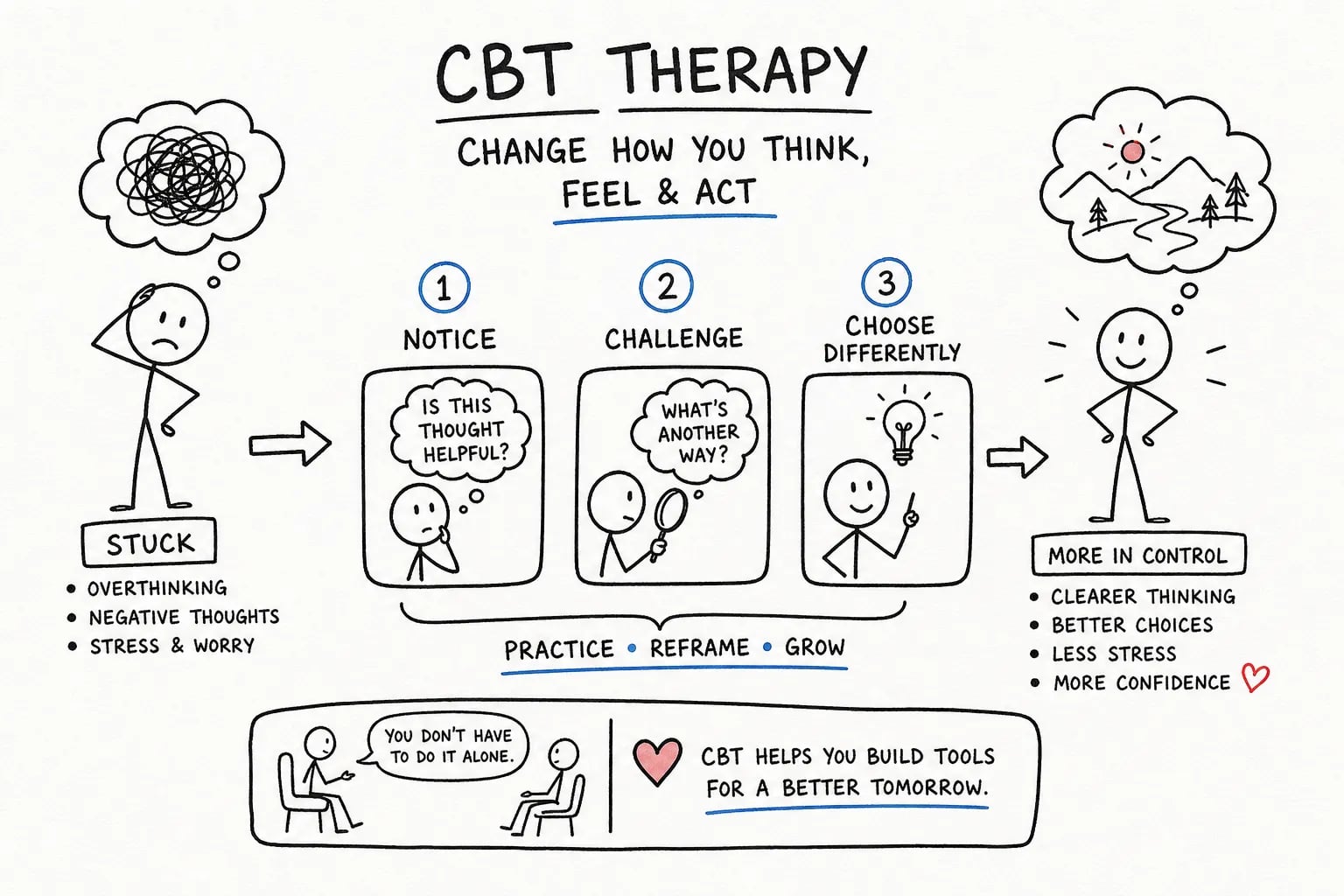
CBT (cognitive behavioral therapy) is a structured, skills-based form of talk therapy that teaches you to identify and change unhelpful patterns in your thinking and behavior. Most people complete a course in 8 to 12 weekly sessions, a time-limited commitment compared to many other therapy formats. It is also one of the most researched forms of psychotherapy available, with strong clinical evidence supporting its use for anxiety, depression, OCD, trauma, insomnia, and more.
At River North Counseling, we are a Chicago-based practice that regularly helps clients understand cognitive behavioral therapy and whether it is the right fit for them. This article answers that directly, covering how the therapy works, which conditions it treats, the techniques you will actually use, and what each session looks like from start to finish.
Key takeaways
- Structured and time-limited: Most courses run 8 to 12 weekly sessions, each lasting 50 to 60 minutes, with a clear agenda every time. Some courses range from 5 to 20 sessions depending on diagnosis and severity, according to Cleveland Clinic and Mayo Clinic guidance.
- Skills you keep: This approach teaches techniques like thought records and graded exposure that remain useful long after treatment ends.
- Broadly evidence-based: Clinical guidelines recommend CBT as a first-line treatment for anxiety disorders, depression, PTSD, OCD, and insomnia.
- Active participation matters: Between-session practice is central to the model, not optional. Skills transfer into real life through consistent repetition outside the therapy room.
- Works in person and online: Research shows therapist-guided remote CBT produces outcomes comparable to in-person sessions for most conditions.
How does CBT actually work?
The core idea behind cognitive behavioral therapy is straightforward: situations trigger automatic thoughts, which shape emotions, which drive behavior. Change one part of that cycle, and the others follow. A critical email at work might trigger the thought “I’m going to lose my job,” which creates anxiety, which leads to avoidance. The therapy teaches you to interrupt that chain rather than ride it all the way down.
What separates this approach from other forms of talk therapy is its structure. Each session has a specific focus and a concrete takeaway. You are not simply venting or processing the past; you are practicing skills, testing beliefs, and building tools you can use outside the room. This active, coaching quality is what makes sessions feel purposeful rather than open-ended.
Skills do not transfer on their own, thought records and behavioral experiments only stick when practiced between sessions, which is why consistent homework is built into the model from the start. Research consistently identifies between-session practice as one of the strongest predictors of durable progress in cognitive behavioral therapy.
Which conditions does this therapy have strong evidence for?
CBT is a first-line psychological treatment for generalized anxiety disorder, panic disorder, social anxiety, and mild-to-moderate depression. Major clinical guidelines, including those from NICE and U.S. evidence-based authorities, consistently place it at the top of recommended options for these conditions. That distinction matters because outcomes have been tested across thousands of patients, not just reported anecdotally.
The evidence extends well beyond anxiety and depression. For PTSD, trauma-focused cognitive behavioral therapy is strongly recommended over non-trauma-focused approaches. For OCD, the approach incorporating exposure and response prevention (ERP) is a principal treatment, according to the American Family Physician. CBT for insomnia (CBT-I) is a first-line recommendation, often preferred over sleep medication. Eating disorders such as bulimia nervosa and binge-eating disorder also have strong evidence behind them.
One nuance worth knowing: cognitive behavioral therapy is not one uniform method. Outcomes are best when the approach is condition-specific and adapted to severity. Treatment for OCD should include ERP. Treatment for PTSD should be trauma-focused. A qualified clinician helps determine which version fits your situation and how intensive the work needs to be.
What core techniques will you actually use?
The most foundational CBT technique is the thought record. You write the situation, record the automatic thought, rate the emotion, list evidence for and against the thought, write a more balanced alternative, and re-rate the emotion. This process, often called cognitive restructuring, targets cognitive distortions such as all-or-nothing thinking, catastrophizing, mind-reading, and emotional reasoning. Over time, you get faster at catching distorted thoughts before they spiral.
Behavioral activation and graded exposure
Behavioral activation addresses the low mood and withdrawal cycle by scheduling small, meaningful activities. Rather than waiting to feel motivated, you act first and let the mood follow. Graded exposure works on a similar principle for anxiety: you build a “fear ladder” and approach feared situations in manageable steps, moving up gradually rather than forcing full confrontation all at once, and both replace the avoidance loop with forward momentum.
Behavioral experiments and problem-solving
Two other CBT techniques round out the core toolkit. Behavioral experiments test a belief in real life instead of accepting it as fact: make a prediction, take one small action, observe what actually happens, and compare the result to the prediction. Problem-solving turns vague, overwhelming worry into a specific and actionable plan. Together, these techniques address avoidance and helplessness directly, which are often the mechanisms keeping anxiety or depression locked in place.
What does a typical course look like?
Most courses run 8 to 12 weekly sessions, though some conditions or severity levels call for up to 20, according to the Cleveland Clinic and Mayo Clinic. Sessions last 50 to 60 minutes and follow a predictable format: a brief mood check-in, a review of between-session practice, an agreed agenda for that session, focused skill work, and a new practice task for the coming week. The structure is collaborative; you and your therapist agree on the focus together.
The arc of treatment follows a recognizable pattern. Early sessions focus on assessment, learning the model, and setting specific goals. Middle sessions are where most skill-building happens: applying techniques, testing beliefs in real life, and gradually approaching avoided situations. Final sessions consolidate the gains and create a relapse-prevention plan so you can handle future challenges independently.
Progress is not always linear. Some people temporarily feel worse in early sessions as avoided situations are approached. According to Mayo Clinic guidance, meaningful symptom improvement often becomes noticeable around sessions five through eight. This is not a cure that eliminates difficulty; it is a skill set that changes how you respond to it.
| Session range | Typical focus |
|---|---|
| 1–2 | Assessment, setting goals, learning the CBT model, initial monitoring of thoughts and triggers |
| 3–4 | Identifying automatic thoughts and behavioral patterns; first skill practice; some people temporarily feel worse |
| 5–8 | Active technique use: thought records, behavioral activation, exposure; many notice meaningful improvement in symptoms |
| 9–12 | Consolidation; applying skills independently; addressing remaining barriers |
| Final sessions | Relapse-prevention planning; recognizing warning signs; deciding on ending or spacing out sessions |
How does CBT compare to medication and other therapies?
Cognitive behavioral therapy and antidepressants produce roughly comparable short-term results for depression and most anxiety disorders. According to ABCT (Association for Behavioral and Cognitive Therapies), medication often acts faster, while the benefits of this approach may persist longer after treatment ends because the skills stay with you. For panic disorder and several phobias, CBT often performs as well as or better than medication alone.
The practical trade-off is real. CBT requires regular practice, dedicated time, and access to a trained therapist. Medication is more convenient and faster-acting but carries potential side effects and can lose effectiveness after discontinuation. Neither is universally better; the right choice depends on your specific condition, severity, preferences, and life circumstances.
For severe depression, OCD, or complex presentations, combined treatment is often the recommended starting point rather than either approach alone. According to a meta-analysis published in The Lancet Psychiatry, combining cognitive behavioral therapy with an antidepressant tends to outperform either treatment alone for more severe depression. This is a decision made with a qualified clinician, not a self-directed one.
Taking the next step toward CBT in Chicago or online
Finding a qualified therapist means looking beyond a general therapy credential. A strong match is a licensed clinical psychologist, licensed clinical social worker, or licensed professional counselor with documented CBT training. Ask whether they use structured techniques, assign between-session practice, and track progress toward specific goals. These are useful questions to help determine whether a therapist actually uses cognitive behavioral therapy methods or simply lists it as a specialty.
At River North Counseling, our licensed therapists are available for both in-person sessions at our River North and Skokie offices and virtually across Chicagoland. Whether you are navigating anxiety, depression, trauma, or simply trying to understand your options, we specialize in matching clients with the right therapist for their specific goals. Telehealth means geography is not a barrier to starting, whether you are based in downtown Chicago, on the North Shore, or anywhere across Illinois.
If you have been putting off getting support, the structured, time-limited nature of this approach makes it a practical and well-evidenced place to begin. Reach out to our team to schedule that first appointment and take a concrete step forward.
Frequently Asked Questions
How soon will you likely notice improvement after starting CBT?
Many people notice meaningful symptom improvement around sessions five through eight. Early sessions focus on assessment and learning the model, and some people temporarily feel worse as avoided situations are approached before improvement becomes apparent.
When should you consider combining CBT with medication?
Combined treatment is often recommended for severe depression, OCD, or complex presentations. A meta-analysis shows that combining CBT with an antidepressant tends to outperform either treatment alone for more severe depression, so this decision is made with a qualified clinician.
What qualifications and signs should you look for when choosing a CBT therapist?
Look for a licensed clinical psychologist, licensed clinical social worker, or licensed professional counselor with documented CBT training. Ask whether they use structured techniques, assign between-session practice, and track progress toward specific goals to confirm they actually use cognitive behavioral therapy methods.