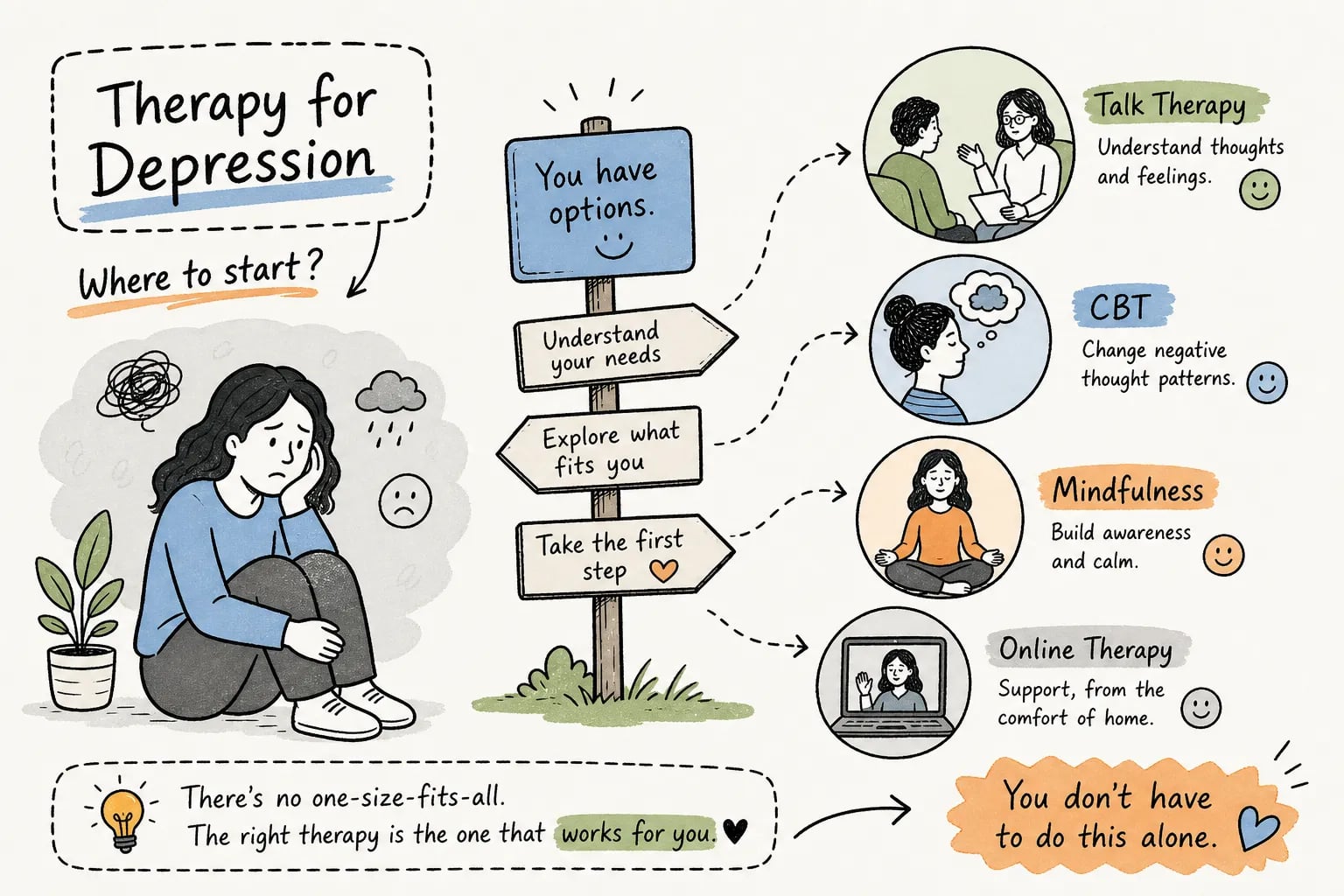


If you’re new to counseling, this beginner therapy guide will walk you through everything you need to know, from understanding therapy types to finding a therapist, knowing what to expect in your first sessions, and recognizing when the work is actually helping. Most people who decide to start therapy don’t feel scared exactly. They feel confused. They’re not sure where to look, what to say at a first appointment, whether they even qualify as someone who “needs” therapy, or how to tell if it’s working once they begin. That confusion leads many people to put it off far longer than they need to.
Seeking support is already a sign of self-awareness. What most first-timers actually need isn’t a push to go, it’s a clear picture of what the process looks like so they can walk in with some confidence. At River North Counseling, new clients share their goals during intake and get matched with a therapist whose specialization and style align with those needs. That structure makes the whole thing feel far less like a leap into the unknown. This guide covers therapy types, what to expect in your first sessions, how to find the right therapist, what it costs, and how to know it’s actually working.
Common therapy types and what each one is actually for
You don’t need to memorize every modality before your first appointment. But knowing what the most common approaches are gives you a better foundation for your first conversation with a therapist, and it helps you ask smarter questions about fit.
The approaches you’ll hear about most
These five approaches come up regularly for people starting therapy for the first time.
Cognitive Behavioral Therapy (CBT) is structured and goal-oriented, focusing on identifying and changing negative thought patterns and behaviors.
Psychodynamic therapy explores unconscious patterns and past experiences to explain current behavior.
Acceptance and Commitment Therapy (ACT) teaches you to accept difficult thoughts while taking action aligned with your values.
EMDR uses guided eye movements to help the brain reprocess traumatic memories and reduce their emotional charge.
Dialectical Behavior Therapy (DBT) builds emotion regulation skills and is particularly effective for intense or overwhelming feelings.
Matching the method to what you’re dealing with
No single approach works for everyone, which is why the first conversation with a therapist matters so much. CBT has the strongest evidence base for anxiety and depression and is typically the first-line recommendation for both. DBT is evidence-based primarily for emotion regulation and conditions like borderline personality disorder, though it can also be helpful for other presentations. EMDR and trauma-focused CBT are both well-established, evidence-based treatments for PTSD, neither is the sole first-line option.
Psychodynamic therapy works well for people who want to understand the roots of their patterns rather than just manage their symptoms. A good therapist will explain their approach and why it fits your situation. Knowing these names means you can ask that question directly, rather than leaving the first session without a clear sense of direction.
How to find a therapist you’ll actually connect with
Finding a therapist feels overwhelming partly because there are so many options and no obvious place to start. A handful of reliable directories do most of the filtering work for you.
Where to start your search
Psychology Today is the largest directory in the country, with filters for insurance, specialty, location, and session format. GoodTherapy vets licenses and applies ethical standards before listing providers. TherapyDen is inclusive-focused with detailed therapist profiles. The APA Psychologist Locator lists verified licensed psychologists specifically. Your insurance company’s provider portal is also a practical starting point that narrows the list by what you’ll actually pay. If the search process feels like too much to manage, practices like River North Counseling handle matching directly, new clients describe their goals during intake and get paired with a therapist whose approach and experience align, which removes one of the most stressful parts of getting started.
What to ask before committing to the first session
Most therapists offer a brief phone consultation before booking. Use it. These questions aren’t an interrogation; they’re a smart way to filter for fit before investing time and money:
- Do you take my insurance, and what will my out-of-pocket cost be?
- What is your experience with my specific concern?
- What therapy approach do you use, and why would it fit my situation?
- What does a typical session look like?
- How do you handle it if we turn out not to be a good fit?
A therapist who answers these questions clearly and without defensiveness is already showing you something important about how they work.
Beginner therapy guide: what your first few sessions will actually look like
The fear of the first session usually comes from not knowing what’s expected. The reality is far less dramatic than most people imagine.
Session one: the intake
The first session is a conversation and assessment, not a deep emotional excavation. You’ll complete paperwork upfront: HIPAA forms, consent to treatment, sometimes symptom questionnaires like the PHQ-9 or GAD-7 to measure anxiety and depression levels. The therapist will ask what brought you in, how long you’ve been dealing with it, relevant personal history, and what you’re hoping to get out of the process. Sessions typically run 50 to 60 minutes. This is also your chance to assess fit, not just theirs to assess you.
Sessions two and three: where the work takes shape
By the second and third session, the therapist has a clearer picture of your goals and starts introducing their approach in a more structured way. In CBT, this might mean beginning to identify specific thought patterns. In psychodynamic work, you might explore a particular relationship or event in more depth. Some people feel noticeably lighter early on; others feel a bit unsettled as they start naming things they’ve been avoiding. Both responses are normal, and neither means the therapy isn’t working.
How to communicate with your therapist so sessions actually move forward
One of the most underrated barriers to progress in therapy has nothing to do with the therapist’s skills. It’s clients not knowing it’s okay to advocate for themselves inside the room.
Naming what isn’t working
Many people stay in sessions that feel stagnant because they assume the therapist knows best and saying something would be rude. The therapeutic relationship is meant to be collaborative. Saying “I don’t think this approach is landing for me” or “I’d like to focus more on my work stress” is not a complaint; it’s useful clinical information. Most therapists will welcome it and adjust. A therapist who responds defensively to direct feedback is itself a signal worth noting.
Setting and updating goals throughout the process
Therapy works better when goals are explicit rather than vague. “Feel better” is hard to track. “Manage anxiety at work without avoiding important meetings” gives both you and your therapist something concrete to work toward. Goals should be revisited every few months because they shift as you make progress and your understanding of what you need deepens. A therapist who checks in on your goals regularly is giving you both a roadmap and a way to measure whether the sessions are doing what they’re supposed to do.
What therapy costs and how to make it financially workable
Cost is one of the most concrete barriers to starting therapy, and it deserves a direct answer rather than a vague reassurance that “options exist.”
Understanding the range: insurance, sliding scale, and self-pay
Self-pay therapy in the United States typically runs $100 to $250 per session, with a national average around $150 for individual therapy. If you’re using in-network insurance, copays generally fall between $20 and $60 after your deductible is met. Sliding scale fees, offered by many providers and adjusted to your income, can bring sessions down to $30 to $80 for qualifying clients. Subscription-based online platforms like BetterHelp or Talkspace run $260 to $400 per month for weekly sessions with messaging, which can be a lower entry point for some. Telehealth through a private practice is often 10 to 20 percent less expensive than in-person sessions at the same office.
The Mental Health Parity and Addiction Equity Act requires that if your insurance plan covers mental health benefits, it must apply the same financial rules to therapy that it applies to physical health care. That means copays, deductibles, and visit limits for therapy cannot be stricter than those for comparable medical services. It’s worth calling your insurer directly to understand what your specific plan covers before booking your first session.
In-person vs. teletherapy: a practical comparison
Both formats have strong clinical evidence behind them. Teletherapy offers scheduling flexibility, no commute, and access to a wider range of therapists regardless of location. In-person sessions can feel more contained and easier to be fully present in, particularly for trauma work or when the physical environment helps you separate therapy from the rest of your day. River North Counseling offers both formats, in-person offices in River North and Skokie, and virtual sessions available across Illinois. For beginners, the better option is whichever one removes the most friction from showing up consistently.
How to know if therapy is actually helping
Progress in therapy is rarely a straight line, and the early stages can feel unclear. Having a realistic framework for assessment keeps you from quitting too soon or staying too long without results.
Signs progress is happening, even when it feels slow
Early signs of progress are often subtle: you start noticing patterns you couldn’t see before, your distress tolerance is slightly higher, or you’re sleeping more consistently. Later, the issues that brought you in feel less consuming, and you find yourself responding differently in situations that used to derail you. Many therapists use validated tools like the GAD-7 and PHQ-9 at regular check-ins to give you an objective read on symptom changes over time. A frequently cited body of psychotherapy outcomes research suggests that about half of clients show measurable improvement after 15 to 20 sessions, though many people notice meaningful changes earlier, around 6 to 12 sessions in.
When to reassess or consider changing therapists
If after 8 to 10 sessions you feel no sense of movement, no real connection with your therapist, or like you’re performing rather than being honest, those are signals worth examining. Changing therapists is not a failure; it’s good self-advocacy. Therapeutic fit is one of the strongest predictors of outcome, and pursuing the right match is part of the process, not a detour from it. At River North Counseling, clients who feel the initial match isn’t right can request a different therapist, because the goal is care that actually works for you, not loyalty to a provider who isn’t the right fit.
Starting is the hardest part
You don’t need to have it all figured out before your first appointment. The most important step is showing up with a basic understanding of what’s available, what to expect, and what questions to ask. There are multiple therapy types suited to different goals; finding the right therapist takes a little research and sometimes a second try; the first few sessions are more conversation than breakthrough; and there are clear, practical ways to track your progress over time.
Choosing to understand yourself well enough to ask for help is its own form of progress. Use this beginner therapy guide as your starting point: if you’re ready to take that first step, River North Counseling’s intake process is designed to match you with a therapist based on your specific goals and situation, so you walk into your first session already pointed in the right direction. Reach out to schedule a consultation, and let the process be simpler than you expected.