

Individual therapy is a one-on-one relationship between you and a licensed therapist, focused entirely on your goals, your history, and the changes you want to make. You meet privately, usually once a week, and work through whatever brought you in, whether that’s anxiety, depression, a difficult life transition, or a general sense that something feels off. The process is structured, confidential, and built around you.
River North Counseling is a licensed group mental health practice serving Chicago and the greater Chicagoland area. Most people feel some combination of curiosity, nervousness, and uncertainty before starting. That’s completely normal. This article walks you through what individual counseling actually is, how sessions work, the most common treatment approaches, and how to choose a therapist who’s genuinely right for you.
Key takeaways
- Private, personalized care: Private therapy sessions keep the entire focus on you, your goals, and your history, with no shared attention.
- Multiple approaches work: CBT, psychodynamic therapy, DBT, and ACT all have strong evidence; the best fit depends on your specific concerns.
- Progress takes time: Many people notice early shifts within 4 to 8 sessions, with meaningful improvement common by 12 to 20 sessions.
- Evidence is strong: Meta-analyses consistently show moderate to large effects for psychotherapy versus no treatment, with gains that often persist after therapy ends.
- Credentials matter: Confirm your therapist holds an active, unrestricted license in Illinois before committing to care.
- Fit shapes outcomes: A strong therapeutic alliance is one of the most consistent predictors of good results across all therapy types.
What is individual therapy, and who is it for?
Individual therapy, also called talk therapy or psychotherapy, is a structured, confidential process where you work with a licensed mental health professional to address specific emotional, behavioral, or psychological concerns. Unlike self-help books or advice from people in your life, a therapist is trained to identify patterns, guide meaningful conversations, and apply evidence-based techniques tailored to your situation. Sessions are confidential; ask your provider about their specific privacy practices and which security standards their telehealth platform uses to understand exactly how your information is protected.
People start individual therapy for all kinds of reasons. Some come in managing clinical symptoms like anxiety, depression, or PTSD, while others arrive during a stressful life transition like a career change, a breakup, or a loss. Many first-time clients simply feel stuck and can’t quite name why. Solo therapy works across that full spectrum. You don’t need to be in crisis. You need to be willing to show up and do the work.
How individual therapy differs from other formats
Couples therapy centers on the relationship between two people, working on communication patterns, conflict, and shared goals. Family therapy pulls in multiple members to address dynamics that affect the whole system. Individual therapy keeps the focus on you alone. That privacy matters. You can speak candidly about relationships, fears, or patterns without managing anyone else’s reaction in the room.
Group therapy brings together several people, usually with a shared concern, facilitated by one or two therapists. Studies comparing group and individual therapy find comparable outcomes for some conditions, particularly depression. Individual counseling, though, offers a level of personalization, depth, and flexibility that group settings can’t always match. When cases require highly personalized care, complex trauma processing, or complete privacy, individual therapy is often recommended as the stronger starting point.
Which therapy approach might work best for your situation?
Cognitive Behavioral Therapy (CBT)
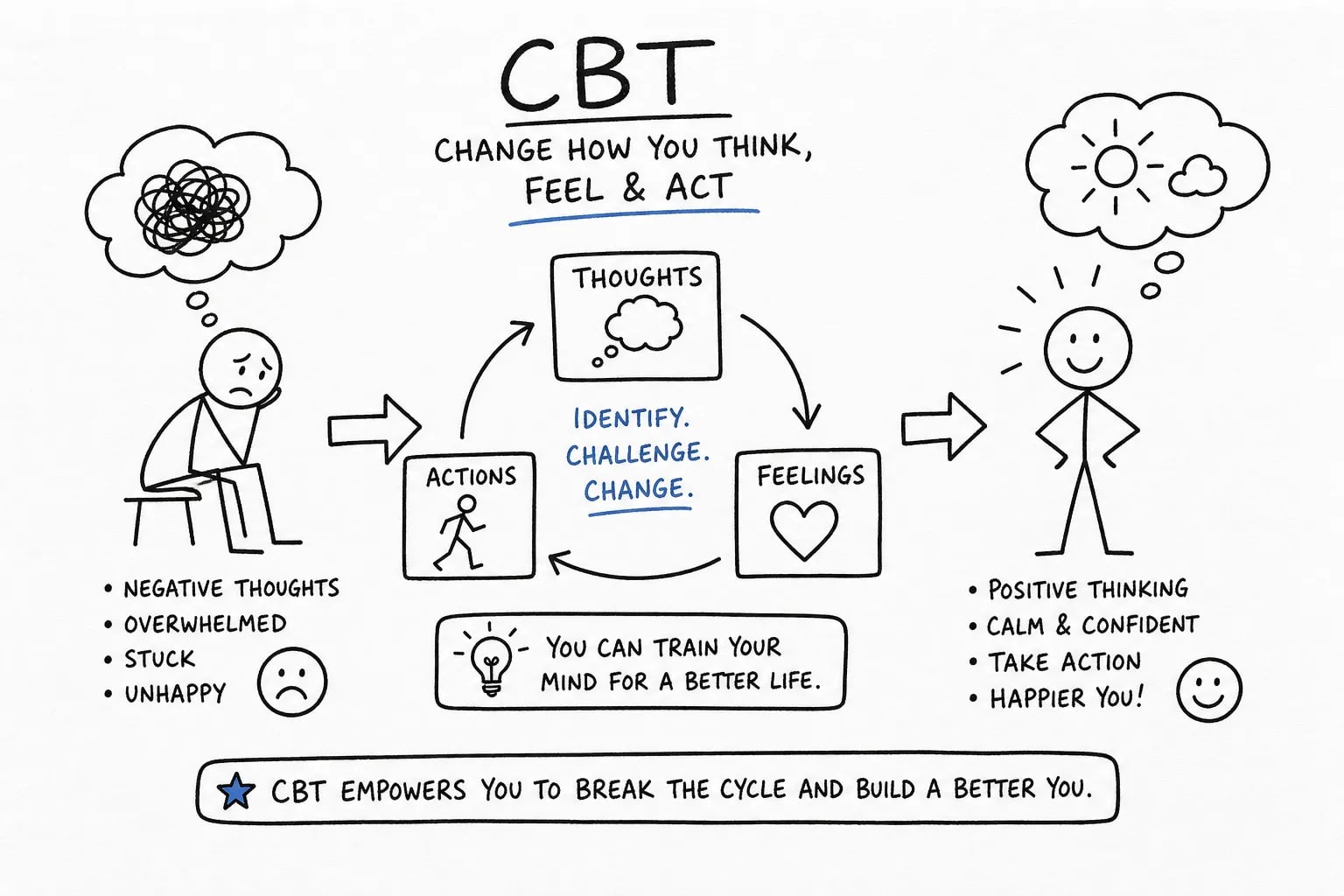
CBT is the most widely researched approach in psychotherapy. It focuses on identifying and changing unhelpful thought patterns and behaviors, using structured skill practice between sessions. CBT has strong evidence for anxiety disorders, depression, OCD, panic disorder, and insomnia. For generalized anxiety disorder, recent network meta-analyses confirm CBT is superior to usual care, with evidence of longer-term benefit. For depression, it performs comparably to antidepressant medication in many adults.
DBT and ACT
Dialectical Behavior Therapy (DBT) builds on CBT with added emphasis on mindfulness, distress tolerance, and emotion regulation, making it especially valuable for people dealing with intense emotional swings or self-harm. Acceptance and Commitment Therapy (ACT) helps you stop fighting difficult internal experiences and instead take action aligned with your values, making it useful for anxiety, depression, chronic stress, and avoidance patterns. Many therapists also integrate multiple approaches, drawing from whichever techniques best fit your specific goals and history.
Psychodynamic therapy
Psychodynamic therapy explores unconscious patterns, attachment styles, and recurring relationship dynamics. It’s well-suited for people dealing with long-standing depression, low self-esteem, or interpersonal struggles who want more than symptom relief.
Trauma-focused therapies
Trauma-focused therapies, including Prolonged Exposure, Cognitive Processing Therapy, and EMDR, are specifically designed to process traumatic memories and reduce avoidance. Clinical guidelines consistently recommend these as first-line treatments for PTSD, and they generally outperform medication for long-term outcomes.
What actually happens inside a therapy session?
Most individual therapy sessions run 45 to 60 minutes and follow a loose but consistent rhythm. You and your therapist begin with a brief check-in covering mood, significant events, and any concerns from the past week. From there, the session focuses on a specific issue: a thought pattern, a situation, an emotional response, or a skill you’re developing. The therapist may ask pointed questions, offer reflections, or guide you through an exercise depending on the approach being used. Sessions typically close with a summary and a simple plan for what to practice or notice before you meet again.
Your first session works a little differently. It’s primarily an intake where the therapist gathers your history, goals, and reasons for coming in, and where both of you assess whether the working relationship feels like a good fit.
Most people start with weekly sessions, especially early on. As symptoms improve, some clients shift to every other week. Evidence-based structured treatments like CBT typically run 12 to 20 sessions, and many people notice meaningful early shifts within 4 to 8 sessions. According to the American Psychological Association, about 15 to 20 sessions produces clinically significant improvement for roughly half of clients.
More complex or chronic concerns, including trauma with comorbid issues or long-standing depression, may require 20 to 30 sessions or ongoing maintenance work. A practical rule: review progress with your therapist after 6 to 8 sessions, and adjust the plan if things aren’t moving.
Does individual therapy actually work?
The evidence base for individual psychotherapy is substantial. Meta-analyses consistently find moderate to large effect sizes, roughly d = 0.6 to 0.8, compared to no treatment, and gains frequently persist after therapy ends. For depression, psychotherapy performs comparably to antidepressant medication in many adults, and combining both often outperforms either alone for moderate-to-severe cases. For anxiety disorders, CBT-based individual therapy shows strong, consistent results. For PTSD, trauma-focused individual therapies are the preferred first-line treatment in major clinical guidelines.
The research is encouraging, but it comes with an honest caveat: average effects mask real variation. Some people reach full remission. Others see partial improvement. A small percentage don’t benefit from a particular approach and need to try a different one. That’s why therapist fit, treatment match, and active participation between sessions all matter as much as the type of therapy itself. A strong therapeutic alliance, where you trust the process and feel genuinely heard, is one of the most consistent predictors of good outcomes across all therapy modalities.
How to find the right individual therapist in Chicago and take the first step
Licensed therapists in Illinois hold credentials that signal their training and scope. The table below breaks down what each credential means and what it allows the clinician to do.
| Credential | Typical training | Prescribes medication? |
|---|---|---|
| LCPC (Licensed Clinical Professional Counselor) | Master’s or doctoral-level counseling; trained to provide psychotherapy for a wide range of concerns | No |
| LCSW (Licensed Clinical Social Worker) | Graduate-level social work with clinical supervision; may be especially familiar with family, community, and insurance factors | No |
| PsyD (Doctor of Psychology) | Doctoral-level clinical training emphasizing assessment and applied therapy; can diagnose and provide psychotherapy | Usually no |
| PhD (Doctor of Philosophy in Psychology) | Doctoral-level training including research and clinical work; can provide psychotherapy and psychological testing | Usually no |
| MD/DO Psychiatrist | Medical degree with psychiatric residency; can diagnose, prescribe, monitor medication, and sometimes provide therapy | Yes |
The most important check is simple: confirm that whoever you see holds an active, unrestricted license in Illinois, verifiable through the Illinois Department of Financial and Professional Regulation (IDFPR) license lookup. A degree or the title “therapist” alone is not enough. The state license is the credential that matters.
Before a first session, a brief consultation call can save you significant time and money. Ask about the therapist’s specific experience with your concern, their typical treatment approach, how they measure progress, and their cancellation policy. Ask whether they take your insurance, and confirm whether telehealth is available if you need flexibility.
At River North Counseling in Chicago, first-time clients are matched with an individual psychotherapist based on their specific goals, concerns, and preferences, removing the guesswork from one of the most common barriers to starting care. Whether you’re in River North, Skokie, or anywhere across the Chicagoland area, we offer both in-person and virtual sessions. Our team includes licensed professionals with expertise in anxiety, depression, trauma, life transitions, CBT, and more.
Ready to take the next step?
Individual therapy is one of the most direct investments you can make in your own wellbeing. At this point you know what it is, how it compares to other formats, which approaches have the strongest evidence, what a real session looks like, and what to look for in a therapist. The next step is simply making contact.
If you’re looking for individual therapy in the Chicago area and aren’t sure where to start, reach out to our team at River North Counseling. River North Counseling works with first-time therapy seekers. You can connect with us by phone, email, or our online intake form. You don’t need to have it all figured out before reaching out. That’s what the first session is for.
Frequently Asked Questions
How do I know if therapy is appropriate if I’m not in a crisis?
Therapy is appropriate even if you’re not in crisis; you only need to be willing to show up and do the work. We see people who come in for clinical symptoms like anxiety or depression, stressful life transitions, or simply feeling stuck without a clear reason. Starting before a crisis can still produce meaningful change.
How quickly should I expect to notice improvement in therapy?
Many people notice early shifts within 4 to 8 sessions, with meaningful improvement common by 12 to 20 sessions. Around 15 to 20 sessions produces clinically significant improvement for roughly half of clients according to the American Psychological Association, though results vary and progress should be reviewed with your therapist after 6 to 8 sessions.
How can I confirm a therapist is properly licensed in Illinois?
Confirm that a therapist holds an active, unrestricted license in Illinois by using the Illinois Department of Financial and Professional Regulation license lookup. A degree or the title ‘therapist’ alone is not enough; the state license is the credential that matters.
What should I ask about privacy and telehealth before my first session?
Ask your provider about their specific privacy practices and which security standards their telehealth platform uses so you understand how your information is protected. We also recommend a brief consultation call before your first session to cover these questions along with experience, treatment approach, progress measurement, and logistics like insurance and cancellation policy.