

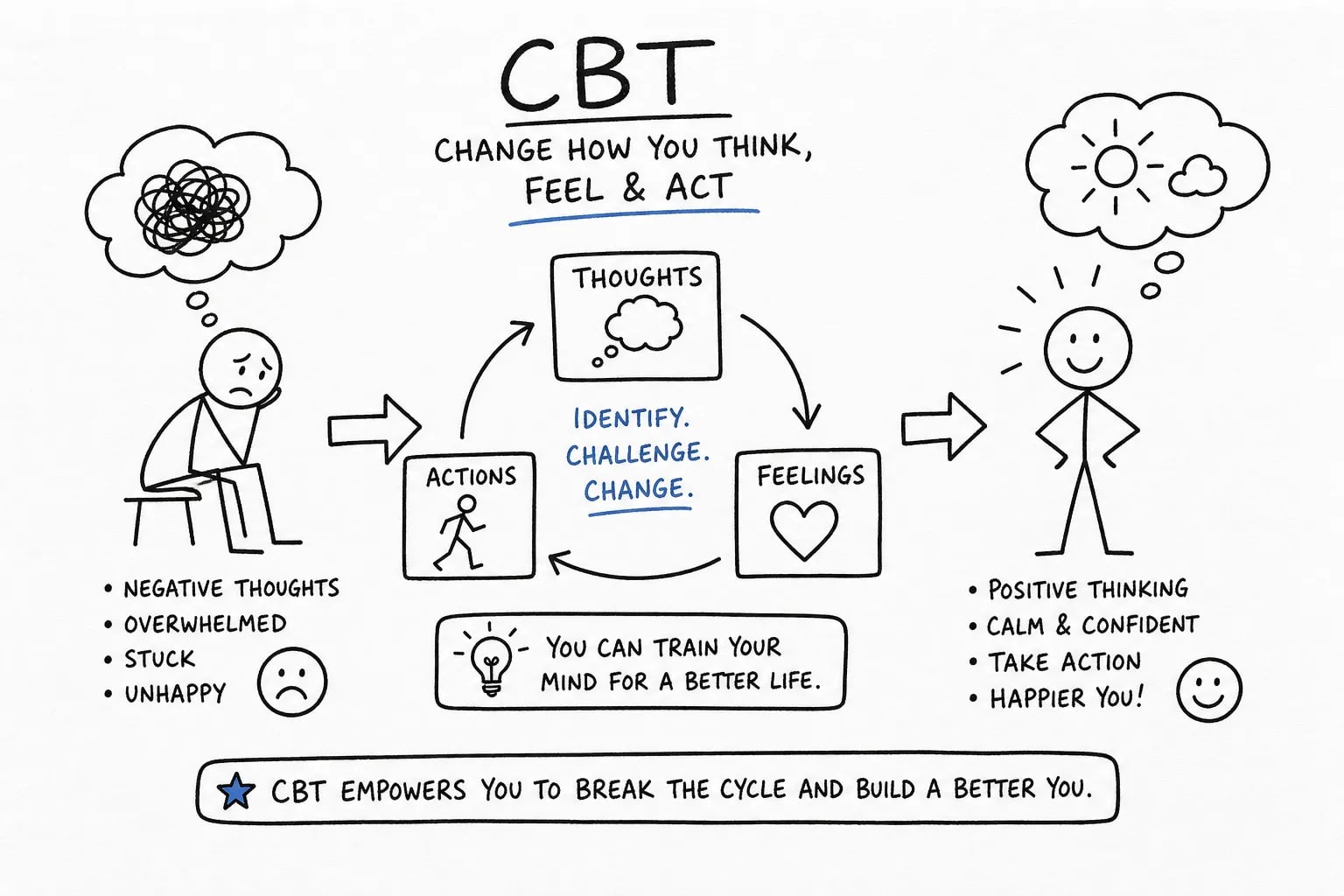
Cognitive behavioral therapy (CBT) is a structured, evidence-based form of psychotherapy that helps you identify and change unhelpful patterns of thinking and behavior to reduce distress and improve how you function day to day. It is one of the most extensively researched treatments in the field of mental health, with strong support across anxiety disorders, depression, PTSD, OCD, and several eating disorders. This approach works by targeting the connection between your thoughts, feelings, and actions rather than exploring the distant past indefinitely.
This article covers the core principles behind CBT, the conditions it treats, the techniques used in sessions, how it compares to other therapy approaches, and what to look for in a qualified provider. River North Counseling offers CBT through licensed therapists serving the Chicago area.
Key takeaways
- Structured and time-limited: CBT typically runs 8–20 sessions depending on the condition, with a clear agenda and measurable goals throughout.
- Strongest evidence base: This therapy is a first-line treatment for anxiety disorders, PTSD, OCD, depression, and eating disorders.
- Skills-based by design: You practice techniques between sessions, which directly improves outcomes.
- Present-focused: The approach targets what is maintaining your distress now, not exclusively what caused it originally.
- Multiple formats available: In-person and therapist-guided virtual CBT show comparable outcomes for most conditions, according to systematic reviews of randomized trials comparing the two formats.
- Provider training matters: Look for independent licensure plus documented, supervised CBT training relevant to your concern.
What is cognitive behavioral therapy, exactly?
At the center of CBT is a deceptively simple idea: your interpretation of an event, not the event itself, drives your emotional and behavioral responses. Two people can experience the same situation and respond entirely differently based on what they each tell themselves about it. The therapy works with that interpretive layer directly, helping you examine whether your thoughts are accurate and whether your behaviors are serving you.
Thoughts, feelings, physical sensations, and behaviors are all connected. Changing one element tends to shift the others, and CBT takes advantage of that interdependence. Therapist and client work as a team, sometimes called collaborative empiricism, testing interpretations against real-world evidence rather than debating philosophically.
The thought-feeling-behavior connection
Consider a straightforward example: you give a presentation and stumble over one section. The automatic thought “I completely failed” can produce shame, cause you to avoid future speaking opportunities, and reinforce the original belief the next time a similar situation arises. This approach interrupts that cycle by examining the thought, checking it against evidence, and generating a more accurate interpretation. Over time, the cycle itself becomes less automatic.
What sets CBT apart from general talk therapy
Cognitive behavioral therapy has a structured format with a session agenda, specific goals, and active skill-building between appointments. It is time-limited by design, not open-ended. Progress is tracked session to session so both you and your therapist can see when goals are being met. General counseling can be genuinely valuable, but this therapy’s defining feature is that it teaches you a transferable set of skills you continue using long after treatment ends.
Which conditions does cognitive behavioral therapy treat most effectively?
CBT has its strongest and most consistent support for anxiety disorders, major depressive disorder, PTSD, OCD, and several eating disorders. A 2025 meta-analysis of 375 adult trials published in JAMA Network found statistically significant benefits across these diagnoses. Effects were largest for PTSD and specific phobias, with large effects reported for panic disorder, social anxiety, generalized anxiety, OCD, depression, bulimia, and binge-eating disorder. It is worth noting that effect-size estimates vary depending on the comparator used, effects are typically largest when compared against a waitlist and somewhat smaller in tightly controlled trials against active treatment or usual care, particularly for depression. For bipolar disorder and psychotic disorders, the approach plays a smaller, mainly adjunctive role.
Anxiety disorders and exposure-based treatment
Exposure-based CBT is particularly effective for phobias, panic disorder, social anxiety, and PTSD. Trauma-focused CBT for PTSD produces some of the largest effects of any therapy studied, according to the 2025 JAMA Network analysis. The mechanism makes sense: avoidance maintains fear, and carefully designed exposure breaks that cycle by creating new learning about what is actually dangerous and what you can tolerate.
Depression, OCD, and eating disorders
For depression, behavioral activation anchors the approach by scheduling achievable activities that restore a sense of accomplishment and pleasure before motivation returns on its own. For OCD, CBT using exposure and response prevention is the primary psychological treatment. Bulimia nervosa and binge-eating disorder also respond well, with this structured approach considered a leading psychological intervention for both conditions.
What are the core cognitive behavioral therapy techniques you’ll practice?
Sessions are active. You learn techniques in the session and practice them between appointments, and that between-session practice is part of what makes the approach work. Research on homework completion, including a meta-analysis examining homework adherence and outcomes, has found a meaningful positive association between completing assigned practice and better results across both anxiety and depressive disorders. The techniques below are educational; exposure work for OCD, trauma, or severe anxiety is best designed with a trained clinician rather than attempted independently.
Cognitive restructuring, thought records, and CBT worksheets
A thought record, one of the most common CBT worksheets, walks you through a situation, the automatic thought it triggered, the emotions and their intensity, evidence supporting and contradicting the thought, and a more balanced conclusion. Using the work example from above: if the automatic thought is “I’m incompetent and will probably lose my job,” the thought record examines what actually happened (one corrected section), what the evidence shows (most of the report was accurate; the supervisor offered a correction, not a warning), and arrives at a more proportionate conclusion. Emotion intensity typically drops noticeably after completing that process.
Exposure and behavioral activation
Exposure involves approaching feared situations gradually rather than avoiding them, starting from less challenging items and working up a hierarchy. The goal is not to eliminate anxiety but to learn that anxiety is tolerable and that feared outcomes are often less likely than predicted. Behavioral activation addresses the depression cycle differently: when low mood leads to withdrawal, withdrawal reduces rewarding experiences, and mood worsens. Scheduling small, specific activities tied to pleasure or accomplishment breaks that cycle before motivation returns naturally.
Behavioral experiments and problem-solving
Behavioral experiments test a specific prediction in real life rather than resolving it intellectually. If you predict that asking a question in a meeting will lead others to judge you negatively, the experiment involves asking the question, observing what actually happens, and updating the belief based on real evidence. Problem-solving within this framework targets practical stressors directly: defining the problem specifically, generating options, choosing one concrete first step, and reviewing the result. Not every source of distress is a thought error; some problems simply need to be solved.
What does a course of CBT actually look like?
The approach is short-term by design. For anxiety disorders such as panic, social anxiety, or generalized anxiety, roughly 8–16 sessions is typical. Depression commonly takes 8–16 sessions for mild-to-moderate presentations, sometimes longer for recurrent or complicated cases. PTSD typically requires 12–20 sessions with a trauma-focused approach, though the length varies considerably. These are ranges, not fixed prescriptions, and many people complete meaningful work in 8–12 sessions.
How many sessions to expect for common problems
Ongoing measurement is built into the model, your therapist tracks progress each session, giving you both a clear signal when goals are being met and an early indicator when the plan needs adjustment. That continuous evaluation is what keeps treatment time-limited rather than indefinite. Specific phobias often respond faster, while complex trauma or long-standing patterns may take longer to address thoroughly.
What happens in your first CBT session
The first session is an assessment and planning conversation, not an immediate deep dive into difficult content. You’ll describe your current concerns, history, and goals. Your therapist will explain the model, how thoughts, feelings, sensations, and behaviors connect, and agree on an initial treatment plan including session frequency and likely duration. For PTSD specifically, the first session does not require you to recount every detail of the trauma; establishing the model and pacing comes first. You may complete questionnaires or begin a simple monitoring exercise before the next appointment.
How does CBT compare to DBT, ACT, and psychodynamic therapy?
These four approaches pursue change through different mechanisms. The right fit depends on the nature of your struggles, not on which therapy has the longest name or the most research behind it overall. If you’ve tried one modality before or a clinician has recommended a specific approach, that context is worth bringing to any initial consultation, a good therapist will help you think it through.
Comparison table: CBT vs. DBT, ACT, and psychodynamic therapy
| Therapy | Main goal | Core methods | Best suited for |
|---|---|---|---|
| CBT | Reduce distress by changing unhelpful thoughts and behaviors | Cognitive restructuring, exposure, behavioral experiments, skills practice, homework | Anxiety disorders, depression, OCD, PTSD, eating disorders; time-limited and skills-focused |
| DBT | Build emotional stability, distress tolerance, and safer behavior | Mindfulness, validation, emotion-regulation, distress-tolerance, interpersonal-effectiveness skills | Severe emotion dysregulation, recurrent self-harm, suicidal behavior, borderline personality disorder |
| ACT | Increase psychological flexibility rather than eliminate unwanted thoughts | Acceptance, mindfulness, cognitive defusion, values clarification, committed action | Chronic distress, avoidance, anxiety, depression, pain, or conflict with personal values |
| Psychodynamic therapy | Develop insight into recurring emotional and interpersonal patterns | Exploration of early relationships, defenses, attachment, conflicts, and the therapeutic relationship | Longstanding relational or personality-related difficulties; typically longer-term |
Which approach is right for you?
Choose CBT for a focused, skills-based approach to a defined problem. DBT becomes particularly useful when emotional crises and self-destructive behavior dominate. ACT is a strong fit when avoidance and conflict with personal values are central to the difficulty. Psychodynamic therapy is worth considering when longstanding relational or personality patterns require deeper exploration. These approaches can also be integrated, and no single modality is universally superior. The strength of the therapeutic relationship and your therapist’s competence matter as much as the modality itself. This point is supported consistently across therapy outcome research. Choosing a therapist should be a collaborative conversation, not a solo research project.
How to find a qualified CBT therapist in Chicago
Finding the right therapist means looking beyond a directory listing. The core criteria are an active independent professional license (psychologist, clinical social worker, professional counselor, or equivalent); documented CBT training beyond a general therapy course; and experience treating your specific concern. Someone who lists this approach alongside twenty other modalities may have limited formal training in it, asking directly is reasonable and appropriate.
What to look for in a CBT provider
Ask prospective therapists where they received their training, how many cases they have treated using structured protocols, and whether they use evidence-based approaches for your specific condition. Voluntary certifications from organizations such as the Academy of Cognitive and Behavioral Therapies indicate dedicated specialization, typically requiring documented clinical hours, supervision, and an examination. A certificate alone should not substitute for an independent license; confirm both. Also consider practical factors: in-person versus virtual availability, session scheduling flexibility, and whether the practice can match you with a therapist whose specialization aligns with your presenting concern.
Starting cognitive behavioral therapy at River North Counseling
River North Counseling’s licensed team includes therapists trained in CBT who work with adults, adolescents, and couples to address anxiety, depression, and stress management. We have in-person offices in River North (downtown Chicago) and Skokie, with virtual therapy available for clients across Illinois. Our intake process includes a careful therapist-matching step so you’re working with someone whose training and specialization align with your goals. If you’re ready to take the next step, reach out to our team to schedule an intake appointment.
CBT gives you tools, not just insight
Cognitive behavioral therapy offers a structured, evidence-based path to changing the thought and behavior patterns that maintain distress. It is not about forcing positivity or dismissing difficult feelings; it is about building the flexibility to respond to life’s challenges in ways that serve you better over time. The conditions it treats most effectively, anxiety disorders, PTSD, OCD, depression, and eating disorders, are exactly the areas where structured, skills-based care tends to produce the most meaningful and lasting change.
This approach is time-limited and goal-oriented, which means you can measure your progress and know when you’re getting there. If you’re in the Chicago area and ready to begin, River North Counseling’s CBT-trained therapists are available for both in-person and virtual sessions. Get in touch with our team to start the conversation.
Frequently Asked Questions
Can CBT be done virtually and is it as effective as in-person therapy?
Yes, CBT can be delivered virtually, and therapist-guided virtual CBT shows comparable outcomes to in-person therapy for most conditions according to systematic reviews of randomized trials. We offer both in-person and virtual CBT options for clients across Illinois, including offices in River North and Skokie, so you can choose the format that fits your needs.
What should I ask a prospective CBT therapist before starting treatment?
Ask where they received their CBT training, how many cases they’ve treated using structured protocols, and whether they use evidence-based approaches for your specific condition. We also suggest confirming an independent professional license in addition to documented CBT training, and checking practical factors like in-person versus virtual availability and scheduling flexibility.