

Picture this: your 14-year-old is failing three classes, barely speaking at dinner, and snapping at you every time you try to connect. You know something needs to change, but when you sit down to search for help, you hit an immediate wall. Family therapist? Parent coach? Family counselor? The terms blur together, the Google results contradict each other, and meanwhile your kid is upstairs with the door closed. If you’re trying to figure out when to choose family therapy over individual parent coaching in Illinois, this confusion is completely normal, and you’re not alone in feeling it.
Family therapy and parent coaching sound interchangeable. They’re not. They treat different problems, involve different people, and carry very different implications for insurance coverage and legal situations here in Illinois. Families who call River North Counseling in Chicago navigate this exact question every week. Our team offers both services so clients can start where their situation actually calls for and adjust as things evolve. This article gives you a practical framework to figure out which path fits your family right now.
How family therapy and parent coaching differ at their core
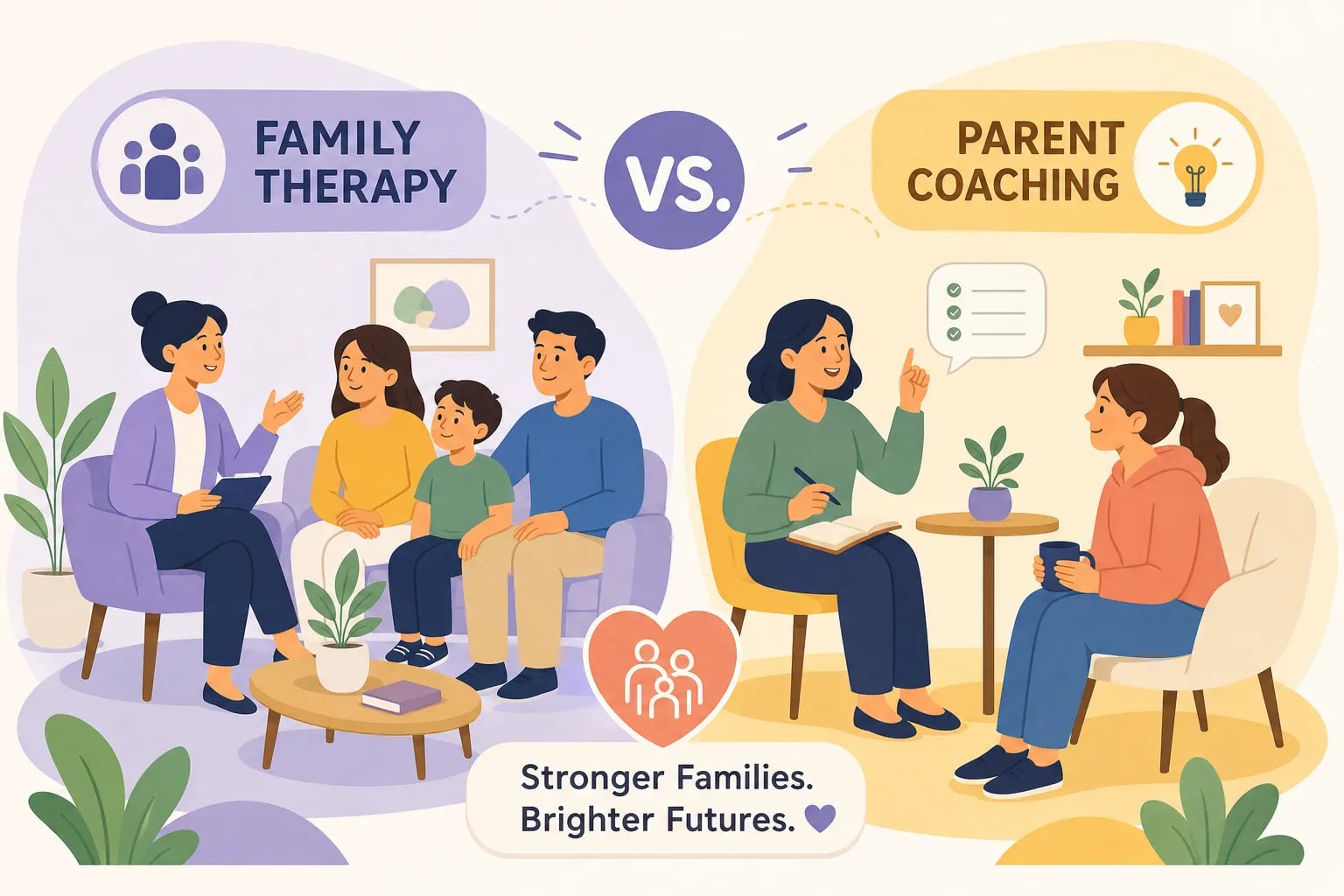
Family therapy is a licensed clinical service. A licensed therapist, typically an LMFT, LCPC, or clinical psychologist, works with the family as a unit. The goal is to identify and change the patterns of interaction, communication, and relationship dynamics that are maintaining the problem. The identified client may be your child, but the treatment system is the whole family. In Illinois, this is a regulated mental health service commonly covered by insurance as a behavioral health benefit when medically necessary and delivered by a credentialed, in-network provider, though coverage varies by plan, benefit design, medical-necessity criteria, and provider credentialing. It is billed under specific CPT codes, so always verify your individual plan’s requirements before starting services.
Parent coaching is skills-based, educational, and non-clinical by design. A coach works with you as the parent, not with the family as a system, to build concrete strategies: setting routines, responding to defiance, improving communication, or learning behavioral reinforcement techniques. In Illinois, there is no separate license for “parent coach,” and if a service involves assessment, diagnosis, treatment planning, or psychotherapy, licensing and billing rules for those activities apply. For purely skills-based coaching that falls outside licensed practice, the service is generally not reimbursable through Medicaid or private insurance unless it is embedded within a licensed clinical service and documented appropriately. That distinction matters when you’re thinking about cost.
When to choose family therapy over individual parent coaching in Illinois: clinical signs
When your family’s situation includes any of the following, family therapy is likely the appropriate starting point, not coaching.
The whole family maintains the problem
Decades of clinical literature show that when a child’s behavior, mood, or functioning is driven by family interaction patterns rather than a gap in parenting skills, treating only the parent is insufficient. Adolescent substance use, severe conduct disorder, attachment disruption following abuse or neglect, eating disorders with significant medical risk, and situations involving suicidality or self-harm all fall into this category. Research on Multisystemic Therapy, Functional Family Therapy, Multidimensional Family Therapy, and family-based treatment for adolescent anorexia consistently demonstrates that the family’s communication patterns, alliances, and responses to the child are part of the clinical picture, and that therapy needs to address all of it.
While behavioral parent training can be highly effective for younger children with straightforward disruptive behavior, systemic family therapies are specifically designed to target reciprocal relationships and wider family dynamics. For complex adolescent presentations, a coaching approach focused on parenting strategies alone is unlikely to reach the relational factors driving the behavior.
Safety concerns and multi-system involvement
When there are active safety concerns, a child threatening harm to themselves or others, domestic conflict, or involvement with DCFS or the juvenile justice system, family therapy is the appropriate clinical service. Illinois child welfare agencies and family courts treat family counseling and parent coaching as distinct tools. Courts typically order family counseling when a child’s emotional development is endangered; DCFS commonly assigns coaching for observable parenting-capacity deficiencies and clinical therapy for trauma, domestic violence, substance use, or mental illness. Parent coaching alone is not designed to address trauma, crisis stabilization, or the relational repair needed after significant family disruption. If you’re involved in a custody or DCFS case, the order itself will usually specify which service is required, and substituting one for the other can create real legal complications.
When parent coaching is the smarter starting point
Family therapy isn’t always the answer. For many families, coaching is the more efficient and appropriate first step.
Behavioral challenges without clinical complexity
If you’re struggling with a younger child’s tantrums, bedtime resistance, or general defiance, and the family unit isn’t in crisis, behavioral parent training has strong research backing. Evidence-based programs in this area teach reinforcement, consistent consequences, effective commands, and problem-solving. These are parenting skills, not psychotherapy, and a qualified coach can deliver them efficiently without requiring full family sessions.
Skill gaps and co-parenting coordination
Parent coaching also fits well when the issue is co-parenting coordination after a separation rather than your child’s clinical presentation. If two parents need practical tools to communicate consistently across two households, coaching provides concrete strategies without requiring joint therapy sessions, which can feel adversarial when the relationship is strained. Coordination is a skill-building need, not a treatment need. That’s a meaningful distinction worth remembering.
These scenarios illustrate two ends of a spectrum. The cases that fall in the middle, where coaching starts to surface deeper relational dynamics, are exactly why it helps to work with a practice that can move with you.
Real Illinois scenarios that show the difference
Scenario: divorce and co-parenting conflict
A couple divorces after a high-conflict marriage. Their 9-year-old starts acting out at school. The parents want help but struggle to be in the same room without arguing. Here, parent coaching for each parent separately makes sense as an initial step, helping them build consistent routines and communication across two homes. If the child’s behavior escalates or shows signs of emotional distress beyond typical adjustment, family therapy becomes the appropriate next move, and the child’s therapist may eventually work with each parent individually or jointly.
Scenario: adolescent behavioral issues and school failure
A 15-year-old in Chicago is skipping school, becoming aggressive, and showing signs of marijuana use. The parent has read every parenting book and nothing is sticking. This situation points toward family therapy, not coaching. The adolescent’s behavior is embedded in the family system, and parent skill-building alone won’t address the relational and potentially clinical factors driving it. This is exactly the kind of presentation where evidence-based family therapies produce the strongest outcomes.
Scenario: growing distance without crisis
Parents of a preteen feel like they’ve lost the ability to talk to their child. There’s no clinical diagnosis and no safety concern, just a growing distance and frequent conflict. This sits in parent coaching territory, at least initially. A coach can help parents shift their communication style, reduce reactivity, and build connection. If that work surfaces deeper relational wounds or attachment concerns, a transition to family therapy makes sense. Practices that offer both services make that transition seamless, without requiring the family to start over with someone new.
Illinois factors every parent should know before choosing
Beyond the clinical picture, a few Illinois-specific realities should shape your decision.
Licensing, insurance, and what each service actually costs you
In Illinois, family therapy delivered by a licensed clinician, whether an LMFT, LCPC, LCSW, or psychologist, is a covered mental health service when medically necessary and when the provider is credentialed with your plan. CPT codes 90846 (family therapy without the patient present) and 90847 (family therapy with the patient present) are recognized by major Illinois commercial insurers and Medicaid managed care plans, though prior authorization requirements, benefit design, and medical-necessity rules vary by plan. Always verify with your specific insurer before starting services.
Parent coaching is a different story. It is generally not a standalone covered benefit under commercial insurance or Illinois Medicaid unless it is integrated into a licensed clinical service and documented appropriately. Families often pay out of pocket for pure coaching services. Illinois Medicaid does offer some caregiver-focused pathways, for example, Family Peer Support under the 1915(i) children’s behavioral health framework (a federal Medicaid option that funds home- and community-based services for children with complex needs), but those programs carry distinct eligibility and authorization requirements separate from standard psychotherapy billing. Verify your individual plan and any applicable state program before assuming coverage.
Court orders and DCFS referrals in Illinois
Illinois family courts and DCFS treat family therapy and parent coaching as distinct tools, not interchangeable ones. Courts may order family counseling when a child’s emotional development is endangered or parenting-time conflict is affecting the child. DCFS typically assigns coaching for observable parenting-capacity deficiencies and clinical therapy for trauma, attachment problems, domestic violence, or mental illness. If your involvement with a court or DCFS specifies a particular service, substituting the other one can have real legal consequences. A provider who understands this distinction is essential when there’s any legal involvement in your case.
A simple framework to help you decide and take the first step
Questions to ask yourself before calling a provider
Before picking up the phone, a few honest questions can point you in the right direction. Is your child showing signs of a clinical diagnosis or safety concern, or is this primarily a parenting challenge? Is the whole family involved in the problem, or is the issue mainly about your own responses as a parent? Is there a court order or DCFS involvement that specifies a service? Do you need insurance coverage, or can you pay privately? Your answers will point you clearly toward one service or the other.
Questions to ask the provider
When you contact a therapist or coach, ask directly: Are you licensed in Illinois to provide family therapy? Do you bill insurance for these services, and under which CPT codes? Do you offer both family therapy and parent coaching? Can you start with one and transition to the other if my family’s needs change? A practice that offers both services under one roof removes the friction of starting over if your needs shift. At River North Counseling, families can begin where their situation actually calls for and move between services without losing continuity of care, handled by a team that already knows your history.
Starting where you are, not where you think you should be
One of the most useful things a good clinician will tell you is that the right starting point often becomes clearer after a thorough intake than it does from the outside. Don’t let uncertainty about which label applies delay you from reaching out. An experienced clinician will assess your situation honestly, explain the clinical picture, and recommend the most appropriate path forward. If you start with coaching and the clinical picture shifts, a practice with both capabilities moves with you without requiring you to rebuild trust with someone new.
When to choose family therapy over individual parent coaching in Illinois, a summary
Family therapy addresses the relational system when clinical complexity, safety concerns, or multi-system involvement is present. Parent coaching builds specific caregiver skills when the core issue is a strategy gap or co-parenting coordination challenge. Illinois factors, including insurance coverage variability, licensing requirements, and potential court involvement, are part of the conversation with any provider you contact.
The most important step is the first one: reaching out to a qualified provider rather than staying stuck in uncertainty while your family waits. If you’re still unsure when to choose family therapy over individual parent coaching in Illinois, a licensed clinician can clarify that during an intake assessment. River North Counseling serves Chicago and the surrounding Chicagoland area with both family therapy and parent coaching, so families can access the right support as their situation evolves. Reach out to our team to schedule an intake and get a clear picture of which path fits your family right now.